Startup due diligence is the process of investigating and verifying a startup's financial performance, legal position, commercial potential, technology, and operational risks before making an investment or acquisition decision. Investors use this evaluation to determine whether the company's claims are supported by reliable evidence and whether the proposed transaction offers an acceptable balance of opportunity and risk. For founders, understanding due diligence is essential because unresolved financial discrepancies, incomplete ownership records, or contractual problems can delay financing and influence the terms investors are willing to offer.
The scope of startup due diligence depends on the company's development stage, industry, and proposed transaction. An angel investor evaluating a young software business may concentrate on founder capabilities, product ownership, market demand, and available cash. A venture capital firm considering a larger investment may conduct a more extensive assessment involving financial records, customer performance, corporate governance, and technical infrastructure. An acquirer may examine additional matters concerning integration costs, contractual liabilities, and the company's ability to operate successfully after a change of ownership.
A successful evaluation does not require the startup to be free from every risk. Early businesses naturally face uncertainty, and experienced investors understand that financial performance, product development, and market positioning can change rapidly. The purpose of due diligence is to identify material uncertainties, verify available information, and determine whether the company has an appropriate plan for addressing significant weaknesses. Founders who maintain accurate records and explain challenges transparently are generally better positioned to support an efficient review.
What Is Startup Due Diligence?
Startup due diligence is a structured investigation carried out by prospective investors, acquirers, lenders, or their professional advisers to assess a company's condition before completing a financial transaction. It tests the information presented during fundraising discussions against financial statements, corporate records, contractual documents, operational data, and other available evidence.
The investigation serves several purposes. First, it establishes whether the company legally owns the assets and rights necessary to conduct its business. Second, it assesses whether reported financial and commercial performance reflects the underlying records. Third, it identifies risks that may affect future growth, cash requirements, ownership, or the proposed transaction. These findings help investors determine whether to proceed and what contractual protections may be appropriate.
The distinction between reviewing a business plan and conducting due diligence is important. A pitch deck communicates management's interpretation of the opportunity, while due diligence evaluates the evidence supporting that interpretation. Revenue claims may be compared with customer contracts and bank receipts, ownership percentages with capitalization records, and technical capabilities with product demonstrations or engineering documentation.
Although due diligence is commonly associated with venture investment, the same underlying principles apply to acquisitions and other significant corporate transactions. The depth of the review changes according to the transaction and the potential financial exposure.
Why Due Diligence Matters for Startup Investment
Investing in an early stage business involves substantial uncertainty because its future performance may depend on unproven products, developing markets, or a relatively small management team. Due diligence helps investors distinguish between ordinary business uncertainty and problems that could materially undermine the investment.
For example, a startup may demonstrate strong revenue growth while relying heavily on one customer. That concentration does not automatically make the company unsuitable for investment, but it changes the risk associated with its forecast. Similarly, a product may have attractive technical features while depending on software or intellectual property that the company does not fully control.
Due diligence also affects the terms of a transaction. Investors may request additional disclosures, changes to governance provisions, completion of specific corrective actions, or adjustments to the financing structure. In an acquisition, the findings can influence the purchase price, payment conditions, warranties, or allocation of potential liabilities.
For founders, preparation has value beyond satisfying a prospective investor. Reviewing internal records can expose weaknesses in financial reporting, customer contracts, and operational processes before those issues develop into larger problems. Maintaining reliable documentation supports better management decisions even when the company is not actively raising capital.
The Main Areas of Startup Due Diligence
Startup evaluation normally involves several connected areas of investigation. Each examines a different aspect of the business, but the findings must eventually be considered together. Strong financial performance cannot automatically compensate for a serious ownership dispute, just as technically impressive software does not establish that customers will purchase the product.
Financial Performance and Cash Sustainability
Financial Due Diligence examines whether a startup's reported financial position is accurate and whether its available resources can support the proposed business plan. Investors may review revenue recognition, expenses, cash balances, outstanding obligations, financial forecasts, and the relationship between accounting results and actual cash movements.
The depth of the assessment depends on business maturity. A company generating recurring revenue may be evaluated through customer retention, gross margins, operating cash consumption, and revenue concentration. An earlier business may have limited financial history, making the quality of its forecasts, funding requirements, and financial controls more important. The underlying objective is to establish what the company has achieved and how reliably it can finance the next stage of development.
Corporate Structure and Legal Obligations
Legal Due Diligence establishes whether the company is properly organized, has authorized its relevant corporate actions, and complies with applicable contractual and regulatory requirements. The review may cover incorporation records, shareholder agreements, outstanding financing instruments, employment arrangements, material contracts, disputes, and regulatory permissions.
Capitalization records are especially important because investors need to understand who owns the company and which securities may create future ownership rights. Options, warrants, convertible notes, and other agreements can affect the shares issued during a financing. Inconsistent records may require correction before the transaction can close, while material contractual restrictions may affect the company's ability to accept new investment.
Market Position and Customer Quality
Commercial Due Diligence evaluates whether the startup's business model and market opportunity are supported by meaningful evidence. Investors examine customer demand, competitive positioning, pricing, sales performance, retention, and the sustainability of the company's growth assumptions.
A business reporting rapid customer acquisition may still face difficulties if those customers leave quickly or generate insufficient revenue to cover associated costs. Investors may therefore compare reported growth with customer contracts, historical behavior, and the economics of delivering the product. The objective is not simply to confirm that a market exists, but to understand whether the company has a credible opportunity to compete and grow within it.
Product Architecture and Technology Risks
Technical Due Diligence focuses on whether the company's product and underlying systems are sufficiently reliable, secure, and capable of supporting its operating plans. Depending on the business, reviewers may assess software architecture, infrastructure dependencies, development practices, documentation, cybersecurity controls, and the ability to increase capacity.
The technical review should reflect the company's stage rather than impose the same expectations on every startup. A prototype may reasonably require further engineering before commercial deployment, while an established platform serving enterprise customers may be expected to demonstrate stronger security, monitoring, and operational resilience. Investors need to understand the resources and risks associated with maintaining and improving the technology.
Ownership of Intellectual Assets
Intellectual Property Due Diligence examines whether the company owns or has sufficient rights to use the intellectual assets on which its business depends. These assets may include software, patents, trademarks, trade secrets, proprietary datasets, designs, and licensed technology.
Ownership problems can arise when contractors or employees develop valuable assets without appropriate assignment arrangements or when third party licenses restrict commercial use. Investors may review ownership documentation, licensing obligations, potential disputes, and the company's ability to continue using important technology. For businesses whose competitive advantage depends heavily on proprietary innovation, these findings can be particularly significant.
Startup Due Diligence Review Framework
The main investigation areas provide different evidence about the company's financial condition, legal position, and commercial prospects. Founders should understand both what reviewers examine and why the requested information matters to the investment decision.
The following table summarizes the principal areas and identifies the questions a reviewer is attempting to resolve.
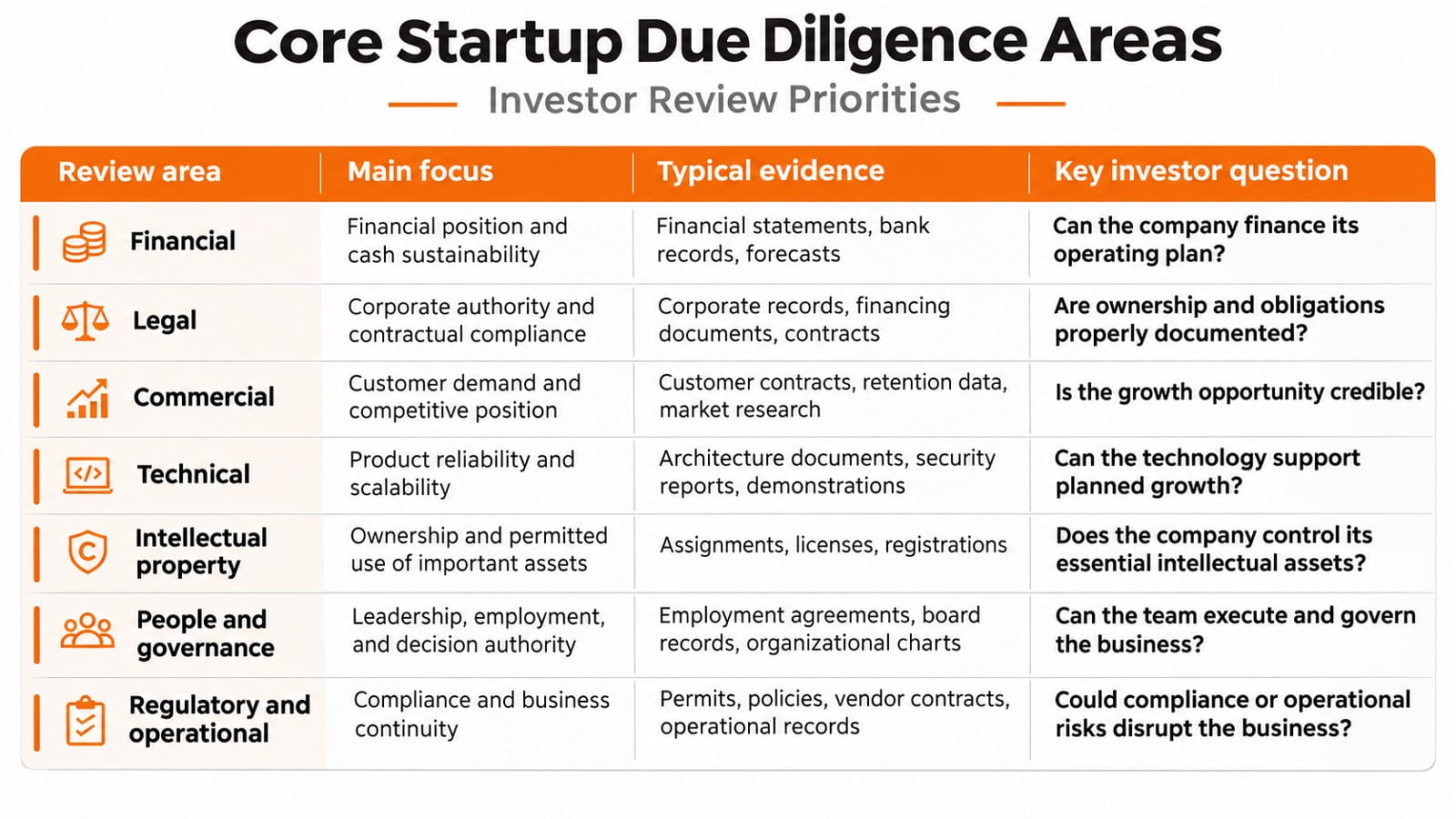
These categories are interconnected rather than independent tests. A customer contract may support commercial revenue claims while also creating legal obligations that affect future performance. Technical infrastructure may explain operating costs, while intellectual property documentation establishes whether the company can continue using essential software. A comprehensive assessment brings these findings together and distinguishes manageable operating risks from issues that could materially affect the transaction.
Preparing Startup Documents for Investor Review
Founders can reduce unnecessary delays by organizing essential records before a potential investor begins a formal investigation. The starting point is a Due Diligence Checklist that identifies the documents needed to support financial, legal, commercial, and operational claims. It should reflect the company's development stage and business model rather than assume that every startup maintains the same records.
The checklist should distinguish documents that already exist from those requiring updates, verification, or professional review. For example, management may have financial reports available but need to reconcile them with bank balances, or it may have an ownership spreadsheet that must be checked against signed securities agreements. Identifying these gaps early allows the company to correct records before an investor requests them.
A Startup Data Room provides a controlled environment for sharing documentation during the review. It may contain corporate formation records, capitalization information, financial statements, material contracts, product documentation, and other relevant evidence. Access permissions should be appropriate to the sensitivity of the information, and confidential materials should not automatically be available to every prospective investor.
Documentation quality is as important as completeness. Investors should be able to identify current versions, understand how figures were calculated, and determine which documents support management's representations. Clear file organization and a consistent record of investor questions make the investigation easier to manage without requiring founders to repeatedly explain the same information.
How the Startup Due Diligence Process Works
The Due Diligence Process generally follows a sequence of initial screening, document examination, verification, issue resolution, and investment decision making. However, the exact order depends on the investor, transaction size, and commercial circumstances. Some investors conduct substantial reviews before issuing a term sheet, while others reserve detailed legal and financial work until the principal investment terms have been discussed.
During preliminary screening, investors examine the business model, management team, market opportunity, financial position, and proposed financing. The objective is to determine whether the opportunity merits further investigation. At this stage, the company may provide a presentation, selected financial information, and explanations of its principal commercial assumptions.
If interest continues, the review becomes more detailed. Investors and advisers request documents, compare company claims with supporting evidence, and identify matters requiring clarification. Some questions can be resolved through existing records, while others may require additional analysis or conversations with management and relevant third parties. Sensitive verification activities should follow appropriate confidentiality and authorization procedures.
The final phase involves evaluating the significance of unresolved matters and determining whether the proposed investment should proceed. Findings may lead to additional contractual protections, corrective actions before closing, changes to valuation or transaction structure, or a decision not to invest.
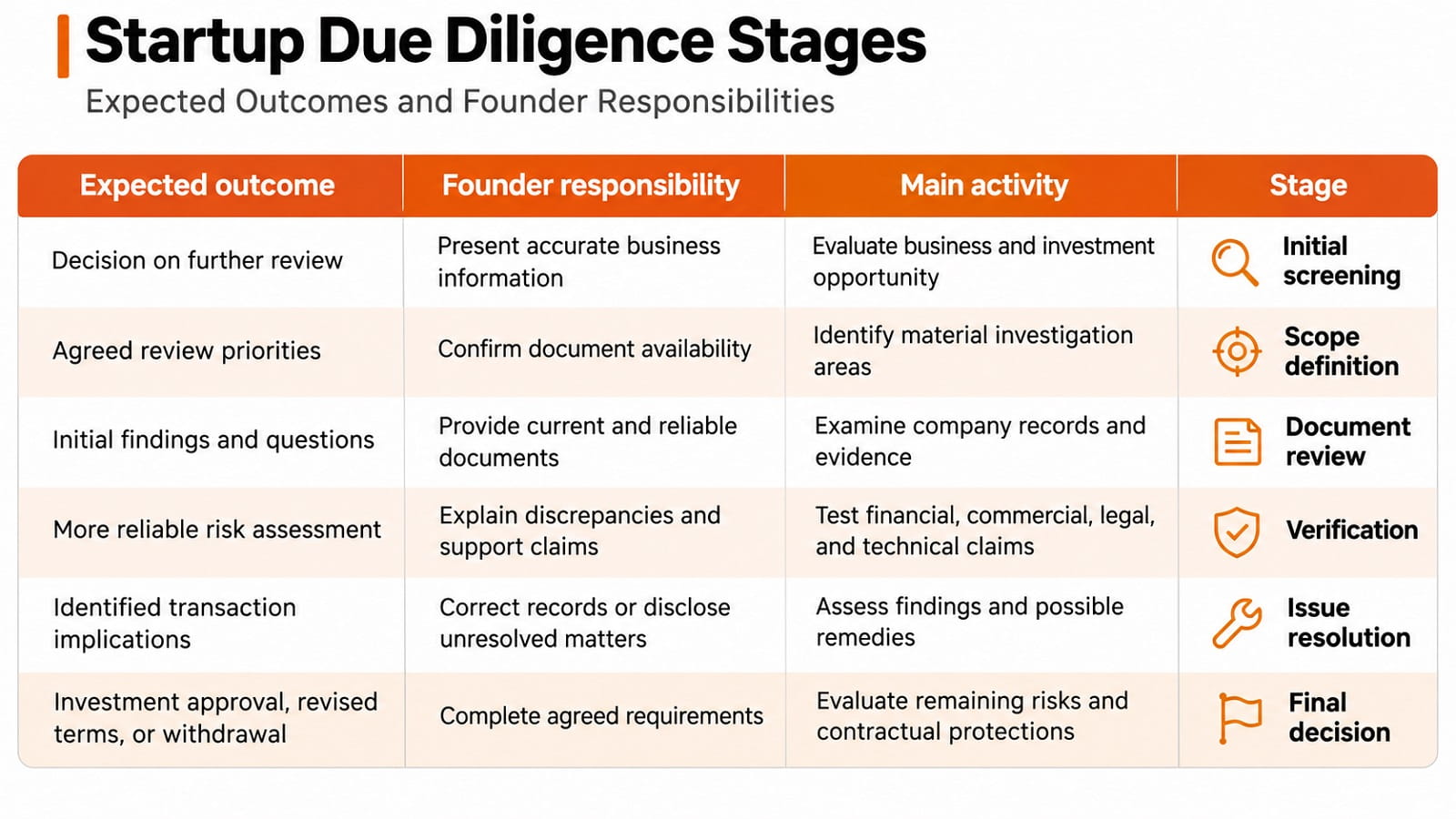
This sequence illustrates the relationship between preparation and transaction outcomes. A review may proceed efficiently when evidence is available and significant questions can be answered promptly, but complex legal or technical issues may require additional work. Founders should not interpret every investor question as a negative signal. The purpose of the process is to distinguish uncertainty that can be managed from risks that materially change the proposed investment.
How Due Diligence Changes by Startup Stage
The depth of investor investigation should be proportionate to the company's maturity. A business still developing its initial product cannot reasonably be expected to demonstrate the same financial history as an established company with substantial recurring revenue. Investors must instead identify the evidence most relevant to the investment hypothesis and the risks associated with that development stage.
At the earliest stages, the assessment may emphasize the founding team, ownership documentation, technical feasibility, product development progress, and the financial resources needed to achieve initial milestones. Limited financial history does not eliminate the need for reliable records, but it changes the weight placed on historic results.
As the startup grows, commercial performance becomes easier to evaluate through customer behavior, revenue quality, gross margins, and operating expenses. Investors may examine whether growth is repeatable, how efficiently the company acquires customers, and whether the business can continue expanding without disproportionate increases in cost.
Later financing rounds and acquisitions generally involve more extensive verification because the transaction may depend on established financial performance, material customer contracts, regulatory obligations, and the ability to sustain business operations. The scope can also expand when the company operates in a heavily regulated sector or relies on complex technical infrastructure.
Understanding Startup Due Diligence Red Flags
Investors do not expect every startup to have perfect systems or eliminate all uncertainty. However, certain findings require closer attention because they may undermine the reliability of company information or create legal and financial exposure.
Common Due Diligence Red Flags include inconsistent capitalization records, unexplained differences between reported revenue and bank receipts, missing ownership assignments for essential technology, undisclosed contractual obligations, and significant weaknesses in financial reporting. Other concerns may arise when the business depends on a single customer, lacks evidence supporting important commercial claims, or cannot explain its financing requirements.
The significance of a finding depends on its cause and consequences. A missing document that can be replaced with reliable evidence may be relatively straightforward to address. An ownership dispute involving the company's core technology could present a much more serious problem. Similarly, declining revenue may be a manageable commercial challenge when management understands the causes, but unexplained discrepancies in reported results can raise questions about the reliability of the entire financial presentation.
Founders should distinguish between correcting a problem and concealing it. Providing inaccurate documents or withholding material information can create additional legal exposure and undermine investor confidence. A better approach is to identify the issue, establish its impact, document corrective actions, and disclose relevant information through the appropriate transaction process.
A Practical Startup Due Diligence Scenario
Consider Meridian Cloud, a fictional software startup seeking a $3 million investment to expand its enterprise product. The company reports $1.2 million in annual recurring revenue and has established a customer base across several industries. Its management team provides financial statements, subscription records, capitalization information, and product documentation for investor review.
The investor identifies three matters requiring additional investigation. First, a substantial customer contributes 35% of reported recurring revenue, creating exposure if that customer reduces spending or terminates its contract. Second, the company's capitalization spreadsheet does not initially include an outstanding convertible instrument. Third, a contractor agreement does not clearly establish assignment of rights to certain software components.
These findings involve different dimensions of risk. Customer concentration affects the reliability of projected revenue, the omitted instrument changes potential ownership dilution, and the contractor agreement raises questions about intellectual property control. None automatically determines that the investment must fail, but each requires evidence and an appropriate response before a final decision.
The following table illustrates how investors might assess the findings and what management could do to address them.
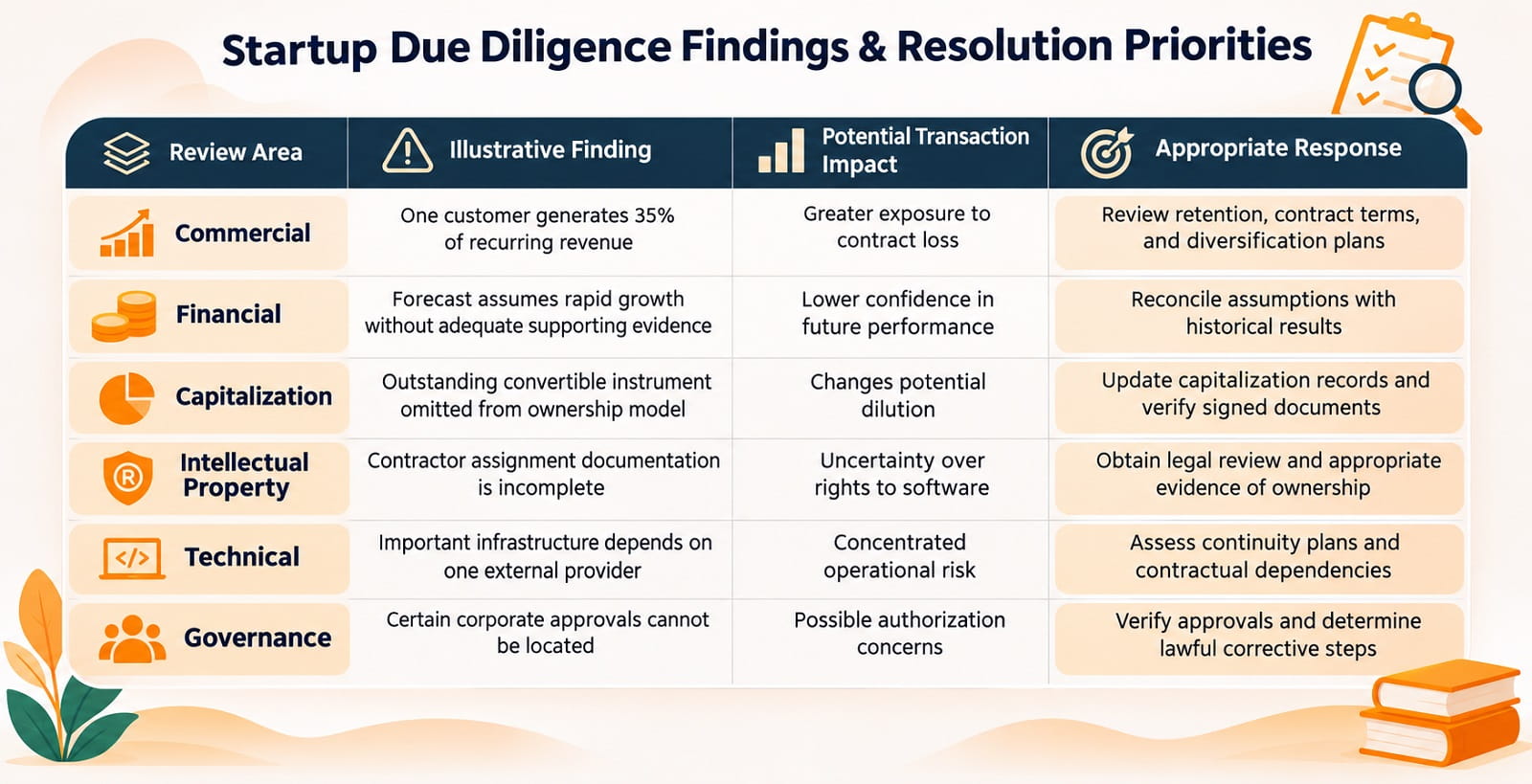
The example demonstrates why due diligence findings must be interpreted in context. Meridian's customer concentration may be acceptable if the contract is durable and the company has a credible diversification strategy. The capitalization discrepancy requires accurate modeling before investment terms can be finalized, while the intellectual property concern may require legal documentation or other corrective action. The investor's ultimate decision depends on the combined financial exposure, the strength of available evidence, and whether unresolved matters can be addressed through the transaction.
How Founders Can Improve Due Diligence Readiness
Preparation is most effective when it becomes part of routine company management rather than an activity that begins only after an investor requests documents. Founders should keep capitalization records consistent with executed agreements, maintain reliable financial reporting, and ensure that important business contracts are accessible and properly documented.
Management should also evaluate the quality of its operating metrics. Revenue, retention, customer acquisition costs, and other measures need clear definitions and consistent calculation methods. When reported figures differ between a pitch deck, financial forecast, and accounting records, the company should be able to explain the differences through documented assumptions rather than unsupported estimates.
Responsibility for due diligence should be assigned clearly. Financial questions may require assistance from accounting professionals, contractual matters from legal advisers, and technical claims from engineering leadership. Coordinating these responses reduces the risk of conflicting explanations and helps management maintain an accurate record of outstanding investor requests.
Finally, founders should periodically review material risks without waiting for an external investigation. Changes in customer concentration, regulatory obligations, software dependencies, and ownership commitments can affect the company's investment readiness over time. Regular internal reviews make it easier to maintain accurate information and respond appropriately when a financing opportunity arises.
Final Thoughts
Startup due diligence is a fundamental part of evaluating investment opportunities and understanding the risks associated with an emerging business. It connects financial performance, legal ownership, commercial demand, technology, and operational capability into a more complete assessment of the company. Rather than relying exclusively on forecasts or management presentations, investors examine the evidence supporting the proposed investment.
For founders, due diligence readiness is an ongoing management responsibility. Reliable financial records, clearly documented ownership, credible commercial metrics, and transparent risk reporting support better financing discussions and reduce the likelihood of unexpected complications. The objective is not to present a company without weaknesses, but to demonstrate that management understands its obligations, can support its claims, and has considered the risks associated with future growth.
A well prepared startup gives investors the information needed to make an informed decision while preserving management's ability to negotiate and execute a suitable transaction. By treating due diligence as part of sound corporate governance, founders can strengthen their investment readiness and improve the quality of decisions made throughout the company's development.
FAQ
What Is Startup Due Diligence?
Startup due diligence is the investigation of a company's financial, legal, commercial, technical, and operational position before an investment or acquisition. Investors examine records and other evidence to verify company claims, identify material risks, and determine whether the proposed transaction is appropriate.
Why Do Investors Conduct Due Diligence?
Investors conduct due diligence to evaluate whether the business matches the opportunity presented during fundraising. The review helps establish the reliability of financial information, the company's ownership structure, its commercial prospects, and material risks that may affect investment value.
What Documents Do Startup Investors Request?
Common requests include incorporation documents, capitalization records, shareholder agreements, financial statements, forecasts, material customer contracts, employment agreements, and intellectual property records. The precise requirements depend on the company's stage, industry, and proposed transaction.
How Long Does Startup Due Diligence Take?
There is no universal duration. A relatively straightforward early investment may involve a limited review, while larger or more complex transactions can require extensive investigation. Timing depends on document availability, investor requirements, legal complexity, and the significance of unresolved findings.
Can a Startup Raise Funding Without Revenue?
Yes. Some early stage investments are made in companies that have not yet generated meaningful revenue. Investors may place greater emphasis on the founding team, technology, market opportunity, product validation, intellectual property ownership, and available financial resources.
Is Due Diligence Required for Every Startup Investment?
The extent of due diligence varies, and not every investment involves the same formal investigation. Nevertheless, investors generally need sufficient information to evaluate the company and satisfy applicable legal or internal investment requirements.
What Happens if Investors Find Problems During Due Diligence?
Findings may lead to requests for clarification, corrective actions, additional contractual protections, revised financing terms, or withdrawal from the transaction. The outcome depends on the seriousness of the issue and whether it can be resolved satisfactorily.
Who Performs Startup Due Diligence?
Due diligence may be conducted by investors and their internal teams, supported by lawyers, accountants, technical specialists, and other professional advisers. The participants depend on the transaction's complexity and the expertise required.
What Is the Difference Between Investor and Acquisition Due Diligence?
Investor due diligence evaluates whether financing a company offers an acceptable investment opportunity. Acquisition due diligence additionally considers matters such as purchasing the business, assumed liabilities, integration requirements, and the consequences of transferring control.
How Can a Startup Prepare for Due Diligence?
A startup can improve readiness by maintaining accurate corporate and financial records, documenting ownership of important assets, organizing material contracts, and ensuring that key performance metrics are supported by evidence. Identifying and addressing material issues before fundraising can reduce unnecessary delays.

Mobina Khanki
Venture & Funding Writer at PinerookMobina Khanki covers venture capital, startup funding, fundraising, and startup finance for Pinerook, focusing on founders and investors.
 Seen first.