
Legal due diligence is the examination of a startup's corporate structure, ownership records, contracts, regulatory obligations, and potential liabilities before an investment or acquisition. Investors use this assessment to verify that the business has the legal authority to operate, issue securities, and fulfill its contractual commitments. For founders, the review can reveal problems that may not be obvious during ordinary business operations, including undocumented equity promises, missing corporate approvals, restrictive customer agreements, and unresolved legal claims.
Within Startup Due Diligence, legal examination establishes whether the company presented during fundraising matches the rights, obligations, and ownership arrangements reflected in its official records. A startup may demonstrate attractive commercial growth while facing contractual restrictions that complicate future financing or prevent the transfer of important business assets. Such findings do not automatically eliminate an investment opportunity, but they can influence valuation negotiations, transaction conditions, and the protections investors request before committing capital.
This guide explains how investors conduct legal due diligence, the principal legal issues they investigate, and how founders can evaluate the consequences of identified risks. It covers corporate governance, equity ownership, material contracts, regulatory compliance, employment arrangements, and outstanding disputes. A practical financing scenario also illustrates how legal findings can affect an investment transaction and what corrective actions may be necessary before closing.
What Is Legal Due Diligence?
Legal due diligence is a transaction-focused investigation into a company's legal status, contractual relationships, rights, and obligations. The review is commonly undertaken by legal advisers acting for prospective investors or acquirers, although the extent of professional involvement depends on the financing structure and size of the transaction. Its purpose is to determine whether material legal facts support the proposed investment and whether unresolved issues create risks that require further investigation or contractual protection.
The scope differs between early-stage fundraising and more complex corporate transactions. A seed investment may require verification of the company's formation, capitalization, founder arrangements, and ownership of essential business assets. A larger institutional round can involve detailed examination of prior securities issuances, employment obligations, major commercial contracts, regulatory permissions, and disputes. An acquisition may require additional scrutiny of asset transfers, change-of-control provisions, assumed liabilities, and third-party consent requirements.
Legal due diligence should not be confused with merely collecting legal documents. A signed agreement may appear complete but contain provisions that restrict the company's future activities or require consent before a transaction can proceed. Similarly, a capitalization table may appear internally consistent while failing to reflect legally binding commitments made to previous investors. Effective review examines the legal consequences of the underlying records rather than treating document availability as proof of compliance.
Corporate Formation and Governance Review
The legal investigation normally begins by establishing the identity and authority of the company receiving investment. Reviewers examine incorporation documents, current governing instruments, relevant registrations, and records of significant corporate decisions. They also consider whether the company has properly authorized earlier securities issuances, major transactions, and the proposed financing.
Corporate governance problems can arise when actions were discussed or informally approved but the necessary formal authorization was not completed. For example, a company may have promised employee equity without obtaining the approvals required under its governing documents and applicable law. The legal significance depends on the jurisdiction, the terms of the promise, and the actions already taken.
Investors also examine the company's decision-making arrangements. Shareholder agreements, voting rights, reserved matters, and board composition can affect which approvals are necessary before issuing new shares. A proposed investment may require consent from existing shareholders or other parties, particularly when previous financing agreements contain protective provisions.
For startups operating through multiple entities, legal advisers may investigate how ownership and contractual obligations are distributed across the group. The company receiving financing should have an understandable relationship with the business operations and assets supporting its valuation.
Capitalization and Previous Financing Obligations
A startup's capitalization records establish who owns the company and which contractual arrangements could change ownership in the future. Investors examine issued shares, share classes, option arrangements, warrants, convertible securities, and other rights that may affect the proposed investment. The objective is to verify not only the current ownership percentages but also the legal validity and potential consequences of existing commitments.
Share Issuances and Investor Rights
The capitalization table should reconcile with the company's legal records and relevant executed agreements. A discrepancy can arise when shares were promised but never formally issued, a transfer was not recorded, or an option arrangement was omitted from the ownership model. Such problems may create uncertainty over the securities outstanding or the approvals necessary for the next financing.
Previous investors may also hold contractual protections affecting future transactions. These can include consent rights, information rights, preemption provisions, or other negotiated arrangements. Whether a particular right applies depends on the governing documents and the relevant agreement, so founders should avoid assuming that every financing automatically overrides earlier contractual commitments.
Convertible Instruments and Side Agreements
Outstanding SAFEs, convertible notes, and similar instruments require examination because their conversion terms may affect the ownership structure when new financing occurs. Reviewers may also investigate side letters granting specific rights to individual investors. These documents should be considered alongside the primary financing agreements rather than evaluated in isolation.
An undisclosed side arrangement can create difficulties even when the startup's capitalization spreadsheet appears accurate. The investor may need to determine whether the agreement changes conversion economics, grants additional participation rights, or requires consent to proposed financing terms. Founders should ensure that ownership projections reflect the complete contractual financing history.
Material Commercial Contracts and Transaction Restrictions
Customer, supplier, partnership, and financing agreements can materially affect the startup's ability to operate or complete an investment transaction. Legal advisers examine important contracts to understand the company's existing obligations and identify provisions that could create unexpected costs or restrict future business activities.
An enterprise customer agreement may contain termination rights, exclusivity obligations, liability provisions, or commitments concerning service performance. A supplier agreement may impose minimum purchases, long-term payment obligations, or restrictions on replacing a technology provider. The significance of each provision depends on the contract's commercial importance and the company's ability to comply.
Particular attention should be given to assignment and change-of-control provisions. Some agreements require consent when contractual rights are transferred, while others are triggered by specified changes in ownership or control. An ordinary minority equity financing does not necessarily trigger the same provisions as an acquisition, and the contractual wording must be reviewed carefully.
Investors may also examine guarantees, security interests, and borrowing covenants to determine whether existing financing agreements restrict the proposed transaction. These matters should be identified early because obtaining third-party consent or renegotiating contractual obligations can affect the expected closing date.
Employment, Founder Agreements, and Legal Responsibilities
Employment and contractor arrangements can create material obligations affecting business continuity and future investment. Legal reviewers examine agreements with founders, executives, employees, and external service providers to determine whether important rights and responsibilities are properly documented. Particular attention may be given to compensation commitments, restrictive covenants, confidentiality obligations, equity incentives, and the legal classification of individuals working for the company.
Founder agreements deserve attention because they can influence control over the business if a founder leaves or a dispute arises. Vesting arrangements, departure provisions, and contractual restrictions may affect the treatment of founder shares or the company's governance. The appropriate legal treatment depends on the jurisdiction and the underlying agreements.
Employee share plans also require verification. Investors may examine whether option grants were authorized, whether their terms match the approved incentive plan, and whether relevant tax or securities requirements have been addressed. A discrepancy does not necessarily invalidate an entire incentive program, but it may require corrective action before the financing closes.
Ownership of intellectual assets developed by employees and contractors is another important consideration. The legal review should establish whether adequate assignment or licensing arrangements exist, while a specialized intellectual property assessment may be necessary where the company's value depends heavily on proprietary technology.
Regulatory Compliance and Potential Legal Liabilities
The regulatory component of a legal review depends on where the startup operates and which activities it conducts. Investors may examine business licenses, regulatory permissions, data protection practices, consumer obligations, and relevant correspondence with public authorities. A company providing ordinary business software generally faces different obligations from a startup operating in financial services, healthcare, or other regulated industries.
A material regulatory issue may affect the company's ability to continue selling its product or enter new markets. For example, a business that requires authorization for a particular activity may face operational restrictions if it has not obtained the necessary permission. Investors need to understand whether compliance deficiencies are isolated, capable of correction, or indicative of a broader problem.
Data protection is also relevant when a company processes personal information. The investigation may consider applicable privacy obligations, data processing agreements, security-related contractual commitments, and the company's exposure to regulatory complaints. The assessment should reflect the laws governing the company's activities rather than assuming that a single compliance framework applies internationally.
Outstanding litigation and threatened claims require separate review. Legal advisers may examine disputes involving customers, former employees, intellectual property, shareholders, or regulators. They consider the factual basis, potential liability, likely costs, and whether the dispute could disrupt operations or materially affect the transaction.
Key Legal Due Diligence Areas and Investor Priorities
Legal reviewers generally assess several connected areas before forming a conclusion about transaction readiness. Corporate records establish legal authority, ownership documents clarify securities rights, and commercial agreements reveal obligations that may affect future business operations. Regulatory and employment matters provide additional evidence about the company's potential liabilities.
The following table summarizes the principal legal review areas and the questions founders should resolve before completing a financing.
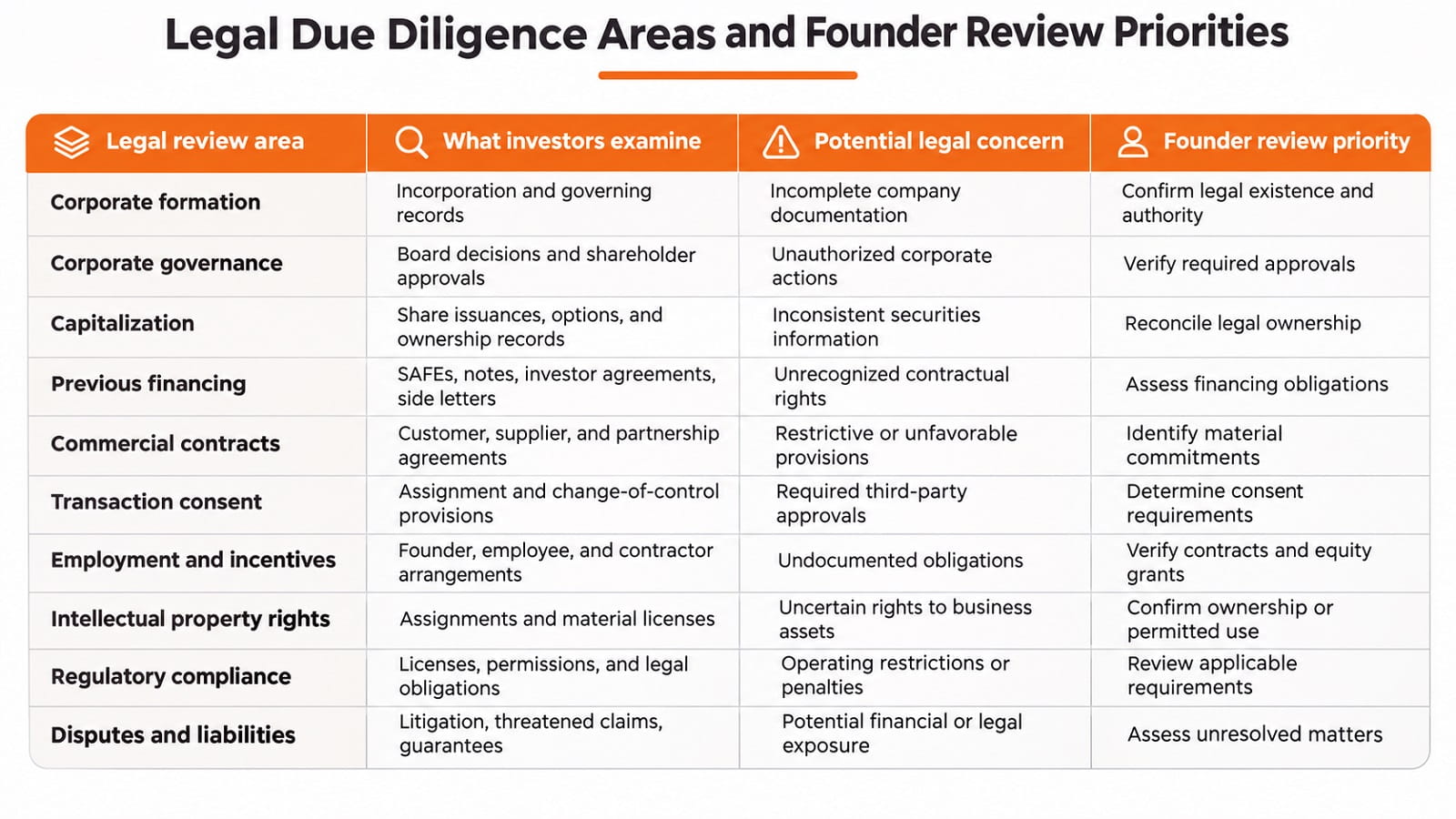
These areas should not be interpreted as independent administrative checks. A previous financing agreement may affect corporate voting rights, while a customer contract may influence both the company's commercial value and the legal permissions needed for an acquisition. Reviewers should identify the practical consequences of each finding and establish whether corrective action, disclosure, or a contractual safeguard is appropriate. The importance of a legal issue depends on its effect on the proposed investment, not simply the number of documents involved.
How Legal Findings Affect Investment Transactions
Legal due diligence can influence transaction negotiations because investors need to understand which risks they will assume after committing capital. Identified problems may result in requests for additional warranties, revised disclosures, changes to financing documents, or specific actions that must be completed before closing. Some matters can be resolved through ordinary corporate procedures, while others require negotiations with shareholders, customers, lenders, or regulatory authorities.
The treatment of a finding depends on its legal significance and the applicable transaction documents. A missing historical approval may be capable of lawful correction, subject to the relevant corporate requirements. A contractual restriction that prevents the company from completing an important transaction may require third-party consent. An unresolved dispute involving the company's principal assets could affect valuation or cause investors to reconsider whether the proposed investment remains acceptable.
Founders should distinguish between obligations that must be satisfied before closing and matters that can appropriately be addressed afterward. Investors may accept certain post-closing commitments, but significant ownership defects, missing permissions, or legal restrictions can require resolution before funds are transferred. This distinction is usually reflected in the negotiated financing documents and related closing conditions.
A Practical Legal Due Diligence Example
Consider AsterCloud, a fictional enterprise software startup seeking a $4 million Series A investment. The company has growing subscription revenue, an established customer base, and a product developed by its internal engineering team and external contractors. During the investment review, legal advisers examine its capitalization records, previous financing agreements, material customer contracts, and employment arrangements.
The investigation identifies four issues. First, the capitalization model omits an outstanding convertible note that may affect ownership after financing. Second, an earlier option grant lacks evidence of the required corporate authorization. Third, a major customer agreement includes a provision requiring consent for specified changes of control. Finally, a former contractor agreement does not clearly establish whether the company owns all relevant rights to a software component.
None of these findings automatically prevents the investment. However, each affects a different part of the proposed transaction and requires an appropriate response. The convertible note influences dilution calculations, the option grant raises an authorization question, the customer provision requires interpretation in light of the actual financing structure, and the contractor agreement creates uncertainty over the company's rights.
The following table summarizes the illustrative findings and possible steps toward resolution.
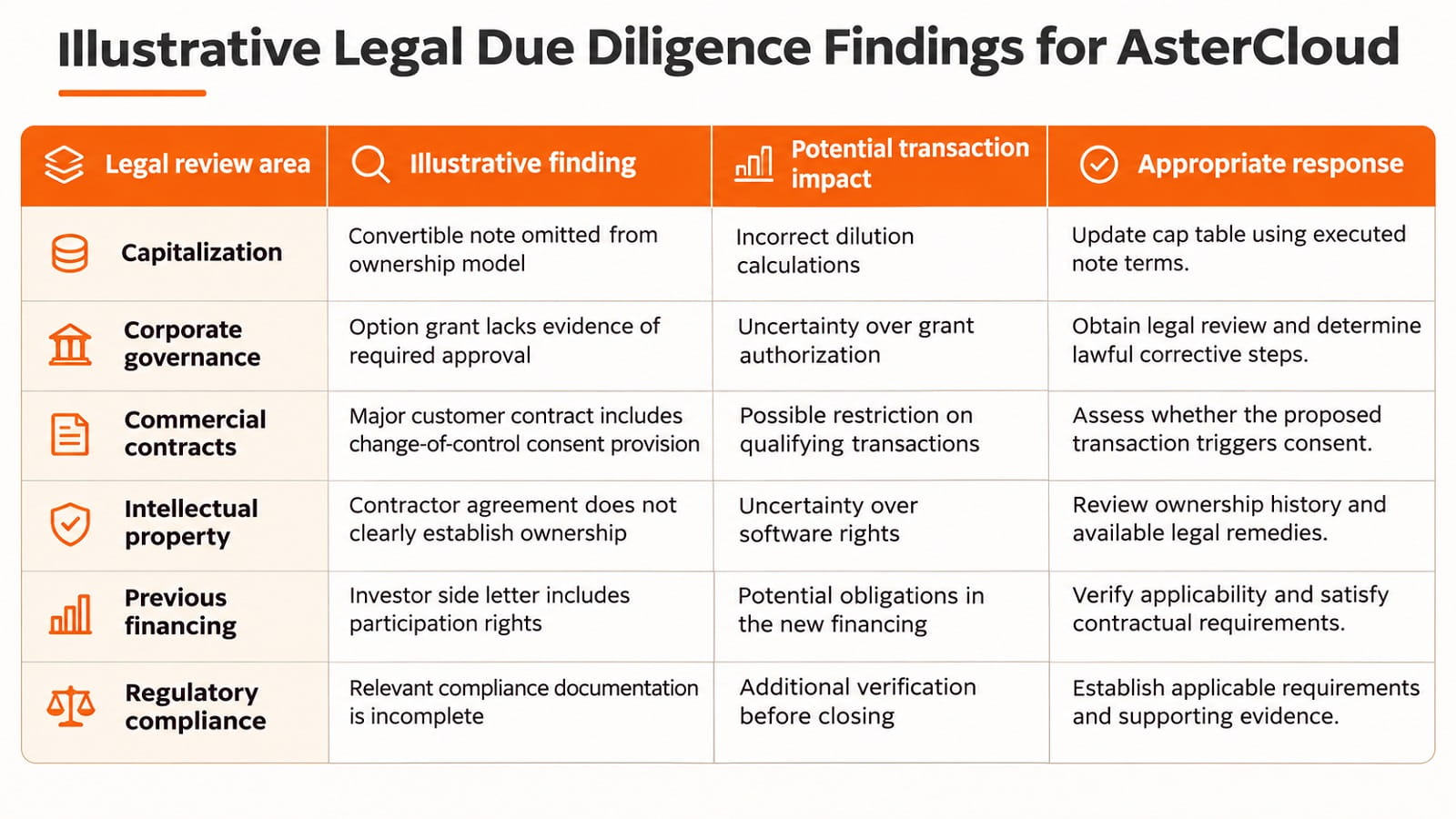
The example illustrates why legal findings should be assessed according to their actual consequences rather than assigned the same level of urgency. AsterCloud's omitted convertible note requires an updated ownership model before investors can evaluate dilution, while the option grant may require formal corrective action under applicable law. The customer contract should be interpreted carefully because a minority investment does not necessarily constitute a contractual change of control. The intellectual property concern may also require specialist legal advice to determine whether the company has the rights necessary to continue using its technology.
Preparing for Legal Due Diligence Before Fundraising
Legal readiness begins with ensuring that corporate records accurately reflect the company's current position. Founders should coordinate with qualified legal advisers to verify the consistency of shareholder records, executed investment agreements, important approvals, and other material commitments. This preparation is particularly valuable when a startup has completed several financing rounds or introduced employee equity arrangements.
Management should also identify contractual restrictions that may affect the proposed transaction. Material customer, supplier, lending, and partnership agreements can contain consent requirements or other provisions that become important during investment negotiations. Reviewing these matters before signing a term sheet can help founders understand whether additional parties must participate in the closing process.
Legal issues should be documented with sufficient detail to distinguish established facts from unresolved questions. A missing agreement should not be presented as executed, and a disputed ownership claim should not be described as resolved without appropriate evidence. Clear explanations and properly supported corrective actions can reduce the risk that an avoidable documentation issue develops into a more serious transaction dispute.
Where the business operates internationally, local legal advice may be necessary. Corporate, employment, securities, privacy, and regulatory requirements differ across jurisdictions, and documentation suitable for one company structure may not be appropriate for another.
Final Thoughts
Legal due diligence helps investors establish whether a startup's corporate records, ownership arrangements, contractual obligations, and regulatory position support the proposed investment. It provides a structured way to identify issues that might affect company control, future operations, financial exposure, or the legal completion of a transaction.
For founders, the value of legal preparation extends beyond answering investor questions. Accurate corporate records, properly documented financing agreements, and an understanding of material contractual restrictions can improve the company's ability to manage future transactions. Problems should be addressed according to their actual legal consequences rather than treated as routine paperwork.
A successful legal review does not require a company to eliminate every potential dispute or contractual risk. It requires reliable evidence, transparent identification of material obligations, and a practical approach to resolving issues that could affect the investment. With appropriate preparation and professional advice, founders can reduce avoidable closing complications while maintaining greater clarity over the company's legal position.
FAQ
What Is Legal Due Diligence for Startups?
Legal due diligence is the investigation of a startup's corporate structure, ownership, contracts, legal obligations, and potential liabilities before an investment or acquisition. Its purpose is to identify material legal risks and establish whether the proposed transaction can proceed under the applicable requirements.
What Do Investors Check During Legal Due Diligence?
Investors commonly review incorporation records, shareholder agreements, capitalization information, previous financing documents, material contracts, employment arrangements, intellectual property rights, and applicable regulatory matters. The scope depends on the company's business and the transaction.
Is Legal Due Diligence Required for Every Funding Round?
Not every investment involves the same formal legal investigation. Smaller early-stage investments may involve a narrower review, while institutional financing and acquisitions typically require more extensive verification. Applicable laws and investor requirements also influence the scope.
Can Legal Due Diligence Delay Startup Funding?
Yes. Missing approvals, ownership discrepancies, unresolved disputes, or required third-party consents can delay closing. The impact depends on the seriousness of the issue, the corrective action available, and the parties involved in resolving it.
Do Investors Review Previous SAFE and Convertible Note Agreements?
Yes, where relevant. Existing convertible instruments can affect ownership dilution, investor rights, and the terms of new financing. Reviewers examine executed agreements and related contractual provisions to determine their implications.
What Happens When a Startup Has Missing Corporate Approvals?
The consequences depend on the applicable law and the corporate action involved. Legal advisers may assess whether correction or ratification is available. Founders should not assume that an undocumented approval can simply be recreated retrospectively.
Can Legal Problems Change Startup Valuation?
Yes. Material legal restrictions, uncertain ownership rights, contractual liabilities, or significant disputes may influence investment negotiations. The effect depends on whether the issue changes the company's risk profile, operations, or anticipated transaction economics.
Who Performs Legal Due Diligence?
Legal due diligence is commonly performed by lawyers representing investors or acquirers, supported by the company's own legal advisers and relevant specialists. The participants and extent of review depend on the transaction's complexity.

Mobina Khanki
Venture & Funding Writer at PinerookMobina Khanki covers venture capital, startup funding, fundraising, and startup finance for Pinerook, focusing on founders and investors.
 Seen first.