
Due diligence red flags are warning signs that indicate potential problems in a startup's financial reporting, ownership structure, customer relationships, legal obligations, technology, or management practices. Investors investigate these signals before committing capital because seemingly minor inconsistencies can reveal risks that materially affect a company's value or ability to operate. A warning sign does not automatically mean that a startup is unsuitable for investment, but it does require an explanation supported by reliable evidence.
Within Startup Due Diligence, identifying warning signs helps investors distinguish ordinary business uncertainty from weaknesses that threaten the investment thesis. Early companies often operate with limited financial histories, concentrated customer bases, and evolving internal processes. These characteristics can be understandable at a particular development stage, yet undisclosed obligations, unsupported claims, or unexplained contradictions may indicate deeper problems. The significance of a finding depends on its potential consequences, whether management understands it, and whether credible corrective action is available.
This guide examines the most important due diligence red flags that startup investors encounter, including financial discrepancies, ownership uncertainty, weak customer evidence, regulatory exposure, technology vulnerabilities, and governance concerns. It explains how to assess severity, distinguish manageable issues from material risks, and evaluate management's response. A practical investment scenario demonstrates how several findings can change the conditions under which an investor is willing to proceed.
What Makes a Due Diligence Finding a Red Flag?
A red flag is an observation that creates reasonable doubt about an important assumption underlying an investment. It might involve information that cannot be verified, a contradiction between documents, an undisclosed legal obligation, or an operational weakness that could interfere with future growth.
Not every problem qualifies as a serious warning. A startup with limited operating history may have less developed reporting procedures than a mature company. However, a financial statement that materially contradicts bank records or an ownership model that excludes executed financing agreements raises questions that require closer investigation.
The difference lies in the consequence and credibility of the issue. Investors should assess whether the finding affects reported performance, ownership, legal authority, operational continuity, or the company's capacity to deliver its business plan.
A useful investigation also considers management's behavior. Founders who acknowledge an issue, explain its origin, and produce appropriate evidence may reduce uncertainty. Repeatedly changing explanations or withholding material information can create a separate concern about the reliability of management representations.
Financial Red Flags Investors Should Investigate
Financial warning signs frequently arise when reported performance cannot be reconciled with accounting records, customer transactions, or cash movements. Investors may identify discrepancies between revenue presentations, financial statements, billing records, and bank activity.
One example is a company presenting contracted future sales as recognized revenue or including temporary implementation income in a recurring revenue metric. The underlying transactions may be legitimate, but the reported figures can misrepresent the stability of the business if their definitions are unclear.
Revenue Discrepancies and Unreliable Financial Metrics
Investors should examine whether revenue calculations follow consistent definitions and reflect the underlying commercial activity. Sudden changes in revenue without corresponding customer evidence may require additional verification.
In subscription businesses, particular attention may be given to annual recurring revenue, customer churn, gross revenue retention, and expansion income. A reported growth rate can appear attractive when a company changes the way it classifies customers or excludes unfavorable periods.
Metric discrepancies should be assessed according to their cause and scale. A documented classification error may be corrected through reliable reconciliation, while repeated unsupported claims can indicate weaknesses in financial controls or deliberate misrepresentation.
Cash Burn, Liquidity, and Hidden Obligations
A startup may report sufficient cash to finance its operations while overlooking restrictions on funds, overdue liabilities, or significant future payments.
Investors therefore examine unrestricted cash, historical cash movements, expected obligations, and the assumptions supporting the company's runway estimate. A simplified runway calculation may be misleading if monthly expenditure is increasing or major payments fall outside the period used to calculate average burn.
Undisclosed debt, personal guarantees, unpaid taxes, or obligations to previous investors may also change the company's financial position. The concern is not simply that liabilities exist, but whether they have been properly identified and reflected in the investment assessment.
Ownership and Capitalization Warning Signs
Ownership uncertainty can materially affect a financing transaction because investors must understand which securities have been issued and which existing rights could influence future ownership.
A capitalization table may appear straightforward while excluding outstanding SAFEs, convertible notes, option grants, or informal commitments. These arrangements can influence dilution and the rights of existing shareholders.
Missing Financing Agreements and Equity Promises
Investors typically compare the ownership model with executed agreements, corporate approvals, and relevant securities records. Discrepancies may indicate that the company has not accurately documented previous financing.
An informal promise of equity can become particularly problematic when the parties disagree about its terms or enforceability. Founders should not treat an unresolved promise as legally nonexistent merely because it does not appear in the capitalization spreadsheet.
The investigation should establish the contractual position and determine whether lawful corrective steps are available. Material discrepancies may need to be resolved before new securities can be issued on the terms expected by investors.
Founder Disputes and Governance Problems
Unresolved disagreements between founders can create uncertainty about leadership, voting authority, intellectual property ownership, or control over important business decisions.
A founder departure is not inherently a negative signal. The concern arises when responsibilities, equity rights, or historical commitments remain disputed and could interfere with operations.
Investors may also examine whether significant corporate actions received the required approvals. Missing governance records can be an administrative weakness, but unauthorized securities issuances or disputed corporate decisions may create more serious legal exposure.
Commercial Red Flags in Customer and Market Evidence
Commercial warning signs often emerge when a startup's reported traction does not support its projected growth. Investors examine customer behavior, sales records, renewal history, and competitive conditions to establish whether the business can sustain demand.
A large sales pipeline does not necessarily represent future contracted revenue. Opportunities may depend on procurement decisions, customer budgets, or product requirements that have not been satisfied.
Customer Concentration and Retention Problems
Revenue concentration becomes important when losing a small number of customers could substantially affect the company's financial position.
A company serving large enterprise customers may naturally have concentrated revenue during its early years. Investors should therefore examine contract duration, renewal history, customer satisfaction, and the reasons customers remain rather than classify concentration alone as evidence of failure.
Deteriorating retention can present a different risk. If customers consistently leave after the initial contract, growth may depend on increasingly expensive acquisition efforts.
Investors should determine whether management understands the causes of churn and whether proposed improvements are supported by customer evidence.
Unsupported Market and Sales Assumptions
Startups may present ambitious market opportunities without demonstrating access to a realistic customer segment. Investors should distinguish between the overall size of an industry and the demand the company can reasonably capture.
A commercial forecast may also depend on conversion rates or customer acquisition costs that differ materially from historical performance. Such differences can be justified when the startup has credible evidence of changes in its product or distribution strategy.
However, a forecast that assumes substantially better results without explaining how they will be achieved requires further investigation.
Legal and Regulatory Red Flags
Legal warning signs arise when a startup lacks clear authority to perform important activities or faces obligations that may restrict its operations or financing.
Examples include incomplete corporate approvals, material disputes, undisclosed contractual restrictions, and missing permissions required by applicable law.
The severity depends on the jurisdiction, the company's business activities, and whether the problem can be lawfully corrected.
A missing routine filing may be manageable, while operating without a required regulatory authorization could place substantial parts of the business at risk.
Intellectual Property Ownership and Licensing Concerns
A startup's principal technology may have been developed by founders, employees, contractors, or external research partners. Investors need to establish whether the company owns or possesses adequate rights to use those assets.
Missing assignment agreements can create uncertainty, particularly when the business depends on software or inventions created before incorporation.
Restrictive commercial licenses and unresolved infringement allegations may also affect the company's ability to sell products or enter new markets.
These issues require appropriate legal investigation. Payment for software development does not universally establish intellectual property ownership, and the absence of a dispute does not prove that every necessary right has been obtained.
Technical and Operational Red Flags
Technology concerns can affect an investment when weaknesses threaten customer service, security, product development, or operating costs.
Investors may encounter infrastructure that cannot support projected demand, inadequate recovery arrangements, unresolved critical vulnerabilities, or a codebase that depends almost entirely on one engineer.
Not every technical limitation is material. Startups often make reasonable compromises while testing products and refining their architecture.
The important questions are whether management understands the limitation, whether appropriate safeguards exist, and whether remediation fits the proposed operating budget.
A recent security test that identified vulnerabilities is not necessarily a worse signal than the absence of testing. A company that documents findings and addresses them may demonstrate stronger controls than one that assumes its systems are secure without evidence.
Governance, Transparency, and Management Integrity
Some warning signs relate less to the underlying business than to the reliability of information supplied during the investment review.
Investors depend on management to explain financial performance, contractual arrangements, operational risks, and other material matters accurately.
When figures change repeatedly without reconciliation or important obligations emerge only after direct questioning, reviewers may need to question whether additional information has been omitted.
Conflicts of interest, undisclosed transactions involving founders or related parties, and inconsistent representations about company ownership can also justify further investigation.
Management credibility should be evaluated using documented facts rather than personal impressions alone. An isolated misunderstanding differs from a repeated pattern of withholding information or making unsupported claims.
A company that communicates weaknesses clearly and provides evidence of corrective action can strengthen investor confidence even when important issues remain unresolved.
Key Due Diligence Red Flags and Investor Responses
Investors should assess warning signs according to their potential effect on the investment rather than the department in which they arise. Financial, legal, commercial, and technical issues frequently interact, and a weakness in one area can reveal problems elsewhere.
The following table summarizes common warning signs, the evidence needed to investigate them, and the appropriate review priority.
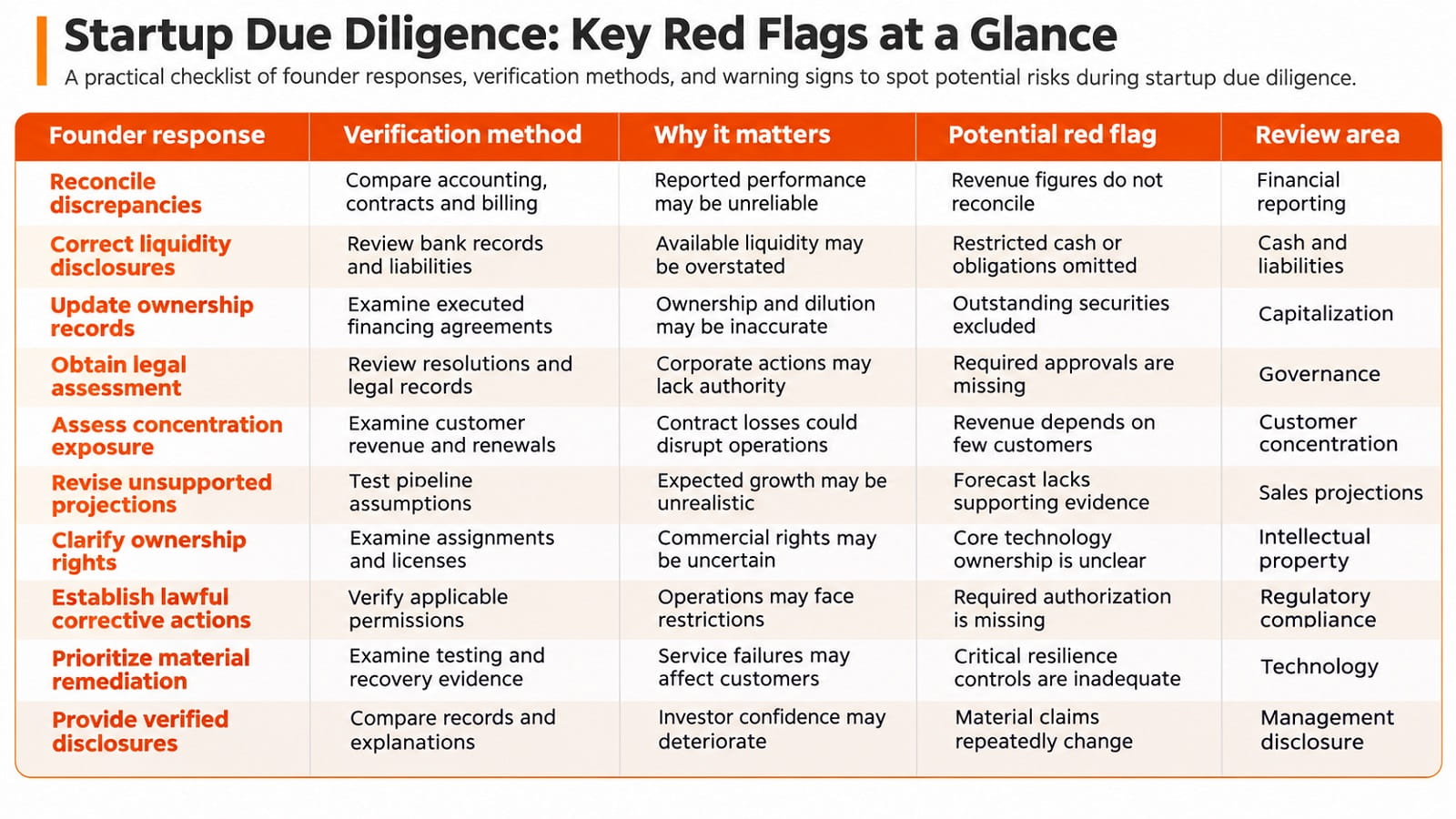
The table illustrates why an effective investigation requires more than identifying problems. A startup with customer concentration may remain commercially attractive if long contracts and strong renewal evidence support revenue durability. By contrast, an unexplained ownership discrepancy may require immediate attention because the investment cannot be evaluated accurately without knowing the company's securities position. The quality of management's response and the evidence supporting it are essential when determining the seriousness of each finding.
Distinguishing Fixable Issues From Deal Threatening Risks
A useful assessment separates problems according to their likely consequences and the corrective actions available. A minor documentation gap may be resolved without affecting investment economics, while a material ownership dispute or unresolved regulatory restriction may require significant changes before financing can proceed.
Investors can use three broad categories to organize their conclusions. The first includes manageable issues that can be corrected through ordinary administrative or operational work. The second contains material risks requiring documented remediation, additional investigation, or negotiated contractual protections. The third includes problems that may undermine the investment thesis or prevent the proposed transaction from proceeding.
These categories are not rigid classifications. A problem can move between categories as new evidence becomes available. A missing contractor agreement, for example, may initially appear manageable but become serious if the contractor disputes the company's right to use essential software.
Investors should also avoid equating an expensive fix with the most significant risk. A costly infrastructure improvement may be predictable and achievable, while a relatively small but deliberately concealed financial obligation may raise broader questions about management reliability.
The objective is to establish which uncertainties can be accepted, which require correction, and which make the proposed investment unacceptable under its current terms.
A Practical Due Diligence Red Flags Example
Consider Meridian Analytics, a fictional subscription software startup seeking a $4 million Series A investment. The business reports $2.5 million in annual recurring revenue and expects significant customer expansion over the following eighteen months.
During the investor review, several inconsistencies emerge. The company's reported ARR includes $200,000 of nonrecurring implementation revenue. Its largest customer accounts for 38% of reported recurring revenue, and the customer agreement is approaching renewal. The capitalization model also excludes an outstanding convertible instrument, while documentation establishing ownership of one important software component remains incomplete.
These findings create different kinds of risk. The ARR discrepancy affects the accuracy of a commercial metric, customer concentration raises questions about revenue durability, the omitted instrument affects dilution, and the software ownership issue may affect the company's legal rights.
Assessing the Severity of Each Finding
Meridian's management acknowledges the discrepancies and begins an independent review with its finance team and legal advisers. The company also requests additional customer evidence and examines its existing software development agreements.
The following table presents the illustrative findings and their potential influence on the financing decision.
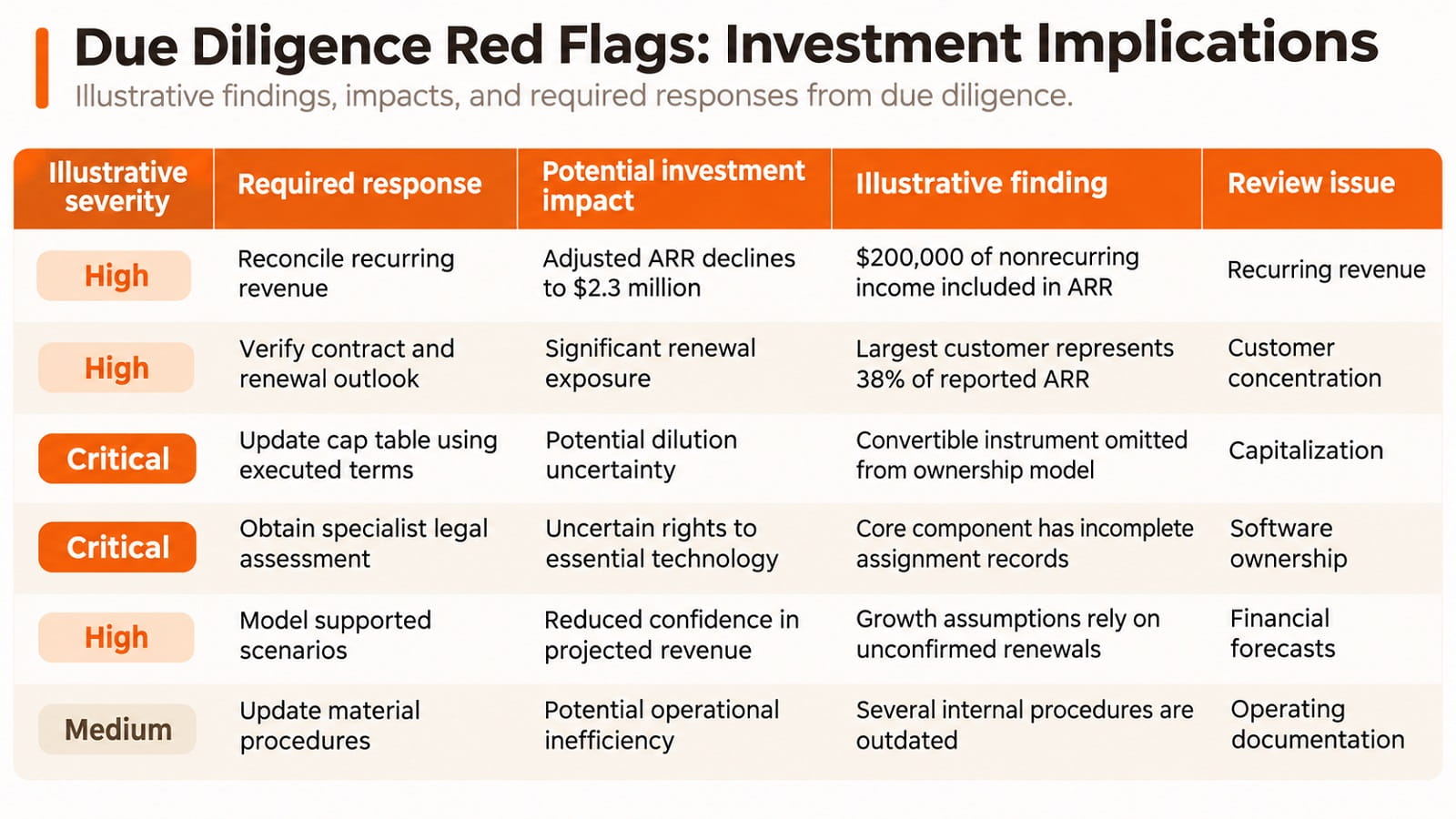
The severity labels are illustrative judgments, not universal investment rules. The omitted convertible instrument requires priority because it directly affects ownership calculations, while the incomplete software assignment could become a transaction obstacle if the company cannot demonstrate adequate rights. The recurring revenue adjustment reduces reported ARR by 8%, but its effect on valuation depends on the investor's assessment of the business and the importance of recurring revenue to the investment thesis. The customer concentration finding also needs further analysis because it is not clear from the available information whether the customer will renew.
How the Findings Change the Investment Decision
Meridian's initial investment case depends partly on reported recurring revenue and expected customer expansion. Once the revenue definition is corrected, investors must evaluate the company using $2.3 million of adjusted ARR rather than the original $2.5 million.
The investment team may also prepare alternative revenue scenarios reflecting uncertainty around the largest customer. However, the company should not automatically assume that the entire customer relationship will disappear. A reasonable assessment uses available contract information, customer feedback, and renewal evidence.
The ownership questions create a different challenge. Even if Meridian's financial outlook remains attractive, investors need clarity about the securities they will receive and the company's rights to its essential technology.
The investor may therefore continue negotiations while requiring legal verification, revised financial disclosures, and satisfactory resolution of specified issues before closing. If these concerns cannot be resolved, the investor may reconsider valuation, transaction structure, or whether to proceed.
How Founders Should Respond to Red Flags
Founders should begin by establishing the factual basis of each concern. An investor's observation may reflect a genuine issue, an incomplete explanation, or a misunderstanding of the available information. The appropriate first step is to verify the evidence rather than immediately reject the finding.
Once the issue is understood, management should assess its potential consequences and determine who is responsible for addressing it. Financial discrepancies may require reconciliation, contractual problems may require legal advice, and technical weaknesses may require engineering investigation.
Corrective action should be supported by evidence. Updating a capitalization spreadsheet does not resolve an underlying contractual dispute unless the ownership records and applicable agreements support the revised position. Similarly, changing a revenue presentation does not establish that the related accounting treatment is correct.
Founders should distinguish completed remediation from actions that remain planned. Material unresolved findings may need to be disclosed, incorporated into financial forecasts, or addressed through negotiated financing conditions.
Transparency can reduce uncertainty, but it does not make every risk acceptable. Some problems may remain material even after management provides a complete explanation.
When Red Flags Affect Valuation or Stop a Deal
Warning signs can influence the investment decision in several ways. A financial adjustment may change the metrics used to support valuation, while a material operational weakness may increase the capital required to execute the business plan.
Investors may respond by requesting additional evidence, modifying financing terms, introducing conditions before closing, or declining the opportunity. The appropriate response depends on the contractual structure and the severity of the findings.
Unresolved ownership disputes, essential regulatory restrictions, or serious concerns about the reliability of management disclosures can be particularly consequential. These issues may prevent an investor from establishing what rights are being acquired or whether the company can operate as represented.
Other problems may be accepted when they are understood and properly reflected in the transaction. Customer concentration, technical debt, or limited operational maturity can be ordinary features of growing companies, provided their implications are not understated.
The central distinction is between an investment containing identifiable risks and an investment whose essential facts cannot be reliably established.
Preventing Red Flags Before Fundraising
Founders can reduce avoidable problems by maintaining consistent reporting, documented ownership records, clear contractual arrangements, and reliable operating information throughout the company's development.
Financial metrics should follow stable definitions, while important claims in investment materials should be supported by appropriate evidence. Changes to ownership or financing arrangements should be reflected in relevant records rather than left for reconstruction during the next funding round.
Management should also evaluate material customer dependencies, important technology risks, and regulatory requirements before seeking external capital. Identifying weaknesses early provides more time to investigate and address them.
An internal readiness review can help prioritize concerns according to their potential consequences. The purpose is not to produce a company without uncertainty, but to ensure that material risks are understood and that representations made to investors remain accurate.
Final Thoughts
Due diligence red flags help investors identify uncertainties that could affect a startup's value, operations, ownership, or ability to complete a financing transaction. Their significance depends on the evidence behind each finding and the potential consequences for the investment.
For founders, the strongest approach is to maintain reliable information, investigate inconsistencies, and address material weaknesses before they become transaction obstacles. A manageable problem supported by clear documentation is different from a significant risk that management cannot explain.
Effective investment decisions require distinguishing ordinary startup uncertainty from issues that undermine essential assumptions. When investors and founders evaluate warning signs according to their actual consequences, they can make more informed decisions about remediation, transaction terms, and whether financing should proceed.
FAQ
What Are Due Diligence Red Flags in Startups?
They are warning signs indicating possible weaknesses in a startup's financial information, ownership records, customer relationships, legal obligations, technology, or management practices. Investors examine these signals to determine whether they affect the proposed investment.
What Financial Red Flags Concern Investors Most?
Common concerns include revenue that cannot be reconciled, inconsistent financial metrics, undisclosed liabilities, unreliable cash forecasts, and unsupported growth projections. Their significance depends on the size, cause, and consequences of the discrepancy.
Can a Startup Pass Due Diligence With Red Flags?
Yes. Some risks can be corrected, explained, or accepted through appropriate investment terms. However, material unresolved problems may delay or prevent a transaction.
Is Customer Concentration Always a Red Flag?
Not necessarily. Early companies may naturally depend on a limited number of customers. Investors assess the resulting risk using contract terms, renewal evidence, customer satisfaction, and the company's diversification prospects.
Why Are Capitalization Table Errors Serious?
Capitalization errors can misrepresent ownership, potential dilution, and existing investor rights. A material discrepancy may affect the economics or legal completion of a financing transaction.
How Do Investors Verify Startup Red Flags?
Investors examine supporting records, reconcile conflicting information, interview relevant parties, and request specialist assessments where appropriate. The methods depend on the issue and the transaction.
Can Due Diligence Red Flags Lower Startup Valuation?
Yes. Findings that reduce expected revenue, increase future costs, or create significant legal exposure can influence valuation negotiations. However, their financial impact is not always equal to the estimated cost of remediation.
What Should Founders Do When Investors Discover a Red Flag?
Founders should verify the issue, explain its cause, assess its consequences, and identify appropriate corrective action. Material unresolved risks should be communicated accurately rather than presented as completed or insignificant.

Mobina Khanki
Venture & Funding Writer at PinerookMobina Khanki covers venture capital, startup funding, fundraising, and startup finance for Pinerook, focusing on founders and investors.
 Seen first.