
Commercial due diligence is the evaluation of a startup's market opportunity, competitive position, customer relationships, and ability to achieve its projected commercial growth before an investment or acquisition. Investors use this assessment to determine whether the company's business model is supported by genuine demand and whether its revenue expectations are realistic. A startup may report impressive sales growth while operating in a narrow market, depending heavily on a few customers, or relying on assumptions about future customer acquisition that have not been adequately tested.
Within Startup Due Diligence, commercial evaluation examines the business conditions that influence whether an investment can generate sustainable returns. Financial records explain historical results, but they cannot independently establish whether customers will renew, competitors will gain market share, or the company's sales strategy will continue producing growth. These questions require an assessment of customer behavior, market developments, competitive alternatives, pricing, and the effectiveness of the startup's commercial operations.
This guide explains how investors perform commercial due diligence, which market and customer indicators they examine, and how founders can support their growth assumptions with reliable evidence. It covers market validation, competitive positioning, customer retention, pricing power, sales pipeline reliability, and commercial forecasting. A practical startup investment example demonstrates how changes in customer retention and sales conversion assumptions can materially affect expected revenue.
What Is Commercial Due Diligence?
Commercial due diligence is a structured investigation of whether a company's products, markets, customers, and competitive advantages can support its current performance and future business plan. It examines the commercial assumptions underlying a proposed investment and tests them against internal operating data, independent market information, and evidence gathered from customers or other relevant market participants.
The scope depends on the company's development stage and the transaction being considered. An investor evaluating a pre-revenue startup may concentrate on the severity of the customer problem, willingness to pay, market accessibility, and evidence of product demand. For a business with established revenue, the review may place greater emphasis on customer retention, competitive win rates, realized pricing, sales efficiency, and the sustainability of growth. Larger acquisitions may involve extensive primary research and independent market assessments.
The distinction between commercial and financial analysis is particularly important. Financial analysis can verify that a company recorded $2 million in revenue, while commercial analysis examines whether the customers responsible for that revenue are likely to remain, whether competitors offer attractive alternatives, and whether the company can realistically expand its customer base. Both perspectives contribute to investment decisions, but they investigate different sources of uncertainty.
A strong commercial review therefore begins with specific questions rather than a generic description of the industry. Investors should identify the assumptions most important to the company's valuation and determine what evidence would support or challenge them.
Evaluating Market Demand and Addressable Opportunity
The market assessment begins by defining the customers the startup can realistically serve. A large industry valuation does not necessarily indicate that a particular startup has a substantial commercial opportunity. Investors need to distinguish the broader market from the customer segments the company can reach with its current product, pricing, distribution model, and resources.
Market sizing should therefore be supported by identifiable commercial assumptions. A company selling specialized software to small healthcare providers might estimate its opportunity using the number of relevant organizations, their purchasing budgets, and the proportion likely to adopt the solution. This approach provides a more useful basis for evaluating potential revenue than applying an unsupported market share percentage to a large global industry estimate.
Market Growth and Customer Demand
Investors examine whether demand is expanding, stable, or declining and what factors influence purchasing decisions. A growing market can create opportunities for new companies, but it may also attract competitors and increase customer acquisition costs. Conversely, a slower-growing market may still support an attractive business if the startup can gain customers through a differentiated product or more efficient distribution.
Evidence can come from industry research, customer purchasing patterns, procurement budgets, regulatory developments, and direct conversations with potential buyers. Founders should distinguish genuine customer demand from expressions of interest that have not resulted in purchasing commitments. Product demonstrations and positive feedback are valuable, but they do not automatically establish willingness to pay at commercially sustainable prices.
The investigation should also identify barriers to adoption. Customers may recognize a problem but lack the budget, authority, or operational capacity to implement a new solution. Understanding these barriers helps investors assess whether the proposed growth strategy matches the realities of customer purchasing behavior.
Competitive Position and Product Differentiation
Commercial evaluation examines how the startup competes against existing providers, alternative technologies, and the option of customers continuing with their current processes. A competitor does not need to offer an identical product to influence demand. In many markets, spreadsheets, internal development teams, established service providers, and alternative workflows can compete with a specialized startup solution.
Investors may compare product functionality, pricing, distribution channels, implementation requirements, and customer support. However, a feature comparison alone rarely establishes a durable competitive advantage. A startup may offer more capabilities than competitors without giving customers a compelling reason to switch.
Competitive Win Rates and Switching Costs
Sales records can provide useful evidence about competitive positioning. Investors may examine which competitors appear in lost opportunities, why customers select the startup, and how purchasing decisions differ across customer segments. Win and loss analysis is particularly informative when supported by consistent CRM records and independent customer feedback.
Switching costs can strengthen customer relationships when a product becomes embedded in important workflows. Integration requirements, staff training, historical data, and implementation expenses may make replacement difficult. However, switching costs should not be confused with customer satisfaction or enduring product superiority. A customer may remain temporarily because migration is expensive while actively planning to adopt another solution.
A credible competitive assessment identifies the conditions under which the company wins, where it loses, and what would need to change for competitors to weaken its position. Founders who acknowledge these limitations can develop more realistic strategies than those who assume their product has no meaningful competition.
Customer Retention and Revenue Concentration
Customer behavior is one of the strongest sources of evidence about a startup's commercial durability. Investors want to understand whether customers continue purchasing after the initial sale, whether they increase their spending, and which circumstances cause them to leave. These questions are particularly important for subscription businesses, enterprise software companies, and other models that depend on recurring customer relationships.
Customer retention should be assessed using clearly defined time periods and comparable customer groups. A company may report a high overall retention rate even though its newest customers leave more quickly than earlier customers. Cohort analysis can reveal whether customer behavior is improving or deteriorating as the business expands into different segments.
For subscription businesses, gross revenue retention measures how much recurring revenue remains from an existing customer group after losses from churn and contraction, excluding expansion. Net revenue retention also incorporates expansion from that same group. These measures can reveal whether existing customers support growth, but their definitions and underlying data must be consistent.
Customer Concentration and Contract Renewal Risks
A company may have attractive growth while relying on a small number of large customers. If one customer accounts for 40% of revenue, an unexpected cancellation could materially change the operating plan. Investors therefore examine concentration alongside contract renewal dates, customer satisfaction, historical payment behavior, and the reasons customers continue purchasing.
Customer interviews can provide an additional perspective. A company may describe a major customer as highly satisfied, while the customer explains that the product is difficult to replace but does not fully meet its expectations. Such findings do not automatically indicate an imminent cancellation, but they can change the assessment of renewal risk.
The most useful retention analysis combines quantitative behavior with an understanding of customer motivations. It explains not only how many customers remain but also why they stay and whether those reasons are likely to persist.
Pricing Power and Commercial Unit Economics
Pricing analysis examines whether customers are willing to pay the amounts assumed in the startup's financial plan. Investors may compare advertised prices with actual contract values, discounts, renewal terms, and the commercial outcomes of previous price changes. A company may have a strong product but limited pricing power if customers can switch to similar alternatives at lower cost.
For subscription businesses, pricing should be considered alongside retention and customer acquisition. A price increase may improve revenue per customer, but the benefit can disappear if it causes sufficient cancellations or reduces new sales conversion. Investors may examine customer segments separately because enterprise clients, smaller businesses, and individual users can respond differently to pricing changes.
Customer acquisition cost and lifetime value estimates can also inform the commercial review. However, these figures depend on assumptions about customer retention, gross margins, and the expenses attributed to acquisition. A high projected lifetime value is less persuasive when the company has only a short customer history or limited evidence about future renewals.
The objective is to determine whether the company's customer economics support sustainable expansion. A startup that acquires customers efficiently but cannot retain them may struggle to build a durable business, while a company with strong retention may still require additional financing if acquiring each new customer is disproportionately expensive.
Sales Pipeline Reliability and Go-to-Market Execution
A startup's growth forecast often depends on converting prospective customers into paying accounts. Investors therefore evaluate the sales pipeline to determine whether projected revenue is supported by opportunities with a credible probability of closing. The existence of a large pipeline is not sufficient because opportunities differ in qualification, customer commitment, expected contract value, and likelihood of conversion.
A commercial review may examine historical conversion rates, average sales cycles, contract values, and the performance of different acquisition channels. Investors also consider whether prospective customers have approved budgets and whether proposed closing dates reflect actual purchasing processes. Opportunities that have remained unchanged for long periods may require different treatment from those progressing through procurement.
For startups entering new markets, historical conversion rates may not apply directly. A sales strategy that works with small domestic customers may not produce the same results when targeting international enterprises. Different purchasing authorities, implementation requirements, and competitors can affect both acquisition costs and sales timing.
Investors should also examine the resources necessary to achieve the forecast. A company planning to double sales may need additional account executives, implementation staff, customer support capacity, and marketing expenditure. Commercial projections are more credible when the planned go-to-market resources align with the expected customer growth.
Key Commercial Due Diligence Areas and Investor Priorities
Commercial reviewers need to connect market assumptions with the evidence available from customers, sales activity, and independent research. The emphasis should be on the factors most likely to influence future performance rather than collecting every available market statistic.
The following table summarizes the principal areas of investigation and identifies what founders should verify before presenting their growth assumptions.
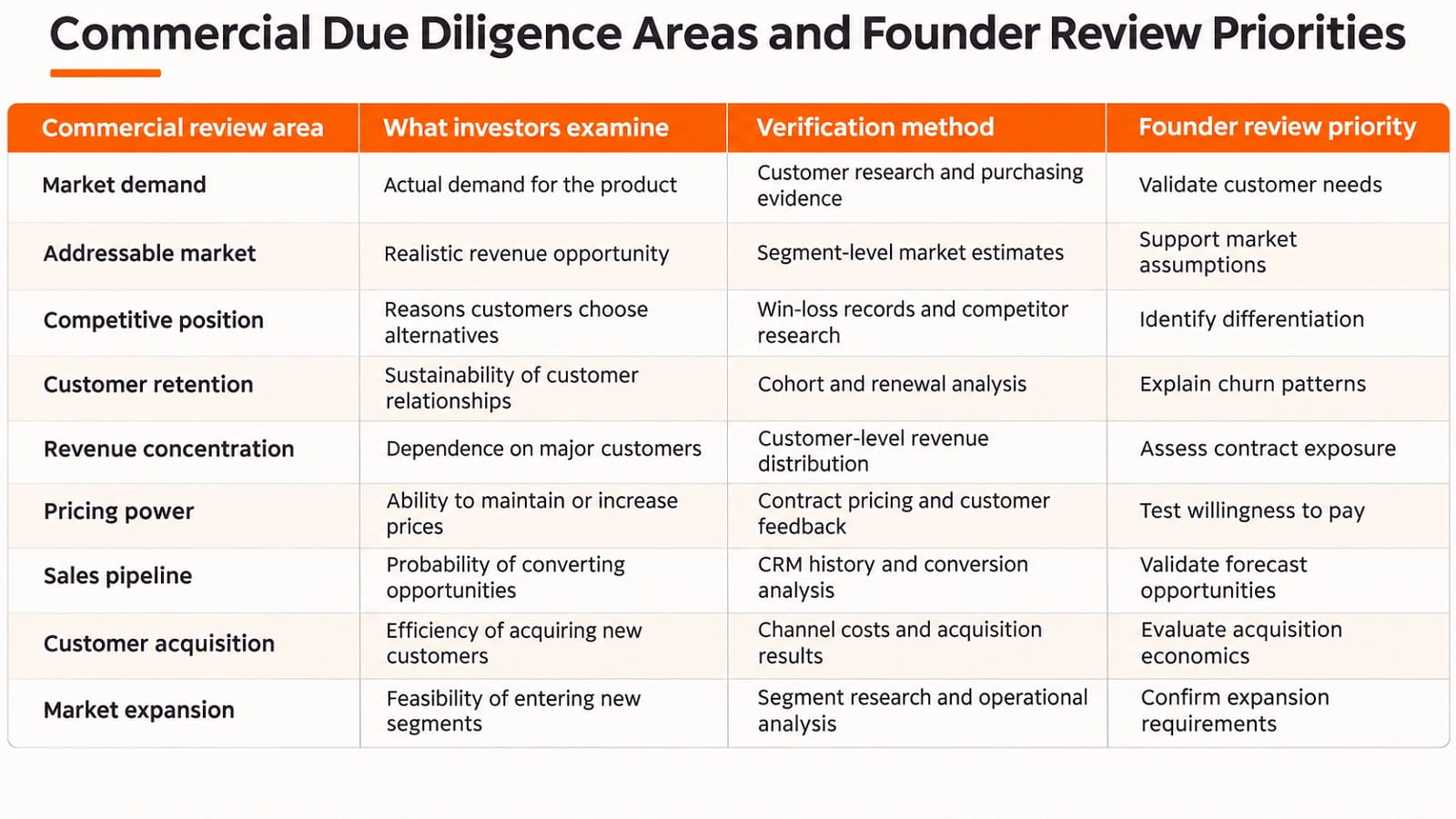
These measures should be interpreted together because commercial performance depends on the interaction between demand, competition, customer behavior, and sales execution. A startup may operate in a growing market but struggle to acquire customers because its product lacks differentiation. Another company may have strong customer retention while facing limited opportunities to expand within its existing segment. Commercial due diligence helps establish which growth assumptions are supported by evidence and which require further validation.
A Practical Commercial Due Diligence Example
Consider VertexFlow, a fictional B2B software startup providing workflow automation tools to mid-sized companies. The business is preparing for a $5 million Series A financing and reports $2.4 million in annual recurring revenue. Management expects ARR to reach $4 million within twelve months, supported by renewals, customer expansion, and new sales opportunities.
Investors initially consider the revenue forecast plausible because the company has an established customer base and a substantial sales pipeline. However, a detailed commercial review identifies differences between management's assumptions and historical customer behavior.
Testing Retention and New Customer Growth
VertexFlow begins the forecast period with $2.4 million in ARR. Management expects to retain 95% of that amount, generating $2.28 million from existing customers before expansion. It also forecasts $420,000 in additional ARR from existing customers and $1.3 million from new customers.
These assumptions produce the company's $4 million projected ARR.
The commercial review finds that historical gross revenue retention is closer to 88% and that the expected expansion revenue relies on several customer upgrades that have not been confirmed. Based on renewal records and customer interviews, reviewers develop an illustrative downside case using 88% gross retention and $240,000 of expansion ARR.
The review also examines the company's $5.2 million qualified new-business pipeline. Management assumes that 25% of the pipeline will convert into new ARR, while comparable historical opportunities have converted at approximately 15%. Applying that historical rate reduces expected new customer ARR from $1.3 million to $780,000.
Comparing Management and Diligence Scenarios
The following table presents the assumptions and resulting ARR under both scenarios. The figures are illustrative and are not intended to represent a forecast for an actual company.
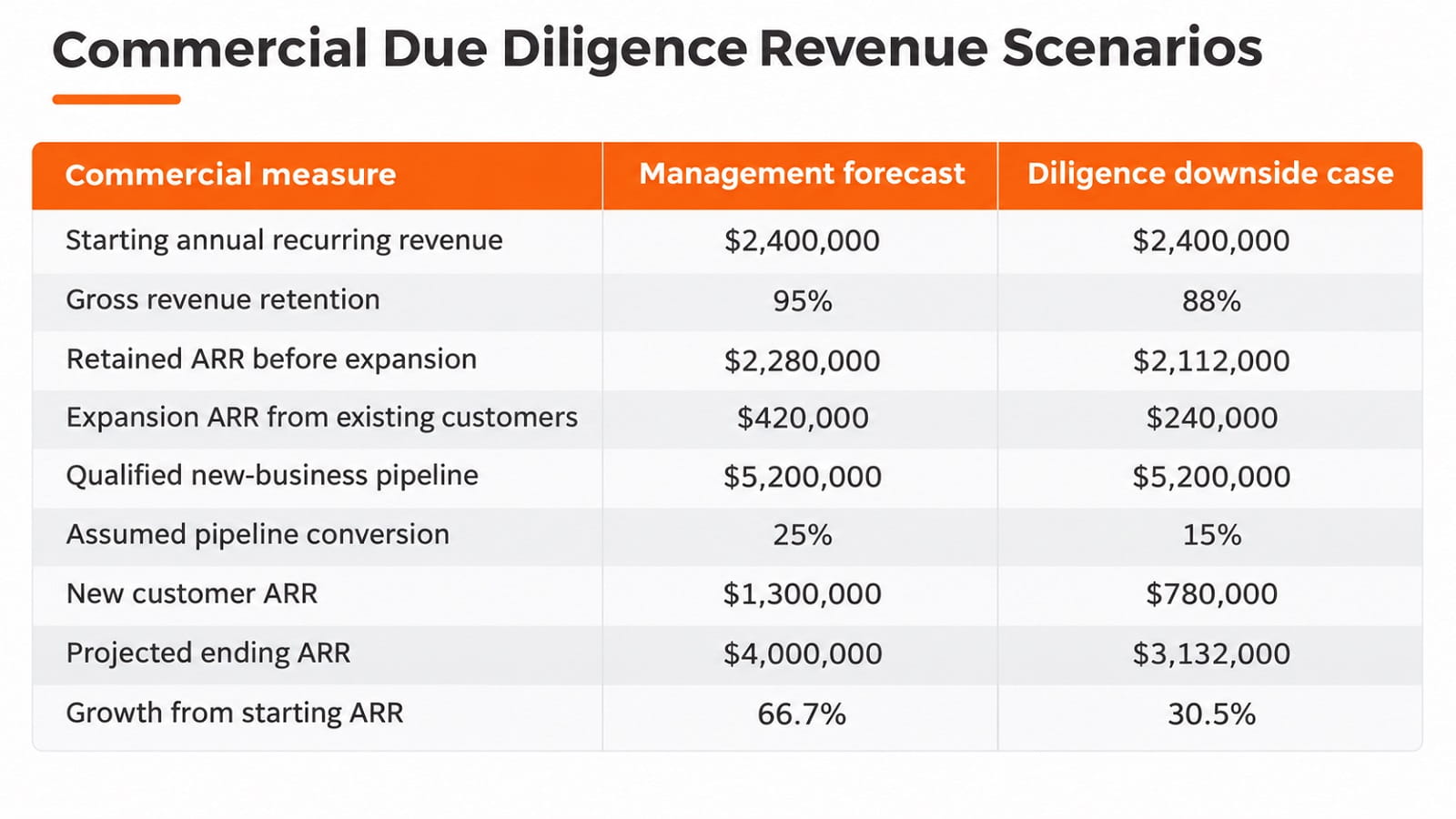
The difference between the two forecasts is $868,000 in ending ARR. The downside case does not indicate that VertexFlow is necessarily failing to grow, because projected ARR still increases by approximately 30.5%. However, it demonstrates that the company's original expectations depend on improvements in customer retention and sales conversion that have not been established by historical evidence. Investors can use these findings to evaluate whether the proposed financing and valuation remain appropriate under more conservative commercial assumptions.
Interpreting the Commercial Findings
The forecast adjustment changes how investors evaluate VertexFlow's growth opportunity. The original plan assumes stronger retention, more expansion revenue, and higher pipeline conversion than the diligence downside case. Each assumption could potentially improve through better customer service, product development, or sales execution, but management needs evidence supporting that improvement.
Investors should also avoid treating historical conversion rates as permanent limits. A change in sales leadership, customer targeting, or product positioning may produce better results. Nevertheless, the forecast should explain why the improvement is achievable rather than assuming that previous performance will automatically change.
For the founders, the review identifies specific operational priorities. Understanding customer departures, verifying potential account expansion, and improving pipeline qualification can support more reliable forecasts. These actions may also improve the company's commercial performance independently of the financing decision.
Commercial Risks That Can Affect Investment Decisions
Commercial due diligence can uncover risks that are not apparent from revenue growth alone. Customer concentration, declining retention, aggressive pricing assumptions, or weak competitive differentiation may all reduce confidence in future performance. The significance of these findings depends on their likely impact on revenue and whether the company can address the underlying causes.
A startup might report rapid growth because it recently entered an underserved market, but new competition may change customer acquisition economics. Another business may depend on a distribution partner whose commercial priorities could change. Investors need to evaluate these possibilities using evidence rather than assuming that historical growth will continue unchanged.
Commercial findings can influence valuation discussions, financing amounts, growth milestones, and the timing of an investment. However, a negative finding does not necessarily require abandoning the transaction. Investors may accept particular risks when the company has credible plans to address them and the proposed investment terms reflect the uncertainty.
Preparing for a Commercial Due Diligence Review
Founders can improve commercial readiness by maintaining consistent customer and sales information throughout the company's operating history. Customer acquisition records, contract renewals, sales pipeline stages, pricing changes, and churn reasons should be documented using clear definitions. This information allows investors to evaluate commercial performance without relying exclusively on management estimates.
Market research should distinguish between broad industry opportunities and customer segments the business can realistically serve. Competitive analysis should identify alternatives customers actually consider, including incumbent providers and internal solutions. Founders should also be prepared to explain why customers choose the product, what causes them to leave, and how those patterns influence the growth strategy.
Management should review commercial forecasts alongside actual results and document significant assumptions. When projected customer acquisition or retention differs materially from historical performance, the company should explain the operational changes expected to produce that result. A forecast supported by customer evidence and realistic sales capacity is more useful than an ambitious projection without a credible execution plan.
The purpose of preparation is not to present a business without commercial weaknesses. It is to demonstrate that management understands customer behavior, competitive pressures, and the assumptions necessary for continued growth.
Final Thoughts
Commercial due diligence helps investors determine whether a startup's market position, customer relationships, and growth assumptions justify the proposed investment. It moves beyond the company's reported financial results to examine the commercial conditions influencing future performance. Market demand, competitive differentiation, customer retention, and sales execution are particularly important because each can materially affect a startup's ability to grow.
For founders, commercial readiness requires a clear understanding of why customers purchase the product, why they remain, and what resources are necessary to acquire new customers. Reliable sales records, customer research, and realistic forecasts strengthen investment discussions while supporting better management decisions.
A credible commercial assessment does not require every growth assumption to be optimistic. It requires sufficient evidence to distinguish achievable opportunities from uncertain projections. When founders understand the commercial drivers of their business, they can present a stronger investment case and make more informed decisions about future expansion.
Frequently Asked Questions About Commercial Due Diligence
What Is Commercial Due Diligence for Startups?
Commercial due diligence evaluates a startup's market opportunity, customer relationships, competitive position, and growth potential before an investment or acquisition. It helps investors establish whether the company's commercial assumptions are supported by market evidence and customer behavior.
What Do Investors Examine During Commercial Due Diligence?
Investors typically examine market demand, competition, customer retention, revenue concentration, pricing, sales pipeline quality, and commercial growth assumptions. The exact scope depends on the startup's development stage, industry, and investment requirements.
How Is Commercial Due Diligence Different From Financial Due Diligence?
Financial due diligence verifies financial reporting, revenue recognition, cash flows, and financial obligations. Commercial due diligence evaluates whether customer demand, market conditions, competition, and sales performance can support future revenue. Both are important but answer different investment questions.
How Do Investors Verify Customer Retention?
Investors analyze customer cohorts, contract renewals, cancellations, and changes in customer spending. They may also interview customers to understand satisfaction, switching costs, and future purchasing intentions. This evidence helps distinguish sustainable relationships from temporary retention.
Why Is Customer Concentration Important?
Customer concentration indicates how heavily the company depends on individual customers. Losing a major customer can materially affect revenue and future growth, particularly when the business has relatively few large accounts. Investors assess concentration alongside renewal history and contractual commitments.
How Do Investors Evaluate a Startup's Sales Pipeline?
Investors compare reported opportunities with historical conversion rates, sales cycle duration, contract values, and customer purchasing readiness. They assess whether the expected sales can realistically close within the forecast period and whether the company has sufficient resources to deliver them.
Can a Pre-Revenue Startup Undergo Commercial Due Diligence?
Yes. For pre-revenue startups, investors may emphasize customer research, problem validation, willingness to pay, product differentiation, and market accessibility. The limited sales history changes the type of evidence available but does not eliminate the need to test commercial assumptions.
Can Commercial Due Diligence Affect Startup Valuation?
Yes. Findings involving customer retention, market growth, pricing power, or sales conversion can change expectations about future revenue. Investors may incorporate these findings into valuation discussions, financing decisions, or the milestones required to support further investment.

Mobina Khanki
Venture & Funding Writer at PinerookMobina Khanki covers venture capital, startup funding, fundraising, and startup finance for Pinerook, focusing on founders and investors.
 Seen first.