Technical Due Diligence is the examination of a startup's software architecture, code quality, cybersecurity, infrastructure, engineering capabilities, and technical risks before an investment or acquisition. Investors use this assessment to understand whether the company's technology supports its commercial claims and can accommodate the growth described in its business plan. A product may perform well during demonstrations while depending on fragile infrastructure, undocumented code, or engineering practices that make future development expensive and unpredictable.
Within Startup Due Diligence, technical evaluation connects the startup's product capabilities with the resources and engineering work required to sustain its business. Financial performance may demonstrate customer demand, but it cannot establish whether the underlying systems are reliable, secure, or capable of serving significantly more users. Investors therefore examine technical evidence alongside management's product roadmap, staffing plans, and expected infrastructure expenditure. The objective is to identify material engineering risks and determine whether they can be addressed within the proposed financing and growth strategy.
This guide explains how technical reviewers examine software systems, assess security controls, evaluate development practices, and identify technology dependencies. It also explores technical debt, engineering team resilience, and the relationship between remediation requirements and investment decisions. A practical startup scenario demonstrates how technical findings can be translated into corrective actions, estimated costs, and execution priorities.
What Is Technical Due Diligence?
Technical due diligence is a transaction-focused assessment of the technology and engineering capabilities supporting a business. It examines not only whether the product currently functions but also whether its architecture, development processes, infrastructure, and technical team can support future operating requirements.
The scope depends on the company's maturity and investment thesis. A pre-seed startup with a working prototype may be evaluated primarily on technical feasibility, foundational architecture, security risks, and the founding team's ability to develop the product. A Series A software company may face closer examination of production reliability, release processes, data protection, scaling limitations, and engineering costs. An acquisition may require additional investigation into integration complexity and the resources necessary to maintain the acquired technology.
A technical review is not equivalent to a routine code audit or penetration test. Code inspection and security testing can provide important evidence, but they represent only part of the investigation. Investors also need to understand infrastructure dependencies, engineering decision-making, the feasibility of the product roadmap, and the potential cost of addressing weaknesses.
The most useful outcome is a risk assessment connected to the investment decision. Rather than simply labeling code as good or bad, reviewers should explain what could fail, how likely the issue is to affect the business, and what resources may be required to resolve it.
Software Architecture and System Scalability
Software architecture influences how efficiently a startup can introduce features, respond to increasing demand, and maintain reliability as its business expands. Investors examine the relationships between services, databases, integrations, and infrastructure components to understand how the system operates and where important dependencies exist.
A startup does not need an unnecessarily complex architecture to demonstrate technical maturity. A well-maintained monolithic application can be appropriate for an early business, while a poorly managed microservices environment may introduce excessive operational complexity. The relevant question is whether the architecture fits the company's current requirements and expected growth.
Reviewers may examine architecture diagrams, database designs, system boundaries, and the assumptions behind important technical decisions. They also assess whether critical components are documented sufficiently for other engineers to maintain them.
Scalability and Performance Evidence
Scalability should be evaluated against realistic operating scenarios rather than unsupported claims that a platform can support millions of users. Investors may examine transaction volumes, concurrent users, response times, database utilization, and load-testing results.
For example, a startup planning to increase its enterprise customer base from 50 to 500 customers should explain how the additional workload will affect database capacity, infrastructure spending, and application performance. If historical usage is insufficient to establish the expected behavior, controlled performance testing can provide additional evidence.
Reviewers should distinguish between limitations that can be addressed through routine capacity increases and those requiring substantial architectural changes. Adding computing resources may resolve some performance problems, while inefficient database queries or tightly coupled services may require more extensive engineering.
The purpose is not to guarantee that the system will never encounter performance problems. It is to identify likely constraints and determine whether the company's engineering plan accounts for them.
Code Quality and Engineering Practices
Code quality affects the cost and reliability of developing software over time. Investors may examine selected areas of the codebase, review version-control history, and evaluate the procedures used to test, approve, and deploy changes.
A successful review does not require every function to follow an idealized engineering standard. Instead, reviewers look for patterns that indicate whether the team can maintain the system without excessive dependence on individual developers or frequent production failures.
Testing and Release Reliability
Automated testing can help identify regressions before software reaches production. Depending on the product, the engineering process may include unit tests, integration tests, end-to-end tests, manual quality assurance, and performance testing.
Test coverage percentages can provide useful information, but a high percentage does not automatically demonstrate effective testing. Reviewers should establish whether the tests cover business-critical behavior, are maintained as the product changes, and reliably detect important failures.
Deployment practices also matter. A team with documented release procedures, appropriate review controls, and a reliable rollback mechanism may be better equipped to address production incidents than a team that depends on manual changes performed by one engineer.
Investors may examine release history, significant incidents, and the time required to restore service after failures. These observations help assess whether current engineering processes are suitable for the company's operating commitments.
Cybersecurity and Data Protection Risks
Cybersecurity assessment examines whether the startup has identified important threats and implemented controls appropriate to its technology and the information it processes. The required safeguards depend on product functionality, infrastructure, customer expectations, and the applicable regulatory environment.
Investors may evaluate authentication, authorization, encryption, secrets management, vulnerability handling, software dependencies, and incident response arrangements. A startup processing sensitive personal or financial information may require more extensive security assurance than a business operating a low-risk prototype.
The NIST Secure Software Development Framework provides a useful reference for integrating security practices into development activities. OWASP ASVS can support verification of relevant web application security controls. Neither framework should be presented as automatic proof of legal compliance or certification merely because a company references it.
Security Evidence and Incident Readiness
Security policies are valuable only when supported by operational practices. Reviewers may request evidence of access reviews, vulnerability remediation, security testing, and procedures for investigating incidents.
Penetration testing can reveal weaknesses, but the date, scope, findings, and remediation status of a test all matter. A company should not describe itself as secure simply because an earlier assessment identified no critical issues.
Investors also examine how the startup would respond to unauthorized access, data loss, or service disruption. This may include checking whether responsibilities are defined, important systems are monitored, and the company has practiced relevant recovery procedures.
Data protection obligations require separate consideration under applicable law. Technical safeguards can support compliance, but they do not replace legal assessment of data processing activities, customer contracts, or regulatory requirements.
Cloud Infrastructure and Operational Resilience
Infrastructure diligence focuses on the systems and external services required to operate the product. Investors examine hosting arrangements, deployment environments, databases, network dependencies, monitoring capabilities, and the company's ability to recover from significant failures.
Cloud platforms offer considerable flexibility, but they do not eliminate operational responsibility. A startup may depend on one cloud region, a single managed database, or an external authentication provider. These choices are not necessarily inappropriate, but management should understand the consequences of an outage and the availability of recovery options.
Backup arrangements are particularly important. Reviewers should establish whether backups are performed, protected, retained appropriately, and periodically tested through restoration exercises. A backup policy alone does not demonstrate that critical information can be recovered within an acceptable timeframe.
Infrastructure costs must also be assessed against the company's growth assumptions. A system may scale technically while becoming commercially expensive to operate. Investors therefore consider whether higher transaction volumes or additional customers will require proportionate or disproportionate infrastructure expenditure.
Technical Debt and Third-Party Dependencies
Technical debt describes engineering compromises that can increase the future cost of maintaining or extending a system. It may arise from accelerated development, outdated dependencies, insufficient testing, architectural shortcuts, or incomplete documentation.
Not every instance of technical debt represents poor engineering. Startups often make deliberate trade-offs to test products quickly or meet important deadlines. The concern arises when accumulated compromises materially increase failure risk or prevent the team from executing its roadmap.
Investors should examine whether management can identify important technical debt, explain its consequences, and estimate the resources required for remediation. A documented backlog with clear priorities provides stronger evidence of control than an unsupported claim that all technical problems will be corrected after fundraising.
Third-party software and services introduce additional dependencies. Reviewers may examine the use of open-source components, external APIs, commercial software libraries, and critical vendors. They should consider maintenance status, security vulnerabilities, service availability, and restrictions affecting continued use.
Software licensing and intellectual property ownership require coordination with legal specialists. The technical team can identify dependencies and how they are used, while legal review determines whether applicable licenses or ownership arrangements create material obligations.
Engineering Team and Key-Person Risk
Technology is not independent of the people responsible for building and maintaining it. Investors therefore examine the engineering team's structure, technical leadership, knowledge distribution, and ability to execute the product roadmap.
A common risk arises when one founder or senior engineer is the only person who understands a critical system. If that individual becomes unavailable, the company may struggle to resolve production incidents, deliver features, or onboard new developers. Reviewers may examine internal documentation, code ownership, and the degree to which important responsibilities are shared.
The investigation should also consider whether the current team has the skills needed for the next stage of development. A startup entering enterprise markets may require stronger security engineering, infrastructure management, or quality assurance capabilities than it needed during initial product development.
Founders should connect hiring plans to identifiable technical requirements rather than assume that additional developers will automatically increase delivery capacity. Recruitment, onboarding, system complexity, and management overhead can influence how quickly a team becomes productive.
Key Technical Due Diligence Areas and Verification Methods
Technical findings are most useful when they can be supported by observable evidence. Architecture diagrams, test results, deployment records, incident reports, and infrastructure metrics help distinguish established capabilities from assumptions about future performance.
The following table summarizes the main areas investors examine and the evidence that can support their conclusions.
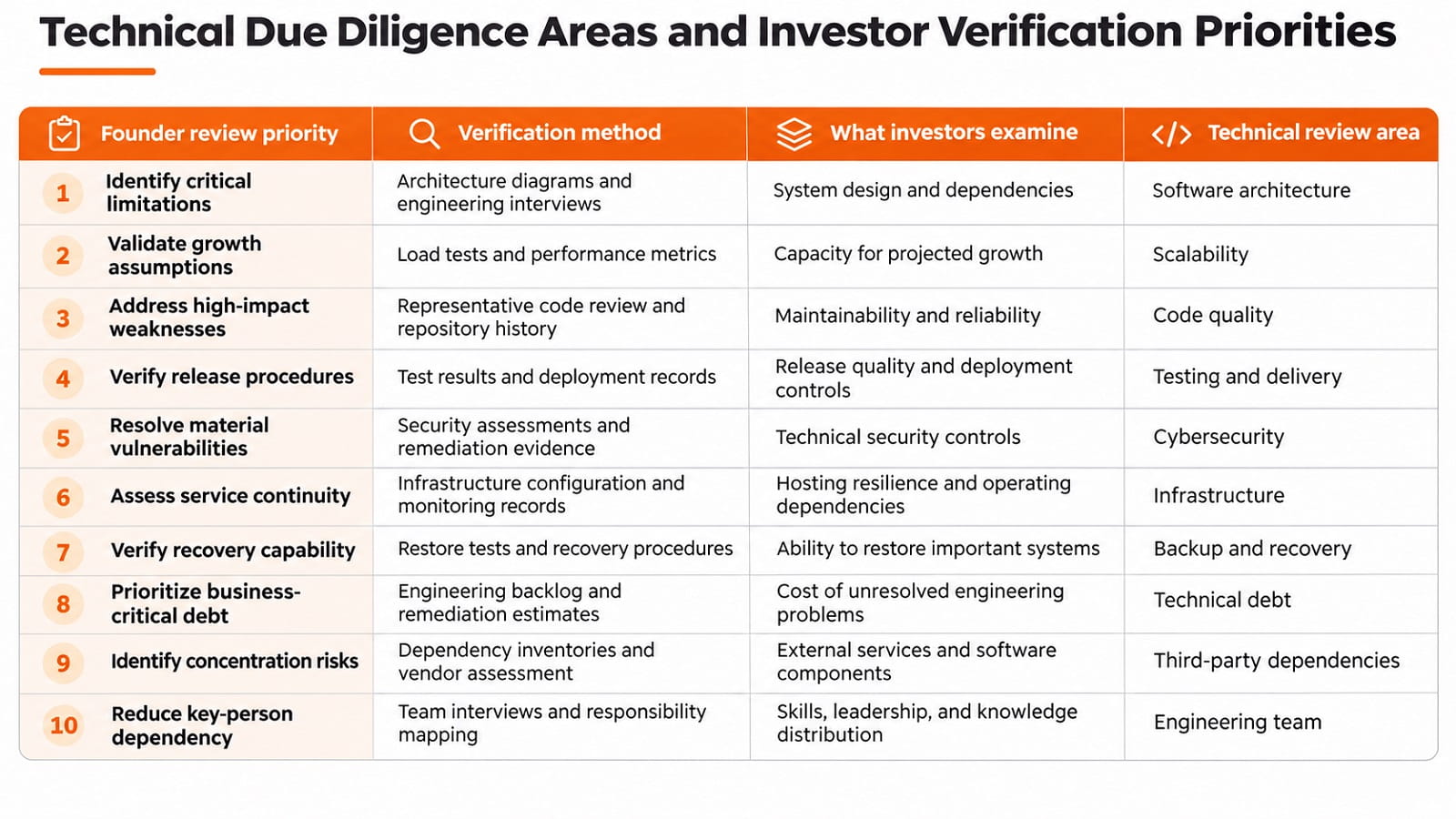
These areas should be assessed together because a weakness in one can amplify problems elsewhere. A scalable architecture provides limited protection when deployment procedures regularly introduce production failures, while strong engineering practices may not compensate for unresolved security vulnerabilities. Investors should evaluate the combined impact of the findings and determine which issues could prevent the company from executing its investment plan.
Evaluating the Product Roadmap and Technical Feasibility
Investors should examine whether the product roadmap is achievable with the available engineering resources and infrastructure. A startup may plan to introduce enterprise integrations, AI capabilities, new geographic deployments, and major product features within the same period. Each initiative can require specialized expertise and create dependencies affecting delivery.
The roadmap should distinguish committed development work from exploratory features. Reviewers may examine engineering estimates, previous delivery performance, technical dependencies, and the time required for testing and deployment.
The review becomes more meaningful when technical milestones are connected to commercial objectives. An infrastructure upgrade may be essential to support larger customers, while a proposed feature may have limited relevance to near-term revenue. Investors need to understand which investments are necessary for growth and which can reasonably be postponed.
AI-enabled startups may require additional investigation into model performance, evaluation methods, data dependencies, monitoring, and ongoing inference costs. Claims about proprietary capabilities should be supported by technical evidence. However, the presence of AI-generated code or third-party models should not automatically be treated as a defect; the relevant concerns are reliability, security, permitted use, and operational sustainability.
A Practical Technical Due Diligence Example
Consider OrbitStack, a fictional B2B software startup seeking $5 million in Series A financing. Its platform supports 80 enterprise customers, and management expects to reach 300 customers within eighteen months. The investor's technical review focuses on whether the system can support that growth without unacceptable outages or substantial unplanned engineering expenditure.
The review identifies several issues. Load testing shows performance deterioration under workloads resembling the expected future customer base. The company has also experienced intermittent deployment failures, and its database recovery process has not been tested recently. In addition, responsibility for an important integration is concentrated in one senior engineer.
These findings do not establish that OrbitStack requires a complete platform rebuild. They indicate that specific engineering improvements should be evaluated and funded before management relies on its original expansion assumptions.
Estimating Technical Remediation Costs
The technical team develops an illustrative remediation plan with six-month delivery estimates. The proposed work includes database performance improvements, automated testing, recovery verification, dependency updates, and internal documentation.
The estimates below represent incremental project costs, assuming existing engineering resources are insufficient to complete the work without additional expenditure. They do not include the company's ordinary operating budget.
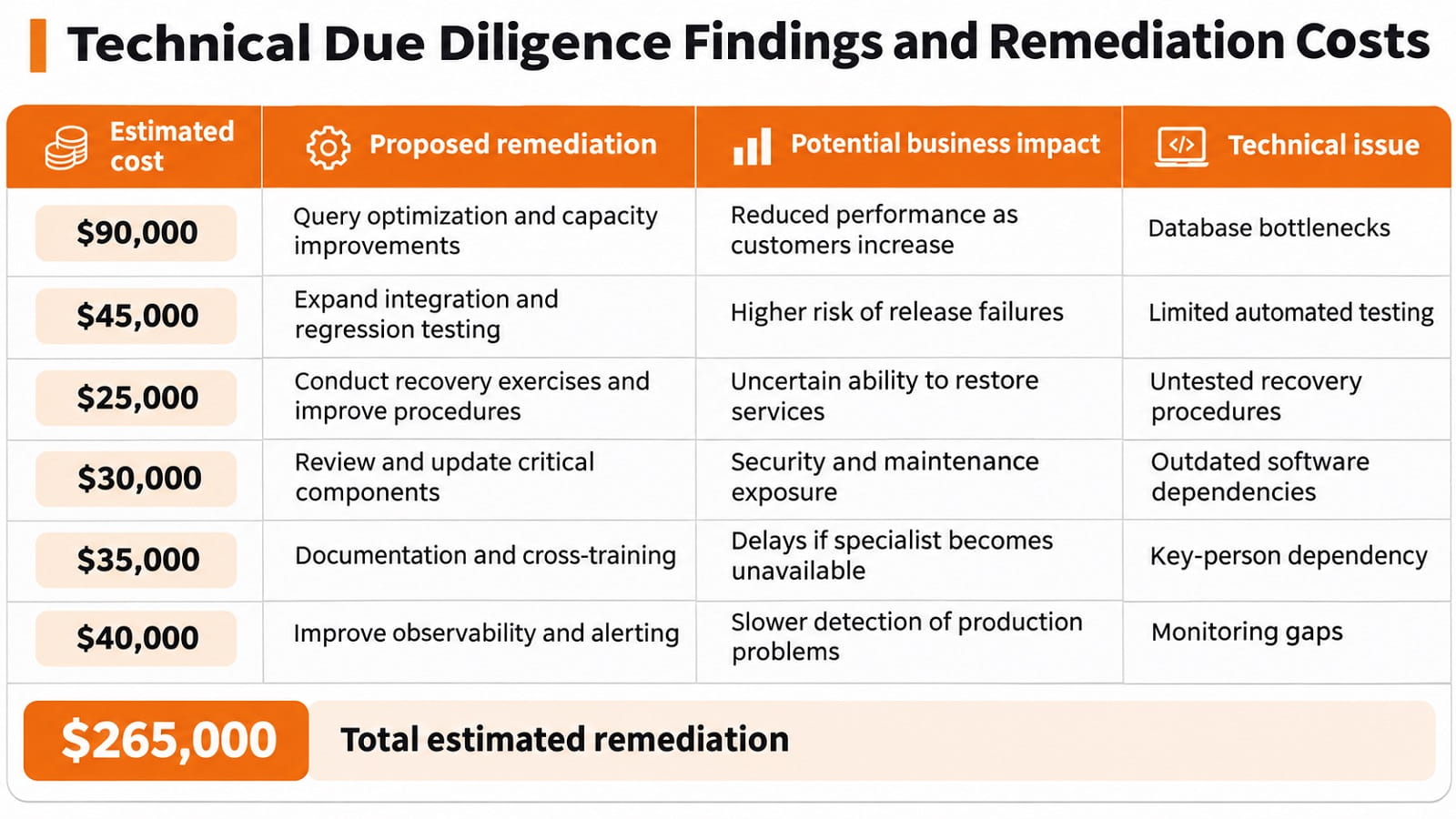
The estimated $265,000 represents approximately 5.3% of OrbitStack's proposed $5 million financing. This calculation does not mean that the technical problems reduce the company's valuation by an equivalent amount. Their actual transaction impact depends on the likelihood of failure, the cost of delays, potential customer consequences, and whether the planned work competes with other engineering priorities. The company should also consider contingency requirements because estimates made before detailed implementation may change.
Interpreting the Investment Implications
OrbitStack's technical review changes the proposed allocation of engineering resources. Rather than treating all financing proceeds as available for new product development and customer expansion, management must reserve funds and engineering capacity for necessary improvements.
The investor may request a revised roadmap demonstrating when the highest-priority remediation activities will be completed. However, the appropriate response depends on the seriousness of the findings. A critical unresolved security vulnerability may require immediate action, while a maintainability improvement could reasonably be scheduled alongside ordinary development.
The example illustrates the difference between documenting a weakness and quantifying its business consequences. Technical diligence becomes more useful when founders can explain how problems affect customer reliability, future expenditure, and the company's ability to deliver its growth strategy.
Technical Risks That Can Influence Investment Decisions
Certain technical findings can materially affect an investment because they challenge assumptions about product reliability, operating costs, or development capacity. Examples include critical security weaknesses, repeated service outages, inadequate recovery arrangements, unsupported software dependencies, and architecture incapable of supporting planned demand.
Reviewers should avoid treating every engineering imperfection as equally important. A missing internal coding guideline may require improvement without affecting the investment thesis. A system that cannot reliably process expected customer workloads may represent a more consequential risk.
The assessment should consider severity, likelihood, business impact, remediation complexity, and management's ability to execute corrective work. Some findings may justify additional investment conditions or a revised operating plan, while others can be accepted as ordinary technology risks associated with a growing business.
Investors may also distinguish between problems that must be resolved before closing and those suitable for post-investment remediation. This decision should depend on the actual risk rather than the desire to produce a completely clean technical report.
Preparing for Technical Due Diligence
Founders can improve technical readiness by maintaining architecture documentation, recording major engineering decisions, monitoring production performance, and documenting known technical risks. These practices make it easier for reviewers to understand the system without requiring unrestricted access to sensitive infrastructure.
The engineering team should be able to explain how the product is deployed, tested, monitored, secured, and recovered after significant incidents. Claims about scalability should be supported by performance evidence where appropriate, while known limitations should be accompanied by realistic remediation plans.
Preparation should also include an internal assessment of technical debt and important third-party dependencies. A documented list of issues, assigned responsibilities, and plausible cost estimates can support a more productive discussion than general assurances that the system is stable.
Finally, founders should coordinate technical disclosure with appropriate confidentiality and security controls. A review may require demonstrations, selected repository access, or specialist interviews, but it should not involve casually sharing production credentials, customer secrets, or unrestricted access to operational systems.
Final Thoughts
Technical due diligence helps investors determine whether a startup's technology can support the business they are considering financing. Architecture, security, infrastructure, engineering practices, and team capabilities each influence the company's ability to maintain its product and execute future development.
For founders, the most important outcome is not a report showing that every engineering decision was ideal. It is a reliable understanding of material technology risks, the resources needed to manage them, and the consequences those risks may have for customers and future growth.
A startup that can support technical claims with evidence, explain existing limitations, and present credible remediation plans is better positioned to discuss its investment requirements. Effective technical evaluation therefore connects engineering realities with financial planning and the long-term development of the business.
FAQ
What Is Technical Due Diligence for Startups?
Technical due diligence evaluates a startup's software architecture, code quality, security, infrastructure, engineering team, and technology risks before an investment or acquisition. It helps investors determine whether the company's technology can support its current operations and future growth plans.
What Do Investors Check During Technical Due Diligence?
Investors may examine architecture, scalability, testing practices, cybersecurity, infrastructure reliability, technical debt, third-party dependencies, and engineering capabilities. The scope depends on the product, business stage, and proposed transaction.
Do Investors Review a Startup's Source Code?
Source code review may be included when relevant to the investment. Reviewers often examine representative components, development history, and engineering practices rather than every line of code. Access should be controlled to protect proprietary information and operational security.
Is Technical Due Diligence the Same as a Security Audit?
No. A security audit focuses on cybersecurity controls and related risks, while technical due diligence examines the broader technology supporting the company. Security findings contribute to the overall assessment but do not replace architecture, scalability, and engineering evaluation.
What Is Technical Debt in Due Diligence?
Technical debt refers to engineering compromises or limitations that may increase the cost of maintaining, securing, or developing a system. Investors evaluate its business impact and whether the company has a credible plan for addressing material issues.
Can Technical Due Diligence Affect Startup Valuation?
Yes. Significant engineering risks may influence valuation discussions, operating budgets, investment conditions, or financing decisions. The effect depends on remediation costs, potential disruption, and whether technical weaknesses challenge the company's growth assumptions.
How Long Does Technical Due Diligence Take?
The duration varies with system complexity, review scope, available documentation, and the nature of the transaction. A limited early-stage assessment may be relatively straightforward, while complex software acquisitions may require extensive technical testing and specialist evaluation.
How Can a Startup Prepare for Technical Due Diligence?
Founders can prepare by maintaining current architecture documentation, reliable development records, security assessments, incident histories, and a prioritized technical debt backlog. Engineering leaders should also be able to explain operational dependencies and provide evidence supporting important technical claims.

Mobina Khanki
Venture & Funding Writer at PinerookMobina Khanki covers venture capital, startup funding, fundraising, and startup finance for Pinerook, focusing on founders and investors.
 Seen first.