
Intellectual Property Due Diligence is the process of examining a startup's patents, trademarks, copyrights, trade secrets, software rights, and intellectual property agreements before an investment or acquisition. Investors use this assessment to establish whether the company owns or has sufficient legal rights to use the intangible assets supporting its business. A startup may have developed valuable technology, attracted customers, and established a recognizable brand while still facing unresolved ownership questions or contractual restrictions that could affect its ability to commercialize those assets.
Within Startup Due Diligence, intellectual property evaluation connects the company's commercial value with the legal rights that make its products and competitive advantages possible. A software platform may generate recurring revenue, but its investment value can be affected if a former contractor owns essential components or if a critical technology license cannot continue under the proposed transaction. Investors must therefore distinguish assets owned by the company from those used under limited permissions, while assessing whether existing rights provide adequate protection in relevant markets.
This guide explains how intellectual property due diligence works, which assets investors examine, and how founders can verify ownership and licensing arrangements. It covers patents, trademarks, copyrights, confidential information, software dependencies, and potential infringement risks. A practical startup scenario demonstrates how incomplete assignments and restrictive licenses can influence transaction readiness and the actions needed to resolve material concerns.
What Is Intellectual Property Due Diligence?
Intellectual property due diligence is a transaction focused investigation into the ownership, validity, scope, and permitted use of intellectual assets associated with a company. Its purpose is to establish whether the business controls the rights required to operate, develop its products, enter important markets, and complete the proposed transaction.
The investigation goes beyond counting patents or confirming that a trademark registration exists. Investors examine the relationship between the assets and the company's actual activities. A patent may cover technology that no longer contributes materially to the product, while unregistered software or confidential manufacturing knowledge may represent the foundation of the company's competitive advantage.
The scope depends on the business and its financing stage. A young software company may require detailed examination of founder contributions, contractor assignments, software licenses, and proprietary code. A biotechnology company may face closer scrutiny of patent claims, research collaborations, licensing arrangements, and restrictions affecting commercialization. A consumer brand may depend more heavily on trademarks, product designs, and control over distinctive commercial materials.
A useful review establishes what the startup owns, what it licenses, which rights may be disputed, and whether any restrictions could prevent the company from executing its business plan.
Identifying the Intellectual Property That Supports the Business
The first step is to identify the intellectual assets that matter to the startup's products, revenue, and future development. An effective inventory distinguishes registered rights, unregistered rights, licensed materials, and proprietary knowledge. It also identifies which company products depend on each asset.
For a software startup, the inventory may include source code, applications, proprietary algorithms, interface designs, technical documentation, software licenses, and certain datasets. A hardware business may rely on patents, industrial designs, embedded software, manufacturing information, and supplier arrangements.
Founders should not assume that every intangible asset receives the same legal protection. A registered patent provides rights defined by its claims and applicable territorial law, while copyright protects qualifying original expression rather than abstract ideas. Trade secret protection depends on the nature of the information and the legal requirements for maintaining its secrecy.
The central question is whether the startup possesses the rights necessary for the commercial activities represented to investors. An asset register becomes more useful when it connects each important asset to its creator, current owner, applicable agreements, registration status, and role in the business.
Verifying Intellectual Property Ownership and Chain of Title
Ownership is one of the most consequential areas of intellectual property review because a startup cannot safely assume that paying for development automatically gives it every relevant legal right. Rules differ by jurisdiction and asset category, particularly for employee inventions, commissioned software, and collaborative research.
The chain of title describes how rights passed from their original creator or owner to the company that currently claims them. Investors examine supporting agreements and records to determine whether each necessary transfer was legally effective.
Founder and Employee Contributions
Many startups begin developing technology before formal incorporation. Founders may create software, designs, research materials, or inventions personally and later use them in the business. The review should establish whether these assets were transferred to the company under valid arrangements.
Employment contracts can also affect ownership, but the legal consequences depend on applicable law and the nature of the work. Investors may examine intellectual property provisions, invention disclosures, and relevant assignment agreements to determine whether the company has obtained the necessary rights.
A document that merely expresses an intention to transfer rights may have different legal consequences from an effective present assignment. For material assets, qualified counsel should assess the relevant wording and applicable law.
Contractors and External Developers
External contractors present a frequent ownership concern because commercial payment and intellectual property ownership are not necessarily equivalent.
For example, a startup may engage an agency to develop its initial software platform. If the contract does not adequately address ownership or licensing, the company may face uncertainty about whether it can modify, distribute, sublicense, or transfer that software.
Investors should examine executed agreements, project specifications, the identity of contributors, and any restrictions affecting delivered materials. Where important rights are unclear, the company may need additional documentation or other lawful corrective measures.
University and Research Collaborations
University research arrangements and joint development projects can involve additional ownership complexity. A founder may have developed an invention while participating in an academic program or using institutional resources. Applicable policies, research agreements, funding conditions, and local laws may affect who holds the resulting rights.
Investors should verify whether the startup owns the technology or operates under a license. If a license is necessary, its duration, field of use, exclusivity, and termination conditions may influence the business's future flexibility.
Reviewing Patents and Patent Applications
Patents can provide commercially important protection for qualifying inventions, but their existence does not guarantee broad market exclusivity or freedom to commercialize a product. Investors therefore examine the status, ownership, territorial coverage, and actual claims associated with material patents.
A startup may have filed several patent applications without receiving granted protection. Pending applications can be relevant, but investors should distinguish applications from enforceable granted patent rights. They may also examine deadlines, maintenance obligations, and whether protection has been sought in countries important to the business.
Patent Coverage and Commercial Relevance
The commercial significance of a patent depends partly on whether its claims cover technology that matters to the company's products or competitive position.
A patent portfolio can appear substantial while offering limited protection against alternative solutions. Conversely, a focused patent protecting a commercially important feature may be highly relevant to the startup's investment proposition.
Investors may request specialist assessments of claim scope, prior art, potential validity concerns, and the relationship between patent protection and product development. These investigations require technical and legal expertise and should not be replaced by simply reviewing patent titles.
Trademarks, Copyrights, and Trade Secrets
Not every startup depends primarily on patent protection. Software products, digital platforms, consumer brands, and service companies may derive considerable value from trademarks, copyrights, proprietary information, and commercially valuable knowhow.
Trademark Rights and Brand Protection
Trademark review establishes whether the company has rights to use and protect names, logos, and other relevant brand identifiers in its important markets.
Investors may examine registration status, ownership, geographic coverage, renewal obligations, and potential conflicts with existing marks. They should also consider whether a brand name used successfully in one country can be adopted in the company's planned expansion markets.
Domain name ownership can be commercially relevant, but registration of a domain does not by itself establish trademark rights. The review should therefore distinguish control over an internet address from legal rights to a brand.
Copyright and Software Ownership
Copyright can protect qualifying software code, designs, written materials, and other original creative works. However, the precise rights and default ownership rules vary by jurisdiction.
For technology companies, investors often need to establish which software components were created internally and which were obtained from third parties. Repository access and development history may help identify contributors, but they do not independently prove legal ownership.
The company should be able to connect important components to appropriate employment agreements, contractor contracts, assignments, or licenses.
Trade Secret Protection
Trade secrets may include confidential processes, algorithms, formulas, technical methods, or commercially valuable information that derives value from remaining secret.
Unlike patents, trade secret protection does not depend on obtaining a patent grant. However, applicable laws generally require the information to satisfy specific confidentiality and protection conditions.
Investors may assess confidentiality arrangements, access restrictions, information handling practices, and the extent to which important knowledge has been disclosed. Where proprietary information has been made public without appropriate safeguards, the company may face difficulties asserting trade secret protection.
Software Licensing and Third Party Intellectual Property
Many startups build products using external software libraries, commercial APIs, development frameworks, and licensed datasets. These dependencies can support efficient development, but they also introduce rights and obligations that must be understood before investors rely on the company's technology.
Open source software is not inherently incompatible with proprietary products. However, individual licenses impose different conditions concerning attribution, distribution, modification, source code availability, and patent rights. The consequences depend on the license terms and how the relevant component is used.
Investors may request a software bill of materials, commonly called an SBOM, to identify external components and applicable licenses. Legal and engineering specialists can then assess whether the company satisfies relevant obligations and whether its planned distribution model creates additional requirements.
Commercial licenses deserve similar attention. A business may depend on a technology license that limits geographic use, prohibits sublicensing, or contains termination provisions relevant to an acquisition. Such restrictions can materially affect future expansion even when the product operates successfully.
Intellectual Property Due Diligence Review Framework
A useful intellectual property assessment connects each asset category with evidence of ownership, protection, and permitted use. Investors should prioritize rights that directly support material products or business revenue rather than reviewing every asset with equal intensity.
The following table summarizes the principal areas of investigation and the matters founders should verify.
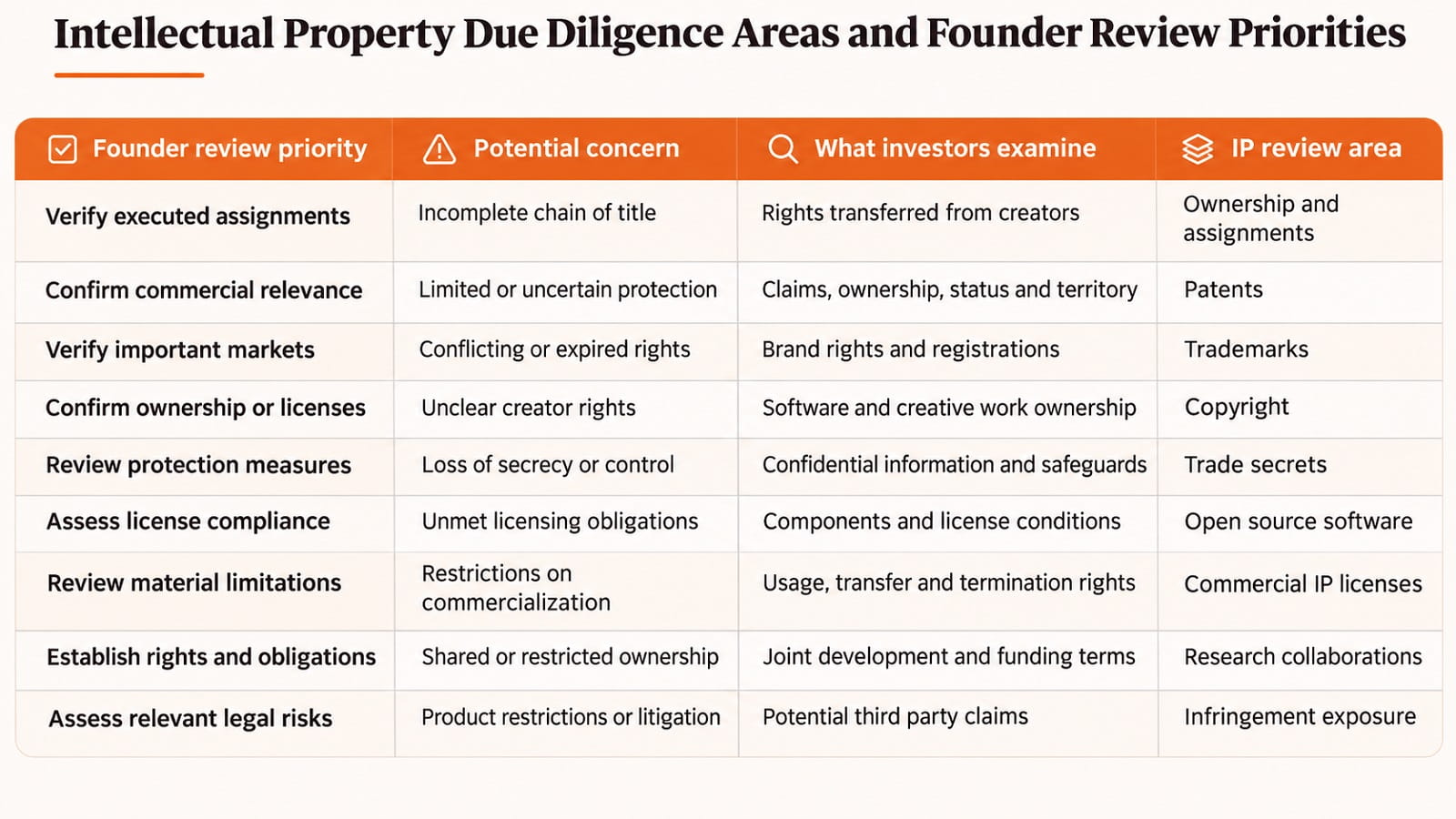
These areas often interact. A software product may include company owned code, licensed libraries, and confidential algorithms, each governed by different rights. A valid patent does not resolve ownership of the underlying software, while an assignment agreement does not establish that the product avoids infringing third party patents. Investors should assess the combined effect of these rights on the startup's ability to operate and expand.
Freedom to Operate and Infringement Risks
Freedom to operate refers to whether a business can undertake particular commercial activities without infringing enforceable rights held by others. It is different from owning a patent or other intellectual asset.
For example, a startup may hold a patent covering an improvement to an existing technology while still requiring permission to use an earlier patented invention. Patent ownership therefore does not automatically establish freedom to manufacture or sell a product.
A relevant assessment may examine patents in intended markets, product functionality, third party licenses, and existing disputes. The scope depends on the technology, jurisdictions, and commercial activities under consideration.
Founders should also disclose material infringement allegations, settlement arrangements, and restrictions affecting important assets. The absence of litigation does not guarantee the absence of infringement risk, but identified claims should be evaluated according to their merits and potential consequences.
A Practical Intellectual Property Due Diligence Example
Consider NovaSense, a fictional startup developing software that analyzes industrial sensor data. The company is seeking $6 million in Series A financing and describes its proprietary analytics engine as an important competitive advantage.
During investor review, advisers identify four issues. An early contractor agreement does not clearly transfer rights to a core software component. One patent application lists the founder as the applicant, while the startup's ownership records lack supporting transfer documentation. An external software component requires further license analysis, and a licensed dataset contains restrictions relevant to planned commercial expansion.
These findings do not automatically establish that NovaSense cannot use its technology. They create questions about the precise rights available to the company and whether additional permissions or corrective actions are necessary.
The following table illustrates how the company could prioritize its response.
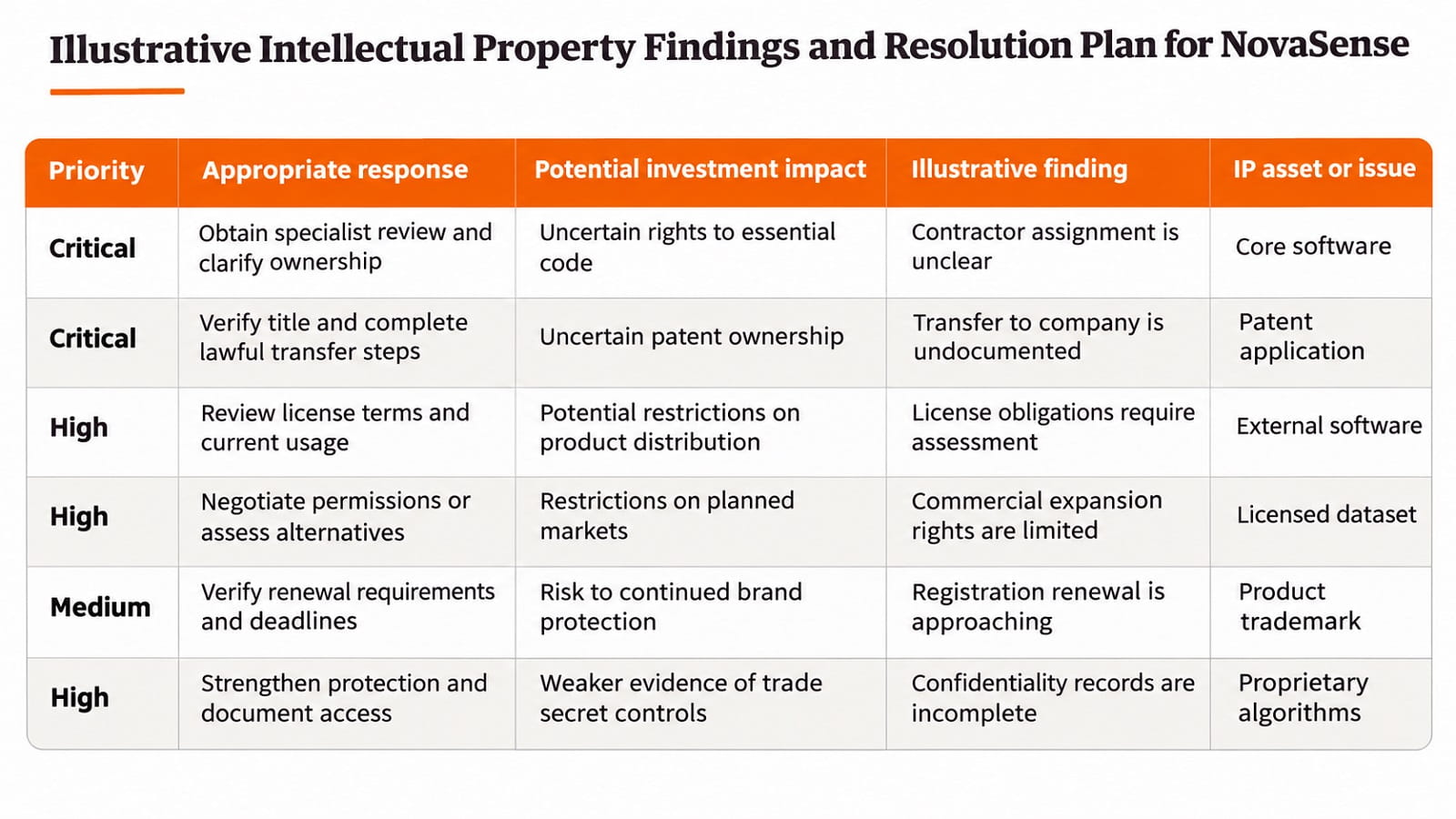
The example demonstrates why intellectual property findings must be evaluated according to their commercial consequences. The missing contractor assignment could directly affect rights to the company's core product, while the trademark renewal may represent a more routine administrative matter if addressed promptly. The dataset restriction might require a commercial negotiation or changes to the expansion plan. Investors should establish which issues can be corrected before closing and which create continuing uncertainty.
How IP Findings Affect Investment Terms
Material intellectual property defects can influence valuation, financing conditions, warranties, and transaction structure. Investors may require evidence of completed assignments, additional licenses, or resolution of significant disputes before closing.
In an acquisition, transfer restrictions and ownership uncertainty may also affect the assets the buyer can obtain. A license that cannot be transferred without consent could have substantial consequences if the acquired business depends on that technology.
Not every weakness requires the same response. The appropriate treatment depends on legal enforceability, business importance, available remedies, and the willingness of relevant parties to cooperate.
Preparing Intellectual Property Records Before Fundraising
Founders can improve investment readiness by maintaining an inventory linking important assets to their creators, owners, agreements, registrations, and business uses. This inventory should be updated when the company engages developers, acquires licenses, files applications, or enters research collaborations.
Legal and technical teams should work together to identify material software dependencies and confirm that relevant rights are documented. Ownership questions should be investigated before investors begin detailed review, particularly where founders or contractors created valuable technology before incorporation.
Confidential materials should be shared through appropriately controlled channels. Providing evidence of ownership does not always require disclosing unrestricted source code, sensitive datasets, or commercially valuable secrets.
The objective is to make the company's intellectual property position understandable, supportable, and consistent with its business strategy.
Final Thoughts
Intellectual property due diligence helps investors establish whether a startup controls the intangible assets that support its products, competitive position, and future growth. Effective assessment considers not only registered rights but also software ownership, trade secrets, licensing arrangements, and potential restrictions on commercialization.
For founders, reliable ownership records and clear licensing arrangements are essential. A valuable product can create considerable business opportunity, but uncertainty over the rights supporting that product may introduce risks that investors cannot ignore.
Preparing intellectual property information before fundraising allows companies to identify missing assignments, assess important dependencies, and address material restrictions. This preparation supports more informed investment decisions and strengthens the startup's ability to develop and commercialize its technology.
FAQ
What Is Intellectual Property Due Diligence?
It is the investigation of intellectual assets, ownership rights, licenses, protection status, and potential infringement risks before an investment or acquisition.
What Intellectual Property Do Startup Investors Examine?
Investors may review patents, trademarks, copyrights, software, trade secrets, licensed technology, proprietary datasets, and contractual rights associated with important products.
Does a Startup Need Patents to Attract Investment?
Not necessarily. Some businesses rely primarily on software copyrights, trade secrets, brand rights, or other commercial advantages. The importance of patents depends on the business model and technology.
Who Owns Software Developed by a Contractor?
Ownership depends on applicable law and contractual arrangements. Paying a contractor does not universally establish ownership of all intellectual property created during the engagement.
Can Open Source Software Create Due Diligence Problems?
Yes, when relevant license obligations are misunderstood or unmet. Open source components are not inherently problematic, but their conditions must be assessed in relation to actual use and distribution.
What Is a Chain of Title in Intellectual Property?
It is the documented sequence through which ownership rights pass from the original creator or owner to the party currently claiming those rights.
What Is the Difference Between Patent Ownership and Freedom to Operate?
Patent ownership establishes rights associated with a particular invention. Freedom to operate concerns whether commercial activities may infringe enforceable third party rights.
Can Intellectual Property Issues Delay Startup Funding?
Yes. Missing assignments, disputed ownership, restrictive licenses, or material infringement concerns may require corrective action before investors complete a transaction.

Mobina Khanki
Venture & Funding Writer at PinerookMobina Khanki covers venture capital, startup funding, fundraising, and startup finance for Pinerook, focusing on founders and investors.
 Seen first.