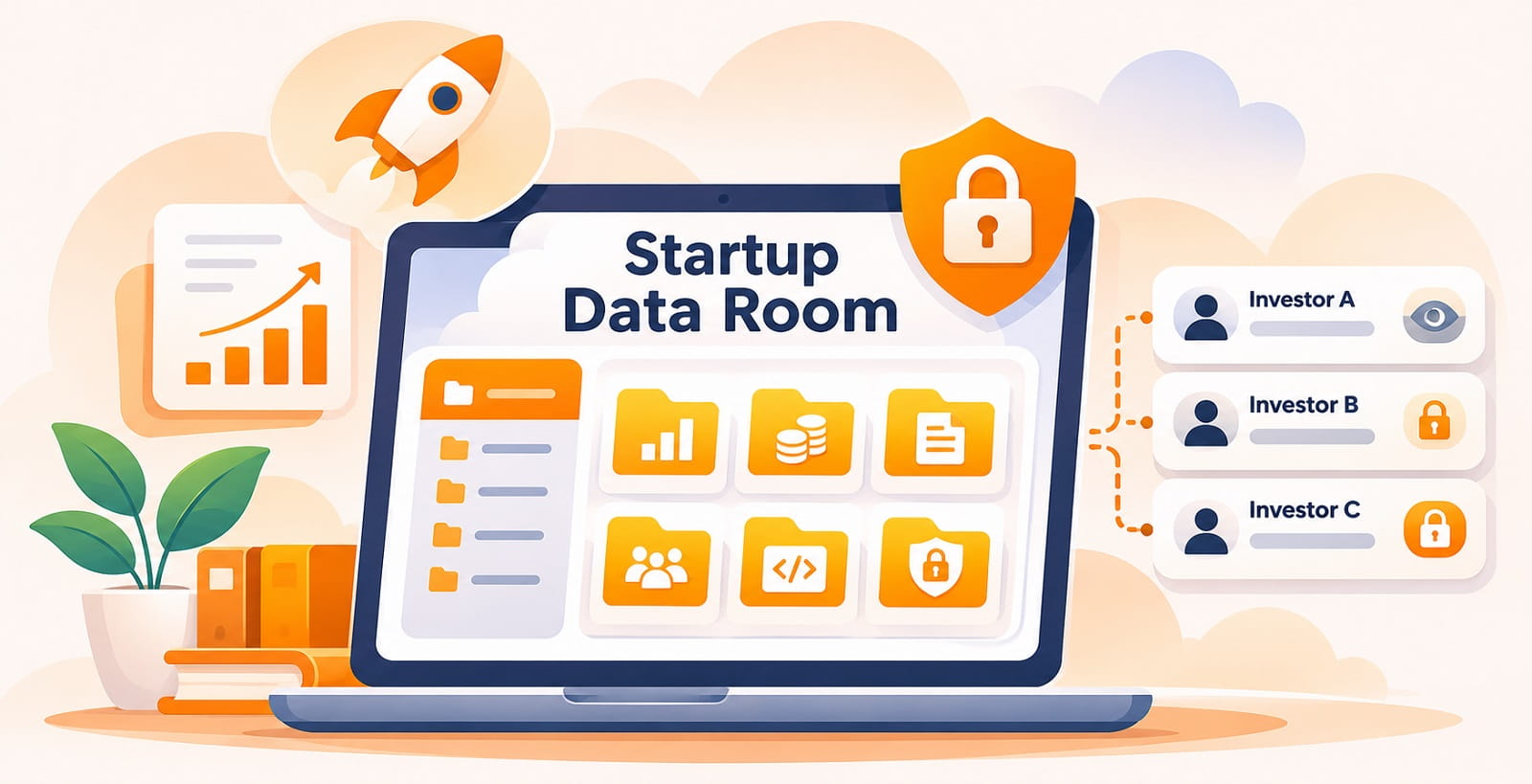
A startup data room is a secure, organized digital workspace where founders share financial, legal, commercial, and operational information with potential investors during fundraising. Rather than sending sensitive documents through scattered email attachments, startups can use a controlled repository to provide reviewers with the information needed to evaluate an investment opportunity. A well-structured data room helps investors locate relevant evidence, reduces repeated document requests, and allows founders to maintain greater control over confidential business information.
Within Startup Due Diligence, the data room serves as the operational link between the company's internal records and the documents investors need to review. Its effectiveness depends not only on the files it contains but also on how information is organized, verified, updated, and shared. Founders must decide which materials should be accessible during early discussions, which require more restricted disclosure, and how document changes will be communicated without creating inconsistent versions of important records.
This guide explains how to establish an investor-ready startup data room, organize folders, apply access controls, and manage requests throughout a financing round. It also examines practical security measures, document versioning, investor communication, and common mistakes that can complicate fundraising. A fictional investment scenario demonstrates how a startup can provide different levels of access to multiple prospective investors without exposing unnecessary confidential information.
What Is a Startup Data Room?
A startup data room is a centralized digital environment used to store and share documents relevant to investment evaluation, financing, or corporate transactions. Its primary purpose is to make important company information available to authorized reviewers in a controlled and understandable format.
The data room typically contains materials that support management's statements about the business, including corporate records, financial information, capitalization data, major contracts, product documentation, and relevant compliance information. However, a useful data room is not simply a collection of every document created since incorporation. It should present an organized set of current, relevant records that investors can review efficiently.
Modern virtual data rooms can provide features such as individual invitations, document-level permissions, access history, watermarks, and restrictions on downloading. The availability of these features depends on the service selected and its subscription level. Some early-stage companies may find that a carefully configured cloud document platform provides sufficient functionality, while larger transactions can require more specialized controls.
The fundamental objective is to give authorized investors reliable access to the evidence they need while preserving the company's ability to manage confidential information and maintain accurate records.
When Should Founders Create a Data Room?
Founders should begin preparing their data room before serious investor verification begins, ideally while organizing the materials for a planned fundraising round. Establishing the structure early makes it easier to identify missing files, resolve inconsistent information, and decide who within the company is responsible for keeping documents current.
The amount of preparation should reflect the company's financing stage. An early startup raising its first external capital may initially need only a concise collection of corporate, ownership, financial, and product information. A company preparing for Series A funding may require more detailed operating metrics, historical financial records, commercial agreements, and technical documentation. A later-stage financing or acquisition may demand considerably broader disclosure.
Preparing early does not mean distributing every document to investors from the beginning. Founders can maintain a complete internal repository while releasing selected information as investment discussions progress. This separation allows the company to remain prepared without providing unnecessary access to commercially sensitive or personal information.
The most effective approach treats the data room as a maintained business resource. Significant corporate actions, new financing agreements, financial reporting periods, and material contracts should trigger appropriate updates rather than leaving the company to reconstruct its records immediately before a transaction.
How to Structure a Startup Data Room
A clear folder hierarchy is essential because investors should be able to identify important records without searching through unrelated files. The structure should follow recognizable business categories and use consistent naming conventions across departments.
Founders should avoid creating numerous overlapping folders for documents that belong to the same subject. A capitalization table, for example, should have a clearly designated location rather than several competing copies under finance, legal, and investor materials. Where one document is relevant to multiple categories, a central index can direct reviewers to the authoritative version.
Organizing Investor Documents by Category
A practical structure begins with a company overview and separates ownership, financial, commercial, legal, and technical materials. Each folder should contain the records relevant to its stated purpose, with additional subfolders introduced only when they improve navigation.
The following table presents an illustrative structure that can be adapted to the startup's development stage, financing requirements, and confidentiality obligations.
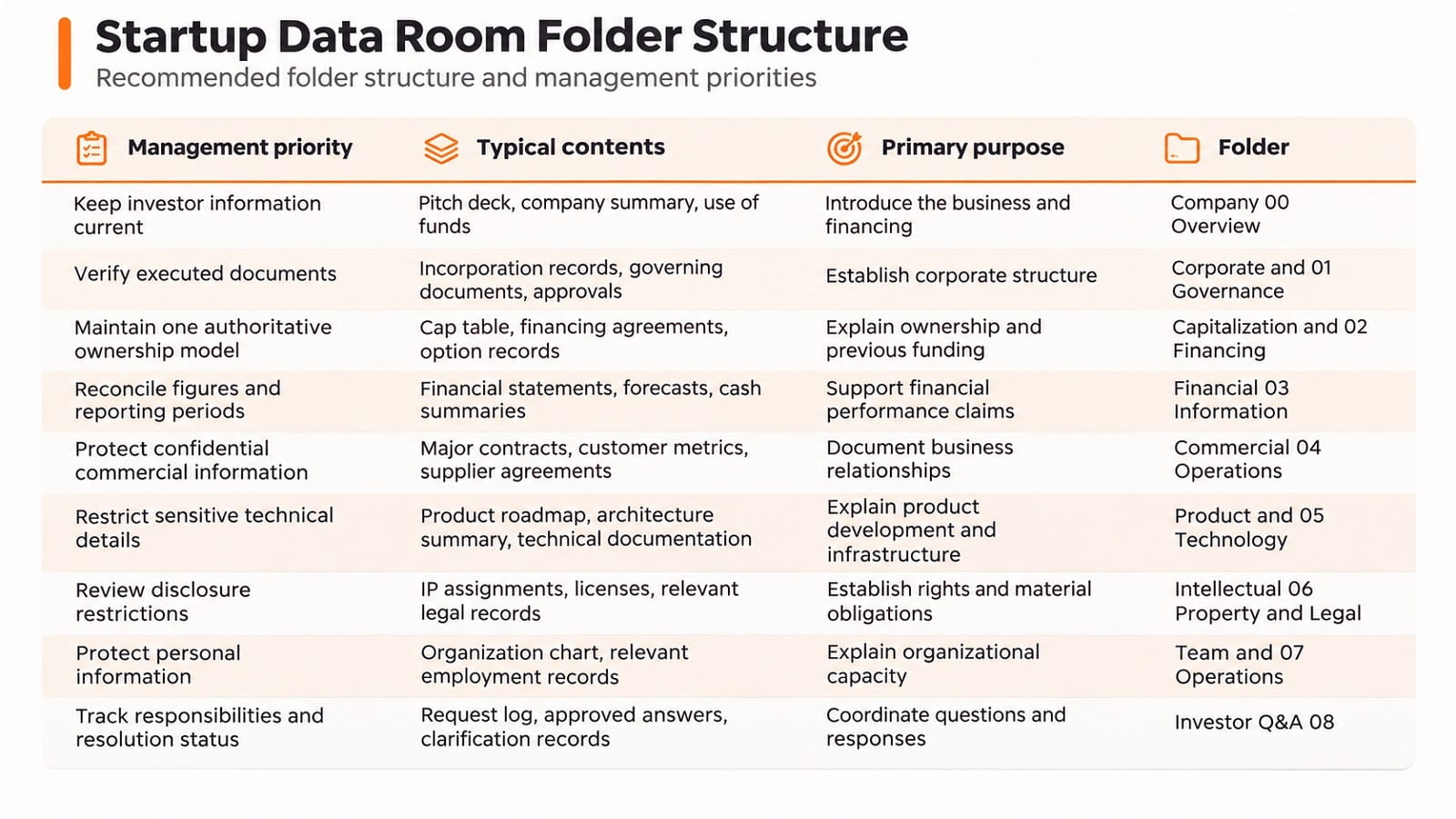
This structure gives reviewers a predictable path through the company's information without requiring founders to expose every file at once. The numbered folders create a consistent order, while the management priorities clarify how each section should be maintained. A startup with limited operating history may need fewer categories, while a larger business may benefit from additional folders covering regulatory matters or transaction closing documents. The structure should remain easy to navigate as the volume of information increases.
Creating a Master Document Index
A master index helps investors understand what information is available and where it can be found. It can identify the document title, folder, reporting period, current version, and any relevant access restrictions. The index is particularly useful when several reviewers request overlapping materials or when the company updates financial information during an active financing process.
Founders should also designate an internal owner for each category. Finance can be responsible for financial statements and forecasts, while legal advisers or authorized company personnel may oversee corporate records and contractual documents. Clear ownership prevents contradictory versions from being circulated and establishes who must approve a document before it becomes available to external reviewers.
Managing Investor Access and Confidentiality
Not every prospective investor needs the same information at the same stage of fundraising. During initial discussions, investors generally need enough information to understand the business model, market opportunity, financial position, and proposed investment. Detailed customer contracts, employee records, proprietary technology, and sensitive legal documents may be unnecessary until a more advanced review.
Founders should therefore organize access according to the stage of the relationship and the legitimate purpose of the request. An investor who has expressed preliminary interest might receive a company overview and selected financial summaries, while an investor conducting detailed diligence may require access to additional supporting records. Outside advisers should receive access consistent with their authorized role rather than automatically inheriting every permission granted to the investment firm.
Using Staged Access
A staged approach divides disclosure into manageable levels. Initial access can cover information suitable for early investment evaluation, while later access can provide more detailed financial, corporate, and commercial evidence. Highly sensitive materials can remain in restricted folders until a specific review need has been established.
This approach reduces unnecessary exposure while allowing serious investors to obtain the information needed for their decisions. However, staged access should not be used to conceal material facts or create misleading disclosures. Founders must satisfy applicable legal obligations and ensure that information provided at each stage accurately represents the business.
Protecting Sensitive Documents
Confidentiality controls may include named-user invitations, multifactor authentication, permission groups, access expiration, document watermarks, and restrictions on downloading. These mechanisms can reduce certain risks associated with unauthorized sharing, although they cannot guarantee that every disclosed piece of information remains confidential.
Founders should pay particular attention to documents containing personal information, customer-level data, privileged legal advice, credentials, or proprietary source code. Some information should be redacted, summarized, reviewed by counsel, or withheld from general access where appropriate. Passwords, API keys, and other operational secrets should not be placed in an ordinary investor data room.
Confidentiality agreements may also be relevant, particularly when a reviewer needs commercially sensitive information. Whether an agreement is appropriate depends on the relationship, the nature of the requested materials, and the transaction. A signed confidentiality agreement should complement reasonable security controls rather than replace them.
Document Version Control and Updating Procedures
A data room can become misleading when different folders contain conflicting versions of the same information. An investor reviewing an older financial model might reach a different conclusion from another reviewer using revised forecasts, while an outdated capitalization table could produce incorrect estimates of ownership dilution.
A reliable update procedure should identify the approved version of each document and distinguish it from historical material. Filenames can include descriptive titles, reporting dates, and version identifiers, but the naming system should remain understandable to people outside the company. Internal drafts and superseded documents should be separated from the materials designated for external review.
When an important file changes, management should assess whether existing investors need to be notified. Material updates to financial performance, capitalization, or contractual obligations may affect earlier conclusions and should not be silently substituted without appropriate communication.
Maintaining a record of changes also helps the company establish what information was available at particular stages of the transaction. Some data room platforms provide access histories and document activity logs, while simpler systems may require an additional internal record.
Handling Investor Questions and Document Requests
Investor questions are a normal part of fundraising and often become more detailed as discussions progress. Reviewers may ask for an explanation of an accounting figure, supporting evidence for a commercial metric, or clarification of a contractual provision. Without a coordinated process, these requests can be answered inconsistently or passed between team members without clear ownership.
A central question-and-answer log allows the company to record each request, assign a responsible person, and identify the status of the response. Questions requiring specialist judgment should be directed to the appropriate finance, legal, commercial, or engineering personnel. Responses should be reviewed before external disclosure when they contain material financial claims, legal interpretations, or sensitive business information.
A useful request log should also distinguish between a question that has been answered and a matter that has actually been resolved. Providing an explanation of a missing document does not establish that the missing agreement has been executed or that an outstanding obligation has been satisfied.
Investor communications should be accurate and consistent, but founders should also maintain appropriate boundaries between separate investment discussions. Information about another prospective investor's confidential negotiations should not automatically be shared merely because several parties are using the same document repository.
Practical Data Room Access Scenario
Consider Northstar Software, a fictional subscription technology company preparing to raise $4 million in a Series A financing. The company has established an internal document repository containing financial records, customer contracts, corporate agreements, and detailed technical information.
Three potential investors are involved at different stages. Investor A has completed introductory meetings and wants to review the company's commercial proposition. Investor B is conducting a more detailed financial and operational assessment, while Investor C has progressed to reviewing a proposed transaction and requires additional legal documentation.
Northstar's management decides to use named-user access and permission groups rather than providing every investor with the same unrestricted link. The finance director oversees financial disclosures, legal counsel reviews sensitive contractual materials, and an authorized internal administrator manages access changes.
The following table illustrates how Northstar could allocate document access based on the legitimate requirements of each review stage.
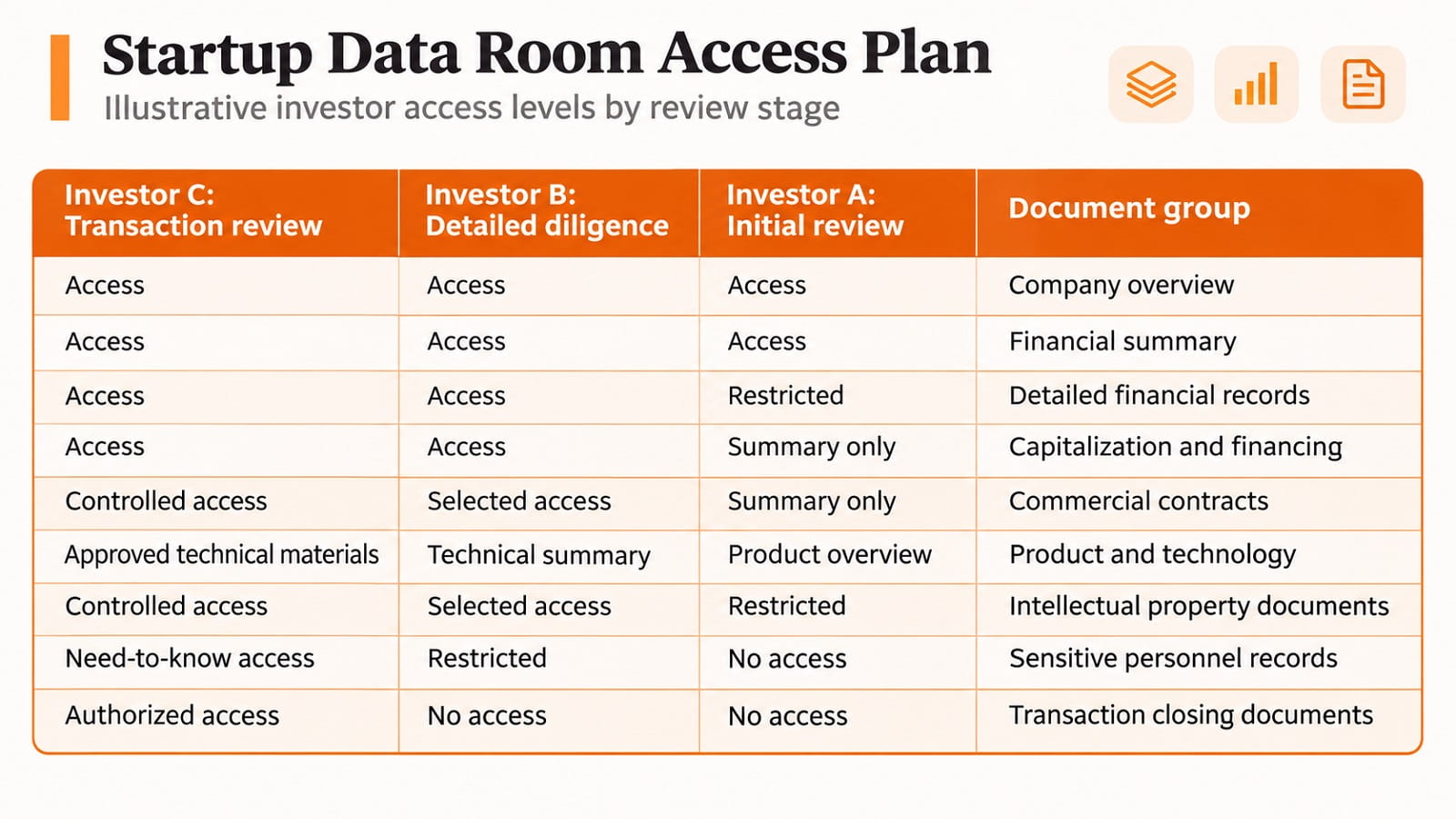
This example demonstrates how staged permissions can support investor review without unnecessarily distributing confidential company records. Investor A receives sufficient information for preliminary evaluation, while Investors B and C obtain progressively more detailed materials according to their review responsibilities. The access levels are illustrative rather than legal requirements, and actual disclosure decisions should reflect the transaction, applicable confidentiality obligations, and the sensitivity of each document. Northstar should also verify that each invited reviewer can access only the materials approved for their role.
Updating Access as Negotiations Progress
Access permissions should change when the relationship with an investor changes. If Investor A advances to detailed diligence, the administrator can expand access after appropriate approval. Conversely, if discussions with Investor B end, the company should review whether continued access is justified and revoke permissions where appropriate.
The company should record significant permission changes and confirm that external advisers do not retain access indefinitely after their work is complete. Revoking platform access can prevent further retrieval from the room, but it cannot guarantee deletion of documents that were previously downloaded or copied.
A defined access review procedure helps founders avoid relying on informal assumptions about who can see confidential information.
Choosing the Right Data Room Software
A startup does not necessarily need an expensive enterprise data room platform to conduct an early financing round. The appropriate solution depends on the number of reviewers, document sensitivity, budget, and required controls. A small financing involving a few investors may be manageable through a carefully configured cloud document service, provided that its security and permission capabilities satisfy the company's needs.
Dedicated virtual data room platforms may offer more granular access rules, document analytics, watermarking, request tracking, and detailed activity histories. These features can be useful when multiple investment firms and professional advisers are reviewing the company simultaneously. However, advanced functionality adds little value if the company lacks reliable underlying documents or clear internal procedures.
Founders should evaluate software based on how easily administrators can manage users, restrict sensitive files, update documents, and understand external access. Export options, pricing structures, data retention policies, and the ability to close the room securely should also influence the decision.
The best platform is one the company can operate consistently throughout the transaction without introducing unnecessary expense or administrative complexity.
Common Startup Data Room Mistakes
One frequent mistake is treating the data room as a one-time upload. Financial records, ownership information, and commercial agreements can change during a financing process, making previously accurate documents outdated. Without clear update responsibilities, investors may rely on information that no longer reflects the company's current position.
Another problem is granting excessive access before understanding the reviewer's needs. Providing unrestricted access to customer contracts, employee information, or sensitive technical documents can create avoidable confidentiality risks. Permission settings should be tested before invitations are distributed, particularly when folders inherit permissions from a broader workspace.
Founders may also overlook document consistency. A revenue figure shown in an investment presentation should be reconcilable with the corresponding financial information, and a capitalization summary should reflect the relevant executed financing documents. Discrepancies require investigation rather than cosmetic changes to make files appear consistent.
Finally, complicated folder structures can make a technically complete repository difficult to use. Excessive nesting, duplicate files, ambiguous filenames, and missing document owners create unnecessary confusion. The goal is to help authorized reviewers locate reliable evidence efficiently, not to demonstrate how many records the company can upload.
Maintaining the Data Room After Fundraising
Following the completion of a financing round, founders should review the information retained in the data room and determine which external permissions should remain active. Transaction-specific access may no longer be necessary, and sensitive documents should not remain available indefinitely without a legitimate purpose.
A record of the completed financing, executed agreements, and relevant approvals should be preserved according to the company's legal and operational requirements. The internal repository can then be updated to reflect the new capitalization structure and other material corporate changes.
This process makes preparation for future fundraising more efficient. Rather than rebuilding the repository from the beginning, the company can update existing records, revise access arrangements, and adapt the structure to the next investment stage.
A maintained data room can therefore become part of the company's broader information governance practices, supporting accurate recordkeeping and controlled disclosure beyond the immediate transaction.
Final Thoughts
A well-managed startup data room helps founders provide reliable information to investors without sacrificing control over confidential company records. Its effectiveness depends on a clear folder structure, accurate documents, appropriate permissions, and consistent procedures for updates and investor requests.
The data room should be designed around the needs of the transaction rather than the number of features offered by a particular software platform. Early-stage companies may require relatively simple arrangements, while larger financing rounds can justify more sophisticated access controls and document management capabilities.
By maintaining an organized repository and assigning clear responsibility for document preparation and disclosure, founders can reduce unnecessary delays and improve the quality of investment discussions. The objective is not to make every internal record publicly accessible, but to ensure that authorized reviewers receive the appropriate evidence in a secure and understandable format.
FAQ
What Is a Startup Data Room Used For?
A startup data room is used to organize and share company information with authorized investors or advisers during fundraising and other corporate transactions. It supports document review while allowing the company to manage access, updates, and confidential information.
What Documents Should Be in a Startup Data Room?
Common categories include corporate records, capitalization information, financial statements, commercial agreements, product documentation, and intellectual property records. The exact documents depend on the company's stage, business model, and the investment review being conducted.
When Should a Startup Create Its Data Room?
Founders should begin organizing the repository before detailed investor requests arise. Preparing in advance helps identify missing information, assign responsibilities, and resolve inconsistencies without delaying active fundraising discussions.
Does Every Investor Need Full Data Room Access?
No. Access should reflect the investor's review stage, authorized role, and legitimate information requirements. Sensitive documents can be placed in restricted areas and released under appropriate conditions.
Can Google Drive Be Used as an Investor Data Room?
A cloud document service may be suitable for relatively simple fundraising reviews if its permissions, security settings, and administrative controls meet the company's needs. More complex transactions may justify a specialized virtual data room platform.
Should Startups Allow Investors to Download Documents?
The decision depends on the sensitivity of the information and the reviewer's requirements. Restricting downloads can reduce some risks, but it does not eliminate unauthorized copying. Founders should use suitable disclosure procedures and confidentiality controls.
How Often Should Data Room Documents Be Updated?
Documents should be reviewed following material changes and as new reporting periods become available. Important updates to financial records, ownership, or contracts should be evaluated for appropriate disclosure to investors who are actively reviewing the company.
What Happens to the Data Room After Fundraising?
The company should review external permissions, preserve relevant transaction records, and update its internal documentation. Maintaining the repository can reduce preparation work for subsequent financing rounds or corporate transactions.

Mobina Khanki
Venture & Funding Writer at PinerookMobina Khanki covers venture capital, startup funding, fundraising, and startup finance for Pinerook, focusing on founders and investors.
 Seen first.