
A liquidity event allows startup shareholders to convert some or all of their ownership into cash or securities they may be able to sell. For founders, employees, and early investors, this can mark the point when years of building and financing a private company begin to produce a financial return. However, a transaction announcement does not necessarily mean that every shareholder receives money immediately. The actual outcome depends on the transaction structure, ownership rights, payment conditions, and the availability of a market for the securities received.
Within Startup Exit and M&A, liquidity is the financial outcome that many shareholders seek, but it is not always equivalent to selling the entire business. Some transactions provide immediate cash to selected holders while the company remains private. Others create a public market for shares or distribute acquisition consideration according to contractual priorities. Understanding these differences helps founders distinguish a successful corporate transaction from the amount of money that ultimately becomes available to each shareholder.
A liquidity event can take several forms, including an acquisition, a public listing, a secondary share sale, or an organized shareholder liquidity program. Each produces different consequences for the company and its investors. This guide explains how these events work, how proceeds are allocated, why preferred shareholders may receive different returns, and how founders can assess the timing and certainty of their potential payouts.
What Is a Liquidity Event?
A liquidity event is a transaction or corporate development that creates an opportunity for owners of an investment to realize some or all of its economic value. For private startup shareholders, it often involves exchanging shares for cash, transferring them to another investor, or gaining access to a market where eligible securities can be sold.
The central concept is the difference between ownership value and accessible money. A founder may own shares with an estimated value of several million dollars, but that value does not automatically represent cash available for personal use.
Private company shares are generally subject to greater transfer restrictions than publicly traded securities. They may lack an active market, require company approval for transfers, or carry contractual rights that influence the amount paid during an exit.
An event becomes financially meaningful to a shareholder when it provides a realizable economic benefit. The size, timing, and certainty of that benefit may differ substantially from the value announced for the company.
Liquidity Event Versus Company Exit
A liquidity event and a company exit are related concepts, but they are not interchangeable.
A company exit commonly involves a transaction that changes corporate ownership or results in shareholders disposing of their interests. An acquisition is a familiar example because another business purchases the startup or its ownership interests.
However, shareholders may obtain liquidity without the company undergoing a complete exit. An early investor might sell part of an existing holding to another investor while the startup continues operating independently.
Similarly, an IPO can establish a public trading market without requiring the company to sell its operations. Existing shareholders may retain most of their ownership while becoming subject to public market rules and any applicable resale restrictions.
The distinction matters because the company's strategic future and an individual's financial outcome are separate questions. A transaction may provide substantial personal proceeds to one shareholder without creating immediate liquidity for others.
Main Types of Startup Liquidity Events
Different transactions create liquidity through different mechanisms. Some involve payments directly to selling shareholders, while others establish a market in which shareholders may eventually sell eligible securities.
An acquisition may distribute cash or securities as part of the purchase consideration. A public listing may provide a potential trading venue for existing holdings. Secondary transactions can allow selected investors or employees to sell shares before the company enters the public market.
Some companies also arrange structured liquidity programs that establish eligible sellers, approved purchasers, and transaction procedures. These programs can provide partial liquidity while the business remains privately owned.
A liquidation or dissolution may result in distributions after the company satisfies applicable creditor and other legal obligations. However, such an outcome can produce little or no return for equity holders.
The following table compares common events according to the way liquidity becomes available.
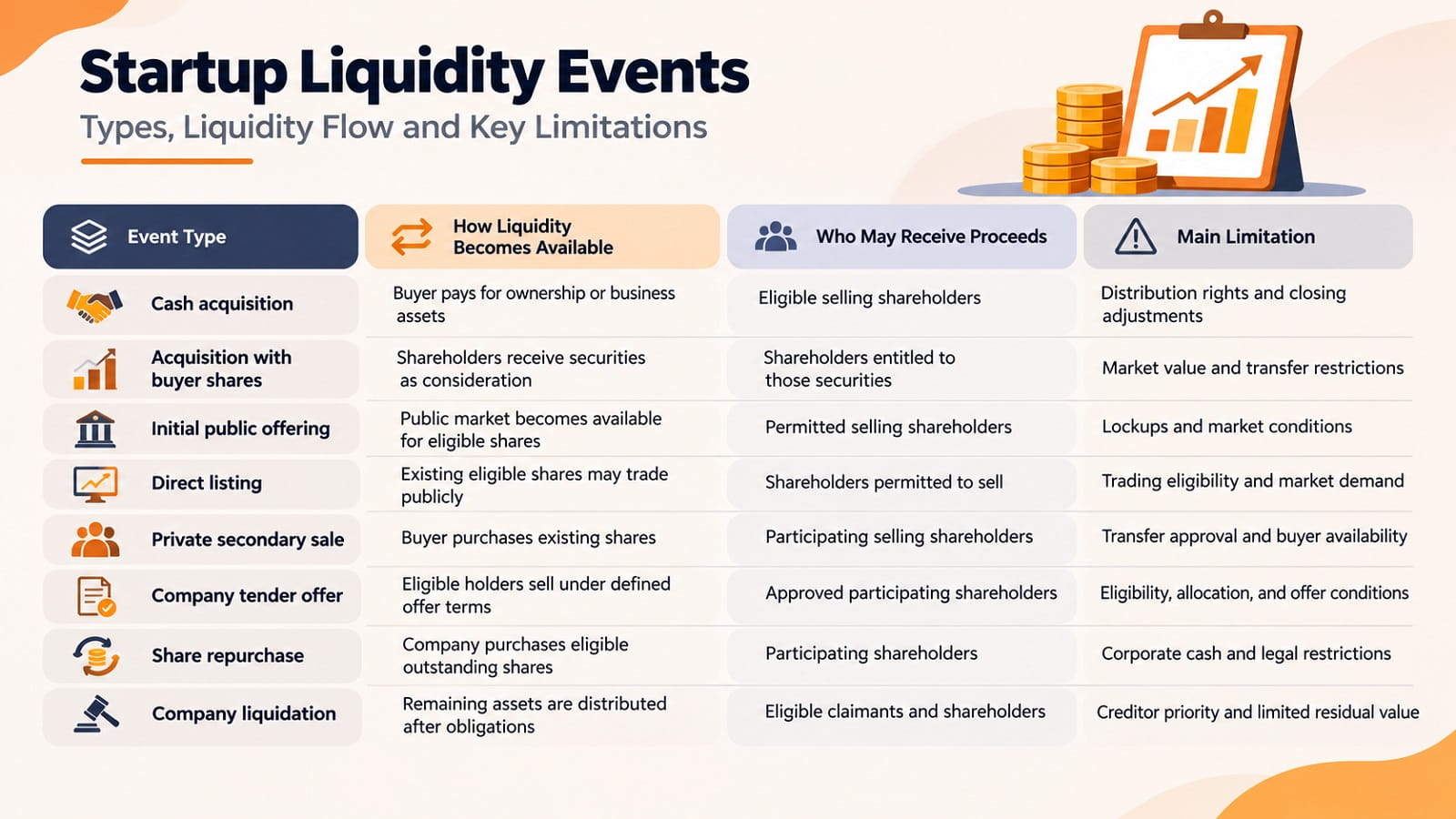
These events should not be treated as equivalent sources of cash. A public listing may provide the possibility of selling shares without guaranteeing immediate proceeds. A secondary program may benefit only selected participants, while an acquisition may allocate its consideration according to several classes of securities. Founders should determine who is eligible to receive value and when that value can actually be realized.
Why Liquidity Matters to Founders and Investors
Startup ownership often requires a long investment horizon. Founders may spend years building a company while retaining most of their wealth in equity. Investors may commit capital that cannot easily be recovered until an appropriate transaction occurs.
Liquidity allows shareholders to reduce their financial exposure and potentially realize investment returns. Early investors may need distributions to return capital to their own fund investors, while founders may seek personal financial security.
Employees can face similar challenges when their compensation includes stock options or restricted equity. These securities may have economic potential, but their value depends on vesting conditions, exercise requirements, taxes, and opportunities to sell the resulting shares.
The existence of a potential buyer or an attractive valuation does not eliminate these constraints. Different shareholders may hold securities with different rights and have different opportunities to participate in a transaction.
An effective liquidity assessment therefore begins with the actual ownership structure rather than the company's headline valuation.
How Shareholder Payouts Are Determined
The total value of a liquidity transaction does not automatically become an equal distribution among shareholders.
In an acquisition, the amount available for distribution may depend on the agreed transaction value, debt repayment, transaction expenses, contractual adjustments, and other obligations.
Once the relevant amount is established, the company's securities and shareholder agreements determine how proceeds are allocated.
Preferred shares can have rights that give their holders priority over common shareholders in specified transactions. Some preferred investors may receive an agreed amount before ordinary shareholders participate in the remaining proceeds.
Other securities may carry conversion rights or additional participation features. These can change the financial outcome significantly.
Founders should examine the fully diluted capitalization and the relevant rights before assuming that ownership percentages directly represent the amount of cash each shareholder will receive.
Liquidation Preferences and Distribution Priorities
A liquidation preference is a contractual right that determines how qualifying proceeds are allocated to preferred shareholders before or alongside other equity holders.
For example, a preferred investor may hold a nonparticipating preference equal to the original investment. In a qualifying sale, the investor may be entitled to receive that preference or convert into common shares if conversion produces a greater return.
Participating preferred securities can create a different result. Depending on their terms, investors may receive a preference and also participate in additional distributions.
These distinctions become especially important when the acquisition price is relatively low compared with the capital previously raised.
A startup might announce a substantial sale while ordinary shareholders receive limited proceeds because senior contractual rights absorb much of the value available for equity distribution.
Founders should model the applicable distribution rules at several possible transaction values. The purpose is to understand how changes in total consideration affect each shareholder class.
Gross Transaction Value Versus Available Cash
Shareholders should distinguish the publicized transaction value from cash available to distribute.
A buyer may describe an acquisition using enterprise value, equity value, or total potential consideration. These measures can produce different figures.
Debt, agreed cash adjustments, transaction expenses, and other liabilities may affect the amount attributable to selling shareholders. Payment structures can create additional differences between the total consideration and the cash delivered at closing.
Some transactions include escrow arrangements or payments dependent on future conditions. Others provide shares in the acquiring company instead of cash.
The result is that a headline offer may contain several components with different levels of certainty.
A reliable financial analysis should identify the amount available immediately, the value subject to future conditions, and the amounts that may never become payable.
A Practical Startup Liquidity Event Example
Consider SilverPeak Software, a fictional enterprise technology company that has agreed to a cash acquisition.
After the negotiated financial adjustments and transaction expenses, assume the amount attributable to equity holders is $20 million. This figure is the distributable equity consideration rather than the enterprise value of the business.
SilverPeak has preferred investors holding an aggregate $6 million nonparticipating liquidation preference. Under the company's agreements, those investors may elect to receive their preference or convert their shares into common equity.
Assume their ownership on an as converted basis would be 25% of the total equity. At the $20 million distributable value, conversion would therefore provide $5 million. The preferred investors elect the higher $6 million contractual preference.
The remaining $14 million is available for ordinary shareholders under these simplified assumptions. The founder owns 50% of the ordinary shares, while the other ordinary shareholders collectively own the remaining 50%.
Calculating the Shareholder Distribution
The acquisition agreement provides that $2 million of the common shareholder allocation will initially remain in escrow. Assume the preferred distribution is paid fully at closing and the escrow is allocated proportionally between the two ordinary shareholder groups.
The following table distinguishes the total potential payout from the amount received immediately.
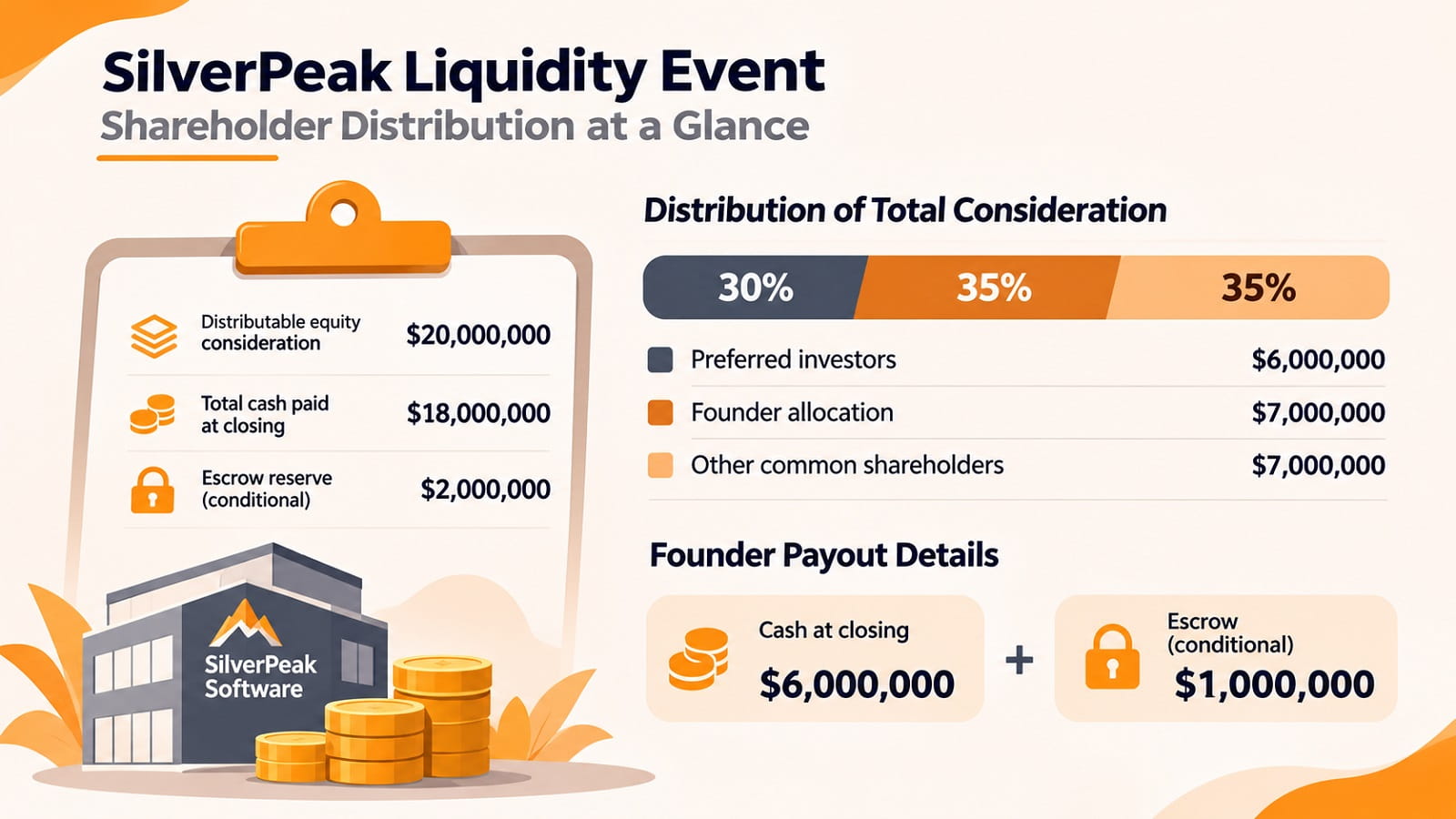
The example demonstrates why total consideration and immediate liquidity must be analyzed separately. SilverPeak shareholders are allocated $20 million in total, but only $18 million is paid at closing. The founder has a potential allocation of $7 million, consisting of $6 million in immediate cash and $1 million subject to escrow release conditions. The preferred investors receive their $6 million preference because it exceeds the amount available through conversion. These calculations exclude personal taxes and assume no additional contractual claims or adjustments.
What the Founder Actually Receives
The founder's economic outcome should be evaluated using the cash received at closing and the uncertain value of the escrow allocation.
If the full escrow amount is released, the founder's gross proceeds reach $7 million. If valid claims or contractual conditions reduce the escrow distribution, the founder receives less.
The preferred distribution also explains why the founder's share of the company does not necessarily determine the founder's percentage of the overall acquisition proceeds.
In this example, the founder owns half of the ordinary equity but receives 35% of total distributable consideration before any reduction in escrow payments.
This percentage follows the simplified preference and ownership assumptions. A different capitalization structure could produce a substantially different outcome.
How Employee Equity Affects Liquidity
Employees may receive a portion of the financial value generated by a startup, but the result depends on the securities or compensation arrangements they hold.
Stock options generally require the holder to satisfy the applicable vesting and exercise conditions. The economic benefit also depends on the difference between the exercise price and the amount available for the shares.
Restricted stock and other equity awards can have different treatment during a sale or public listing. Some awards may accelerate, be converted, be canceled for consideration, or remain subject to continuing conditions, depending on their agreements.
Employees should not assume that every equity award automatically produces cash when an acquisition is announced.
Founders and finance teams should verify the treatment of outstanding awards and communicate the relevant conditions accurately. Clear calculations can help employees understand their potential proceeds without implying that uncertain benefits are guaranteed.
Why Liquidity Can Be Delayed
A transaction may create economic value without making the full amount available immediately.
In an acquisition, part of the payment may be held in escrow or depend on future milestones. These arrangements can delay distributions or make a portion of the consideration uncertain.
After a public listing, contractual lockups and applicable securities restrictions may limit when certain shareholders can sell.
Private transactions can face different delays, including company approval requirements, buyer eligibility checks, and restrictions on transferring existing shares.
The timing of liquidity also depends on market conditions. Even securities that are legally transferable may be difficult to sell at an attractive price if there is insufficient buyer demand.
Shareholders should distinguish a contractual right to receive value from the ability to convert that value into usable cash at a particular time.
Tax Considerations After a Liquidity Event
The amount distributed to shareholders before taxes does not necessarily represent the amount they can retain.
Tax treatment may depend on the shareholder's country of residence, the type of securities, the original acquisition cost, holding period, and legal structure of the transaction.
Different forms of consideration may also have different consequences. Cash proceeds, buyer securities, exercised stock options, and certain employee compensation payments are not automatically treated in the same manner.
Founders should establish the relevant tax position before signing binding transaction documents. Understanding estimated liabilities can influence the amount of liquidity needed and the attractiveness of alternative payment structures.
Tax planning should be based on professional advice relevant to the individual shareholder. A rule applicable to one investor or jurisdiction should not be assumed to apply to every participant in the transaction.
How Founders Prepare for Future Liquidity
Preparation should begin before a buyer makes an offer or a public listing becomes imminent.
Founders need accurate ownership records, executed shareholder agreements, and a clear understanding of preferred securities, options, and other commitments.
Financial records should also support the company's reported performance. Unresolved liabilities or inconsistencies can affect transaction proceeds and delay negotiations.
A useful preparation exercise is to model distributions under several transaction values. This reveals how shareholder returns change when the available equity consideration is lower or higher than expected.
Management should also determine whether employees and early investors may have separate liquidity needs. These priorities can influence financing discussions and the selection of potential transaction structures.
The goal is to establish a realistic understanding of who could receive proceeds, in what amount, and under which conditions.
Common Liquidity Event Mistakes
One common mistake is assuming that the latest startup valuation represents cash available to shareholders. Private financing valuations may involve securities with specific rights and do not guarantee that a buyer will pay the same amount for the business.
Another mistake is overlooking liquidation preferences. A founder may own a meaningful percentage of the company but receive considerably less than that percentage of the sale proceeds.
Shareholders may also treat deferred consideration as equivalent to immediate cash. Escrow, performance conditions, and restrictions on buyer shares can create uncertainty that should be reflected in any financial assessment.
A further error is assuming that an IPO automatically allows every existing investor or employee to sell. Trading eligibility and market demand remain important.
Finally, founders sometimes model only a favorable transaction outcome. Examining lower valuation scenarios is equally important because contractual priorities may produce very different distributions when proceeds are limited.
Final Thoughts
Liquidity events can turn long periods of startup ownership into financial returns for founders, employees, and investors. However, the value announced for a company does not necessarily equal the amount available to its shareholders.
The outcome depends on the type of transaction, the company's capitalization, contractual distribution rights, and the timing and certainty of payment. Preferred shares, escrow arrangements, and transfer restrictions can produce meaningful differences between shareholders participating in the same event.
Founders should evaluate potential liquidity using realistic distribution models rather than headline valuations alone. Understanding who receives value, how much becomes available immediately, and which amounts remain uncertain provides a stronger basis for financial decisions.
FAQ
What Is a Liquidity Event in a Startup?
It is a transaction or development that allows eligible shareholders to realize some or all of the economic value of their ownership through cash proceeds or a potential market for their securities.
Is an IPO a Liquidity Event?
Yes, an IPO can create a public market for shares. However, existing shareholders may face restrictions that prevent immediate sales, so public listing does not guarantee immediate personal liquidity.
Does an Acquisition Always Provide Cash to Founders?
No. An acquisition may include buyer shares, deferred payments, or contingent consideration. Preferred rights and transaction adjustments can also reduce the proceeds attributable to founders.
Can a Startup Have a Liquidity Event Without Being Sold?
Yes. Private secondary transactions and structured shareholder liquidity programs may allow eligible holders to sell existing shares while the business remains independent.
Who Gets Paid First During an Acquisition?
The order depends on the transaction structure, applicable creditor claims, and the securities and contractual rights involved. Preferred shareholders may receive priority over ordinary shareholders in qualifying distributions.
Do Employees Receive Money During a Liquidity Event?
They may, depending on the equity or compensation arrangements they hold. Vesting, exercise prices, security rights, and transaction terms determine the potential benefit.
What Is the Difference Between Valuation and Liquidity?
Valuation estimates the economic worth of a business or security. Liquidity concerns the ability to convert an ownership interest into cash or another asset that can realistically be sold.
Can a Liquidity Event Produce No Return for Shareholders?
Yes. When liabilities and senior claims absorb the available value, some equity holders may receive little or no proceeds. An unsuccessful liquidation can leave nothing for ordinary shareholders.

Mobina Khanki
Venture & Funding Writer at PinerookMobina Khanki covers venture capital, startup funding, fundraising, and startup finance for Pinerook, focusing on founders and investors.
 Seen first.