The due diligence process is the structured investigation investors undertake to verify a startup's business claims, assess material risks, and determine whether a proposed investment should proceed. It commonly involves preliminary screening, defining the scope of review, examining supporting evidence, resolving outstanding questions, and completing investment approvals. Although the exact sequence varies, founders benefit from understanding how these activities are coordinated and what must happen before financing can close.
Within Startup Due Diligence, the investigation connects an investor's initial interest with a decision supported by evidence. A startup may have a convincing pitch, promising customer growth, and an agreed preliminary valuation, but the investor still needs to confirm that essential information is reliable and material risks are understood. The review can therefore influence transaction timing, financing conditions, and the final agreements. It may also reveal matters that require corrective action before an investment can be completed.
This guide explains how the due diligence process works from preliminary evaluation through closing, including the responsibilities of founders, investors, and professional advisers. It examines how review requests are coordinated, how findings are classified, and why some transactions progress faster than others. A practical financing scenario illustrates how an organized process can help a startup resolve material issues without losing control of its fundraising schedule.
How the Startup Due Diligence Process Begins
The investigation often starts before a formal term sheet is signed. During initial fundraising discussions, investors assess the startup's business model, management team, market opportunity, traction, and financing requirements. These activities help determine whether the company fits the investor's strategy and whether further investigation is justified.
Early screening may involve management presentations, product demonstrations, financial summaries, and discussions with the founding team. Investors can also examine selected customer metrics or conduct preliminary market research. The depth of this work depends on the financing stage and the investor's internal procedures.
At this point, founders should establish which information the investor genuinely needs. Providing relevant evidence can support productive discussions, but distributing extensive confidential records before the relationship develops may create unnecessary risks. Sensitive information should be shared through appropriate channels and according to applicable confidentiality obligations.
The preliminary stage may conclude with a decision to discontinue discussions, request additional information, or negotiate a term sheet. A term sheet generally records important proposed commercial terms, although its legal effect depends on its wording and applicable law. Signing one does not automatically guarantee that investment funds will be transferred.
Stage 1: Defining the Scope of the Review
Once the parties are ready for a detailed investigation, the investor establishes the areas requiring examination. The scope reflects the proposed investment, the company's maturity, its business model, and any concerns identified during earlier discussions.
A seed investor evaluating a small software startup may concentrate on ownership records, product development, available cash, and founder commitments. A larger investment in an established company may involve extensive reviews of commercial performance, financial reporting, legal obligations, technology, and regulatory matters.
The investor may assign different specialists to examine particular subjects. Financial advisers can review financial information, legal counsel can examine contractual and corporate matters, and technical specialists can evaluate technology-related claims. These investigations often operate simultaneously rather than waiting for one another to finish.
Founders should identify an internal coordinator responsible for receiving requests and directing them to the appropriate team members. Clear responsibility reduces duplicated work and prevents different departments from providing conflicting explanations.
Establishing Review Priorities
Not every concern requires equal attention. The parties should identify issues that could materially affect the transaction, including disputed ownership, significant liabilities, unreliable financial information, or required regulatory permissions.
These matters deserve earlier investigation because they may affect whether the investment can proceed at all. Less consequential requests can be addressed while the principal review activities continue.
An agreed scope also helps prevent uncontrolled expansion of information requests. Additional questions may be justified as findings emerge, but the company should understand why new information is necessary and how it relates to the investment decision.
Stage 2: Collecting and Sharing Information
After the scope is established, investors request the evidence necessary to verify the company's representations. Founders coordinate document preparation, confirm that information is current, and determine which materials are approved for external disclosure.
The objective is not simply to upload as many files as possible. Each document should support a relevant question and be consistent with other information already provided. For example, a capitalization summary should reflect applicable financing agreements, while revenue figures in the investment presentation should agree with the company's defined reporting metrics.
A central request register can record document requests, responsible team members, delivery status, and outstanding explanations. This allows management to identify delays without repeatedly contacting every department.
When information is incomplete, the company should acknowledge the limitation and identify the appropriate next action. Producing an estimated figure or unsigned document as though it were verified can create more serious problems than explaining that reconciliation or review remains underway.
Stage 3: Verification and Independent Investigation
Document collection provides the evidence needed for the investigation, but verification requires reviewers to test whether that evidence supports management's statements.
Different workstreams apply different methods. Financial reviewers may reconcile reported results with underlying records. Commercial specialists may interview customers or examine sales conversion assumptions. Legal advisers assess the enforceability and implications of material agreements, while technical reviewers may examine architecture, performance evidence, and operational controls.
These activities should remain proportionate to the transaction. A small early-stage investment does not necessarily require the same investigations as a large acquisition. However, the absence of extensive operating history does not remove the need to examine material risks.
Managing Investor Questions
Verification frequently produces follow-up questions. A reviewer may discover an inconsistent ownership percentage, request further explanation of a customer contract, or seek evidence supporting a projected growth rate.
Founders should maintain a central question log that identifies the request, the person responsible, the expected response, and whether the issue has been resolved. A response should distinguish established facts from assumptions or matters requiring additional investigation.
Consistent communication is especially important when multiple advisers are involved. The finance team and legal counsel may need to coordinate answers where an outstanding financing instrument affects both accounting treatment and ownership. A clear review procedure helps prevent conflicting information from reaching investors.
Stage 4: Evaluating Findings and Resolving Issues
Once reviewers have examined the relevant evidence, they assess the significance of identified problems. The purpose is to distinguish manageable weaknesses from matters that could materially change the proposed investment.
An unresolved issue should be evaluated according to its potential business impact, the reliability of the available evidence, and the options for correction. A missing administrative record may be relatively straightforward to replace, whereas uncertainty over ownership of essential technology may require specialist legal investigation.
Findings can generally be managed through corrective action, further verification, agreed risk allocation, or changes to the proposed transaction. Some issues require resolution before closing, while others may be suitable for documented post-investment commitments.
Separating Material Findings From Routine Requests
A company may receive dozens of clarification requests during an investment review. Treating every question as critical can overwhelm management and delay more consequential work.
Founders should prioritize matters according to severity and the possibility that they could prevent or substantially alter the investment. An inaccurate capitalization model may directly affect financing economics, while an outdated internal organization chart is unlikely to have the same significance.
Investors may also distinguish between risks they can accept and conditions they require the startup to satisfy. This distinction allows the parties to focus negotiations on genuinely material issues rather than extending the process indefinitely.
The Due Diligence Process Timeline
There is no universal timeline for startup diligence. The period depends on company stage, transaction complexity, document readiness, investor procedures, and whether specialist assessments or third-party approvals are required.
Preliminary investigations can begin before an agreed term sheet, while confirmatory review, documentation, and transaction approvals may continue afterward. Some stages overlap, particularly where legal advisers begin preparing investment agreements while other reviewers complete their investigations.
The following table presents an illustrative six-week confirmatory review plan for a startup with an agreed term sheet. The periods are planning assumptions rather than industry-standard deadlines, and several activities occur in parallel.
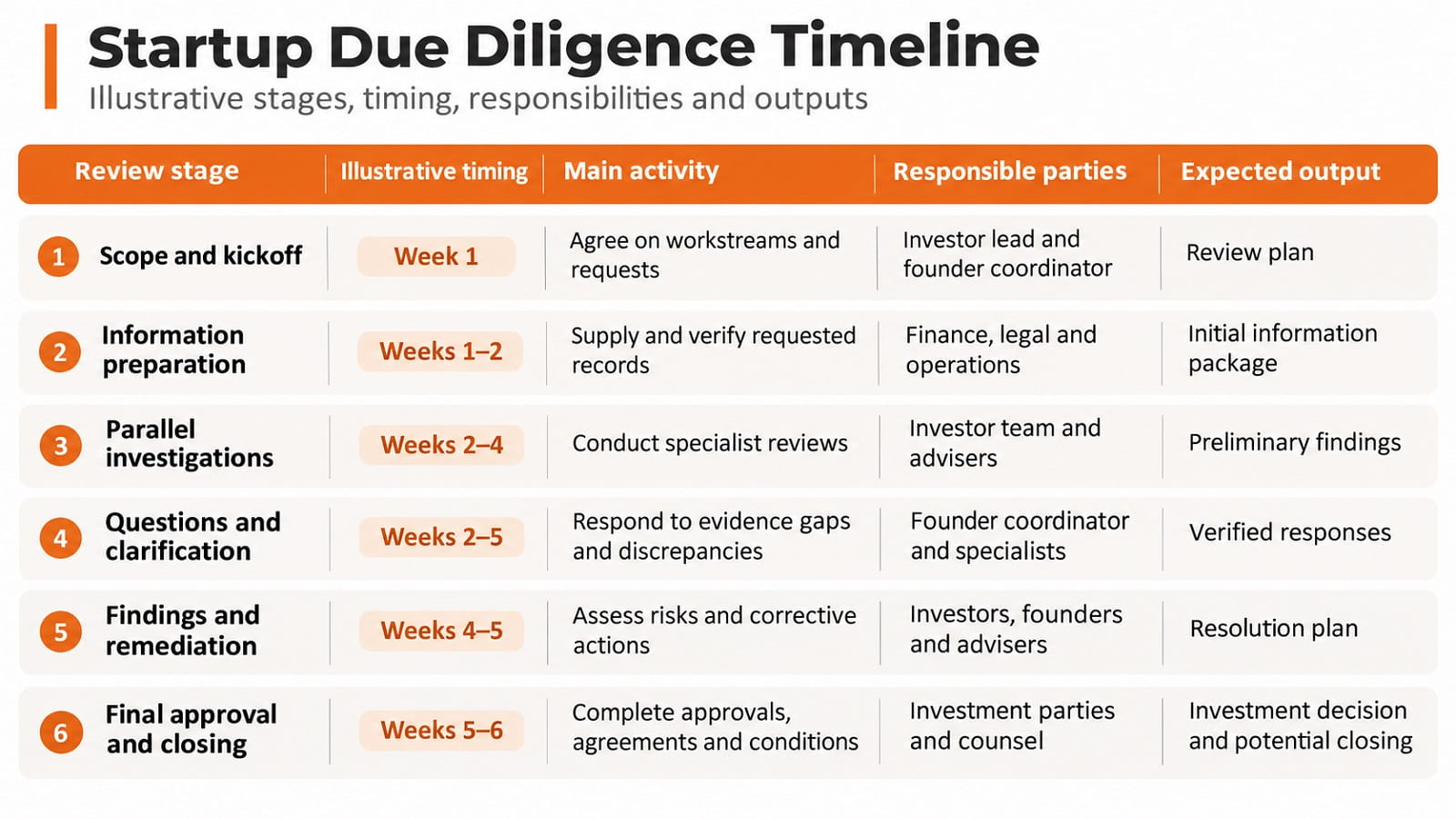
The table demonstrates why efficient coordination matters. A startup may complete its initial document submission during the second week while financial and technical reviewers continue asking questions. Legal documentation may also progress before every investigation has concluded. However, this illustrative schedule does not guarantee closing within six weeks. Material findings, additional negotiations, regulatory requirements, or third-party consents can extend the process.
A Practical Due Diligence Process Example
Consider Clearpath Analytics, a fictional B2B software company seeking a $3 million Series A investment. After several management meetings, the lead investor agrees to preliminary financing terms and begins a confirmatory review. The company assigns its finance director to coordinate requests, while legal counsel and the engineering lead manage specialist questions.
The review starts with a request plan covering financial performance, ownership, commercial contracts, and technology. During the first two weeks, Clearpath supplies most of the requested information and identifies several items that require further verification.
Three matters become important. A convertible instrument is missing from the capitalization model, one large customer's renewal assumptions require clarification, and the engineering team has not completed a recent recovery test. Each finding affects a different area of the investigation, but the company needs to coordinate its responses within the same financing timetable.
Tracking and Resolving Review Findings
Clearpath establishes an issue register that records each finding, the action required, the responsible team, and its effect on transaction readiness. This makes it possible to distinguish completed responses from matters that remain outstanding.
The following table shows the fictional company's position during the fourth week of its review.
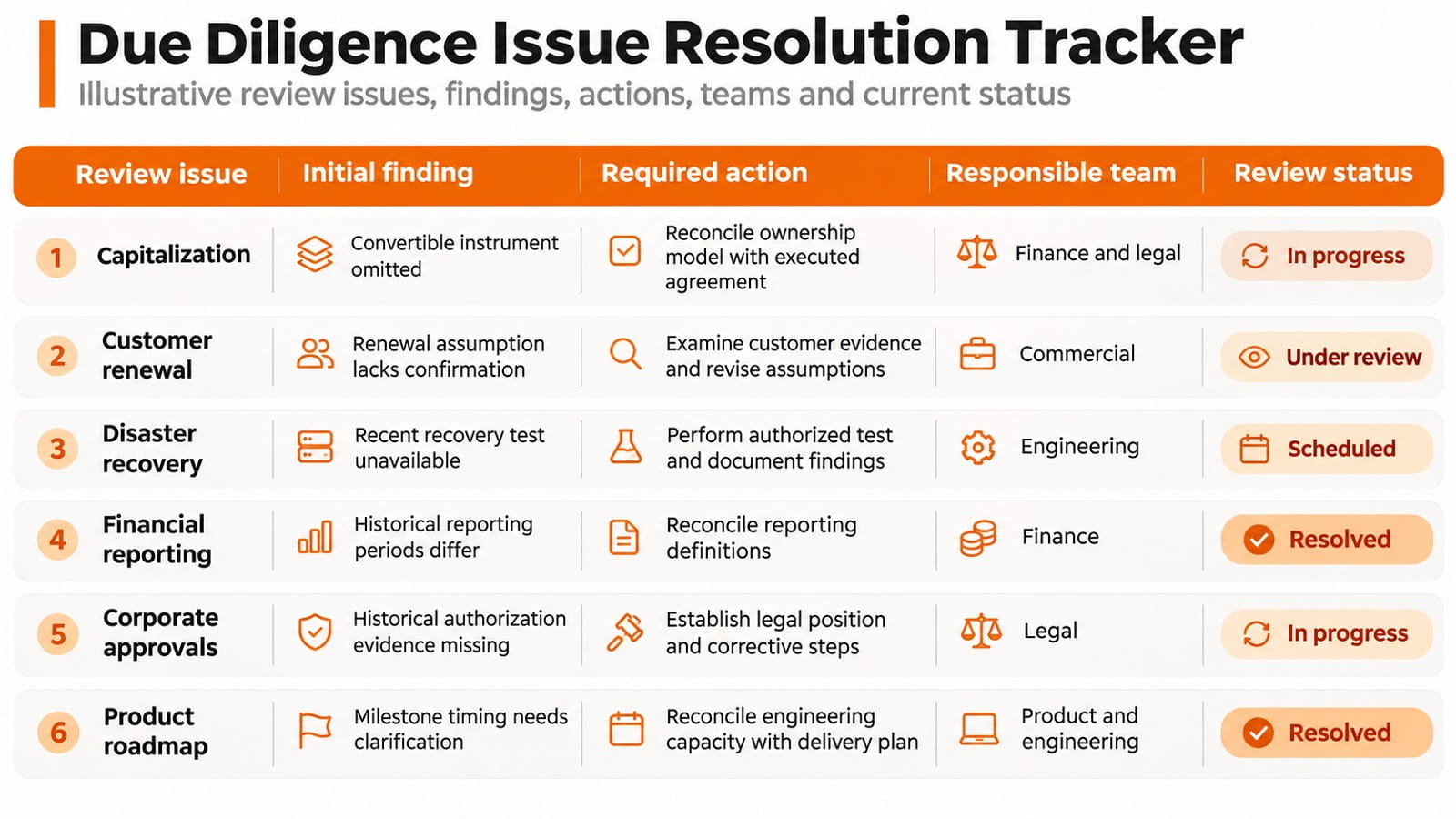
This tracker does not determine whether Clearpath should receive investment. Its purpose is to make the remaining work visible and establish accountability. The capitalization issue may affect the ownership calculations used in the investment agreements, while the customer renewal question could influence commercial projections. The recovery test concerns operational resilience and may be resolved through appropriate technical verification. Each item requires evidence before it can reasonably be classified as resolved.
Moving From Findings to Closing
By the fifth week, Clearpath's management has updated its ownership calculations and supplied additional customer evidence. Its engineering team has also documented the recovery test, including any limitations requiring future work. The investor reviews these responses to determine whether material concerns have been addressed.
If the outstanding findings are acceptable, the parties can continue completing definitive financing agreements and applicable approvals. If important matters remain unresolved, the investor may request additional conditions or modify its proposed terms.
The example illustrates that review completion depends on the resolution of material uncertainties rather than simply reaching a scheduled deadline. An organized process improves visibility and coordination, but the investor's decision still depends on the significance of the evidence.
From Due Diligence to Investment Closing
Completing substantive investigations does not automatically complete the investment. The parties may still need to finalize legal agreements, obtain corporate approvals, satisfy closing conditions, and complete the transaction's funding mechanics.
For a venture equity financing, definitive documents may address share issuance, investor rights, governance, information rights, and other negotiated terms. The specific agreements depend on jurisdiction and transaction structure.
Some transactions involve signing and closing on the same date, while others require separate steps because consents, approvals, or other conditions must be satisfied first. Investors may also choose milestone-based or tranched financing structures when appropriate.
A founder should therefore distinguish a positive investment recommendation from a completed transaction. Until binding requirements and applicable funding conditions have been satisfied, the expected investment should not automatically be treated as available operating cash.
Common Causes of Due Diligence Delays
Delays frequently arise from problems in coordination rather than the volume of requested information alone. When several company representatives respond independently, investors may receive inconsistent financial figures or conflicting explanations of contractual obligations.
Another source of delay is the late discovery of material records. Outstanding securities, incomplete assignments, missing approvals, and contractual consent requirements can become difficult to resolve when identified close to the expected funding date.
External dependencies can also extend the schedule. Customer references, specialist testing, regulatory procedures, legal negotiations, and third-party approvals may not be completed entirely within management's preferred timeframe.
Founders can reduce avoidable delays by establishing a single review coordinator, keeping reliable records, assigning deadlines for responses, and identifying potentially critical issues early. However, speed should not come at the expense of accuracy or necessary professional review.
How Due Diligence Differs by Financing Stage
The same review process cannot be applied identically to every startup. Early-stage businesses often have limited financial history, fewer customer contracts, and relatively simple corporate structures. Their investors may therefore place greater emphasis on the founding team, product feasibility, ownership arrangements, and the resources needed to reach initial milestones.
As the business develops, the review generally becomes more evidence-intensive. Institutional investors may require detailed financial information, operating metrics, customer validation, and specialist assessments of legal or technical matters.
Later-stage financing and acquisitions can introduce additional requirements relating to governance, regulatory compliance, transaction structure, and the transfer of business assets. These differences influence both the investigation and the time required to complete it.
The guiding principle is proportionality: the investigation should address the risks material to the proposed investment without assuming that every company must satisfy the same documentation and operational standards.
Final Thoughts
The due diligence process provides a structured connection between initial investor interest and a final financing decision. It allows investors to verify important claims, assess material uncertainties, and determine which risks require correction or contractual protection before committing capital.
For founders, the main operational challenge is coordinating information, specialists, and decisions without allowing the investigation to disrupt ordinary business activities. Clear responsibilities, reliable records, and a disciplined method for tracking findings can reduce avoidable delays and improve communication.
An effective process does not guarantee that investment will proceed. It creates the conditions for an informed decision by ensuring that relevant evidence is examined and material issues receive appropriate attention. Startups that prepare for this work can approach financing negotiations with greater clarity about their obligations, risks, and transaction readiness.
FAQ
What Is the Due Diligence Process for Startups?
It is the structured investigation investors use to verify a startup's business claims, examine supporting evidence, identify material risks, and decide whether to proceed with an investment.
What Are the Main Stages of Due Diligence?
The main stages generally include preliminary screening, defining the review scope, collecting information, verifying evidence, evaluating findings, and determining whether outstanding matters have been resolved sufficiently for a transaction decision.
Does Due Diligence Happen Before or After a Term Sheet?
It can occur both before and after a term sheet. Preliminary business evaluation often precedes a term sheet, while more detailed confirmatory investigations commonly follow it.
How Long Does Startup Due Diligence Take?
The duration varies significantly. Some straightforward early-stage reviews can be completed relatively quickly, while complex institutional financing rounds may require several weeks or longer. Document readiness and unresolved issues influence the schedule.
Who Manages the Due Diligence Process?
The investor typically coordinates its review, while the startup assigns internal representatives to supply records and answer questions. Legal, financial, commercial, and technical advisers may support specific investigations.
Can Investors Withdraw After Due Diligence?
Yes, depending on the contractual arrangements and circumstances. Investors may decide not to proceed if findings materially change their assessment of the business or if agreed closing requirements cannot be satisfied.
What Happens After Due Diligence Is Completed?
The parties evaluate remaining findings and, if they intend to proceed, complete the necessary financing documents, approvals, and closing conditions. A favorable review does not by itself guarantee the transfer of funds.
How Can Founders Make the Process More Efficient?
Founders can maintain reliable records, assign clear internal responsibilities, centralize investor requests, respond consistently, and resolve material discrepancies early. Appropriate confidentiality controls and professional advice remain important.

Mobina Khanki
Venture & Funding Writer at PinerookMobina Khanki covers venture capital, startup funding, fundraising, and startup finance for Pinerook, focusing on founders and investors.
 Seen first.