Learning how to find angel investors starts with identifying individuals who actively invest in businesses similar to yours. A suitable investor understands your industry, considers companies at your development stage, and has the financial capacity to participate in your funding round. Founders can discover potential investors through angel groups, startup communities, accelerator programs, professional introductions, and research into previously funded companies. However, finding names is only the beginning. The real challenge is identifying investors whose interests, experience, and expectations align with the business.
Within Angel Investing, finding suitable investors is an important part of preparing a startup for external financing. Founders need to understand how much capital they require, which milestones the investment will support, and what evidence they can present before approaching potential backers. An investor who regularly finances enterprise software companies may be a stronger prospect for a software startup than a wealthy individual with no experience investing in technology businesses.
Understanding how to find angel investors requires a structured approach to investor research, relationship development, and fundraising communication. Rather than contacting hundreds of people with the same message, founders can improve their efforts by identifying relevant investors, verifying their investment activity, and establishing credible connections. This guide explains where to search for angel investors, how to evaluate potential matches, how to approach them professionally, and how to organize an effective investor outreach strategy.
How to Find Angel Investors for Your Startup
The most effective starting point is to define the type of investor your startup needs. Angel investors differ in their preferred industries, investment stages, geographic interests, financial capacity, and involvement with portfolio companies. A founder who understands these differences can build a more relevant investor list and avoid spending time on contacts unlikely to consider the opportunity.
Several sources can help identify potential investors. Angel investment organizations publish information about their members and investment interests, while startup accelerators often introduce participating companies to experienced investors. Professional networks, industry conferences, and recommendations from other entrepreneurs can also provide valuable connections.
Online research offers another useful approach. Previous startup funding announcements, professional biographies, and publicly available investment portfolios may reveal investors who have supported similar businesses. However, past investment activity does not guarantee that someone is currently making new investments.
The objective is to combine different discovery channels while evaluating each potential investor against the startup's specific financing requirements.
Angel Investor Directories and Investment Groups
Angel investor directories provide a practical starting point for identifying people and organizations involved in startup financing. They may include regional investment groups, sector focused organizations, and communities that coordinate opportunities for private investors.
The Angel Capital Association maintains information about angel investment organizations in the United States. Founders can examine relevant groups and review their websites to understand investment preferences, geographic requirements, and application procedures.
In the United Kingdom, the UK Business Angels Association provides information about the angel investment ecosystem. Regional investor organizations may also offer opportunities for founders seeking connections within particular markets.
Directories should be treated as research tools rather than guaranteed sources of financing. A listed organization may have limited investment capacity, specific membership requirements, or investment criteria that exclude certain businesses.
Founders should examine eligibility requirements and current activity before preparing an application.
Startup Accelerators and Incubators
Accelerators can connect founders with mentors, experienced entrepreneurs, and investors who regularly evaluate early stage companies. Some programs organize investor presentations or demo days where participating startups introduce their businesses to potential financial backers.
However, the quality of these connections varies between programs. A specialized accelerator may provide access to investors with relevant industry knowledge, while a general entrepreneurship program may offer broader networking opportunities.
Founders should review the program's previous participants, investor relationships, eligibility requirements, and financial terms before applying. Participation should support the startup's commercial development rather than serve only as a way to meet investors.
An accelerator can be particularly useful when the founder also needs assistance improving business strategy, customer validation, or fundraising preparation.
Startup Events and Industry Conferences
Startup conferences, pitch competitions, entrepreneurship gatherings, and industry events can create opportunities to meet potential investors in person.
These environments allow founders to establish relationships through conversations about the business rather than immediately presenting a financing request. An investor may be more willing to continue a discussion after learning about a relevant customer problem or product opportunity.
Before attending an event, founders should research speakers, investors, and participating organizations when this information is publicly available. Identifying a small number of relevant contacts can make attendance more productive.
Following the event, a personalized message referring to the conversation can help maintain the relationship.
Professional networking is most effective when it develops trust and demonstrates relevance rather than focusing exclusively on obtaining immediate funding.
Best Places to Find Angel Investors
Different investor discovery channels offer different advantages. Some provide access to large networks, while others create opportunities for personal introductions or specialized industry connections.
Founders should select channels according to the type of company they are building, the amount of funding required, and the investors most likely to understand their market.
The following table compares practical discovery channels and explains how founders can use each one.
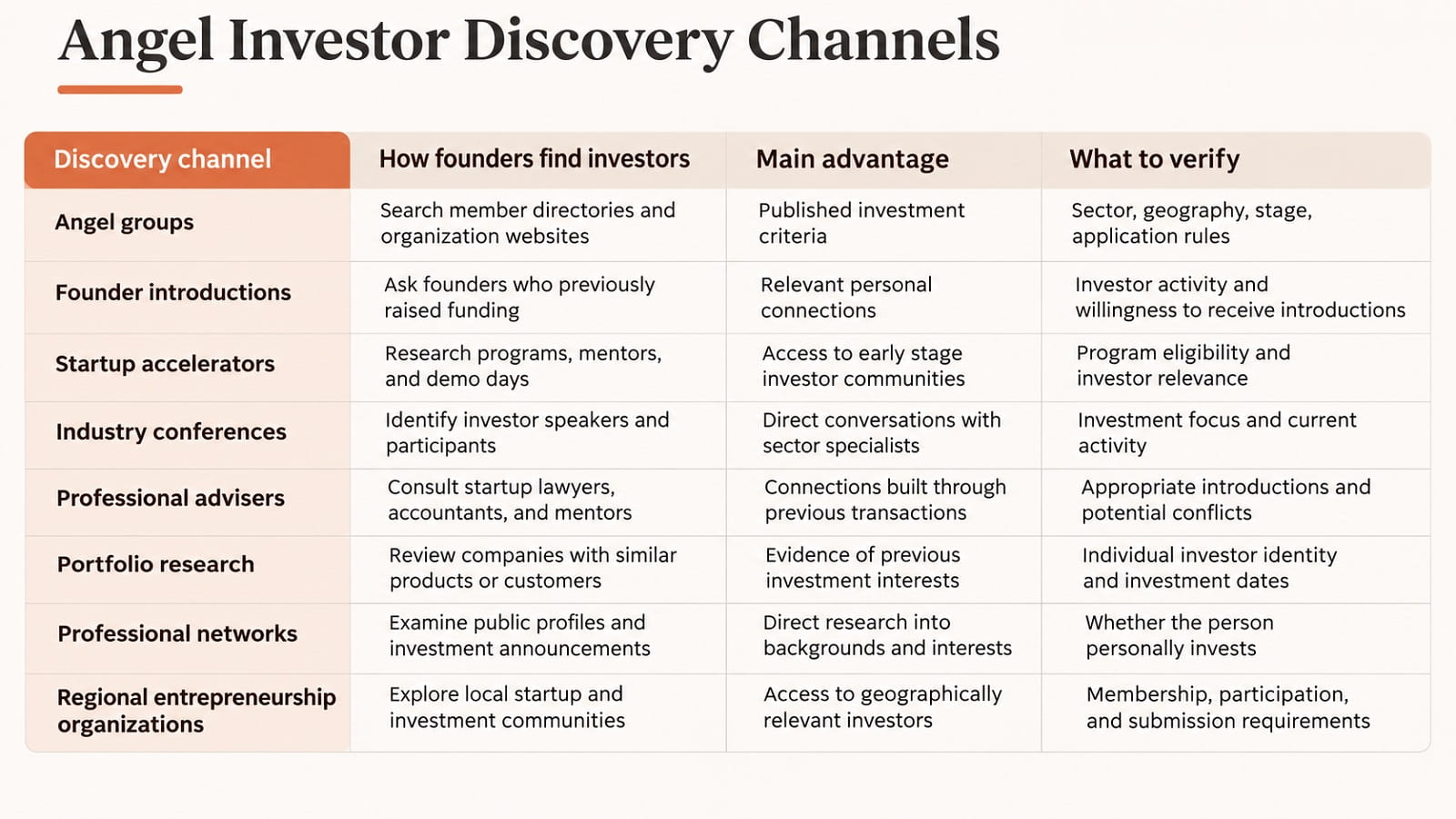
No single channel is sufficient for every startup. A company operating in a specialized industry may benefit most from portfolio research and sector events, while a local early stage business may find relevant investors through regional organizations. Founders should combine a small number of suitable channels and assess the quality of the resulting contacts instead of measuring progress by the size of an unqualified investor list.
How to Identify the Right Angel Investors
Finding a financially capable individual is not the same as identifying a suitable startup investor. The best prospects generally have experience, interests, or investment preferences that connect directly with the company's business model.
Founders should begin by defining an ideal investor profile. This can include preferred investment stage, relevant industries, geographic focus, estimated investment capacity, and expected involvement after financing.
For example, an enterprise cybersecurity startup may benefit from an investor who understands corporate technology sales, security requirements, and recurring software revenue. That experience could provide useful strategic insight beyond the investment itself.
The investor's approach to business development should also be considered. Some angels actively advise founders and introduce them to commercial partners, while others prefer limited involvement.
A useful investor research process answers one important question: why would this specific person be interested in this particular company?
If the answer cannot be supported by credible evidence, the investor may not belong on the priority list.
Researching Angel Investors and Previous Investments
Previous investments can provide meaningful evidence of an angel investor's interests and experience. Founders can review funding announcements, public interviews, professional profiles, and investment portfolio information to identify individuals who have supported similar startups.
However, investor research requires more than finding a name in a financing announcement. The person may have participated through a venture capital fund rather than making an independent personal investment.
Founders should distinguish individual angel investors from institutional representatives and determine whether the person has authority to make investment decisions.
Investment dates also matter. Someone who funded a startup several years ago may have changed investment priorities or stopped making new investments.
When reliable information is available, founders should record the investor's previous investments, relevant professional background, industry interests, and possible introduction routes.
This research helps create more personalized outreach and reduces the likelihood of contacting investors whose interests no longer match the business.
Building an Angel Investor Target List
A structured investor list is one of the most useful tools in the fundraising process. Instead of collecting names without context, founders should maintain a working record that explains why each prospect deserves attention.
The list can include investor names, professional backgrounds, sector preferences, investment stages, previous investments, contact sources, and relationship status.
It is also useful to record whether the investor has publicly stated a preferred investment amount or geographic focus.
Each prospect should receive a priority based on relevance and available access. An investor with direct industry experience and a credible mutual connection may deserve greater attention than someone with a prominent public profile but little interest in the startup's market.
Founders can divide prospects into three practical categories: investors ready for outreach, investors requiring additional research, and contacts that do not currently match the opportunity.
This approach makes fundraising activity easier to organize and helps management spend time on the most promising relationships.
How to Approach Angel Investors Through Introductions
Personal introductions can provide useful context when approaching potential investors. A founder may obtain an introduction through another entrepreneur, an existing adviser, a professional colleague, or someone who has previously worked with the investor.
A strong introduction should explain why the startup and investor may be a suitable match. For example, a founder developing healthcare technology could benefit from an introduction by an entrepreneur who previously raised funding from an investor experienced in medical software.
Founders should make the process straightforward for the intermediary. A concise company description, relevant commercial evidence, and a clear explanation of the requested meeting are usually sufficient.
The person making the introduction should have a genuine relationship with the investor and be comfortable facilitating the conversation.
An introduction does not guarantee funding, but it can create a more informed starting point than an unsolicited message.
How to Contact Angel Investors Without Connections
Not every founder has access to an established network of investors. Direct professional outreach can still create opportunities when it is relevant, respectful, and consistent with applicable fundraising regulations.
A useful message should demonstrate that the founder has researched the recipient. Mentioning relevant experience or previous investment interests provides a clear reason for contacting that individual.
The message should explain what the startup does, which customer problem it addresses, and what progress the team has achieved.
For example, a founder building logistics software might describe how the product helps distributors improve inventory planning and mention that the company has already secured paying customers.
The founder can then request a brief introductory conversation to determine whether the opportunity aligns with the investor's interests.
Generic messages, unsupported claims, and promises of guaranteed financial returns should be avoided.
Founders should also consider securities regulations before conducting broad investment outreach. In the United States, certain private offering exemptions restrict general solicitation, while others permit it subject to specific conditions.
Writing an Effective First Message to an Angel Investor
The first message should be concise enough for a busy investor to understand the opportunity quickly. It should explain the business, provide relevant evidence of progress, and establish why the recipient may be interested.
A suitable message might read:
Subject: Enterprise software startup seeking a relevant angel investor
Hello,
I am the founder of Everpath Analytics, a software company helping regional distributors improve inventory planning.
We have launched our first commercial product and are working with paying business customers. I noticed your previous involvement with enterprise software companies and thought our market might align with your investment interests.
We are preparing an early funding round to expand product development and customer acquisition.
Would you be open to a short introductory conversation?
Best regards,
Founder, Everpath Analytics
The message introduces the company without overwhelming the investor with financial projections or extensive technical details. It provides a reason for the contact and a clear next step.
Everpath Analytics is a fictional company used for illustration. Actual messages should include accurate information and comply with applicable securities requirements.
Preparing for the First Angel Investor Meeting
Once an investor expresses interest, founders should be ready to discuss the business in greater detail.
A concise pitch presentation should explain the customer problem, proposed solution, market opportunity, business model, competitive position, team, and intended use of investment capital.
Financial information should be consistent with the company's underlying records. If management presents revenue, customer growth, or product usage figures, it should be able to explain how those measures were calculated.
Investors may also ask why the company needs a particular amount of funding and which milestones the capital is expected to support.
A credible answer connects spending plans with measurable progress. Hiring an employee is an operational activity, while reaching a commercial milestone explains why that expenditure may be valuable.
Founders should also use the meeting to evaluate the investor. Understanding previous investments, expected involvement, decision making, and future funding capacity can reveal whether the relationship is suitable.
A Practical Angel Investor Search Example
Consider Everpath Analytics, a fictional software startup developing inventory planning tools for business customers.
The founder has launched an initial product and secured several paying customers. The company now wants to raise $600,000 to improve its technology and expand commercial operations.
Rather than contacting every investor found online, the founder begins by researching people with experience in enterprise software, supply chain technology, and early stage financing.
The initial research identifies 30 potential investors. After reviewing industry preferences and company stage, 18 appear to meet the basic criteria.
Further research identifies 12 prospects with credible evidence of relevant investment activity and a potentially appropriate contact route.
Example Angel Investor Outreach Funnel
The founder organizes a targeted outreach campaign and records the results at each stage. The following figures represent a hypothetical planning example rather than average industry conversion rates.
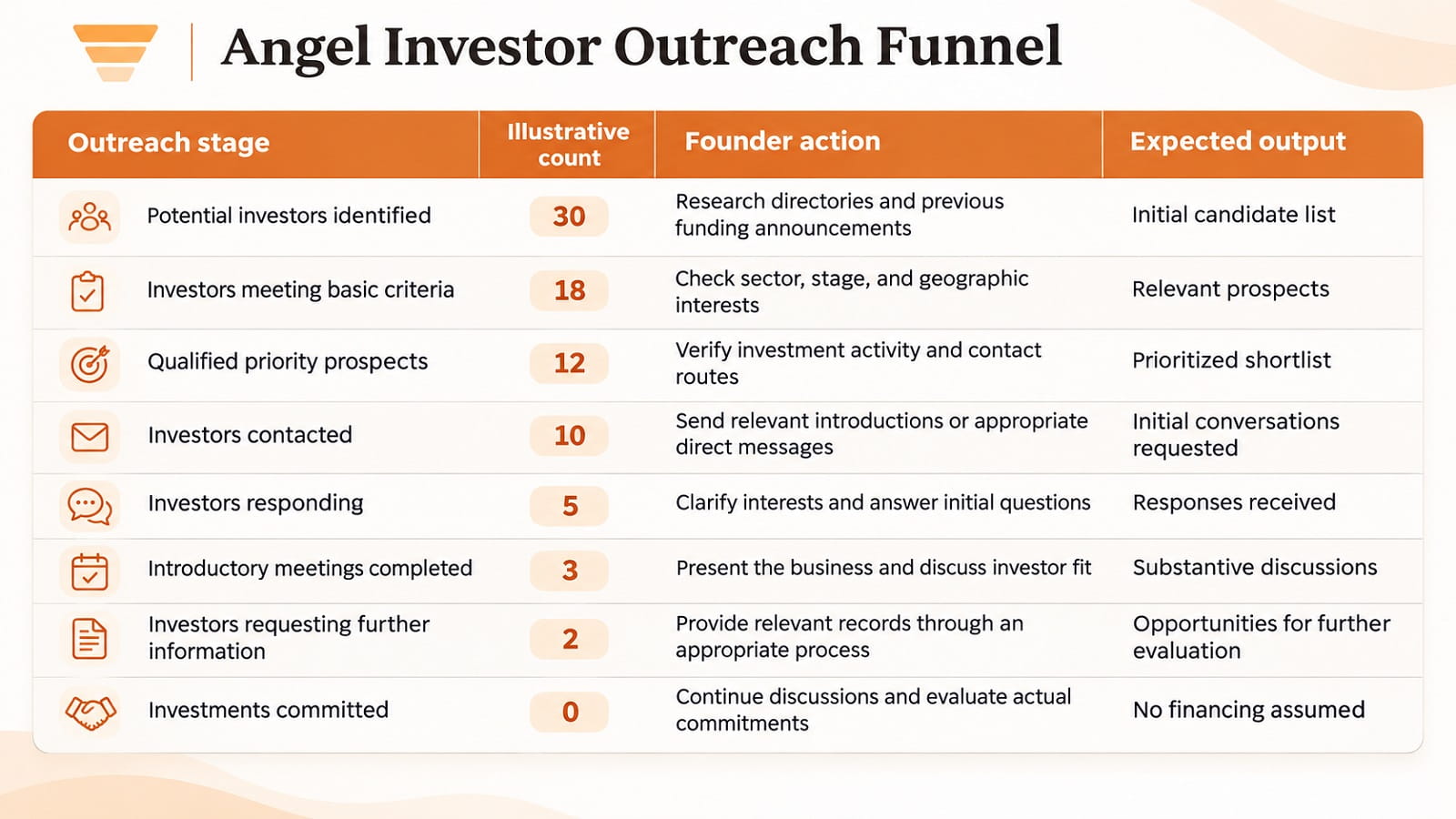
In this scenario, the founder identifies 30 names but reaches a more focused group of 12 qualified priority prospects. Five of the ten contacted investors respond, and two request additional information after the initial discussions. These results indicate potential interest, not a successful financing round. No investment is assumed until the parties complete the necessary review, agreements, and funding conditions. The value of the funnel is that it makes each stage visible and allows the founder to identify where the search is progressing or losing momentum.
Improving the Investor Search Based on Results
The founder should examine why certain prospects did not progress through the outreach process.
Some investors may prefer businesses with more established revenue, while others may not support the company's sector or geographic market.
A lack of response can also indicate that the initial message did not communicate the opportunity clearly enough. However, founders should not assume that every unanswered message reflects a weakness in the business.
Everpath can use feedback to improve its investor criteria, clarify its commercial traction, and identify more relevant introduction opportunities.
The objective is not to maximize the volume of outreach. It is to build credible discussions with investors who understand the company and have the ability to support its financing needs.
How to Follow Up With Angel Investors
Professional follow up is an important part of investor relationship management. Potential investors may receive many opportunities, and an unanswered message does not necessarily mean the opportunity has been rejected.
Founders can send a concise follow up after a reasonable interval, particularly when they have a relevant update about product development, customer traction, or financing progress.
Messages should remain respectful and avoid creating artificial urgency. Repeating the same request many times without new information is unlikely to improve the relationship.
After an introductory meeting, a short summary can clarify the discussion, answer outstanding questions, and identify any agreed next steps.
Founders should maintain a record of previous communications, investor responses, requested information, and future actions.
When an investor clearly declines, the founder should respect that decision rather than continue sending repeated funding requests.
Common Mistakes When Finding Angel Investors
One common mistake is contacting investors without researching their investment preferences. A large list of irrelevant contacts can consume considerable time without generating meaningful conversations.
Another mistake is presenting unsupported claims about customer demand, revenue, partnerships, or market opportunity. Experienced investors may request evidence, and inconsistencies can undermine confidence in the founder.
Some entrepreneurs also confuse investor interest with a financial commitment. A positive conversation or request for additional documents does not guarantee that an investment will be completed.
Founders should also be cautious about individuals claiming to guarantee financing in exchange for unusual upfront fees. Investor identity, professional background, and authority to invest should be verified before sharing sensitive information or making payments.
Finally, the relationship should be assessed beyond the amount of money offered. An investor whose expectations conflict with the startup's business objectives may create long term difficulties even when the proposed funding appears attractive.
How Long Does It Take to Find Angel Investors?
The time required to identify and secure suitable angel investment varies considerably between startups.
A company with relevant industry connections, established customer evidence, and a clear financing plan may be able to begin productive conversations more readily than a founder entering an unfamiliar market.
However, investor research, introductory meetings, business evaluation, and legal documentation can all require substantial time.
The availability of investor capital also affects the process. An interested investor may be unable to participate because of existing commitments or current investment priorities.
Founders should organize fundraising around their available cash runway rather than assume that investment will follow immediately after initial discussions.
A realistic plan accounts for research, conversations, negotiation, documentation, and the possibility that some interested prospects will ultimately decline.
When to Change Your Angel Investor Search Strategy
If investor outreach consistently produces weak results, founders should evaluate the reasons before simply expanding the number of contacts.
The selected investors may not match the startup's development stage or industry. Alternatively, the company may need stronger commercial evidence or clearer financial assumptions.
Feedback from relevant investors can help identify the main issue.
For example, repeated questions about customer retention may indicate that the startup needs additional evidence of product demand before pursuing a larger fundraising campaign.
If investors understand the opportunity but cannot participate because of their investment criteria, a different group of prospects may be more appropriate.
Changing the strategy should be based on evidence rather than isolated rejection.
Final Thoughts
Understanding how to find angel investors requires more than identifying individuals with substantial financial resources. Successful investor discovery depends on matching a startup's business model, development stage, and financing needs with people who have relevant investment interests.
Angel groups, startup accelerators, professional introductions, industry events, and portfolio research can provide useful sources of potential investors. However, each prospect should be evaluated carefully before the founder invests time in direct communication.
A structured investor list, credible commercial evidence, and professional outreach can improve the quality of fundraising discussions. Tracking responses also helps founders understand which channels are producing relevant opportunities and where their approach may require adjustment.
The objective is to build relationships with investors who understand the startup, share compatible expectations, and can make informed decisions about supporting its development.
FAQ
Where Can I Find Angel Investors for My Startup?
Founders can research angel groups, investment directories, startup accelerators, entrepreneurship events, industry communities, and previous funding announcements. Professional introductions can also provide access to relevant investors.
Can I Find Angel Investors Online?
Yes. Investor organization websites, professional profiles, public funding announcements, and relevant directories can help identify potential investors. Their current activity and suitability should be verified before contact.
How Do I Approach Angel Investors Without Connections?
Research investors with relevant interests and use appropriate professional contact channels. A concise message explaining the business, its progress, and the reason for contacting that investor can provide a useful starting point, subject to applicable fundraising rules.
Do I Need Revenue Before Contacting Angel Investors?
Not necessarily. Some angels invest before a startup generates revenue, while others expect paying customers, pilot projects, or other evidence of demand. Expectations vary by investor and industry.
How Many Angel Investors Should I Contact?
There is no universal number. Founders should prioritize relevant prospects, maintain a structured contact list, and expand outreach based on the quality of investor matches and observed responses.
What Should I Send an Angel Investor First?
A short introduction describing the company, customer problem, commercial progress, and reason for the contact is often appropriate. The initial message can request a brief conversation rather than presenting every detail of the business.
Do Angel Investor Directories Guarantee Funding?
No. Directories provide information about potential investors and investment organizations. Funding decisions depend on individual investment criteria, business evaluation, available capital, and applicable legal requirements.
How Can I Tell Whether an Angel Investor Is Legitimate?
Founders should verify the investor's identity, professional background, previous investment activity, and authority to invest. Unverifiable promises, unusual upfront fees, and requests for sensitive information without a legitimate purpose are warning signs.

Mobina Khanki
Venture & Funding Writer at PinerookMobina Khanki covers venture capital, startup funding, fundraising, and startup finance for Pinerook, focusing on founders and investors.
 Seen first.