
Angel investing is a form of private financing in which individuals invest their own money in early stage businesses in exchange for equity or contractual rights to future equity. These investors often support companies before they have the revenue, profitability, or operating history needed to attract larger institutional funds. Beyond capital, experienced angels may help founders develop their strategy, establish commercial relationships, and prepare for future fundraising.
For startups, angel financing can provide an opportunity to test a business model, hire essential employees, or bring a product to market. For investors, it offers exposure to potentially valuable private companies, but with substantial uncertainty. Many startups fail, and even successful investments can remain difficult to sell for years.
Understanding angel investing requires examining both sides of the relationship. Founders need to know what investors expect, how ownership is negotiated, and whether outside capital supports their business objectives. Investors need to evaluate financial risk, the credibility of the team, the terms of the investment, and the possibility of future liquidity. This guide explains the fundamentals, common investment structures, practical funding decisions, and how returns can develop over time.
What Is Angel Investing?
Angel investing involves individuals providing capital to private businesses, usually during their early development. The investment is typically made in expectation of financial returns if the company grows and its shares eventually become valuable or can be sold.
Unlike conventional lenders, angel investors generally do not expect an ordinary equity investment to be repaid through fixed monthly installments. They accept ownership risk in exchange for the possibility of participating in future appreciation.
Investors may be former founders, executives, professionals, or individuals with experience in a particular industry. Some actively advise the businesses they finance, while others participate primarily as financial investors.
The amount invested varies considerably. A single angel may provide a relatively small amount, while several investors can collectively finance a larger round. There is no universal minimum investment that defines an angel.
The defining characteristics are the investor's private capital, exposure to business risk, and participation in a company that is usually not publicly traded.
How Angel Investing Works for Startups
Angel financing begins when a company identifies a need for capital and determines whether exchanging ownership for investment is appropriate.
A founder might seek financing to complete product development, validate customer demand, or recruit a small commercial team. The proposed investment should correspond to a credible operating plan rather than an arbitrary fundraising target.
The investor assesses the business and negotiates the terms under which capital will be provided. If both parties agree and the transaction satisfies applicable requirements, the company receives funds and the investor receives the agreed securities or contractual investment rights.
The relationship usually continues after closing. Investors may receive periodic financial updates, provide introductions, or participate in future financing discussions. Their level of involvement depends on the agreements and the working relationship established with management.
Angel financing is therefore more than a transfer of money. It creates an economic relationship between the startup and an outside investor whose interests may remain connected to the company for several years.
Angel Investors Versus Venture Capital Firms
Angel investors and venture capital firms both provide capital to private businesses, but they differ in how they operate.
An angel typically invests personal funds and may make decisions independently. A venture capital firm generally manages capital contributed by fund investors and operates according to an investment mandate.
This distinction influences decision making, investment size, ownership expectations, and reporting requirements. An individual investor may place considerable emphasis on personal confidence in the founder, while a venture capital fund may follow a more formal investment committee process.
However, the categories overlap. Some experienced angels make large investments, and some venture capital firms participate in very early financing rounds.
Founders should evaluate each investor's actual funding capacity, decision process, and expectations rather than assuming that every angel is informal or every venture capital firm is unsuitable for an early business.
When Startups Seek Angel Investment
Angel investors often become relevant when a startup has progressed beyond an initial concept but is not yet ready for larger institutional financing.
A company may have developed a working prototype, completed customer interviews, or secured its first paying customers. These forms of evidence can make a business more credible even when revenue remains limited.
Some investors are willing to fund companies at the idea stage, particularly when the founders have relevant experience or exceptional technical capabilities. Others require stronger evidence of demand.
The appropriate timing depends on how much capital the startup needs, what it can demonstrate, and which milestones the investment will help achieve.
Founders should avoid raising equity capital before understanding the cost of selling ownership. An investment that solves a short term financial problem may create long term consequences if the valuation or contractual rights are unfavorable.
Types of Angel Investors
Individual angels differ in experience, investment capacity, and willingness to participate in business decisions.
Some are former entrepreneurs who understand the challenges of developing a company. Others have industry knowledge, technical expertise, or professional relationships that make them valuable partners for startups operating in particular markets.
Certain investors provide capital without becoming involved in daily operations. Others prefer to mentor founders, advise on commercial strategy, or support future fundraising.
A super angel investor generally refers to an experienced individual who invests actively and may deploy larger amounts or participate in more transactions than a typical angel. The expression is an informal industry description rather than a separate legal classification.
Investors may also work together. An angel syndicate allows multiple participants to invest in a company through a coordinated arrangement, sometimes using a dedicated investment vehicle. Such structures can simplify the management of investor participation, although their legal and economic terms vary.
The appropriate investor depends on the startup's financing requirements and the value the relationship can provide beyond the investment.
Where Founders Meet Angel Investors
Finding suitable investors begins with identifying people whose investment interests match the startup's industry, stage, geography, and financing needs.
Founders may develop relationships through entrepreneurial communities, accelerators, industry conferences, professional introductions, and existing advisers. Connections to founders who have previously raised capital can also help identify relevant investors.
An angel investor network brings together individuals interested in reviewing startup investment opportunities. Some networks coordinate screening and presentations, while individual members make their own investment decisions.
For entrepreneurs researching how to find angel investors, the most useful approach is usually to create a focused list of investors with demonstrable interest in comparable businesses. A relevant introduction supported by evidence of progress is generally more productive than sending the same pitch to a large number of unrelated contacts.
Before approaching investors, founders should establish the amount they intend to raise, the purpose of the funds, and the operating milestones the financing is expected to support.
What Angel Investors Look for in a Startup
Investors typically evaluate the people building the company, the problem being solved, the market opportunity, and the evidence that customers are interested in the proposed solution.
The founding team matters because early businesses frequently lack established operating systems and predictable revenue. Investors want to understand whether the team has the capabilities and judgment required to respond to changing conditions.
Market size is relevant, but an ambitious market estimate cannot replace evidence of customer demand. Early traction may include pilot projects, product usage, signed agreements, or paying customers.
Financial assumptions should also be credible. Founders need to explain how capital will be used, how long it is expected to last, and which milestones will indicate progress.
The detailed angel investor requirements vary by investor, investment structure, and jurisdiction. Commercial expectations such as traction and founder experience should also be distinguished from legal eligibility requirements.
In the United States, many private offerings rely on registration exemptions, and the applicable rules can determine which investors may participate and what verification or disclosure obligations apply.
Preparing a Startup for Angel Funding
A company seeking outside investment should be able to explain its product, customers, business model, and financial needs in a concise and consistent way.
A pitch deck commonly introduces the problem, the proposed solution, market opportunity, competitive position, evidence of demand, team, and funding plan. These materials should be supported by underlying financial and operating records.
Founders should also maintain an accurate capitalization table. This record identifies existing shareholders, outstanding securities, and the potential effects of issuing additional ownership interests.
Corporate documents, intellectual property ownership, important contracts, and financial information should be sufficiently organized for investor review.
Preparation is not about making a young company appear fully mature. It is about identifying which claims can be supported and disclosing important uncertainties accurately.
The following table summarizes the principal areas founders and investors should examine before agreeing on financing terms.
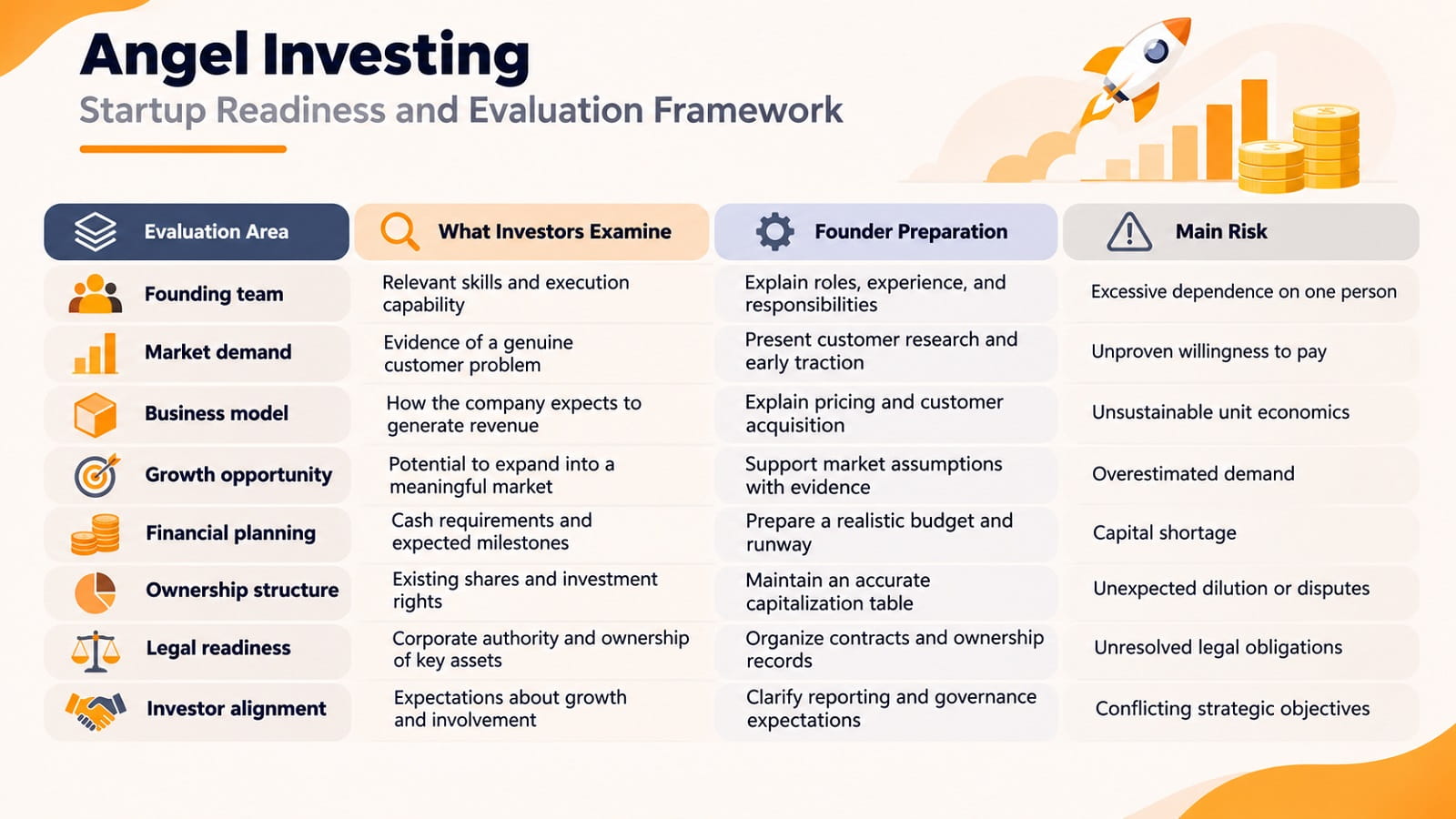
This framework helps both parties distinguish genuine business potential from unsupported projections. An early startup does not need to demonstrate the operating history of an established company, but it should be transparent about what has been proven and what remains uncertain. Investors can then assess whether the opportunity matches their financial capacity, expertise, and willingness to accept risk.
How the Angel Investment Process Works
The angel investment process generally moves through initial discussions, business evaluation, negotiation, legal documentation, and funding.
The first stage usually establishes whether the opportunity matches the investor's interests. If both parties wish to continue, the investor may review financial records, customer evidence, ownership arrangements, and commercial assumptions.
Due diligence can vary in scope. An individual investor making a modest commitment may follow a different review procedure from an organized investment group coordinating a larger transaction.
Negotiations typically address the investment amount, valuation or conversion mechanism, securities issued, governance rights, and other relevant conditions.
Once the parties agree on the terms, legal documentation is prepared and the transaction is completed according to the applicable requirements.
Founders should understand that investor interest is not equivalent to a binding commitment. Financing remains uncertain until the necessary agreements and funding conditions are satisfied.
How Angel Investments Are Structured
Angel capital can enter a startup through several financing instruments.
A priced equity investment involves issuing shares under an agreed valuation. The investor becomes a shareholder according to the terms of the transaction.
A convertible note generally begins as a debt instrument that may convert into equity under specified circumstances. Its terms can include interest, maturity, conversion discounts, and valuation caps.
A Simple Agreement for Future Equity, commonly called a SAFE, gives the investor contractual rights to receive equity under specified future conditions. It is not the same as an ordinary share purchase or a conventional loan.
The economic outcome depends on the exact instrument. A valuation cap does not necessarily establish the current company valuation, and conversion mechanics can produce different ownership percentages depending on the agreement.
Founders should model possible outcomes before signing, particularly when multiple convertible instruments or future financing rounds are expected.
Angel Round Funding and Ownership
An angel round is a financing round in which one or more angel investors provide capital to a startup. It may take place before, during, or alongside another early financing stage.
The investment amount and negotiated valuation determine the initial ownership impact when new shares are issued in a priced round.
A basic calculation is:
Post Money Valuation = Pre Money Valuation + New Investment
The investor's ownership percentage is then calculated by dividing the new investment by the post money valuation, assuming a straightforward share issuance without other capitalization adjustments.
For example, a $500,000 investment at a $4.5 million pre money valuation produces a $5 million post money valuation and an initial investor ownership interest of 10%.
This result can change with future share issuances, employee equity plans, convertible instruments, or negotiated rights.
A Practical Angel Investing Example
Consider Northstar Labs, a fictional software startup developing workflow tools for small businesses.
The company has completed its initial product and secured a limited number of paying customers. Management believes it needs $500,000 to improve the product, recruit a commercial employee, and expand customer acquisition.
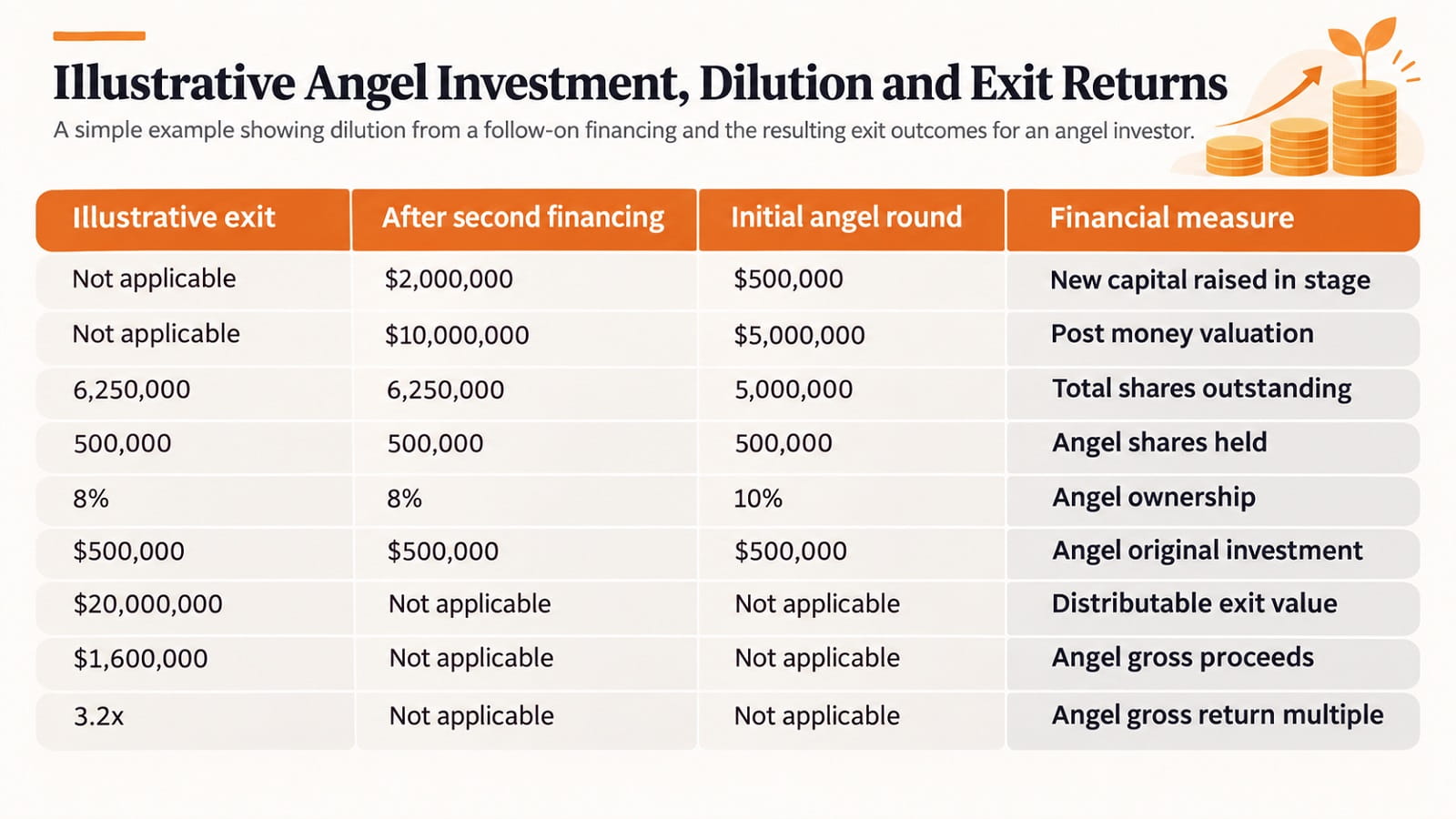
An angel investor agrees to invest $500,000 through a priced equity round at a $4.5 million pre money valuation. Assume the company has 4.5 million ordinary shares outstanding and the investor receives 500,000 new ordinary shares at $1 per share.
Immediately after financing, the company has 5 million shares outstanding. The angel owns 10%, while the original shareholders retain 90%.
Modeling Future Dilution and Investment Value
Two years later, assume Northstar raises an additional $2 million at an $8 million pre money valuation.
For simplicity, all securities have identical economic rights, and there are no employee option pools, liquidation preferences, convertible instruments, transaction expenses, or other adjustments.
At the second financing, the company issues 1.25 million new shares at $1.60 each. Its total outstanding share count becomes 6.25 million.
The original angel retains 500,000 shares, but the ownership percentage decreases from 10% to 8%.
Assume the company is subsequently acquired for $20 million in distributable equity consideration, with proceeds allocated proportionally to all ordinary shareholders.
What the Example Means for Founders
Northstar receives $2.5 million across the two financing rounds. This capital may allow the company to expand, but its founders give up a larger share of ownership over time.
The angel's financial outcome depends on the value ultimately realized, not simply the valuation announced during later fundraising.
A higher valuation can indicate progress, but it does not create a cash return unless the investor can sell eligible securities or receive a qualifying distribution.
Founders should therefore evaluate funding decisions in terms of the capital received, milestones supported, future dilution, and the rights granted to investors.
How Angel Investors Make Money
Angel investors usually seek returns from an increase in the economic value of their ownership.
Potential outcomes include an acquisition, a public listing followed by an eligible share sale, or an approved private secondary transaction.
However, an increase in the estimated valuation of a startup is not the same as a realized investment return. Private shares may remain illiquid even when later financing rounds suggest substantial appreciation.
Investors can also lose their entire investment if the business fails or shareholders receive no residual proceeds.
The actual angel investor returns depend on the amount invested, entry valuation, subsequent dilution, security rights, and proceeds available at exit.
Portfolio performance is particularly important because startup outcomes are uneven. A limited number of successful investments may account for much of the value generated across a group of investments, while others deliver little or no capital recovery.
Investors should assess potential returns alongside the possibility of long holding periods and permanent loss.
Main Risks of Angel Investing
Angel investing involves financial, commercial, legal, and liquidity risks.
A startup may fail to establish sufficient customer demand or run out of capital before reaching sustainable operations. Competition can weaken its market position, while technology problems or management decisions may reduce its prospects.
Even a growing company can require additional financing. New share issuance may dilute existing investors, and later investors may negotiate rights that affect distributions during an exit.
Private securities also lack the liquidity normally available in established public markets. Investors may be unable to sell when they need cash.
Information risk is another concern. Young companies often have limited financial history and may provide fewer disclosures than public companies.
Diversification can reduce exposure to any individual startup, but it does not eliminate the possibility of substantial portfolio losses.
The appropriate investment amount depends on the individual's financial circumstances, investment objectives, and capacity to lose the committed capital.
Legal and Regulatory Considerations
Angel investments must comply with the securities laws that apply to the issuer, investors, and offering.
In the United States, many early stage financings use exemptions from registration. Eligibility and offering procedures depend on the particular exemption.
For example, Rule 506(b) and Rule 506(c) under Regulation D have different requirements concerning investor participation and general solicitation.
The term accredited investor has a defined legal meaning in the United States. Other jurisdictions use different rules and classifications.
Founders should not assume that a private transaction is exempt from securities regulation simply because the investor is an individual or already knows the company.
Accurate disclosures, appropriate agreements, corporate authorization, and proper treatment of investor rights are important throughout the financing.
Legal requirements can change, and parties should obtain advice relevant to the jurisdiction and structure of the proposed investment.
Building a Productive Founder and Angel Relationship
The relationship between a founder and an angel investor can continue long after the initial financing.
A useful arrangement begins with clear expectations about reporting, communication, decision authority, and investor involvement.
Founders may benefit from an investor who understands their industry and can provide introductions to customers, employees, or future funding sources. However, advice should not replace management's responsibility for running the business.
Investors should respect the company's operational structure and any governance boundaries established in the agreements.
Regular updates can help maintain trust by explaining progress against milestones, changes in cash runway, and material business challenges.
The strongest relationships combine transparency with a shared understanding of the startup's goals and the uncertainty involved in achieving them.
When Angel Investing Is Not the Right Fit
Angel financing may be unsuitable for a business that does not need substantial outside capital or whose founders do not want to share ownership.
Some companies can grow through customer revenue, founder savings, or financing arrangements that avoid selling equity. These approaches have their own limitations, but they may better suit businesses with predictable cash requirements and modest growth ambitions.
Angel investment can also create challenges when investors expect rapid expansion that conflicts with the founder's preferred operating model.
For investors, the asset class may be unsuitable when capital preservation, reliable income, or short term liquidity is a priority.
Both parties should evaluate whether the financing structure matches their objectives before proceeding. An available investment is not automatically the right investment.
Final Thoughts
Angel investing provides early stage companies with access to capital and, in some cases, valuable business experience. It can help founders develop products, validate demand, recruit employees, and prepare for future growth.
However, the financial relationship extends beyond the initial funding amount. Valuation, dilution, security rights, investor expectations, and future liquidity all influence the outcome.
Founders should seek investors whose objectives and expertise fit the needs of their business. Investors should evaluate opportunities using realistic assumptions and recognize the possibility of losing their capital.
A sound angel investment combines credible business evidence, clear legal terms, and expectations that reflect both the potential rewards and the substantial uncertainty of early stage companies.
FAQ
What Is Angel Investing?
Angel investing involves individuals providing personal capital to private businesses, usually at an early stage, in exchange for equity or contractual rights to future equity.
How Much Money Do Angel Investors Typically Invest?
Investment amounts vary considerably by investor, company, and market. Individual commitments may be relatively small, while coordinated groups can provide larger amounts. There is no universal minimum.
Do Angel Investors Own Part of the Company?
They may receive shares immediately through a priced equity investment or obtain contractual rights to future shares through another financing instrument.
Is Angel Investing the Same as Venture Capital?
No. Angels generally invest their own capital, while venture capital firms typically manage investment funds financed by outside investors. Their investment stages and methods can overlap.
Do Angel Investors Get Their Money Back?
Returns are not guaranteed. Equity investors generally depend on future liquidity or distributions, and they may lose all their invested capital.
What Do Angel Investors Look for Before Investing?
Common considerations include founder capabilities, customer demand, growth opportunities, business economics, financial requirements, and the credibility of the company's operating plan.
Can Startups Raise Money From Multiple Angel Investors?
Yes. Several investors may participate in the same financing round directly or through a coordinated investment structure, subject to the relevant agreements and regulations.
How Long Do Angel Investors Hold Startup Shares?
Holding periods vary and can extend for many years. The timing of any sale depends on company performance, available buyers, transaction opportunities, and applicable restrictions.

Mobina Khanki
Venture & Funding Writer at PinerookMobina Khanki covers venture capital, startup funding, fundraising, and startup finance for Pinerook, focusing on founders and investors.
 Seen first.