A due diligence checklist helps startup founders identify, verify, and organize the documents investors may request before completing a financing transaction. It covers corporate ownership, financial records, customer contracts, intellectual property, employment arrangements, and other evidence needed to support the company's investment proposition. A useful checklist does more than confirm whether a document exists. It also establishes whether the information is current, consistent with other records, properly authorized, and suitable for sharing with prospective investors.
As part of Startup Due Diligence, a well prepared checklist connects the claims made during fundraising with the evidence available to verify them. A startup may present compelling revenue growth, an experienced management team, and attractive product opportunities, but investors still need to understand whether its financial figures reconcile, its ownership records are accurate, and its essential technology is legally controlled by the company. Organizing these materials before serious investment discussions can reduce avoidable delays and help founders identify problems while there is still time to address them.
This guide provides a practical due diligence checklist for startups preparing for investor review. It explains the documents commonly requested, how requirements differ by company stage, and which records deserve immediate attention. A fictional fundraising example also demonstrates how founders can identify missing information, assign responsibilities, and distinguish routine documentation gaps from issues that may affect an investment decision.
What Should Be Included in a Startup Due Diligence Checklist?
A startup due diligence checklist should include the records necessary to establish the company's legal existence, ownership, financial condition, commercial activities, and ability to conduct its business. The precise requirements vary by jurisdiction, industry, financing structure, and development stage, but most investor reviews begin with a relatively consistent set of information. Corporate documents establish how the company is organized, financial records support claims about its performance, and commercial or technical materials help investors assess whether the business can execute its plans.
The checklist should distinguish between information required for initial investment screening and documents needed during a more extensive review. At an early stage, a pitch deck, current capitalization table, financial summary, and evidence of ownership over the product may be sufficient to support preliminary discussions. Larger investment rounds generally require more detailed financial statements, contractual records, regulatory information, and supporting schedules. Founders should avoid preparing every conceivable document without considering its relevance to the transaction.
A useful checklist also includes a method for recording document status. Marking an item as complete should mean that it has been checked for accuracy and is ready for the intended review, not merely that a file has been uploaded. Where an item is unavailable or does not apply, the company should record the reason and identify whether any further action is necessary.
Corporate Formation and Governance Documents
Corporate records establish that the startup exists as a legal entity and has the authority to conduct business, issue securities, and enter into financing agreements. Investors commonly request incorporation documents, current constitutional or governing documents, and relevant records of shareholder or board decisions. The purpose is to confirm that the proposed investment is being made into the intended legal entity and that its material corporate actions have been properly authorized.
Founders should examine whether the records reflect the company's current structure. Changes to the company name, registered details, subsidiaries, directors, or governing documents should be supported by the relevant documentation. Historical board approvals and shareholder resolutions may also matter when reviewing earlier financing rounds, equity issuances, or significant contractual commitments. Missing approvals should be assessed under applicable law rather than recreated or assumed to have existed.
Companies operating through multiple legal entities may need a group structure diagram explaining their relationships and ownership. This becomes especially important when intellectual property, employees, revenue, or customer contracts are held by different entities. Investors need to understand which entity owns the assets and obligations associated with the proposed investment.
Capitalization Table and Shareholder Records
The capitalization table is one of the most important documents in an investor review because it identifies existing ownership and potential future equity obligations. It should account for issued shares, shareholders, employee options, warrants, and outstanding instruments that may convert into equity. Investors use this information to understand how a proposed financing would affect ownership and whether contractual rights have been properly reflected.
A spreadsheet alone may not provide adequate evidence. The company should reconcile its capitalization model with share registers, executed investment agreements, option grants, approvals, and other relevant records. Outstanding SAFEs and convertible notes deserve particular attention because their conversion terms may materially change the ownership percentages shown in a simplified presentation.
Founders should also distinguish between issued equity and contractual promises to issue equity. An undocumented commitment to provide shares to an employee or adviser may create uncertainty that needs legal review. Where ownership records disagree, management should identify the underlying documents and establish the correct position before presenting a definitive capitalization model to investors.
Financial Statements, Revenue Records, and Forecasts
Financial documentation allows investors to test whether the company's reported performance is consistent with its underlying accounting and business records. Common requests include historical income statements, balance sheets, cash flow information, accounting schedules, bank records, financing agreements, and financial forecasts. The required depth depends on company maturity, applicable reporting obligations, and investor expectations.
For a revenue generating startup, reported sales should be supported by appropriate contracts, invoices, billing systems, or other reliable evidence. Management should be able to explain material differences between accounting revenue and cash receipts, particularly where subscriptions, deferred revenue, customer refunds, or different billing periods are involved. Investors may also examine operating expenses, outstanding liabilities, and cash consumption to assess how much additional financing the business requires.
Forecasts deserve separate attention because they represent assumptions about future performance rather than verified historical results. A credible model should connect revenue projections, hiring plans, operating expenses, and capital requirements to identifiable business drivers. Founders should document the assumptions behind the forecast and ensure that the figures presented in fundraising materials are consistent with the financial model.
Customer Contracts and Commercial Evidence
Commercial records help investors understand the quality of the company's revenue and the strength of its customer relationships. Depending on the business model, requested evidence may include major customer agreements, supplier contracts, subscription records, pricing schedules, sales reports, customer concentration information, and retention metrics. These documents support the assessment of whether the startup's commercial results are sustainable.
A company reporting strong annual recurring revenue should be able to explain how that figure is calculated and which customer arrangements support it. If the business depends heavily on a small number of customers, investors may examine contract duration, termination rights, renewal history, and payment performance. Commercial claims should also be consistent across the pitch deck, financial reports, and underlying customer data.
Sensitive customer information should be shared carefully. Founders can often provide summaries or appropriately redacted records during initial discussions, with fuller disclosure controlled according to the needs of the transaction and applicable confidentiality obligations. The objective is to provide sufficient evidence without unnecessarily exposing personal information, commercially sensitive pricing, or protected customer data.
Intellectual Property and Technology Documentation
For technology companies, intellectual property records establish whether the business has the rights necessary to develop, operate, and commercialize its products. Investors may request founder and contractor assignment agreements, employment provisions relating to inventions, intellectual property registrations, software licensing arrangements, and material third party technology agreements.
A frequent area requiring attention is software or other intellectual property developed before the company was formally established. Founders may have created important technology personally or engaged external developers without completing all necessary assignments. If the company cannot demonstrate adequate ownership or usage rights, the issue may affect investment negotiations. The correct response depends on the applicable law, the original agreements, and the underlying ownership history.
Technical materials may also be relevant where the company's investment proposition depends on a software platform or proprietary infrastructure. Product architecture summaries, security policies, infrastructure dependencies, and development roadmaps can help explain the technology. The checklist should identify whether such materials are available without attempting to replace a specialist engineering assessment.
Employment, Compliance, and Material Obligations
Employment records help establish the company's contractual relationships with founders, employees, contractors, and advisers. Investors may examine employment agreements, confidentiality obligations, equity incentive documentation, and information about key personnel. The company should confirm that important commitments have been documented and that equity compensation arrangements are consistent with its capitalization records.
Regulatory and compliance documents depend heavily on the startup's industry and location. A software business handling personal information may need to provide relevant privacy policies, data processing arrangements, and information about applicable compliance obligations. Companies operating in regulated financial, healthcare, or other specialized sectors may require additional permissions or evidence of compliance.
Material disputes, guarantees, outstanding debt, significant supplier commitments, and other obligations should not be overlooked simply because they do not appear in the initial fundraising presentation. Their relevance depends on potential financial exposure and the proposed transaction. Founders should maintain accurate records and obtain appropriate professional advice where a contractual or regulatory issue cannot be resolved through routine documentation.
Essential Startup Due Diligence Document Checklist
A comprehensive checklist brings these records together in a form that can be reviewed before documents are shared externally. Its purpose is to establish which evidence is available, what each document supports, and whether any unresolved matter requires attention.
The following table summarizes core document categories and the verification priorities founders should address when preparing for investment discussions.
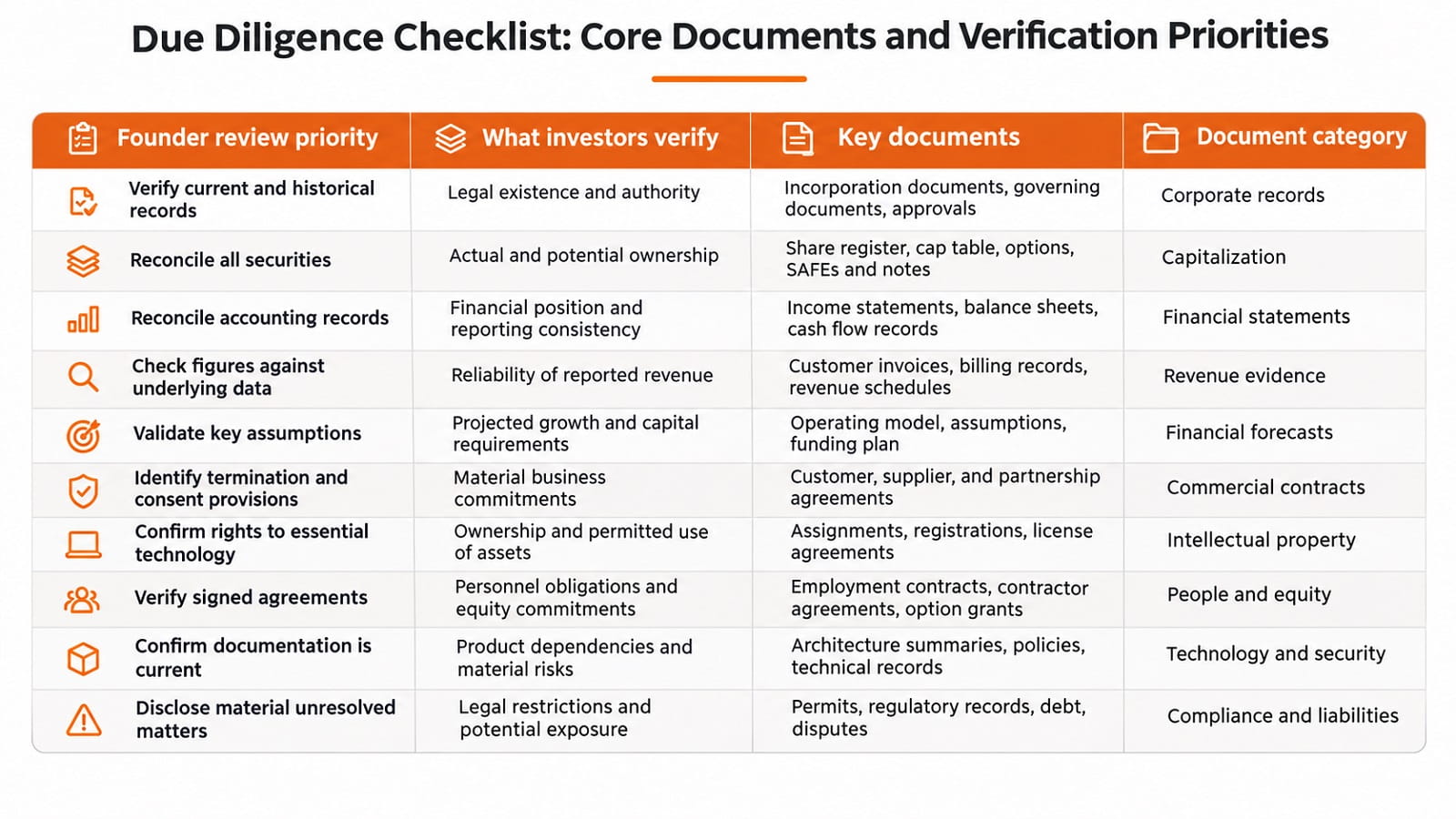
The table provides a starting framework rather than a universal document requirement for every company. An early business without customers will not have the same revenue documentation as an established subscription company, while regulated startups may require additional evidence. Founders should adapt the checklist to their circumstances and distinguish documents that are not applicable from records that should exist but cannot be located. This distinction allows investors to understand genuine limitations without treating every empty checklist item as an unresolved problem.
How to Prioritize Due Diligence Documents
Not every document deserves the same preparation priority. Founders should begin with records that support the company's basic legal identity, ownership, financial position, and rights to its principal assets. Problems in these areas can affect the proposed investment directly, making them more consequential than missing supplementary presentations or internal planning documents.
A practical approach is to separate documents into three readiness groups. The first contains information necessary to support initial investor discussions, including the pitch deck, capitalization table, financial summary, and evidence of core intellectual property rights. The second includes records that should be ready for a serious investment review, such as material contracts, detailed financial information, and corporate approvals. The third includes additional evidence that may be requested during a specialist assessment or transaction closing.
This prioritization should remain flexible. A startup developing medical technology may need certain regulatory records earlier than a company selling an ordinary consumer software product. Similarly, a company with complicated previous financing arrangements should verify its capitalization before sharing ownership projections. The correct order follows the potential significance of missing evidence rather than a fixed list of documents.
Tracking Missing Documents and Review Status
A checklist becomes more useful when it functions as an internal tracking system. Each document should have an identified owner, a review status, and an appropriate next action. Founders may also record the date of the latest version and whether the information is approved for sharing with external parties. This prevents incomplete records from being presented as final and makes it easier to coordinate work between finance, legal, and operational teams.
A simple status framework can distinguish documents that are ready, under review, missing, or not applicable. An additional category may be useful where information exists but requires correction before it can be shared. The distinction matters because an unsigned agreement creates a different problem from a document that has been finalized but has not yet been uploaded.
For example, if the finance team has prepared a revenue report but the reported totals disagree with the accounting records, marking the document as available would not adequately describe its condition. The company should record that reconciliation remains outstanding, assign responsibility, and avoid presenting the figures as verified until the discrepancy is resolved.
A Practical Document Readiness Example
Consider Cedar Analytics, a fictional software startup preparing for a $2 million seed financing. The company has a completed pitch deck, a current financial model, and customer contracts supporting its principal revenue claims. However, management discovers that its capitalization spreadsheet excludes one outstanding SAFE, a contractor agreement lacks clear intellectual property assignment wording, and the latest revenue summary has not been fully reconciled against accounting records.
The three findings require different actions. The capitalization model needs to incorporate the executed SAFE and its conversion terms, while the contractor agreement requires legal review to establish the company's rights. The revenue discrepancy must be investigated using accounting records and the underlying billing information. None of these issues should be treated as corrected until appropriate evidence supports the resolution.
The following table shows how Cedar could monitor the issues before sharing its final investment materials.
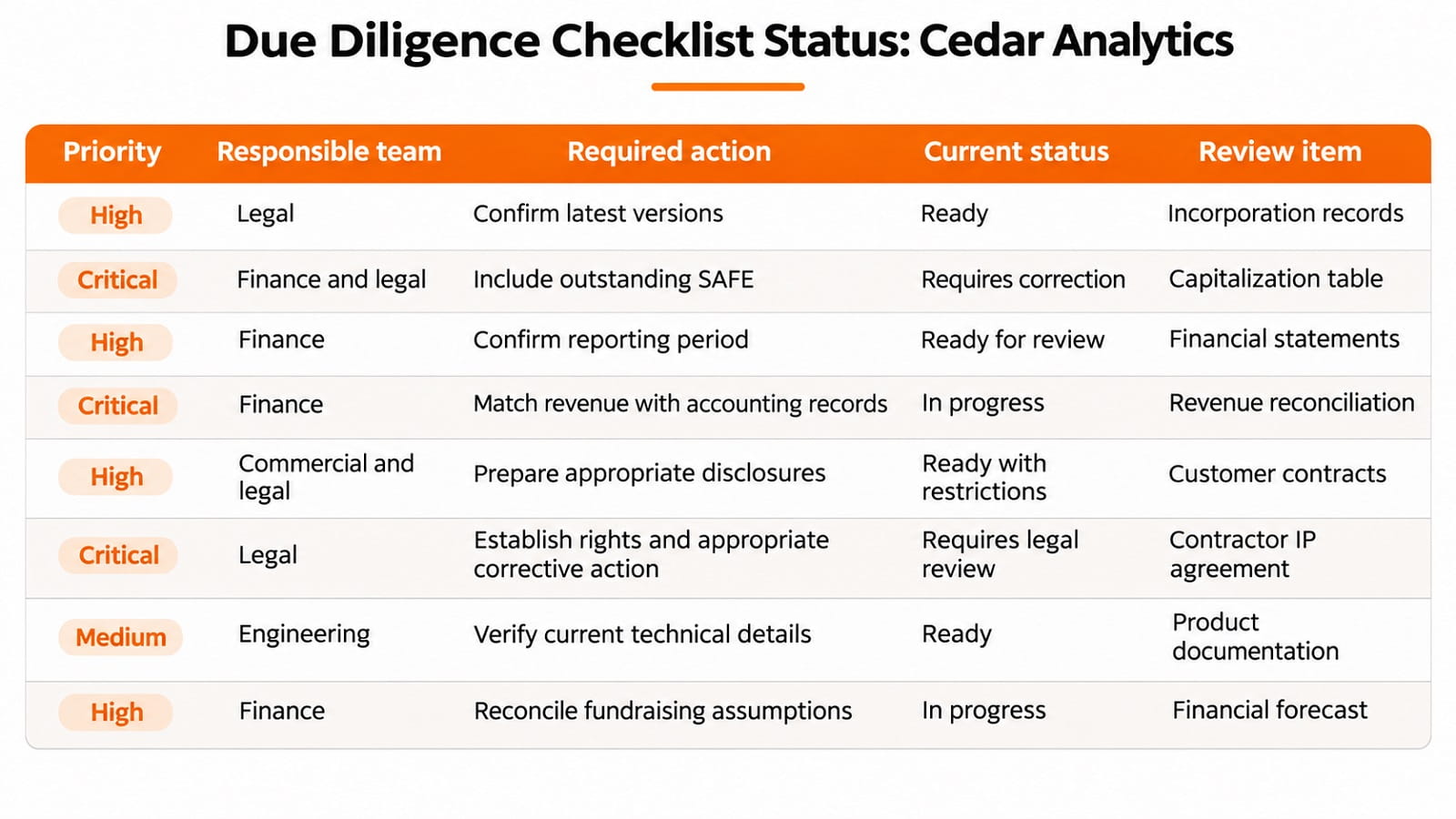
This example demonstrates how document availability and investment readiness can differ. Cedar possesses several essential records, but the capitalization, revenue, and intellectual property issues prevent management from treating the complete package as verified. Prioritizing these matters allows the company to address potentially material weaknesses before investors rely on the information. The status table is an internal management tool rather than evidence that the company has satisfied every legal requirement associated with the proposed financing.
Organizing the Checklist for Investor Access
After reviewing the documents, founders should arrange them in a controlled repository using clear categories and consistent naming conventions. Documents relating to corporate ownership should be distinguishable from financial statements, contracts, and technical materials. A file index can help reviewers identify what has been supplied and whether supporting records are available.
Access should be managed according to the sensitivity of each document. Highly confidential customer agreements, personal employee information, proprietary source code, and other restricted materials may require additional protections or staged disclosure. Founders should avoid granting unrestricted access to the entire document repository simply because a prospective investor has expressed interest.
Version control also matters. When a capitalization table or financial model changes, the company should identify the current approved version and preserve an appropriate record of earlier disclosures. Maintaining consistency between documents reduces confusion and allows investor questions to be answered using reliable information.
The checklist should identify which documents are ready to share, but it need not determine every access permission. Those decisions should reflect confidentiality obligations, applicable laws, and the circumstances of the transaction.
Common Due Diligence Checklist Mistakes
One common mistake is using document availability as the only measure of readiness. A company may have uploaded its shareholder agreement, financial statements, and customer contracts without confirming that the information is complete or consistent. Investors are interested in the substance of the records, not merely the number of files provided.
Another mistake is allowing several teams to maintain different versions of important information. Finance may calculate revenue using one definition while sales reports present another, or a pitch deck may show an ownership percentage that excludes outstanding convertible instruments. These differences should be identified and reconciled before external review.
Founders may also spend excessive time preparing documents with limited relevance while ignoring material gaps in essential records. A professionally formatted market presentation cannot resolve unclear intellectual property ownership or an inaccurate capitalization table. Preparation should prioritize the evidence that supports the transaction's fundamental assumptions.
Finally, companies sometimes respond to missing documents by producing explanations that imply an obligation has been fulfilled when it has not. An incomplete contract, absent approval, or unresolved compliance issue may require professional review. Accurate disclosure and documented corrective actions are more appropriate than assuming the matter will not be examined.
Maintaining the Checklist Between Funding Rounds
Due diligence preparation should not end when one investment closes. Startups regularly enter new contracts, hire employees, issue securities, develop intellectual property, and change their financial forecasts. These activities can make earlier records incomplete or outdated.
Management should assign responsibility for updating important corporate and financial information as changes occur. New equity grants should be reflected in capitalization records, relevant corporate approvals should be preserved, and material contracts should be stored with their executed versions. Financial reporting should also follow consistent definitions so that subsequent investment materials can be prepared without reconstructing historical data.
Maintaining an accurate checklist creates an operational benefit beyond fundraising. It helps founders understand the company's documentation obligations and identify gaps before they affect a transaction. A reliable internal record system can also make future acquisitions, financing rounds, or corporate restructuring easier to manage.
Final Thoughts
A due diligence checklist gives founders a structured way to prepare the evidence investors may need before committing capital. Its value comes from verifying the accuracy, completeness, and relevance of company records rather than simply collecting documents. Corporate ownership, financial reporting, commercial agreements, and intellectual property rights deserve particular attention because weaknesses in these areas can materially affect an investment decision.
An effective checklist should reflect the company's development stage and the requirements of the proposed transaction. Founders can improve readiness by prioritizing critical documents, assigning responsibility for unresolved issues, and ensuring that financial and ownership information remains consistent across internal records and fundraising materials.
Maintaining this discipline between financing rounds supports more reliable company management as well as investor preparation. When essential information is organized, verified, and appropriately controlled, founders are better positioned to respond to questions and proceed through investment discussions without preventable documentation delays.
FAQ
What Is a Due Diligence Checklist for Startups?
A due diligence checklist is an organized record of documents and information used to support an investor's evaluation of a startup. It commonly includes corporate documents, capitalization records, financial information, commercial contracts, intellectual property evidence, and applicable compliance materials. A useful checklist also identifies missing documents and the actions required to verify them.
What Documents Do Investors Request First?
Initial requests often include a pitch deck, financial overview, capitalization table, company formation records, and evidence supporting the startup's main business claims. The exact scope varies by investment stage and investor. More detailed contracts, accounting records, and technical documentation may be requested once discussions progress.
Does a Seed Stage Startup Need Audited Financial Statements?
Not every seed investment requires audited financial statements. Requirements depend on the jurisdiction, regulatory framework, investor expectations, and transaction structure. However, the absence of an audit does not remove the need for accurate accounting information and reliable financial records.
How Should Founders Handle Missing Documents?
Founders should identify why the document is unavailable, determine whether it is legally or commercially required, and assign responsibility for addressing the gap. Where corrective action requires legal or accounting expertise, appropriate professional review may be necessary. Material unresolved issues should not be represented as completed.
Is a Capitalization Table Enough to Prove Ownership?
A capitalization table summarizes ownership but should be supported by executed investment agreements, relevant corporate approvals, share records, and other applicable documents. Investors may examine these records to verify whether the reported percentages and potential dilution are accurate.
Should Startups Share Every Document Immediately?
Not necessarily. Document access should reflect the investor's legitimate review requirements and the sensitivity of the information. Confidential customer records, personal information, and proprietary technical materials may require additional controls or disclosure at a later stage.
How Often Should a Due Diligence Checklist Be Updated?
The checklist should be updated when material company information changes, including new investment agreements, equity issuances, significant contracts, or changes to financial reporting. Periodic internal reviews can also help identify outdated documents before the next fundraising transaction.
Can a Checklist Guarantee That a Startup Passes Due Diligence?
No. A checklist improves preparation and helps identify missing evidence, but it does not establish that the underlying business is financially sound, legally compliant, or suitable for investment. Investors must still assess the information and risks associated with the proposed transaction.

Mobina Khanki
Venture & Funding Writer at PinerookMobina Khanki covers venture capital, startup funding, fundraising, and startup finance for Pinerook, focusing on founders and investors.
 Seen first.