
Financial Due Diligence is the process of examining a startup's financial records, revenue quality, cash flow, liabilities, and future funding requirements before an investment or acquisition. Investors use this review to verify financial performance, identify material risks, and evaluate whether the business has enough capital to support its growth plans. The process also examines the reliability of reported earnings, operating costs, and financial forecasts to establish a clearer picture of the company's financial position.
Within Startup Due Diligence, financial examination connects a startup's fundraising narrative with its actual economic performance. A company may report substantial recurring revenue while depending heavily on nonrecurring contracts, or present a healthy cash balance without accounting for restricted funds and upcoming obligations. These differences can change how investors assess liquidity, future dilution, and the amount of capital required to reach the next milestone. Identifying them before an investment decision helps both founders and investors evaluate the transaction using more dependable information.
This guide explains how investors verify startup financial performance, assess cash consumption, evaluate revenue recognition, and test the assumptions behind financial projections. It also examines working capital, debt obligations, and the relationship between financial findings and investment terms. A practical example demonstrates how adjustments to reported revenue, available cash, and operating expenditure can materially change the financial picture presented during fundraising.
What Is Financial Due Diligence?
Financial due diligence is a structured investigation designed to establish whether a company's financial information accurately represents its performance, financial position, and potential future obligations. It goes beyond reviewing a profit and loss statement or checking a bank balance. Investors and financial advisers analyze how reported figures were produced, whether accounting practices are consistent, and what the underlying records reveal about the business's operating economics.
The scope of the investigation depends on the company's development stage and the proposed transaction. A pre-seed investor may focus on available cash, monthly expenditure, funding history, and the cost of reaching the next product milestone. An investor evaluating a revenue-generating Series A company may examine customer-level recurring revenue, gross margins, customer retention, and detailed financial forecasts. An acquirer may require a more extensive assessment of normalized earnings, working capital, indebtedness, and potential financial exposures.
Financial due diligence should also be distinguished from a statutory financial statement audit. An audit provides assurance about financial statements under the applicable auditing and reporting framework, while due diligence investigates matters relevant to a specific transaction. Audited statements may provide valuable evidence, but they do not replace an assessment of customer concentration, future financing needs, or the commercial assumptions supporting a startup's valuation.
How Investors Verify Startup Revenue
Revenue is often one of the first areas investors examine because it influences perceptions of growth, market adoption, and business value. The review begins by identifying how the startup defines revenue and whether the figures shown in its fundraising materials agree with its accounting and operating records. A company may present annual recurring revenue, total contract value, recognized accounting revenue, and cash collections, but these measures represent different economic concepts and should not be used interchangeably.
For example, a software company may receive payment for a twelve-month subscription at the beginning of a contract. Depending on the applicable accounting framework and contract terms, revenue for services provided throughout the year is generally recognized as the performance obligations are satisfied rather than simply when cash is collected. The upfront payment may therefore create a deferred revenue liability even though the company has already received the money. Investors examine these differences to determine whether revenue growth is being reported consistently.
Revenue Recognition and Recurring Income
For subscription businesses, annual recurring revenue is an important commercial metric, but it is not the same as recognized annual revenue under accounting standards. ARR usually represents an annualized measure of recurring subscription commitments or revenue, according to the company's stated methodology. Its calculation should exclude nonrecurring income that does not satisfy that definition.
A startup that includes implementation fees, one-time consulting work, or temporary services in its recurring revenue figure may overstate the stability of its commercial performance. Investors may reconstruct recurring revenue from customer contracts, billing records, subscription schedules, and cancellation data to establish a consistent measure.
The review also considers the company's revenue recognition policy. Different contractual arrangements can involve multiple performance obligations, variable consideration, discounts, and customer acceptance conditions. The appropriate treatment depends on the contractual substance and applicable accounting rules, making consistent classification essential.
Customer Concentration and Revenue Reliability
Revenue quality depends not only on accounting accuracy but also on the durability of the customer relationships supporting it. A startup generating a significant proportion of sales from one or two customers may face substantial financial exposure if those agreements expire or customer spending declines.
Investors may examine the proportion of revenue attributable to the largest customers, historical renewals, contractual termination rights, and payment performance. Customer concentration is not automatically evidence of poor management, particularly for young enterprise startups. However, it changes the risk associated with future revenue and may require additional scenario analysis.
For recurring revenue companies, investors can also evaluate customer churn, expansion revenue, contraction, and retention using underlying customer-level records. These measures help determine whether growth is supported by lasting customer demand or depends on continually replacing customers who leave.
Evaluating Startup Profitability and Cost Structure
Financial due diligence examines whether the company's reported margins accurately reflect the costs required to deliver its products or services. This involves reviewing how expenses are classified, whether relevant costs have been included, and whether the resulting margins are consistent over time.
Gross margin is particularly important for understanding operating economics. It is generally calculated by subtracting the cost of revenue from recognized revenue and dividing the result by recognized revenue. However, the calculation is only meaningful when the company consistently identifies the costs associated with delivering its products or services.
For a software business, cost of revenue may include relevant hosting expenses, third-party service charges, payment processing, and personnel directly responsible for delivering the service, according to the company's accounting policy. Costs associated with product development, sales, and general administration may be classified separately. The correct treatment depends on the accounting framework and the substance of the expenses.
Investors may question margins when cost allocation changes without explanation or when essential delivery expenses are excluded from the calculation. A company presenting an unusually high gross margin should be able to support its figures through consistent accounting records.
Quality of Earnings and Nonrecurring Items
For more established startups and acquisition targets, investors may examine the quality of earnings to determine whether reported profitability reflects sustainable operations. This can involve identifying unusual revenue, temporary expense reductions, exceptional transactions, or costs that are unlikely to recur.
An adjusted earnings measure should not simply remove every expense management considers inconvenient. Any adjustment requires a clear explanation and supporting evidence, particularly where the resulting figure influences valuation.
For early-stage startups that are not yet profitable, normalized earnings may be less informative than cash consumption, gross margin trends, and unit economics. The financial review should reflect the company's maturity rather than apply the same profitability expectations to businesses at fundamentally different stages.
Cash Burn Rate and Runway Assessment
Cash sustainability is a central concern when evaluating startups because many growing companies operate at a loss while developing products and acquiring customers. Even a business with attractive long-term prospects can encounter financial difficulties if it runs out of cash before reaching a critical milestone or securing additional funding.
Investors therefore examine how quickly the company consumes available resources and how its cash position is expected to change. Monthly net cash burn is commonly calculated as cash outflows minus cash inflows over a defined period, when outflows exceed inflows. It is important to distinguish this measure from accounting losses, which can include noncash items and timing differences.
A simplified runway calculation divides available unrestricted cash by monthly net burn:
\[ \text{Cash Runway}=\frac{\text{Available Cash}}{\text{Monthly Net Cash Burn}} \]
If a startup has $900,000 of usable cash and consistently consumes $150,000 per month, the simplified calculation indicates six months of runway. However, this estimate assumes a constant monthly burn rate and does not account for changes in revenue, hiring, capital expenditure, debt payments, or other obligations.
Understanding Changes in Cash Requirements
Investors should examine historical cash consumption alongside the company's forward-looking operating plan. A startup may have maintained low expenses by postponing hiring or product investments, but its burn rate could increase significantly once expansion begins.
Similarly, annual subscription prepayments can temporarily improve cash balances without eliminating future service delivery obligations. Uncollected receivables and irregular tax payments may also affect liquidity in ways that a simplified monthly average does not capture.
An effective assessment therefore uses a time-based cash forecast showing expected receipts, payments, and available balances. Scenario analysis can reveal whether the company has sufficient liquidity if customer payments arrive late, planned sales do not materialize, or operating expenses exceed expectations.
Working Capital, Debt, and Financial Obligations
A startup's available financial resources cannot be understood solely by examining its bank balance. Investors also need to consider the timing of customer payments, supplier obligations, accrued expenses, and other commitments that may require cash. These items influence the company's ability to finance ordinary operations and can reveal liabilities that are not obvious from a summary presentation.
Working capital analysis focuses on operating assets and liabilities, including receivables, payables, and relevant accrued balances. The exact definition used in an investment review or acquisition can vary, particularly where cash, debt, or certain non-operating items are excluded. Investors may examine overdue customer payments, aging supplier balances, and changes in collection periods to understand whether operations are generating or consuming cash.
Debt and financing commitments require separate consideration. Bank loans, venture debt, equipment financing, leases, and other obligations may involve scheduled payments, security arrangements, or contractual restrictions. Founders should also disclose outstanding convertible financing where relevant, although its accounting and contractual treatment differs from conventional debt. The aim is to establish the company's actual obligations and identify potential claims on future cash flows.
Tax liabilities and other accrued obligations can be particularly important when financial reporting is incomplete. Unpaid payroll taxes, unresolved sales tax matters, or significant unrecorded expenses may alter the company's financial position. Investors generally need evidence that these exposures have been identified and appropriately assessed, rather than relying on management's assumption that no material liabilities exist.
Key Financial Due Diligence Metrics and Verification Methods
Investors typically evaluate several financial indicators together rather than treating any single metric as proof of business quality. Revenue growth may appear attractive, but its value depends on customer retention, delivery costs, and the resources required to sustain expansion. Similarly, a positive cash balance provides limited reassurance if substantial payments are due shortly.
The following table summarizes the principal financial measures, the evidence commonly used to verify them, and the issues that can influence an investor's assessment.
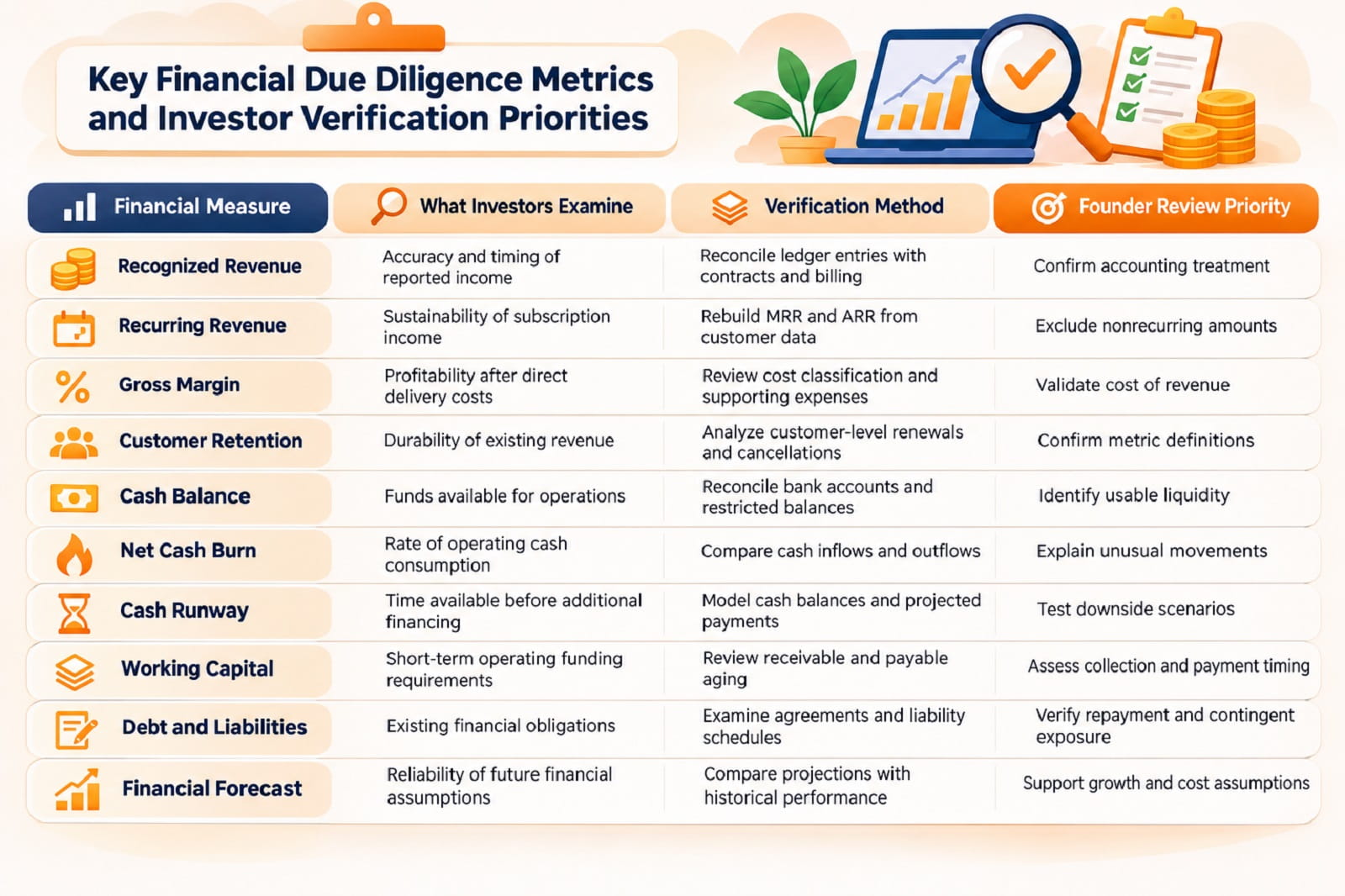
These measures become most useful when their relationships are examined rather than when they are presented as independent statistics. A company may show increasing recurring revenue while experiencing deteriorating retention or rising customer acquisition costs, indicating that growth requires further investigation. Similarly, a high reported cash balance may not translate into a long runway when upcoming liabilities and planned expenditure are considered. Investors should evaluate the consistency of the evidence supporting each metric and determine whether any differences materially affect the company's financial outlook.
Testing Financial Forecasts and Growth Assumptions
Forecasts are central to startup fundraising because investors often commit capital based partly on the company's expected future performance. Financial due diligence therefore examines whether projections are supported by credible operating assumptions and whether management has incorporated the costs necessary to achieve its targets.
A forecast should connect revenue growth to identifiable drivers. For a subscription business, those drivers might include new customer acquisition, existing customer expansion, churn, pricing changes, and the timing of commercial contracts. Expenses should reflect the people, infrastructure, sales activity, and other resources required to deliver the forecast growth.
Investors may compare previous forecasts with actual results to understand how accurately management has predicted business performance. Consistent differences between forecast and actual outcomes can indicate weaknesses in planning assumptions, although unexpected market changes may also explain deviations.
Base, Downside, and Upside Scenarios
A useful financial model should distinguish a central operating plan from alternative outcomes. A base case represents management's supported expectations, while a downside case tests conditions such as slower customer acquisition, higher churn, delayed collections, or increased operating expenditure.
An upside scenario can help evaluate the consequences of stronger-than-expected growth, including additional working capital, staffing, and infrastructure requirements. Faster revenue expansion does not always improve short-term cash flow when the company must spend ahead of customer payments.
Investors may use these scenarios to determine whether the proposed funding amount provides adequate liquidity. If the company can execute its plan only when every forecast assumption is achieved, the financing strategy may leave little room for unexpected developments.
A Practical Financial Due Diligence Example
Consider HarborCloud, a fictional subscription software startup seeking $3 million in Series A financing. Its investor presentation reports $1.5 million in annual recurring revenue, a gross margin of 78%, and $900,000 in cash. Management also estimates monthly net cash burn at $100,000, implying approximately nine months of runway.
During the financial review, investors reconcile the reported figures with subscription contracts, general ledger records, bank statements, and the company's recent expenditure. They identify several differences that alter the financial position initially presented.
Reassessing Revenue and Profitability
HarborCloud's $1.5 million headline recurring revenue figure includes $180,000 in one-time implementation services. These services may represent valid recognized revenue under the applicable accounting framework, but they should not be included in an ARR metric intended to measure recurring subscription income.
After removing the nonrecurring component, the adjusted ARR becomes $1.32 million. This does not automatically reduce recognized accounting revenue by the same amount; it corrects the definition of the recurring revenue metric.
The review also identifies direct service delivery costs that were previously classified outside cost of revenue. After applying a consistent cost allocation policy, the illustrative gross margin declines from 78% to 70%. Investors can then evaluate the operating economics using a more consistent cost base.
Recalculating Available Cash and Runway
The company initially reports $900,000 in cash, but $60,000 is contractually restricted and unavailable for ordinary operating expenditure. Usable cash is therefore $840,000.
The review also identifies recurring cash payments that were omitted from management's simplified burn calculation. After reconciliation, average monthly net cash burn increases from $100,000 to $140,000.
Under a constant-burn assumption, the revised runway is:
\[ \frac{\$840,000}{\$140,000}=6\text{ months} \]
The following table compares management's original figures with the results of the illustrative financial review.
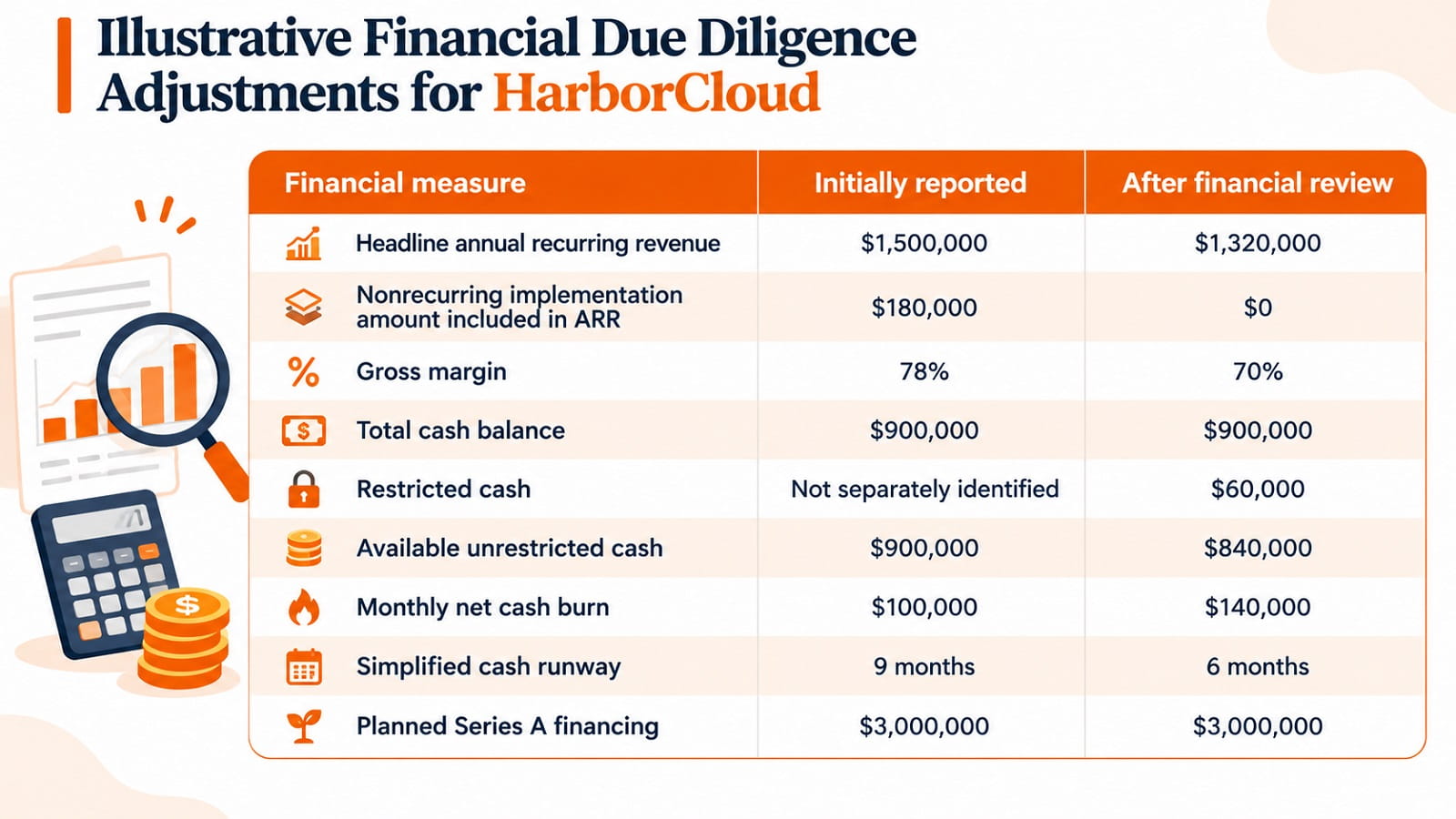
The example demonstrates how financial due diligence can change an investor's understanding without establishing that the underlying business lacks potential. HarborCloud still has recurring customers and a meaningful cash balance, but its sustainable revenue measure, profitability, and liquidity differ from the initial presentation. Most significantly, the estimated runway declines by three months after accounting for restricted funds and previously omitted expenditure. The founders must therefore reconsider the timing of their fundraising and the resources required to reach the milestones supporting the next investment decision.
Interpreting the Financial Findings
HarborCloud's situation illustrates the importance of distinguishing reporting corrections from operational problems. Including implementation services in recurring revenue is a metric classification issue that can be corrected through consistent definitions and supporting schedules. The gross margin adjustment may indicate that management needs to improve cost allocation, but it also provides investors with a clearer picture of service delivery economics.
The revised runway creates a more immediate financial concern. Six months of estimated cash coverage may leave the company vulnerable if financing negotiations take longer than expected or if operating expenditure increases. A detailed monthly forecast is therefore necessary to establish when liquidity pressure could arise and whether the company needs to modify spending, financing timing, or its proposed funding plan.
The company should explain each adjustment transparently and provide evidence supporting the corrected figures. Investors can then evaluate whether the differences represent manageable reporting weaknesses or indicate broader concerns about financial controls and management forecasting.
Financial Due Diligence Red Flags
Certain financial findings require additional investigation because they can undermine the reliability of the company's reported performance. Material revenue differences, unexplained bank reconciliation items, inconsistent accounting policies, and unsupported financial projections are examples of issues that may affect an investment decision.
Other concerns can arise when a company excludes recurring operating expenses from its reported profitability, fails to recognize important liabilities, or presents customer growth without accounting for cancellations. Related-party transactions and unusual cash transfers may also require explanation, particularly when they are not clearly documented in the financial records.
The significance of a warning sign depends on the circumstances. An accounting classification error that can be reconciled and corrected is different from intentionally misstated financial information. Investors should establish the cause, amount, and potential continuing impact of each finding before determining its importance.
Founders can improve financial readiness by investigating discrepancies before presenting final numbers. Consistent accounting practices, documented metric definitions, and reliable forecasts make it easier to explain the business's financial position and address legitimate investor concerns.
How Financial Findings Affect Investment Decisions
Financial due diligence can influence whether an investor proceeds with a transaction and how the investment is structured. Findings that change expected profitability, cash requirements, or outstanding obligations may affect valuation discussions, financing amounts, and the conditions that must be satisfied before closing.
For example, a shorter-than-expected runway may lead investors to examine whether the proposed financing amount is sufficient to support the company's operating plan. Significant customer concentration or uncertain revenue recognition may prompt more conservative growth assumptions.
In an acquisition, financial findings may also influence purchase price calculations, working capital adjustments, debt treatment, and contractual protections. The relevance of these mechanisms depends on the transaction and should not be assumed to apply identically to ordinary venture equity financing.
The purpose of the review is not necessarily to eliminate every financial risk. It is to understand the company's actual position well enough to evaluate whether the proposed transaction remains commercially and financially reasonable.
Preparing Financial Records Before Investor Review
Founders can reduce unnecessary delays by maintaining monthly financial statements, reconciling cash accounts, documenting revenue classifications, and preserving evidence supporting important operating metrics. A consistent financial reporting process is particularly valuable because investors may compare several periods to evaluate trends rather than rely on the latest month alone.
The company should also maintain a financial model that connects historical results to future assumptions. Revenue projections, hiring plans, operating costs, and cash requirements should follow consistent definitions so that management can explain how the forecast was developed.
Responsibility for financial information should be clearly assigned. An internal finance lead or qualified external professional may coordinate accounting records, metric reconciliation, and investor responses. Important adjustments should be documented rather than silently changing figures between successive versions of the financial model.
Financial preparation is most effective when it improves the company's own decision-making as well as its fundraising readiness. Reliable revenue, margin, and cash information helps management identify problems early and evaluate whether its operating plan remains financially sustainable.
Final Thoughts
Financial due diligence helps founders and investors distinguish attractive financial presentations from the underlying economic performance of a startup. By verifying revenue, evaluating margins, examining cash consumption, and assessing outstanding obligations, the review establishes a more reliable basis for understanding the company's strengths and financial risks.
The most useful findings are not always the most dramatic. A corrected revenue definition, revised cost allocation, or more accurate cash forecast can materially improve investment decisions without changing the company's fundamental commercial opportunity. Founders who understand these differences can communicate their financial position more effectively and plan future capital requirements with greater confidence.
Maintaining consistent financial records, credible forecasts, and transparent reporting strengthens readiness for investment while improving everyday financial management. A company that understands where its cash comes from, how it is spent, and which assumptions support future growth is better equipped to evaluate financing opportunities and manage uncertainty.
FAQ
What Is Financial Due Diligence for Startups?
Financial due diligence is the investigation of a startup's financial statements, revenue, expenses, cash flows, liabilities, and forecasts before an investment or acquisition. Its purpose is to verify reported information, identify material financial risks, and support an informed transaction decision.
What Financial Documents Do Investors Usually Request?
Investors commonly request financial statements, accounting records, bank reconciliations, revenue schedules, financial forecasts, debt agreements, and relevant tax information. The scope depends on the company's stage, business model, and the proposed transaction.
How Do Investors Calculate Startup Burn Rate?
Net cash burn is commonly calculated by subtracting cash inflows from cash outflows during a period when the company consumes more cash than it receives. Investors may reconcile these movements with bank records and evaluate whether the observed rate is representative of future expenditure.
What Is the Difference Between ARR and Recognized Revenue?
ARR is an annualized commercial measure of recurring subscription revenue, calculated according to a defined methodology. Recognized revenue is recorded under the applicable accounting rules when revenue recognition requirements are satisfied. Annualized recurring commitments and accounting revenue therefore should not be treated as interchangeable figures.
Do Pre-Revenue Startups Need Financial Due Diligence?
Yes. Even when a company has no meaningful revenue, investors may examine cash balances, spending patterns, financing history, capital requirements, and projected costs. The emphasis shifts from historical profitability toward liquidity, financial controls, and the resources required to achieve future milestones.
Can Financial Due Diligence Change a Startup's Valuation?
Yes. Findings affecting revenue quality, profitability, liabilities, or future financing requirements may influence how investors evaluate the company. The effect depends on the significance of the findings and the investment's commercial circumstances.
Is Financial Due Diligence the Same as a Financial Audit?
No. A financial statement audit provides assurance under an applicable auditing framework, while due diligence examines financial information in relation to a particular transaction. Audited statements may support due diligence but do not replace it.
What Happens When Investors Discover Financial Discrepancies?
Investors may request additional explanations, supporting records, accounting corrections, or revised forecasts. Material findings can influence transaction terms or lead investors to reconsider the opportunity. The outcome depends on whether the discrepancy can be reliably explained and how it affects the company's financial position.

Mobina Khanki
Venture & Funding Writer at PinerookMobina Khanki covers venture capital, startup funding, fundraising, and startup finance for Pinerook, focusing on founders and investors.
 Seen first.