Generative Engine Optimization (GEO) is the practice of improving how a brand, website, or product appears in answers generated by AI search systems such as ChatGPT, Google AI, and Perplexity. Unlike traditional search visibility, the goal extends beyond earning a position in search results. It includes being recognized, accurately described, recommended, and cited when people ask AI systems for information.
A useful GEO strategy begins with the questions customers ask, the information AI systems can find, and the evidence supporting a brand's claims. The real challenge is connecting those elements to business outcomes rather than treating every AI mention as a success.
How to Build a Generative Engine Optimization Strategy
The most effective starting point is not rewriting an entire website. It is identifying the questions that influence customer decisions and establishing whether the business appears in the answers.
We approach GEO as a sequence of connected activities: understand the search demand, establish current visibility, improve the information available to AI systems, and measure the results.
Identify the Questions That Influence Customer Decisions
Traditional keyword research provides a useful foundation, but AI search introduces longer and more specific questions.
A person researching accounting software might search Google for "best accounting software." In an AI assistant, the same person can describe their company size, budget, existing tools, and reporting requirements before requesting a recommendation.
That distinction changes how topics should be prioritized.
Start with questions collected from customer conversations, sales calls, support requests, product comparisons, and existing search data. Group them according to the decisions users are making.
For a software company, these groups could include product discovery, feature comparisons, pricing considerations, integrations, and implementation requirements.
The objective is to identify topics where the business has a legitimate reason to appear in the answer.
Establish a Baseline Across AI Search Platforms
Before changing content, examine how different AI systems currently describe the business.
Use a consistent set of representative questions and record whether the response mentions the brand, recommends its product, cites its website, or describes its capabilities accurately.
A mention and a recommendation are not the same result. A brand can appear in a response without being presented as a suitable option for the user's needs.
Record the platform, question, date, language, cited sources, and response. These details make subsequent comparisons meaningful.
The initial findings should reveal three distinct opportunities: relevant questions where the brand is absent, answers where competitors are referenced instead, and responses containing incomplete or outdated company information.
Prioritize Pages With Commercial Relevance
Not every page deserves the same GEO investment.
We prioritize pages that influence purchase decisions or contain information customers need to evaluate a business. Product documentation, pricing explanations, service pages, research, and detailed comparisons are stronger starting candidates than articles covering broad topics unrelated to the company's expertise.
Consider a project management platform with extensive articles about workplace productivity but limited documentation about its integrations.
Publishing more general productivity content does not resolve the information gap for someone asking an AI assistant which project management platforms integrate with their existing software.
The better investment is making accurate integration information publicly accessible, complete, and verifiable.
This approach gives the strategy a clear connection to what the business offers.
How Generative AI Search Finds and Uses Information
Understanding how AI systems obtain information helps explain the difference between making a page discoverable and making it useful as a source.
AI search experiences can combine language models with information retrieval systems. When an answer is grounded in external sources, the system retrieves relevant material and uses it to support its response.
Google's AI search features use retrieval techniques connected to Google's search systems. They also employ query fan out, which expands a complex question into related searches to gather supporting information.
A question about choosing payroll software, for example, can involve separate information needs concerning pricing, compliance, integrations, and company size.
A business does not need to appear for every variation of the original question. Its content needs to provide useful information for the parts of the decision it can genuinely address.
ChatGPT, Perplexity, and Google's AI features have different retrieval systems and interfaces. Their source selection and response generation processes are not identical.
It is also important to distinguish three outcomes:
Brand mention: The AI response names the company or product.
Source citation: The response identifies a page or document as supporting information.
Referral visit: The user follows a link from the AI experience to the website.
These outcomes measure different kinds of visibility. A citation does not guarantee a visit, and a brand mention does not establish that the company's website was used as a source.
The Relationship Between GEO and Traditional SEO
The distinction in GEO vs SEO is primarily about how visibility is experienced and measured.
Traditional SEO improves a website's presence in search results. GEO focuses on how information about a brand or website appears within AI generated answers.
The underlying work overlaps substantially. Search engines and AI search systems both depend on accessible information, relevant content, reliable sources, and clear website structure.
Google explicitly treats optimization for its generative search features as part of SEO. It does not require a separate GEO markup format or special optimization technique for eligibility in AI Overviews and AI Mode.
The difference becomes more visible when evaluating performance.
A page can earn organic search traffic without appearing in a particular AI generated answer. An AI assistant can also mention a company without generating a website visit.
This changes how marketing teams assess search visibility. Rankings and organic traffic remain important, but they no longer describe every interaction between a prospective customer and a brand.
Rather than replacing established SEO work, GEO extends the evaluation to AI generated discovery, attribution, and recommendations.
Content Quality and Evidence in GEO
The strongest content investment is information that contributes something useful beyond what competing pages already explain.
For AI Search Content Optimization, we focus on the facts, experiences, and evidence that make a page valuable to readers and suitable for reference.
Original research, product testing, documented processes, transparent comparisons, and clearly explained expertise provide information that cannot be recreated by simply paraphrasing existing articles.
For example, an article reviewing customer relationship management software becomes more useful when it explains the products tested, evaluation criteria, integration limitations, and relevant pricing conditions.
A generic list of features provides less help to someone making a specific purchasing decision.
Information must also be current. Pricing, product availability, company policies, and technical capabilities can change. Pages containing these details should be maintained using the underlying source records rather than updated solely to display a recent publication date.
Clear headings, descriptive tables, and readable text help people navigate complex information. They also make it easier to identify the claims and evidence presented on a page.
There is no need to rewrite every paragraph into artificially small sections for AI systems. Google has explicitly stated that special content chunking is not required for its generative search features.
The objective is to make the content understandable, accurate, and useful.
Brand Authority and AI Search Citations
Website content is only one part of a company's information footprint.
AI systems can encounter information about businesses through independent publications, industry reports, product directories, reviews, and other publicly available sources.
This makes consistency particularly important.
A company describing itself as an enterprise software provider on its website should not have outdated public profiles presenting a different product category, old company name, or discontinued service.
A useful GEO review compares the business's official information with the descriptions available across relevant external sources.
The goal of AI Search Citations is to improve the conditions under which a page can be discovered and selected as supporting evidence. No publisher can require an AI system to cite a particular website.
Credible third party coverage can provide additional evidence about a business, especially when the publication contributes independent research or verification.
Manufactured endorsements and repetitive promotional mentions do not provide that evidence.
The more useful approach is to make genuine expertise visible through accurate documentation, original contributions, independent coverage, and consistent business information.
Technical Accessibility Across AI Search Platforms
Content quality cannot compensate for a page that the relevant retrieval system cannot access.
For Google AI Overviews and AI Mode, a page must meet Google's search eligibility requirements, including being indexed and eligible to appear with a snippet.
There is no separate technical registration process required for these features.
The situation differs for ChatGPT Search. OpenAI identifies OAI SearchBot as the crawler used for search discovery. Website owners need to ensure that their access policies and infrastructure permit the relevant crawler when they want their content available for search inclusion.
This is an important part of ChatGPT SEO, but allowing crawler access does not guarantee placement in an answer.
The practical work behind AI Crawler Optimization includes reviewing crawler permissions, server responses, access restrictions, and the availability of important content in a readable format.
The distinction between search discovery and model training also matters. Search crawlers and training crawlers can serve different purposes, and website owners should make access decisions according to those purposes.
There is no universal file or markup specification that guarantees AI visibility.
For Google Search specifically, the company states that llms.txt is not required and does not improve eligibility for generative search features.
Technical accessibility creates the conditions for discovery. Whether content becomes part of a response remains a separate question.
GEO Implementation Roadmap
A GEO program becomes easier to manage when each activity has a defined output and a method of verification.
The following workflow provides a practical structure for an initial implementation.
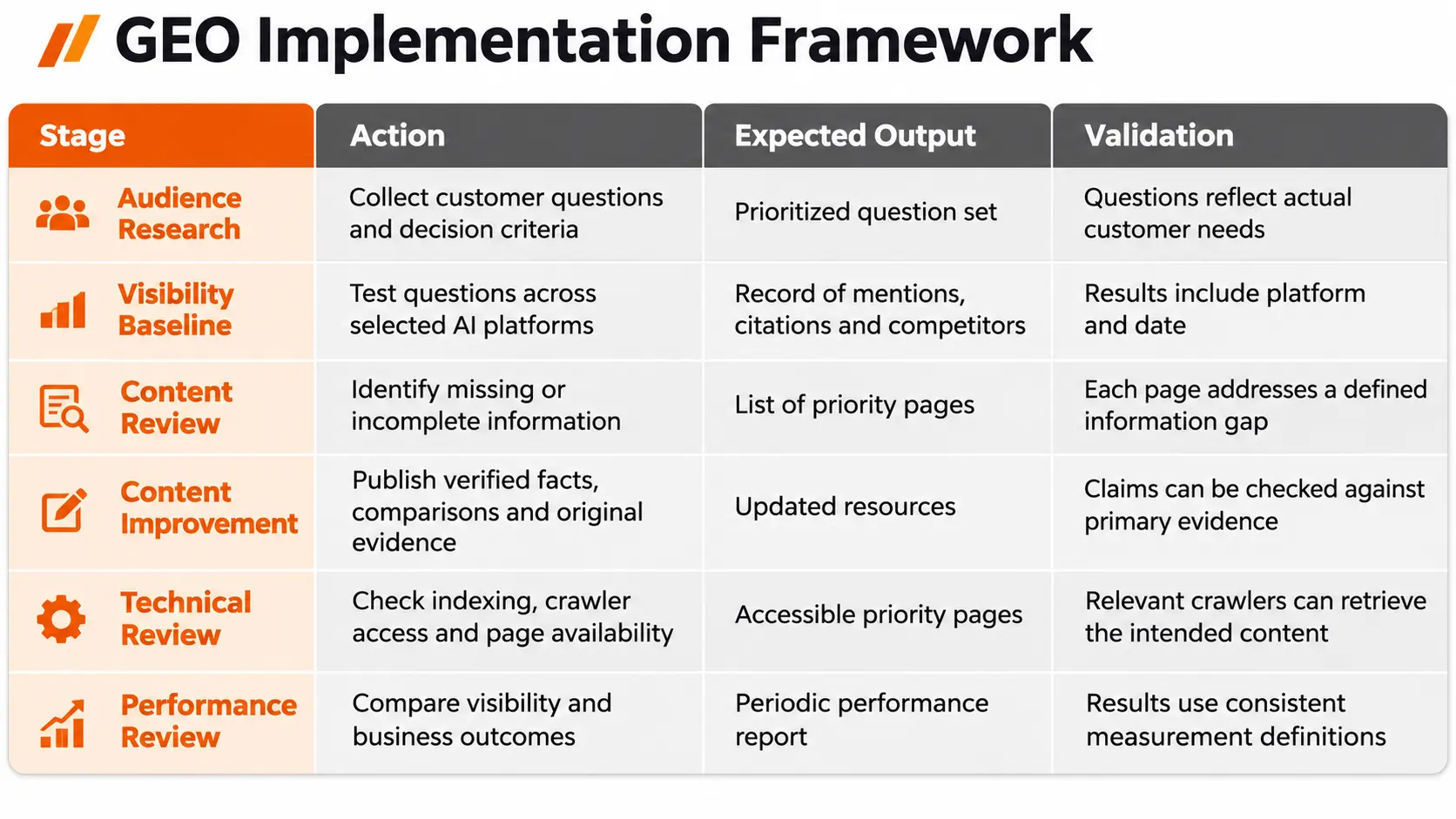
The order matters. Optimizing content before identifying the questions users ask creates activity without a clear business objective.
The same applies to measurement. A reporting dashboard has little value if the team has not established what constitutes a relevant mention, a useful citation, or a successful customer interaction.
For an initial project, a focused group of important questions and commercially relevant pages provides a more manageable evaluation than attempting to optimize every published URL.
Measuring Generative Engine Optimization Performance
GEO measurement requires more than counting how many times a company's name appears in AI responses.
We separate visibility, accuracy, and business impact.
Visibility measures whether the brand or its content appears in relevant answers. Accuracy establishes whether the response describes the business correctly. Business impact examines the visits and actions associated with AI discovery.
AI Search Visibility Tracking connects these measurements across platforms and reporting periods.
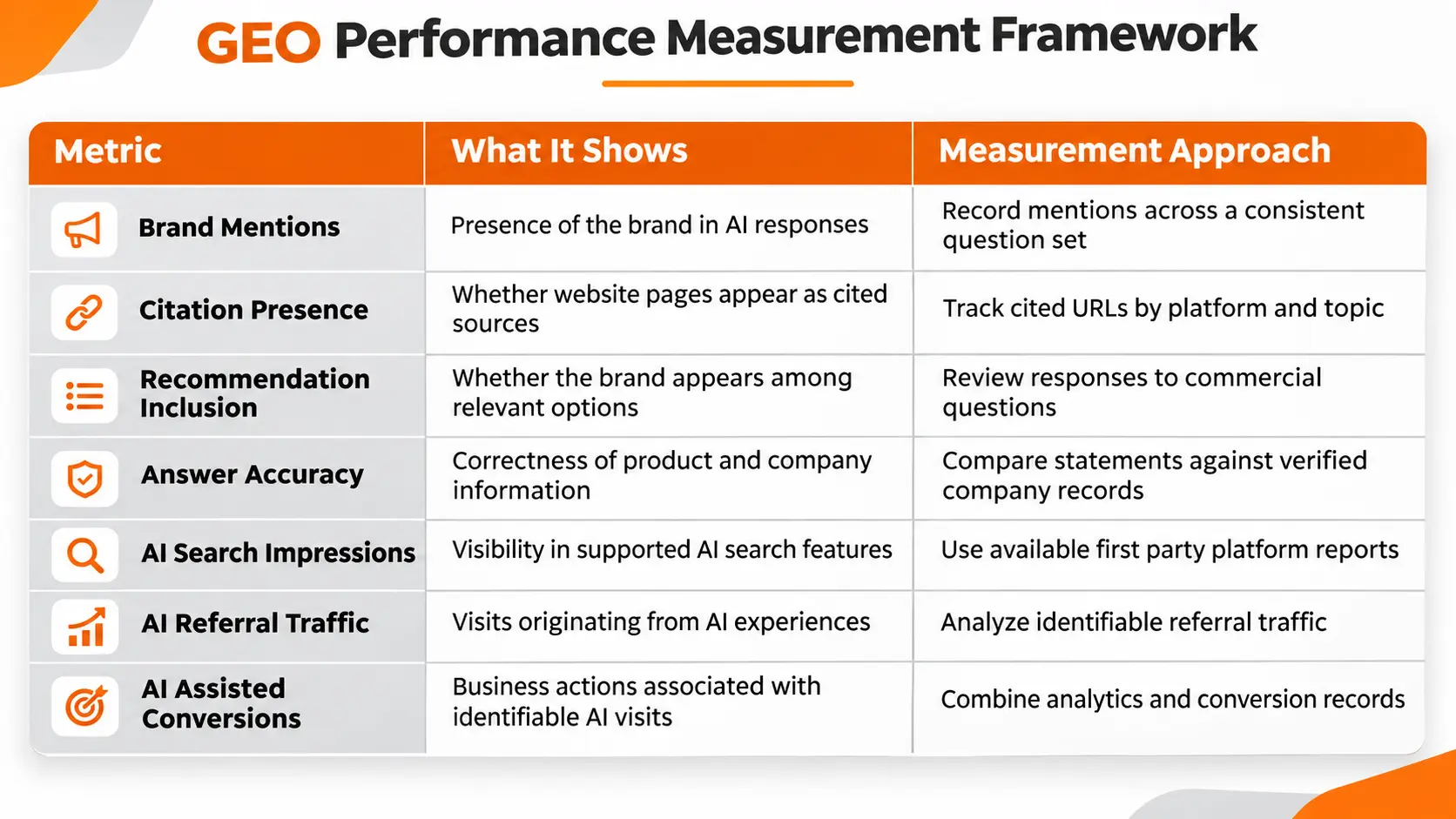
These metrics should not be combined into a single score without explaining how the score is calculated.
A company appearing in an informational answer has achieved a different outcome from a company recommended during a purchase comparison.
Current Platform Reporting
Measurement capabilities have advanced beyond manually collecting AI responses.
Google introduced dedicated Generative AI performance reports in Search Console in June 2026 and completed their global rollout in August 2026. These reports provide information about impressions, pages, countries, devices where available, and performance over time.
Bing Webmaster Tools also introduced AI Performance reporting in 2026. Its capabilities include citation activity, referenced pages, grounding queries, and additional insights into topics and competing sources.
These tools report different information and should not be treated as interchangeable measures of total AI visibility.
For ChatGPT, identifiable referral traffic provides another useful signal. It measures users reaching the website, not every instance in which ChatGPT mentions or cites the brand.
Independent monitoring tools can extend coverage across multiple platforms, but sampled responses are not a complete record of every answer shown to every user.
Evaluating GEO as a Business Investment
GEO deserves a place in a marketing strategy when AI search participates in how customers research, evaluate, or select products and services.
The investment should follow the value of those decisions.
A business selling specialized software has a clear reason to prioritize technical comparisons, integrations, and evaluation criteria. A local service business needs accurate service information, locations, availability, and credible customer evidence.
Publishing a high volume of broad informational articles does not resolve these distinct needs.
We would judge progress through changes in relevant brand visibility, the accuracy of recommendations, qualified referral traffic, and measurable customer actions.
There are limits to attribution. A customer can encounter a brand in an AI answer and visit its website through another channel later. Without identifiable evidence, that interaction cannot be assigned a precise conversion value.
The business case should therefore distinguish directly observed outcomes from estimated influence.
A successful GEO strategy improves the information available to prospective customers while giving the business a clearer understanding of its presence in AI driven discovery.
The Long Term Role of GEO in Search
Generative search changes the way people interact with information, but it does not eliminate the need for trustworthy websites.
AI platforms still require relevant material to support factual answers, comparisons, and recommendations. Businesses remain responsible for making their information accurate, accessible, and useful.
The sustainable approach is to develop content and public information that deserve to be referenced, then evaluate whether AI systems actually use them.
Generative Engine Optimization is most valuable when it connects discoverability with credibility and customer decisions. Strong performance is not simply appearing in more AI responses. It is appearing accurately in the answers that matter to the people a business wants to reach.
FAQ
Can we do GEO if our company doesn't have a blog?
Yes. A blog is not a requirement for GEO. A business can publish useful information through product pages, documentation, service descriptions, research resources, and other publicly accessible pages. The appropriate content format depends on what customers need to understand before making a decision.
What if an AI assistant keeps showing our old company name?
The business should first verify that its official website, organization details, product documentation, and relevant external profiles consistently display the current name. Outdated information should be corrected at its source. Changes in AI responses depend on the platform's retrieval and information update processes, so the correction cannot be assumed to appear immediately.
Can GEO work for a business targeting several countries?
Yes. Each target market should be evaluated using its own language, customer questions, product availability, and regulatory context. Translating existing pages is insufficient when the underlying customer requirements differ. Geographic visibility should be measured separately wherever platform reporting supports that distinction.
Will AI search pick up information hidden behind a customer login?
Content requiring authentication is not publicly accessible to standard web crawlers. Publicly available summaries, specifications, and supporting documentation can communicate information intended for wider discovery without exposing protected customer materials. Access controls should remain in place for private information.
What if an AI assistant recommends our competitor using incorrect information about us?
The first step is to preserve the exact question, response, platform, and date. The incorrect statements should then be compared against current official information and any cited sources. Where the platform provides a feedback mechanism, the inaccurate response can be reported. Publishing clear corrective information improves the available evidence but does not guarantee an immediate change to future recommendations.

Fatemeh Jahangard
Technology & AI Writer at PinerookFatemeh Jahangard covers AI, emerging technologies, and digital innovation for Pinerook, focusing on how technology shapes startups and industries.
 Seen first.