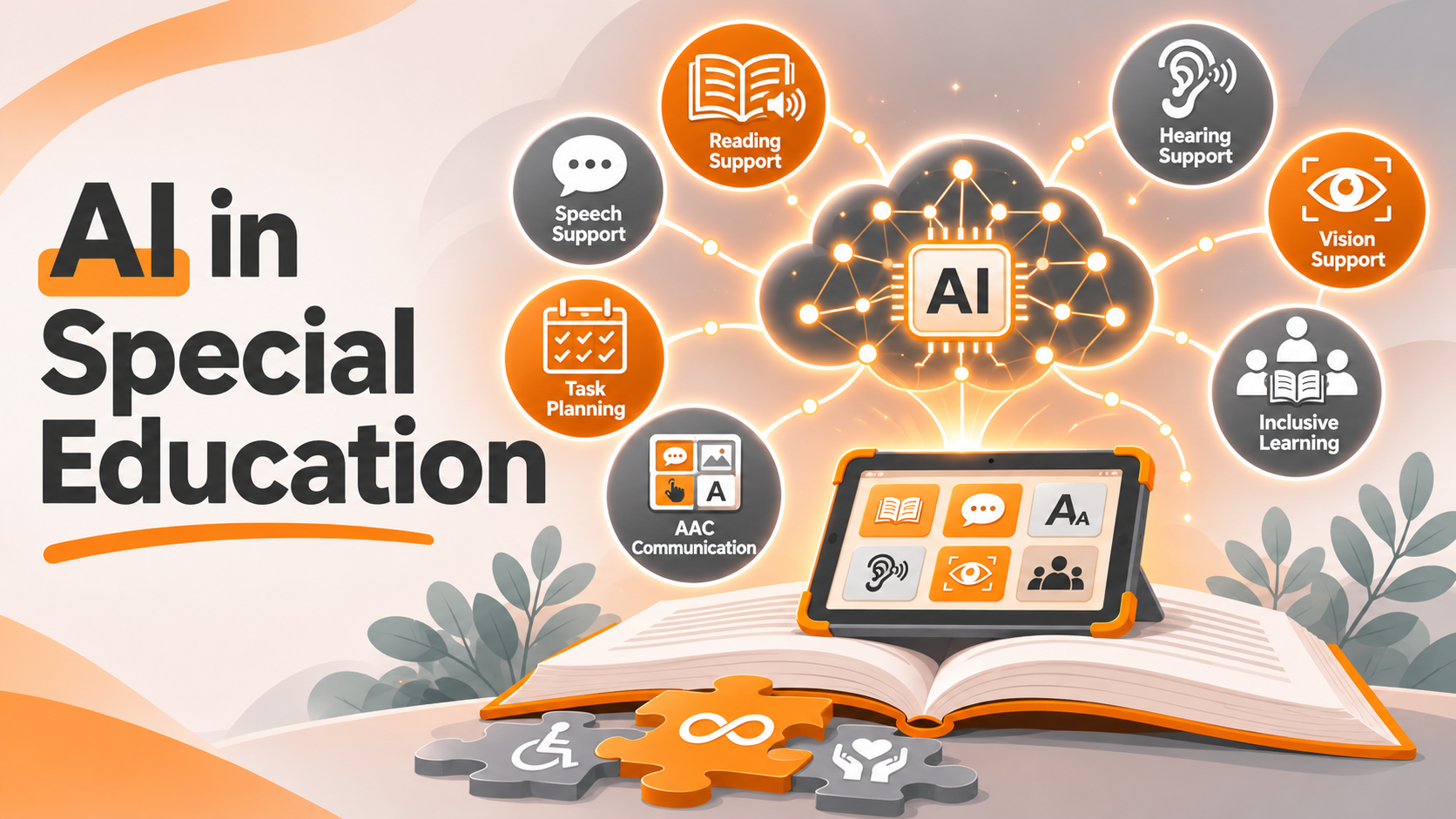
AI in special education helps students with disabilities access lessons, communicate, practise essential skills, and participate more independently in the classroom. Teachers can use it to adapt learning materials, support reading and writing, and prepare individualized instruction without rebuilding every resource from scratch.
The difference becomes clear when a student needs more than a standard worksheet or verbal explanation. AI can provide another way to access the same learning objective. Its value, however, depends on how well that support meets the individual student's needs, not simply how advanced the technology is.
Applications of AI in Special Education
The strongest applications of artificial intelligence in special education address barriers that teachers and students encounter during ordinary classroom activities. Reading a lesson, expressing an answer, following instructions, and demonstrating understanding can require different forms of support.
Reading and Writing Support
AI powered reading tools can provide spoken versions of written material, identify challenging words, and create additional reading practice.
For students with dyslexia or other reading difficulties, these features offer alternative ways to engage with educational content. A student can listen to a passage while following the text or practise specific words with guided feedback.
AI can also help teachers adjust the language of instructional materials. For example, a complex science passage can be rewritten using simpler sentence structures while preserving its essential concepts.
We consider that distinction important. Adapting the language should make the lesson accessible without removing the knowledge the student is expected to learn.
Writing assistance serves a related purpose. Speech recognition, word prediction, and structured writing prompts can help students express ideas when spelling, handwriting, or written organization presents a barrier.
Communication and Speech Support
Students with limited functional speech need reliable ways to communicate their choices, questions, and ideas.
Augmentative and alternative communication, known as AAC, includes communication boards, symbol systems, and speech generating devices.
AI can extend these systems through context aware word prediction, language processing, and adaptive communication suggestions.
For example, a student selecting symbols on a communication device can receive suggested words that help complete a message. The student remains in control of what the device communicates.
Not every AAC system uses artificial intelligence, and more advanced prediction does not automatically make a communication system better.
Speech language pathologists need to evaluate whether the technology matches the student's communication abilities, preferred language, and method of interaction.
Visual and Hearing Accessibility
AI assistive technology can make educational materials more accessible to students with visual or hearing disabilities.
Computer vision systems can recognize printed text, identify objects, and generate spoken descriptions of images.
For a student with limited vision, this can provide information about a document or physical object that would otherwise require another person's description.
AI supported captioning and speech recognition offer access to spoken classroom information through text.
The accuracy of these features matters. Automated captions can misrepresent technical vocabulary, while generated descriptions can omit details from diagrams and scientific illustrations.
Teachers should verify important content and ensure that AI tools complement, rather than replace, required accessibility services.
Individualized Learning Activities
Students receiving special education services do not all learn through the same instructional format.
AI can help teachers prepare activities with different levels of language complexity, presentation formats, and practice requirements.
For example, a teacher introducing fractions can prepare an activity using visual representations for one student and structured verbal instructions for another.
The mathematical objective remains the same, but the route toward understanding changes.
For students who benefit from predictable sequences and explicit instructions, AI can help educators draft visual schedules, break classroom tasks into manageable steps, and prepare practice scenarios.
These materials require teacher review because a student's disability label alone does not determine their learning preferences or support needs.
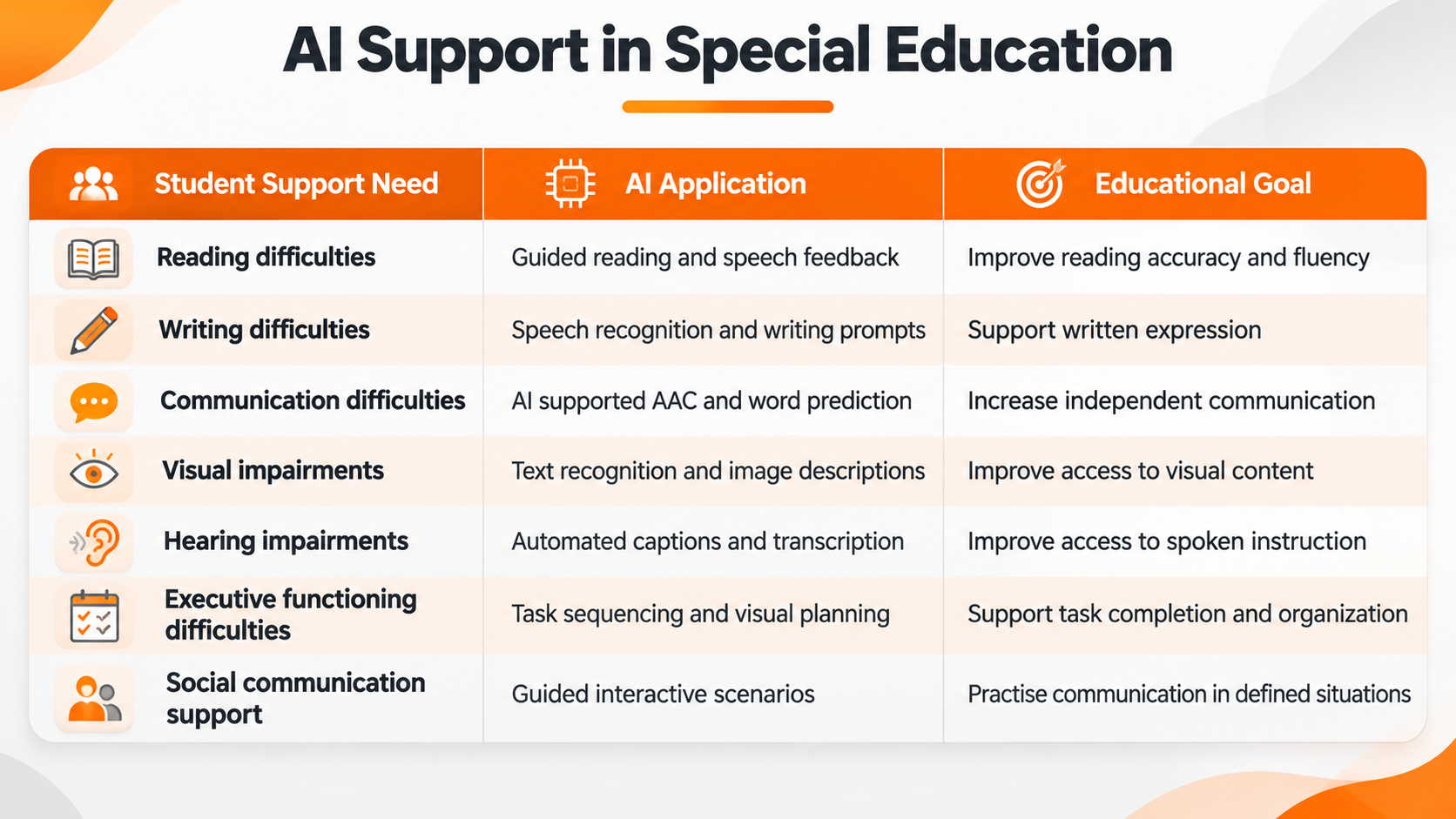
The most useful way to choose an AI application is to begin with the educational barrier, not the student's diagnosis.
Two students with the same disability can have different communication abilities, learning preferences, and academic goals. A tool that supports one student does not automatically meet the needs of another.
The following table connects common educational needs with relevant AI applications and the outcomes teachers should evaluate.
These are examples of possible instructional matches, not recommendations based on diagnosis alone.
The appropriate support depends on the student's assessed needs, existing accommodations, and professional guidance. Teachers should judge success by changes in participation and demonstrated skills rather than the number of times a student uses the tool.
Real Examples of AI in Special Education
The clearest evidence of practical AI use comes from specific educational settings. These examples show what schools and technology providers have implemented without assuming that every application produces the same results.
Microsoft Reading Coach for Reading Practice
Microsoft Reading Coach uses artificial intelligence to create personalized reading activities and identify words that students find challenging.
Students read aloud while the system analyzes their reading accuracy and fluency. The platform then provides additional practice based on the words identified during the activity.
Teachers can assign reading passages and examine information about student progress.
For special education, its value lies in creating structured opportunities for reading practice. A student working toward a fluency goal can practise targeted words without waiting for the teacher to prepare a completely new activity.
The tool is not a substitute for specialized reading instruction or a diagnostic assessment. Its performance information should support, rather than determine, instructional decisions.
Microsoft Seeing AI for Visual Access
Microsoft Seeing AI is an accessibility application developed for people who are blind or have low vision.
It uses artificial intelligence to recognize text, describe objects, and communicate information about the surrounding environment.
In an educational setting, a student can use its capabilities to access printed information or receive descriptions of unfamiliar objects.
This offers a practical example of how AI can support independent access to information.
However, generated image descriptions need verification when the material contains essential academic detail. A description of a scientific diagram must communicate the relationships that matter to the lesson, not simply identify the objects shown.
Mesquite Independent School District for IEP Preparation
A 2026 Education Week report described how Mesquite Independent School District in Texas introduced an AI system to support the preparation of individualized education programs.
The system brings together information from district platforms and helps educators identify patterns in student performance.
It also identifies missing sections in IEP documentation without independently deciding which educational interventions a student should receive.
District educators reported that preparation time fell from as much as three hours to approximately 45 minutes per student.
This is a meaningful example of administrative support because the technology assists with organizing information while educators retain responsibility for interpreting student needs.
The reported time savings belong to that district's implementation and should not be treated as a guaranteed result for other schools.
AI for Special Education Teachers and IEPs
Special education teachers manage responsibilities that extend beyond classroom instruction. They prepare individualized education programs, document student progress, coordinate services, and communicate with families.
AI can support this work by organizing observational notes, drafting measurable learning objectives, and converting classroom data into structured summaries.
A 2026 study published in Frontiers in Education examined the use of generative AI for special education practice. Participants described benefits in preparing IEP goals, organizing information, and producing instructional materials. The study also reinforced the need for professional review of generated content.
Supporting Individualized Education Programs
An individualized education program, or IEP, describes a student's educational needs, measurable goals, services, and accommodations.
AI can help teachers prepare draft language or identify sections requiring further attention.
For example, a teacher developing a reading goal can use an approved AI system to organize the target skill, assessment method, and progress criteria into a structured draft.
The actual goal must still reflect the student's documented performance and the decisions of the IEP team.
Under the United States Individuals with Disabilities Education Act, responsibility for developing and reviewing an IEP belongs to the designated team, which includes the student's parents.
AI cannot independently determine eligibility, prescribe services, or replace that decision process.
Preparing Accessible Teaching Materials
Teachers can use generative AI to prepare alternative explanations, comprehension exercises, vocabulary activities, and visual learning resources.
Consider a classroom studying the water cycle.
One student needs a shorter reading passage. Another needs a sequence of illustrated steps. A third needs accessible text that can be read through assistive technology.
AI can help prepare these versions from the same instructional objective.
The teacher's responsibility is to ensure that each version remains accurate, accessible, and consistent with the student's learning goals.
This approach connects the efficiency of lesson preparation with the actual purpose of specialized instruction.
Benefits of AI in Special Education
The benefits of AI in special education should be evaluated through student participation and educational progress.
Improved access to learning materials is one benefit. Students who struggle with conventional written or spoken instruction gain additional ways to engage with the curriculum.
Independent communication is another important outcome. When a student can express a choice or request assistance through an appropriate communication system, the technology supports meaningful participation.
Teachers also benefit when AI reduces repetitive preparation and documentation.
The central question is whether that saved time translates into better instruction, stronger collaboration with families, or more individual attention.
Research published in Social Sciences in 2025 reviewed 15 studies on AI applications in special education. It identified promising uses in personalized learning, communication, and support for learners with disabilities, while emphasizing limitations in available evidence and implementation.
We should therefore distinguish between a technology that demonstrates a useful capability and one that has been shown to improve educational outcomes.
A successful application needs measurable evidence of progress.
Limitations of AI in Special Education
The consequences of an inaccurate AI response are greater when the tool influences accessibility, communication, or individualized educational planning.
Inaccurate and Inaccessible Outputs
Generative AI can produce instructions that are inappropriate for a student's reading level or omit important details from educational material.
Automated speech recognition can also struggle with speech patterns that differ from those represented in its training data.
These limitations matter because inaccessible or inaccurate output can prevent a student from completing a task even when the software appears to function correctly.
Accessibility must be tested with the intended student and activity rather than assumed from the product description.
Privacy of Student Information
Special education records contain sensitive information about learning needs, evaluations, services, and student progress.
In the United States, the Family Educational Rights and Privacy Act governs the disclosure of personally identifiable information from education records.
Educators should use approved systems and follow institutional data protection requirements before submitting student information.
Removing a student's name is not sufficient when other details can identify the individual.
Bias and Individual Differences
AI systems can produce recommendations influenced by incomplete training data or assumptions about disability.
A student with autism, for example, should not automatically receive a particular instructional strategy because an AI model associates that strategy with the diagnosis.
Educators need to evaluate the actual student's abilities, preferences, and educational goals.
The student's perspective is important in determining whether an assistive tool increases independence or creates an additional barrier.
Responsible AI Use in Special Education Classrooms
Responsible implementation begins with a clearly identified student need and a suitable educational objective.
We would start with one activity that currently presents a barrier. A teacher could select a reading task, introduce an approved AI support, and observe how the student performs compared with the existing method.
The evaluation should focus on the student's ability to participate, understand the material, and complete the intended task.
For technology affecting communication or accessibility, the decision should involve the appropriate specialists and the student.
Families should also understand what the tool does, which information it processes, and how its effectiveness will be reviewed.
The Center on Inclusive Technology and Education Systems, supported by CAST, emphasizes collaborative decisions that involve educators, families, assistive technology specialists, and students.
This provides a stronger basis for implementation than adopting a tool simply because it includes an AI feature.
It also reflects an important principle of AI in Education: technology should expand access to meaningful learning without reducing human responsibility for educational decisions.
Final Thoughts
AI in special education offers practical support for reading, communication, accessibility, lesson preparation, and individualized educational planning.
Its strongest applications address an identified barrier while preserving the student's ability to participate and demonstrate understanding.
For educators, the priority should be selecting appropriate support and verifying its educational value. For students, the goal is greater access, independence, and participation.
Artificial intelligence becomes useful in special education when it serves those goals rather than allowing the technology itself to determine how a student should learn.
FAQ
Does my kid's school have to pay for an AI tool in their IEP?
In United States public schools, assistive technology required for a student to receive a free appropriate public education must be provided without charge to the family under IDEA.
An AI tool must first be determined to be an appropriate required support. This does not mean that schools must purchase every application requested by a parent.
Can my child use their school AI tool at home too?
Under IDEA regulations, school purchased assistive technology must be made available for home use when the IEP team determines that access outside school is necessary for the student to receive a free appropriate public education.
Families should discuss the circumstances of home use, training requirements, and technical access with the IEP team.
What if the AI can't understand my child's speech?
The student should have access to a communication method that does not depend on successful speech recognition.
A speech language pathologist can assess alternatives such as symbol selection, direct typing, or other AAC access methods. The selected system should allow the student to communicate reliably.
Can I find out what information an AI app keeps about my child?
Parents can request information from the school about the applications it uses, the data collected, and the provider's retention practices.
In the United States, FERPA provides eligible parents with rights to inspect and review their child's education records. Whether particular application data falls within those records depends on how the information is maintained and used.
Can my child use AI during an exam if they have accommodations?
Permitted assistance depends on the student's documented accommodations and the rules governing the assessment.
Families and educators should clarify whether the tool is authorized before the examination. Approval for assistive technology during instruction does not automatically establish permission for every assessment.

Fatemeh Jahangard
Technology & AI Writer at PinerookFatemeh Jahangard covers AI, emerging technologies, and digital innovation for Pinerook, focusing on how technology shapes startups and industries.
 Seen first.