
AI search content optimization means improving website content so it gives clear, accurate, and useful answers to questions people ask through ChatGPT, Perplexity, and Google AI Search. The most effective starting point is to review existing pages, replace vague information with specific details, and make important answers easy to find.
The content side of Generative Engine Optimization (GEO) works best when every change serves a real reader. A page does not need a separate AI version or a rigid writing formula. It needs information that people can trust, understand, and use to make decisions.
How to Optimize Content for AI Search
Start with a page that already serves a defined audience. The goal is to improve the quality of its answers without changing the subject or creating unnecessary content.
A practical content optimization process follows five steps:
Identify the reader's task. Establish the specific information someone needs from the page.
Review the existing answer. Find unclear explanations, missing details, unsupported claims, and outdated information.
Improve the content structure. Place the most relevant information where readers can find it without searching through unrelated paragraphs.
Add verifiable details. Include accurate product information, original evidence, useful comparisons, and documented limitations.
Evaluate the revised page. Compare its search performance and AI visibility against a recorded baseline.
These steps belong to a single editorial process. There is no reason to rewrite a page around dozens of AI related keywords when the existing content already answers its intended question.
The more useful test is whether someone reading the revised page can make a better informed decision than they could before.
Selecting Existing Pages for AI Search Optimization
Not every published page deserves the same attention. We prioritize content according to its relevance to customer decisions and the information missing from the current version.
Commercial and Product Comparison Pages
Product comparisons, service descriptions, integration documentation, and purchasing guides deserve close attention because readers use them to evaluate specific options.
Consider a company selling project management software. Its website contains an article about improving team productivity, but the product page provides little information about integrations, user permissions, and reporting capabilities.
For someone comparing project management platforms, the product page has the more immediate information gap.
Improving that page gives readers the details needed to determine whether the product fits their requirements.
This does not mean informational articles have less value. It means optimization priorities should follow the decisions the content supports.
Pages With Incomplete Answers
A page can attract organic search traffic and still provide an incomplete answer.
For example, an article comparing cloud storage services might explain available storage capacity without discussing file recovery, collaboration permissions, or data residency.
Those omissions matter to a business deciding where to store sensitive operational documents.
Reviewing customer questions, internal search data, support conversations, and relevant search queries helps identify the information readers still need.
The objective is not to add every related topic. It is to complete the answer the page promises to provide.
Improving Content Structure and Clarity
Good content structure helps readers locate information and understand how individual details relate to the broader subject.
For AI search content optimization, the same principle matters. The content should state what it means without requiring readers to interpret promotional language or search across unrelated sections.
Clear Headings and Direct Explanations
Each heading should identify the subject covered underneath it.
A heading such as "Powerful Features" gives little information about what follows. "Reporting and Analytics Features" establishes a specific expectation.
The opening sentences should then explain the available functionality before introducing supporting details.
There is no requirement to turn every heading into a question. A descriptive heading can communicate the subject more effectively.
Likewise, short paragraphs are useful when they improve readability, but splitting every sentence into a separate block does not establish better AI search performance.
Google explicitly states that special content chunking is not required for AI Overviews or AI Mode.
The structure should reflect the information, not a formatting rule created solely for search engines.
Precise Language and Context
Broad marketing claims rarely help someone evaluate a product or service.
Statements such as "advanced technology," "seamless integration," and "powerful analytics" should be replaced or supported by details explaining the actual capabilities.
For instance, describing an analytics platform as providing automated reports is less informative than identifying which reports it generates, where the data comes from, and how users receive the results.
The useful details are the ones that answer the customer's next question.
When a feature has a limitation, include that limitation instead of allowing the reader to assume the feature does more than it actually supports.
AI Search Content Optimization Examples
A practical way to understand content improvement is to compare vague copy with a more specific version.
The following examples use a fictional business software platform. They illustrate editorial improvements rather than tested changes in AI search rankings or citations.
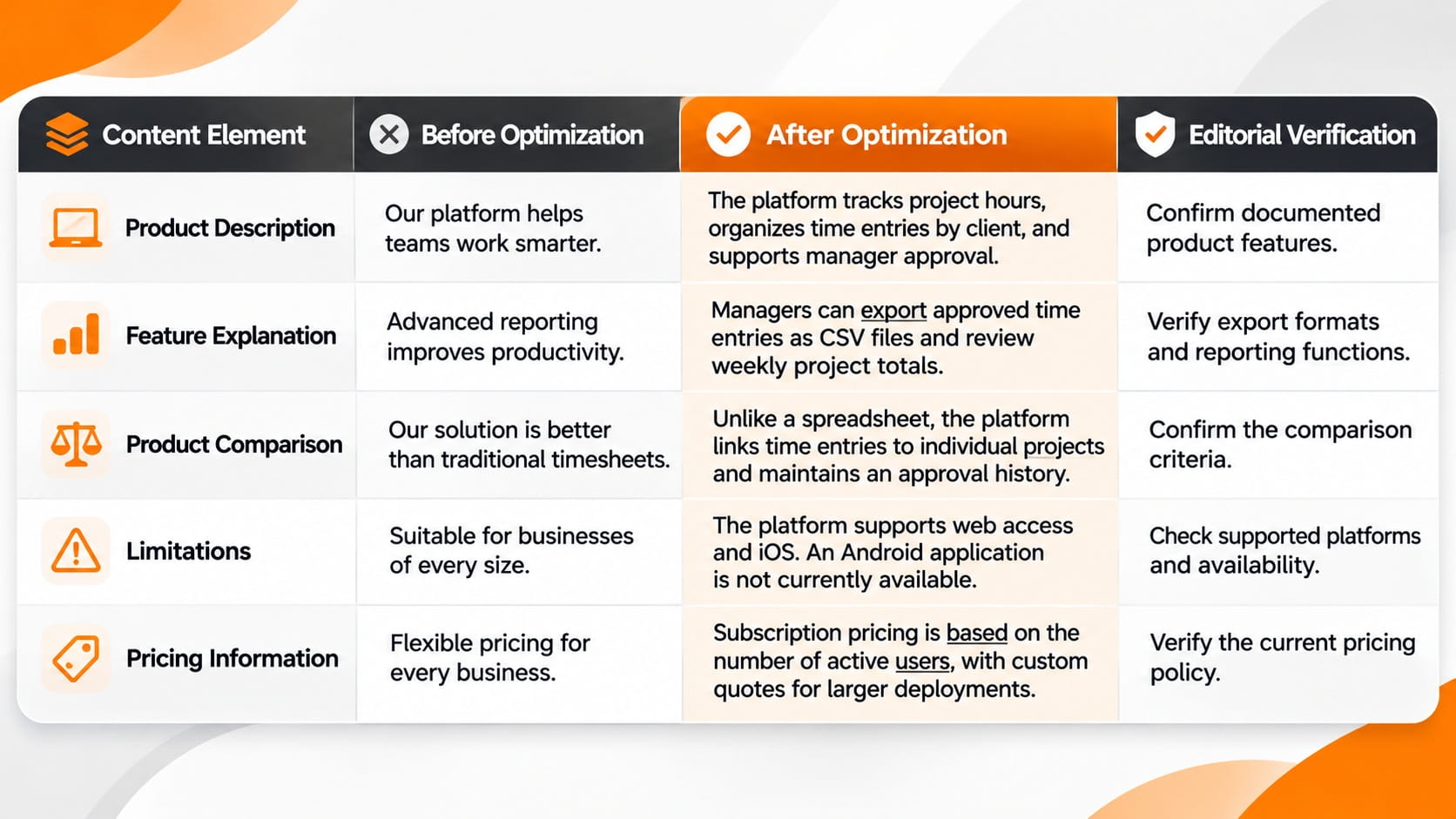
Subscription pricing is based on the number of active users, with custom quotes for larger deployments.
Verify the current pricing policy
The revised examples are more useful because they communicate specific information. They do not depend on exaggerated language or unsupported performance claims.
The same editing approach applies to educational content.
An article about cloud computing becomes stronger when it explains the actual differences between deployment options rather than repeating that cloud services improve flexibility and efficiency.
The goal is to replace assumptions with details that readers can evaluate.
Adding Original Evidence and Useful Information
Content becomes more valuable when it contributes information that is not available in every competing article.
For a software review, that information can come from documented product testing. For an industry report, it can come from a defined research method and a clearly described dataset.
For a service business, it can include documented project requirements, delivery processes, and the conditions that affect pricing or implementation.
Product Tests and Original Research
If an article claims that a software product performs faster than a competing option, the comparison needs supporting evidence.
The reader should be able to identify the tested versions, relevant conditions, measurement method, and actual results.
Without those details, the statement remains a promotional claim.
The same standard applies to percentages and industry statistics. A number should identify what was measured and the population or dataset behind it.
Adding numbers without reliable evidence does not improve the substance of the content.
Source Attribution and Editorial Accountability
Information drawn from external research should be distinguishable from the publisher's own findings.
A reader needs to understand whether a statement comes from an official product specification, independent research, or an observation made during testing.
This distinction is particularly important for technical, financial, and business content.
An editorial review should also identify who is responsible for maintaining the information. Clear authorship and relevant expertise help readers evaluate the material.
These practices improve the reliability of the page itself. They do not guarantee that a particular AI platform will select it as a source.
Optimizing Product and Comparison Content
Product and service pages present a different editorial challenge from general educational articles.
The person reading a product comparison needs enough information to determine which option satisfies a defined requirement.
A comparison that only lists advantages leaves important questions unanswered.
Feature Compatibility and Restrictions
For a business software comparison, prioritize capabilities that influence adoption.
These include supported integrations, access permissions, available platforms, implementation requirements, and relevant restrictions.
If the product supports an integration only through a paid plan, that condition belongs alongside the feature description.
The reader should not have to consult several additional pages to understand a material limitation.
Pricing and Availability Information
Pricing content should communicate the purchasing model accurately.
When a product offers fixed subscription plans, identify the plan conditions and relevant limitations.
When pricing requires a custom quote, explain the factors that determine the quote rather than inventing an estimated price.
Availability also matters. A feature announced for a future release should not be presented as available today.
This level of precision helps readers compare options without relying on assumptions.
Maintaining Content Accuracy and Freshness
A well written page can become unreliable when the information it contains changes.
This is particularly relevant for software, finance, technology, and other subjects involving product updates, pricing changes, or evolving requirements.
Content maintenance should follow changes in the underlying information rather than arbitrary publishing schedules.
Updating Facts Without Rewriting the Entire Page
When a product changes its pricing model, the relevant pricing section needs revision.
There is no reason to rewrite an accurate technical explanation elsewhere on the page merely to make the article appear new.
The same principle applies to product comparisons. A newly introduced feature should be reflected in the comparison criteria, with existing claims checked against current product documentation.
Publication dates should describe actual editorial activity rather than create an artificial impression of freshness.
Preserving the Original Search Intent
A content refresh should improve the page's answer without changing its primary subject.
If an article explains how to choose accounting software, adding unrelated sections about artificial intelligence, automation trends, and general business productivity can weaken its focus.
Those subjects deserve inclusion only when they help the reader evaluate accounting software.
The strongest refresh preserves the original purpose while improving completeness, accuracy, and clarity.
Evaluating AI Search Content Improvements
Content optimization needs an evaluation process that distinguishes published changes from observed outcomes.
Before editing a page, record its current search performance and the relevant AI responses in which it appears.
The evaluation should use a consistent group of questions reflecting the page's intended audience.
After publication, examine whether the revised content appears in relevant responses, whether the information is represented accurately, and whether the cited sources have changed.
Content Level Measurements
For each revised page, record its URL, primary search intent, revision date, and the substantive information added or corrected.
Then compare relevant impressions, organic visits, identifiable AI referrals, and citations wherever those measurements are available.
A brand mention should not be counted as a citation unless the response identifies a source.
A citation should not be counted as a website visit unless the user actually follows a link.
This distinction prevents visibility measurements from being confused with business outcomes.
Interpreting the Results
AI search responses vary across platforms, question phrasing, locations, and retrieval conditions.
A change in citations after a content update does not establish that the update caused the difference.
For a more useful comparison, retain the original questions, document the testing conditions, and review the same set over time.
The result is a record of observed performance rather than an unsupported claim about how an AI search algorithm works.
Building a Sustainable Content Optimization Process
AI search content optimization works best as part of normal editorial maintenance.
The content team identifies important customer questions, checks whether existing pages answer them, and improves the information where necessary.
Product specialists verify technical claims. Editors preserve clarity and consistency. Performance reviews identify pages that deserve another examination.
There is no need to create a separate content library for AI search or publish duplicate versions of articles already serving their audience.
The strongest content improvement is one that makes a page more useful even if no AI system ever cites it.
That is the practical standard worth maintaining. Clear answers, specific facts, reliable evidence, and accurate comparisons serve readers directly while providing a stronger foundation for discovery across search environments.
FAQ
Can we keep the same URL after rewriting most of an article?
Yes. Keeping the existing URL is appropriate when the revised article serves the same primary purpose. A substantial rewrite does not require a new address. If the subject changes enough to justify a different page, the site should evaluate its URL structure and apply appropriate redirects when replacing an existing resource.
Will AI search understand a comparison table saved as an image?
An image does not provide the same text accessibility as an HTML table. Important comparison data should also be available in readable text. Images can support the explanation, but they should not be the only place where essential product specifications or comparison results appear.
Can we use AI tools to rewrite our existing content?
Yes. AI tools can assist with drafting, restructuring, and editing. However, factual claims, product specifications, research findings, and references must be verified before publication. The quality and accuracy of the finished material remain the publisher's responsibility.
What if our prices change every week?
The page should describe the applicable pricing model and use an approved source for current prices. Where automated pricing updates are available, the published information should reflect the authoritative pricing system. Unsupported fixed amounts should not be presented as current prices.
Do translated articles need their own AI search optimization?
Yes. Each language version should reflect the terminology, customer requirements, and product availability of its target market. Direct translation does not establish that the same examples, comparisons, and purchasing considerations are relevant in every country.

Fatemeh Jahangard
Technology & AI Writer at PinerookFatemeh Jahangard covers AI, emerging technologies, and digital innovation for Pinerook, focusing on how technology shapes startups and industries.
 Seen first.