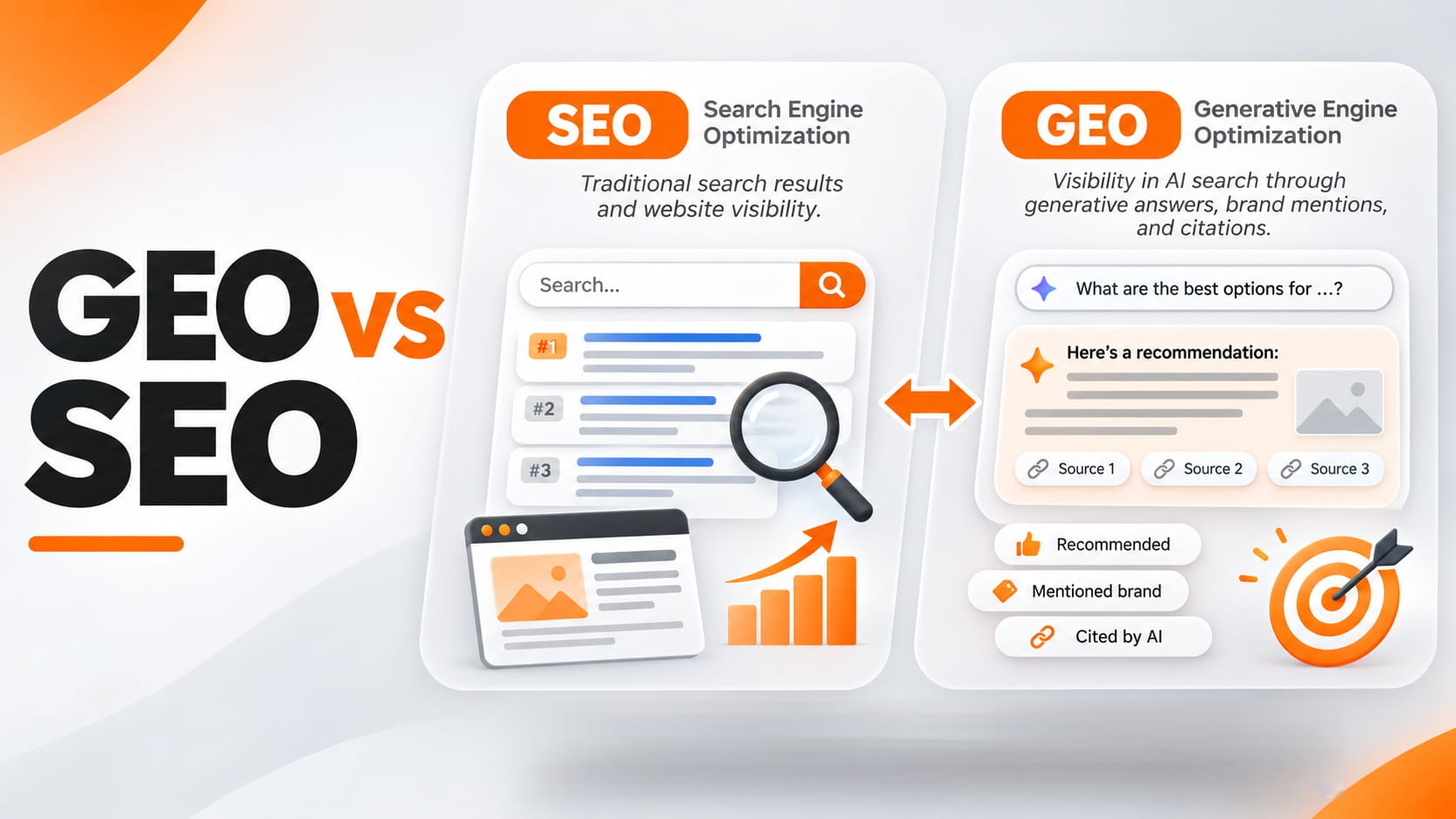
GEO and SEO both improve a brand's visibility in search, but they measure success differently. SEO focuses on making websites discoverable through search engines, while Generative Engine Optimization (GEO) examines whether a brand or its content appears in AI generated answers, recommendations, and citations.
Neither replaces the other. Google Search, ChatGPT, and Perplexity create different opportunities for discovery, and businesses need to understand where their customers make decisions. The important question is not which strategy is newer, but where each one delivers value and how to invest in both without duplicating work.
GEO vs SEO: Key Differences
The main difference between GEO and SEO is the outcome being measured.
SEO improves a website's visibility in search results. GEO focuses on a brand's presence and representation within AI generated responses.
SEO covers technical accessibility, content relevance, search rankings, and the experience users have when they reach a website. Its performance can be evaluated through impressions, clicks, organic traffic, and conversions.
GEO examines whether AI search systems mention a company, cite its content, represent its products accurately, or recommend it in response to relevant questions.
Consider a business selling customer relationship management software.
A person searching Google for "CRM software for small businesses" can find product pages, reviews, and comparison articles. SEO helps those pages become discoverable.
Another person asks ChatGPT to recommend CRM software for a ten person sales team that uses Gmail and needs automated reporting. The resulting answer can compare several products and cite supporting sources.
GEO focuses on the company's presence in that generated comparison.
The distinction is not absolute. Google's AI Overviews and AI Mode are part of Google Search, and established SEO practices remain relevant to their operation. GEO adds an answer focused perspective to how search visibility is evaluated.
How GEO and SEO Influence Search Discovery
Understanding the difference between a search result and a generated answer helps explain why identical content can produce different visibility outcomes.
Traditional Search Results
Search engines discover pages, process their content, and select results based on relevance and other ranking systems.
The user receives a search experience containing links, snippets, and additional search features. The website can receive traffic when someone selects its result.
SEO supports this process through accessible pages, useful information, internal linking, accurate structured data, and other established practices.
A page's position is one useful measurement, but its business value also depends on whether the search leads to meaningful engagement or conversion.
AI Generated Search Responses
AI search systems can retrieve information from multiple sources and use it to construct a response.
Google describes a process called query fan out, in which its AI search features issue related searches to gather information about different aspects of a question.
Other AI search systems use their own retrieval and response generation processes. As a result, the same question can produce different sources and recommendations across platforms.
This creates several possible outcomes for a business.
Its website can appear as a cited source. Its brand can be mentioned without a citation. The response can recommend competing products, or it can provide information without mentioning the business at all.
These outcomes are not interchangeable.
A citation shows that a source was referenced. A recommendation indicates that a brand was included among relevant options. Neither automatically establishes that the user visited the website or became a customer.
Where GEO and SEO Overlap
SEO and GEO share much of their underlying work. The distinction becomes clearer when we separate the activities that improve discoverability from the additional outcomes measured in AI responses.
Technical Accessibility
A website must make important public information accessible to the systems expected to discover it.
For Google AI Overviews and AI Mode, pages must meet Google's established eligibility requirements, including being indexed and eligible for a search snippet.
Google states that these AI features do not require additional technical optimizations beyond its existing search guidance.
Other platforms use different crawling and retrieval mechanisms. Their access requirements must be checked independently.
A website blocked from relevant crawlers cannot rely on content improvements alone to make those pages accessible.
Content Relevance and Credibility
Both disciplines benefit from information that addresses a real customer need.
Product specifications, independently verifiable claims, accurate comparisons, original research, and clear documentation give readers useful evidence when evaluating a business.
For example, a software comparison that documents actual integrations, product limitations, and pricing conditions provides more decision value than a list of promotional descriptions.
The same information supports traditional search discovery and provides material that AI search systems can retrieve and reference.
However, publication quality does not guarantee placement in an AI response. Retrieval decisions, competing sources, question context, and platform behavior also affect what appears.
Brand Information Beyond the Website
A business's public identity extends beyond its own domain.
Industry publications, product directories, independent reviews, and relevant external resources can contain information that helps users evaluate a company.
SEO considers external links and authority signals as part of search visibility. GEO also evaluates whether information from these sources contributes to how the brand is described within AI answers.
The practical priority is consistency and accuracy, not creating promotional mentions simply to increase their number.
GEO vs SEO Comparison for Marketing Teams
The following comparison separates the goals, visibility outcomes, and measurements of each approach.
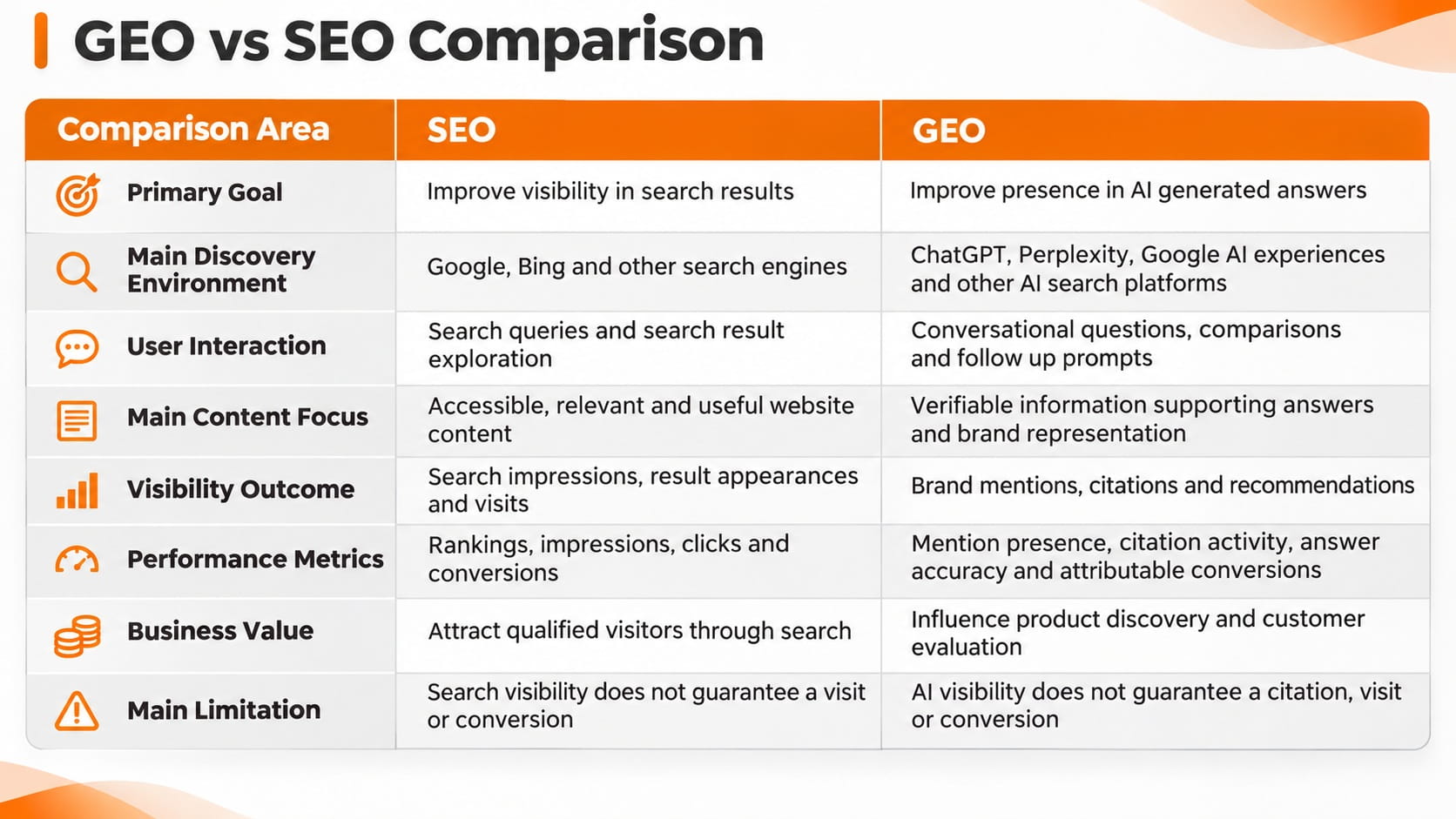
A business generating qualified organic traffic from established search results has a reason to protect that channel. A business frequently evaluated through AI product comparisons also needs to understand how those systems present its information.
The correct investment depends on customer behavior and measurable business outcomes.
GEO vs SEO Performance Metrics
Comparing GEO and SEO performance requires more than combining all visibility data into a single dashboard.
For traditional SEO, Google Search Console provides information about search impressions, clicks, search queries, and other performance dimensions.
In June 2026, Google introduced dedicated Generative AI performance reports within Search Console, with global rollout completed in August. These reports provide more specific visibility data for Google's generative search features, including impressions and the pages appearing in those experiences.
This development matters because visibility inside Google's AI features can now be examined separately from broader search reporting.
Bing Webmaster Tools also introduced AI Performance reporting in February 2026. It provides information about citation activity, referenced pages, and grounding queries across supported Microsoft AI experiences.
These are platform specific measurements, not a complete record of every AI response.
For a useful comparison, we distinguish three types of results.
Search Traffic and Conversions
Traditional SEO reporting connects website discovery with visits and measurable actions.
Organic visitors can be evaluated through engagement, qualified leads, purchases, and other business outcomes.
This provides a direct relationship between search activity and actions recorded on the website.
AI Mentions and Citations
AI visibility requires a different measurement method.
A business can test a consistent group of relevant questions across selected AI platforms, record the responses, and monitor changes in mentions, cited sources, and competitor inclusion.
The questions, markets, platforms, and measurement dates need to remain documented so results can be compared.
A single AI response is not sufficient evidence of consistent visibility.
Revenue Attribution
Revenue measurement requires additional care.
A user can discover a company through an AI recommendation and later visit its website through a branded search. That interaction does not automatically appear as AI referral traffic.
Directly identifiable referrals and conversions can be reported as observed activity. Broader influence should be treated separately unless supporting attribution data is available.
This distinction prevents marketing teams from presenting all AI mentions as measurable revenue.
Choosing Between GEO and SEO
The useful decision is not whether to abandon one strategy. It is which activity should receive attention first.
Businesses With Limited Organic Visibility
For a website with significant indexing problems, inaccessible pages, or missing product information, foundational SEO work takes priority.
Those problems prevent the business from presenting useful information through established search channels and can also affect retrieval by AI systems.
Fixing access and content quality creates a more reliable foundation for both approaches.
Businesses With Established Search Traffic
A website already receiving qualified organic traffic has an existing source of measurable customer acquisition.
The next evaluation should compare that performance with the brand's visibility in AI responses for relevant commercial questions.
If competitors appear in those answers while the business is absent, reviewing the underlying information and cited sources becomes a defined GEO opportunity.
That does not justify reducing investment in a search channel that continues to generate customers.
Businesses Competing for AI Recommendations
For software providers, professional services, and other businesses where buyers compare alternatives, AI recommendations create an additional point of influence.
A prospective customer can ask an AI assistant to compare three products before opening any company website.
In this situation, teams should examine whether the answers accurately describe their products, which competing businesses appear, and what evidence supports the recommendations.
The results help identify missing product information, incomplete comparisons, or inconsistencies across public sources.
The priority follows the customer's decision process rather than the popularity of a particular marketing term.
Combining GEO and SEO in One Strategy
The most practical approach is to build one coordinated search strategy with separate performance measurements.
Consider a B2B software company launching a new reporting product.
The SEO team identifies searches related to automated reporting, software integrations, and reporting platforms for small businesses.
The GEO evaluation examines the questions prospective customers ask AI assistants when comparing those products.
Both activities reveal demand, but they offer different views of how customers express it.
Build Content Around Shared Customer Needs
The company can develop a product comparison covering supported integrations, reporting capabilities, pricing conditions, and implementation requirements.
That information serves people arriving through search results and people researching products through AI assistants.
There is no need to publish two versions of the same article simply because the discovery channels differ.
The content should address the underlying decision clearly and provide evidence readers can verify.
Review Discoverability Across Platforms
After publication, the team checks whether search engines can access and index the page.
It also verifies the relevant access policies for AI search systems.
There is an important distinction between optimizing published information and changing the behavior of a language model itself.
Both approaches rely on accessible, accurate, and relevant content. Generative Engine Optimization (GEO) extends traditional SEO by focusing on how brands and their information appear in AI generated answers, citations, and recommendations. A well structured comparison page can support both strategies without requiring separate content for each search experience.
Evaluate the Results Separately
The SEO report examines search visibility, organic visits, and conversions.
The GEO report examines whether the company appears in relevant AI answers, whether its information is accurate, and which sources are cited.
Changes should be assessed against a documented baseline. An increase in AI mentions after a page update does not, by itself, prove that the update caused the increase.
Using a shared content strategy with separate measurement methods allows teams to understand the contribution of each channel without counting the same business outcome twice.
The Right Balance Between GEO and SEO
SEO remains essential for making a website discoverable through search engines. GEO extends that work by examining how brands and information appear within AI generated answers.
The two approaches share content quality, technical accessibility, and credible information as foundational requirements. Their main difference lies in the outcomes businesses choose to measure.
For teams allocating resources, the best approach is to preserve proven organic acquisition while examining AI visibility where customers actively research and compare options.
GEO does not replace SEO. It expands the definition of search visibility to include the answers customers encounter before deciding which websites or businesses to explore.
FAQ
Can we block GPTBot and still show up in ChatGPT Search?
Yes. OpenAI provides separate crawler controls for search discovery and model training. Website owners can allow OAI SearchBot while disallowing GPTBot. These settings serve different purposes, and allowing search access does not guarantee inclusion in generated answers.
Do we need an llms.txt file to get our website into AI results?
No universal requirement exists for an llms.txt file. Google explicitly states that additional AI specific text files are not required for inclusion in AI Overviews or AI Mode. Website owners should follow the documented access and eligibility requirements of each platform rather than treating the file as a guaranteed visibility mechanism.
Will changing our domain affect our visibility in AI answers?
A domain migration changes the addresses through which search systems access published information. Permanent redirects, updated canonical references, internal links, and sitemaps help preserve discoverability. AI citations can continue referencing older addresses until the relevant systems refresh their information, so both search performance and cited URLs should be monitored after migration.
Can we use the same GEO strategy for different countries?
The underlying principles can be shared, but each market requires its own audience research and evaluation. Customer terminology, language, product availability, and competitive alternatives differ across countries. A localized strategy should therefore use market specific questions, accurate regional information, and separate performance measurements.
What if an AI assistant keeps recommending us with outdated prices?
The company should first verify that its public pricing information and relevant external listings are accurate. The incorrect response should be recorded with its question, platform, date, and cited sources. Where feedback mechanisms are available, the error can be reported. Updating the source information is necessary, but the timing of changes in subsequent AI responses depends on the platform's retrieval and update processes.

Fatemeh Jahangard
Technology & AI Writer at PinerookFatemeh Jahangard covers AI, emerging technologies, and digital innovation for Pinerook, focusing on how technology shapes startups and industries.
 Seen first.