ChatGPT SEO is the process of improving how a website and brand appear in ChatGPT Search results, recommendations, and cited sources. To increase visibility, businesses need accessible web pages, accurate product information, clear positioning, and credible sources that connect their offerings to real customer questions.
Unlike traditional search engines, ChatGPT does not provide a fixed ranking position for every keyword. The objective within Generative Engine Optimization (GEO) is to become a relevant and trustworthy option when ChatGPT helps someone research a product, compare businesses, or make a decision.
How to Optimize Your Website for ChatGPT Search
Getting found in ChatGPT begins with understanding what potential customers expect the assistant to recommend.
We approach ChatGPT SEO through six practical actions:
Identify relevant customer prompts. Focus on the questions people ask when comparing products, evaluating services, and looking for recommendations.
Confirm search accessibility. Make sure ChatGPT Search can discover and retrieve the public pages that describe your business.
Clarify your brand positioning. Explain who the product serves, which problems it solves, and what distinguishes it from alternatives.
Publish verifiable product information. Provide accurate features, integrations, pricing conditions, and limitations.
Strengthen independent brand coverage. Maintain accurate information in relevant reviews, industry publications, and partner resources.
Evaluate actual ChatGPT responses. Examine whether your business appears, how it is described, and which sources support the answer.
A brand should not attempt to appear in every recommendation.
A CRM designed for small sales teams has a stronger reason to appear in answers about lightweight sales management than in recommendations for enterprise software requiring complex deployment.
That distinction guides the entire process. The objective is to connect the business to questions it can genuinely answer.
How ChatGPT Finds and Uses Web Sources
ChatGPT Search does not simply display a traditional list of websites matching the exact words in a search query.
When web search is used, ChatGPT can transform a user's request into one or more targeted searches, retrieve relevant information, and combine the findings into a response.
Consider this question:
"Which CRM is best for a small sales team using Gmail that needs automated reports?"
ChatGPT can investigate several parts of that request, including CRM integrations, reporting features, pricing, and suitability for smaller teams.
The assistant may draw information from official product websites, independent reviews, and comparison articles.
A company's homepage is therefore only one potential source of information.
Search Results and Brand Recommendations
ChatGPT can mention a brand without linking directly to its website.
For example, an answer might recommend a CRM based on an independent software review that describes its Gmail integration.
The company receives a recommendation, while the publication provides the cited source.
An answer can also reference official product documentation without explicitly recommending the company.
These outcomes matter for different reasons.
A recommendation tells us the brand has been presented as a possible solution. A citation shows which information source was referenced in the answer.
Neither outcome establishes a permanent ranking position.
Context and Personalized Answers
ChatGPT can account for information included in the conversation, such as the user's budget, preferred tools, location, or business requirements.
Two customers researching the same category can receive different recommendations because their needs differ.
This changes how we should think about search optimization.
Rather than targeting one short keyword, we need to understand the specific situations in which a product is relevant.
A clear description of supported integrations and customer requirements provides more useful information than repeatedly describing a platform as the best solution for every business.
Confirming ChatGPT Search Eligibility
Before improving brand information, confirm that ChatGPT Search can access the website.
OpenAI uses OAI SearchBot to discover websites for its search features.
The crawler needs permission to access the relevant public pages. Hosting providers, content delivery networks, and security systems must also permit requests from OpenAI's published search crawler IP ranges.
A website can allow the crawler in robots.txt while blocking it through a firewall.
We therefore check both permissions and the actual server response.
Search Crawling and Model Training
OpenAI distinguishes between OAI SearchBot and GPTBot.
OAI SearchBot supports search discovery. GPTBot collects content that may be used to develop foundation models.
Website owners can permit search crawling while restricting GPTBot.
Allowing search access does not require granting the same permissions for model training.
ChatGPT also uses separate systems to retrieve pages in response to user actions. Those requests should not be confused with automatic search crawling.
Accessible Website Content
The essential information on a public page should be available in a form the intended crawler can retrieve.
For a software website, this includes product descriptions, supported features, integration details, and relevant documentation.
If the server returns an almost empty HTML document and relies entirely on JavaScript to load the information, accessibility requires closer examination.
Check the initial HTML and confirm that the page delivers its essential information.
Search eligibility does not guarantee inclusion in ChatGPT responses. OpenAI states that several factors influence which results are selected.
Once the technical requirements are satisfied, the more valuable work is improving the relevance and reliability of the information itself.
Improving Brand Relevance for ChatGPT
A company needs to explain its offering in terms that match the decisions customers are making.
Consider two descriptions of the same software.
Generic description:
"Our innovative CRM helps businesses streamline operations and achieve better results."
Specific description:
"Our CRM helps small sales teams manage customer contacts, track deals, and organize sales activities. The platform includes Gmail integration and configurable sales reporting."
The second description gives readers concrete information about the product's purpose and capabilities.
It identifies the product category, target customer, and relevant features.
These details also make it easier to evaluate the product against a specific buyer requirement.
Product Positioning and Customer Needs
We start by identifying the questions that determine whether someone should choose a product.
For business software, those questions include supported integrations, team size, permissions, reporting capabilities, and implementation requirements.
The website should provide accurate answers on the pages where customers expect to find them.
A product page establishes what the software does.
An integration page explains compatibility and configuration requirements.
A pricing page clarifies purchasing conditions.
A comparison page helps readers understand the differences between legitimate alternatives.
The purpose is not to repeat the same marketing claims across multiple pages. Each resource should contribute information relevant to a particular customer decision.
Clear Product Limitations
A product becomes easier to evaluate when its limitations are explained alongside its capabilities.
If a CRM supports Gmail but not Outlook, that distinction matters to a company using Microsoft 365.
If automated reporting is restricted to a particular subscription plan, the pricing information should make that condition clear.
Broad statements about serving every type of customer are less useful than documented requirements and capabilities.
An accurate description helps the reader determine whether the product meets their needs.
ChatGPT SEO Optimization Example
To make the process practical, consider Cedar CRM, a fictional software company serving small sales teams.
The company wants to appear when ChatGPT users ask for CRM recommendations involving Gmail integration, automated reporting, and affordable subscriptions.
Its website has product pages, but the descriptions are broad and important purchasing details are difficult to find.
The following framework connects relevant customer prompts to the information the business needs to improve.
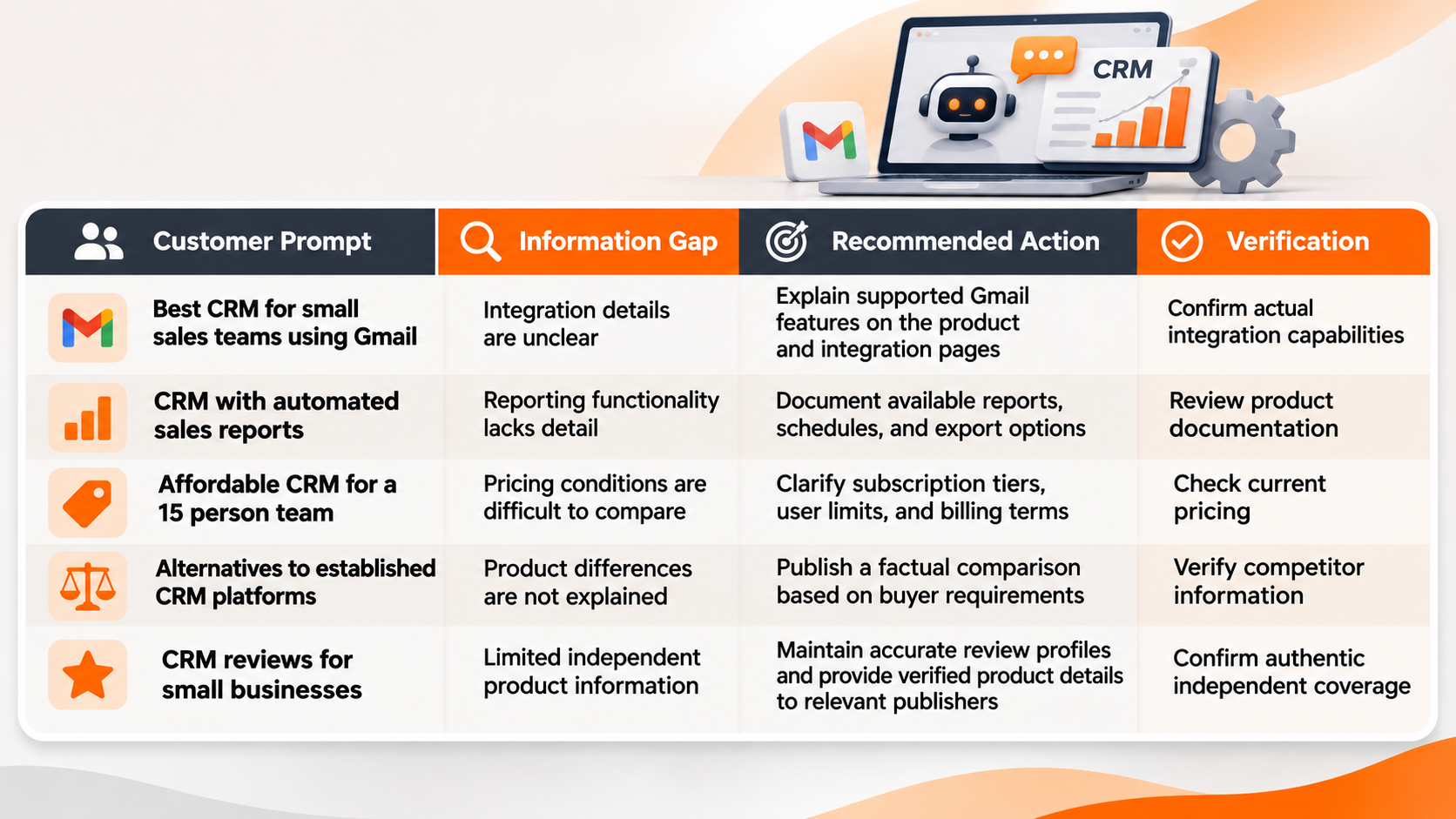
This framework does not claim that the fictional company has achieved any particular ChatGPT ranking.
It demonstrates how we connect a customer question to a specific information gap and a verifiable improvement.
The most useful outcome is not a collection of newly published pages. It is a clearer explanation of why the product belongs in a particular recommendation.
Once the information is accurate and accessible, the company can examine whether ChatGPT begins including it in relevant answers.
Building a Reliable Brand Presence Across the Web
ChatGPT can use information from sources outside a company's website.
Independent software reviews, industry publications, partner documentation, and verified business profiles can provide additional context.
If an independent review describes a software product as suitable for small teams, that assessment contributes a different perspective from the company's own marketing material.
The distinction matters because a brand cannot establish independent credibility simply by repeating its claims.
Independent Reviews and Industry Coverage
We prioritize publications and directories that customers actually consult when evaluating the product category.
For a software company, this can include established software review platforms, specialist technology publications, and relevant integration partners.
Each source should describe the business accurately.
Outdated product categories, discontinued features, and incorrect subscription details can create conflicting information across the web.
A company that describes itself as a lightweight CRM on its website but appears as an enterprise marketing automation platform in external listings presents inconsistent information.
Correcting those discrepancies improves the public record available to customers and information retrieval systems.
Relevant Brand Mentions
Brand mentions from credible sources can help establish the context in which a company is discussed.
An industry publication reviewing sales software provides more relevant information for a CRM business than an unrelated website mentioning the brand without context.
The same principle applies to partnerships and customer stories.
A genuine integration announcement can establish that two products work together. A documented customer case can explain a specific implementation.
We should not confuse the quantity of mentions with the quality of supporting evidence.
Manufactured reviews and promotional claims presented as independent opinions do not create reliable information.
Keeping Business Information Current in ChatGPT
ChatGPT SEO now includes more than maintaining public webpages.
OpenAI also provides business information and commerce features that businesses can use when eligible.
These features deserve attention because they offer ways to provide current information directly, without replacing the need for accurate public sources.
Business Profiles in ChatGPT
OpenAI's Business Hub allows eligible businesses to claim their profiles and update business information after completing the required verification.
Available information can include the business description, product or service category, website, and relevant policies.
Businesses can also access insights about their presence in ChatGPT when the required access and verification conditions are met.
Claiming a profile helps the business manage information it provides through that channel.
It does not guarantee that ChatGPT will recommend the business or give it higher placement.
Availability and supported features depend on the business's location, type, and eligibility.
Product Information for Retailers
Retail businesses have an additional consideration: product discovery in ChatGPT shopping experiences.
OpenAI supports structured merchant product feeds that provide catalog information, including product names, descriptions, prices, and availability.
Eligible retailers can use supported feed integrations to keep this information current.
Product data from Shopify merchants is also integrated through Shopify Catalog.
This information helps ChatGPT understand which products are available and their relevant attributes.
A product feed is not a substitute for accurate product pages, nor does it guarantee a recommendation.
For service businesses and software providers, the priorities remain clear business descriptions, verified capabilities, and relevant supporting information.
Evaluating ChatGPT Search Visibility
After improving the website and brand information, we need to examine what ChatGPT actually says.
A useful evaluation starts with a defined set of customer prompts recorded before the changes.
For example, Cedar CRM could examine questions involving Gmail integration, sales reporting, subscription costs, and CRM alternatives.
Each response should be reviewed for three distinct outcomes.
Brand presence: Whether Cedar CRM appears in the answer.
Recommendation relevance: Whether ChatGPT presents it as suitable for the customer's stated requirements.
Information accuracy: Whether the explanation matches the product's documented capabilities and limitations.
We also record the cited sources, distinguishing the company's own pages from independent publications.
These observations provide context for the results. A brand mentioned in an irrelevant recommendation has not achieved the same outcome as a product accurately matched to a buyer's requirements.
Search Visibility and Website Traffic
ChatGPT Search can display links to sources used in its answers.
Visitors following those links can generate identifiable referral traffic in website analytics.
However, brand visibility and referral traffic measure different outcomes.
A customer might encounter a company through a ChatGPT recommendation and visit its website later through another channel.
That visit cannot automatically be attributed to the original recommendation.
We therefore keep observed ChatGPT mentions, direct citations, and identifiable website visits separate.
Consistent Performance Reviews
ChatGPT answers can differ depending on the user's prompt, conversation context, available sources, and search conditions.
A single response cannot establish a stable ranking.
Use a consistent set of prompts, record the observation dates, and compare responses under documented conditions.
The important question is whether the brand becomes more accurately and consistently represented across relevant customer needs.
This gives SEO teams a practical basis for deciding which areas require further attention.
Prioritizing ChatGPT SEO Improvements
The next action should follow the evidence.
If ChatGPT cannot find a public product page, access should be investigated before changing the content.
If the website is accessible but lacks details about an important feature, that information should be verified and published.
If ChatGPT correctly understands a product but relies on outdated external descriptions, those independent sources deserve attention.
If the business appears in recommendations but is described incorrectly, identifying the source of the inaccurate claim becomes the priority.
These situations require different solutions.
Publishing more general articles will not correct a firewall restriction. Adding keywords will not resolve inaccurate pricing. Increasing promotional mentions will not establish a product capability that does not exist.
The most useful ChatGPT SEO strategy is to make a business easier to discover, easier to understand, and easier to evaluate for the customer questions it genuinely serves.
That is a more defensible objective than attempting to hold a fixed position in an AI generated answer.
FAQ
Can ChatGPT recommend our business even if we don't have a website?
Yes. ChatGPT can refer to businesses using information available from public listings and other accessible sources. However, the business has less control over its public information without an authoritative website.
What if our brand has the same name as another company?
Use accurate identifying details across official and independent sources, including the business category, website, location, and product names. These details help distinguish separate organizations. A shared name alone does not establish that ChatGPT will correctly identify the intended business in every response.
Can we pay to appear first in ChatGPT recommendations?
No. ChatGPT advertising is separate from the assistant's answers. Paying for advertising does not provide control over organic recommendations or source selection. Sponsored placements are identified separately from generated responses.
Can ChatGPT find information that's only available after customers log in?
Private content is not available for ordinary public crawling behind an authentication requirement. A user may provide information or grant access through a supported connection, but that does not make the content a public search source.
Can we ask ChatGPT to correct outdated information about our business?
Users can report inaccurate responses through available feedback controls. Businesses should also correct outdated information in authoritative sources and, where eligible, update their claimed business profiles. A correction request does not guarantee an immediate change in every generated answer.

Fatemeh Jahangard
Technology & AI Writer at PinerookFatemeh Jahangard covers AI, emerging technologies, and digital innovation for Pinerook, focusing on how technology shapes startups and industries.
 Seen first.