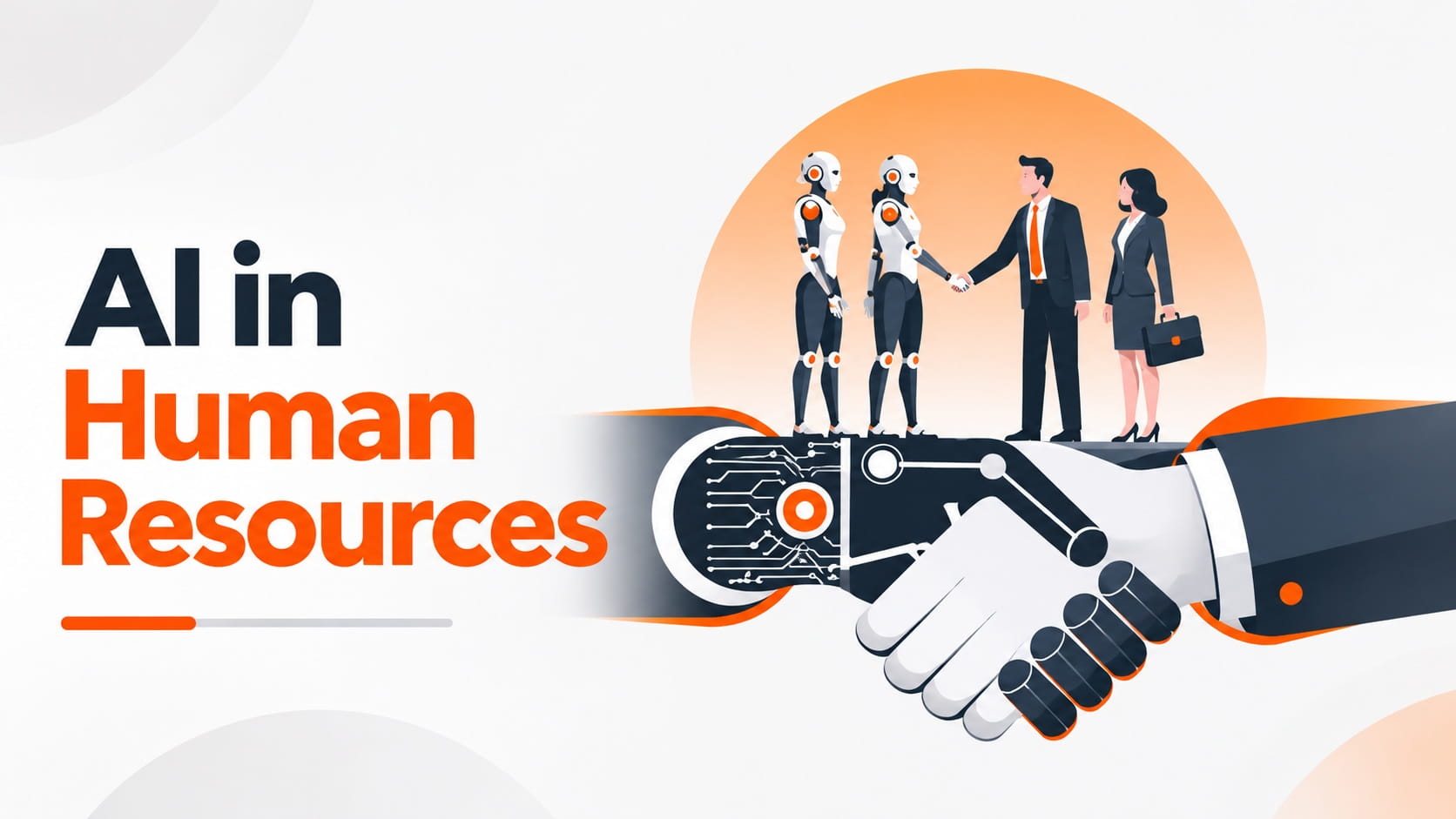
AI in human resources is changing how companies recruit employees, manage talent, deliver HR services, and plan their workforce. Recruitment teams use it to organize candidate information, managers use it to identify skill gaps, and HR departments rely on intelligent assistants to handle employee requests.
The real advantage is not simply completing administrative work faster. It is giving HR professionals better information and more time for decisions that require human judgment. Companies such as IBM and Ferring have already demonstrated how this works in practice, offering useful lessons for organizations considering their own AI investments.
Applications of AI in Human Resources
Artificial intelligence in human resources supports activities throughout the employee lifecycle, from the first job application to career development and workforce planning.
The most useful applications address a specific operational problem. A recruitment team struggling with application volume needs a different system from an HR department dealing with thousands of employee questions.
The following table shows where AI fits into the major HR functions and which decisions should remain with people.
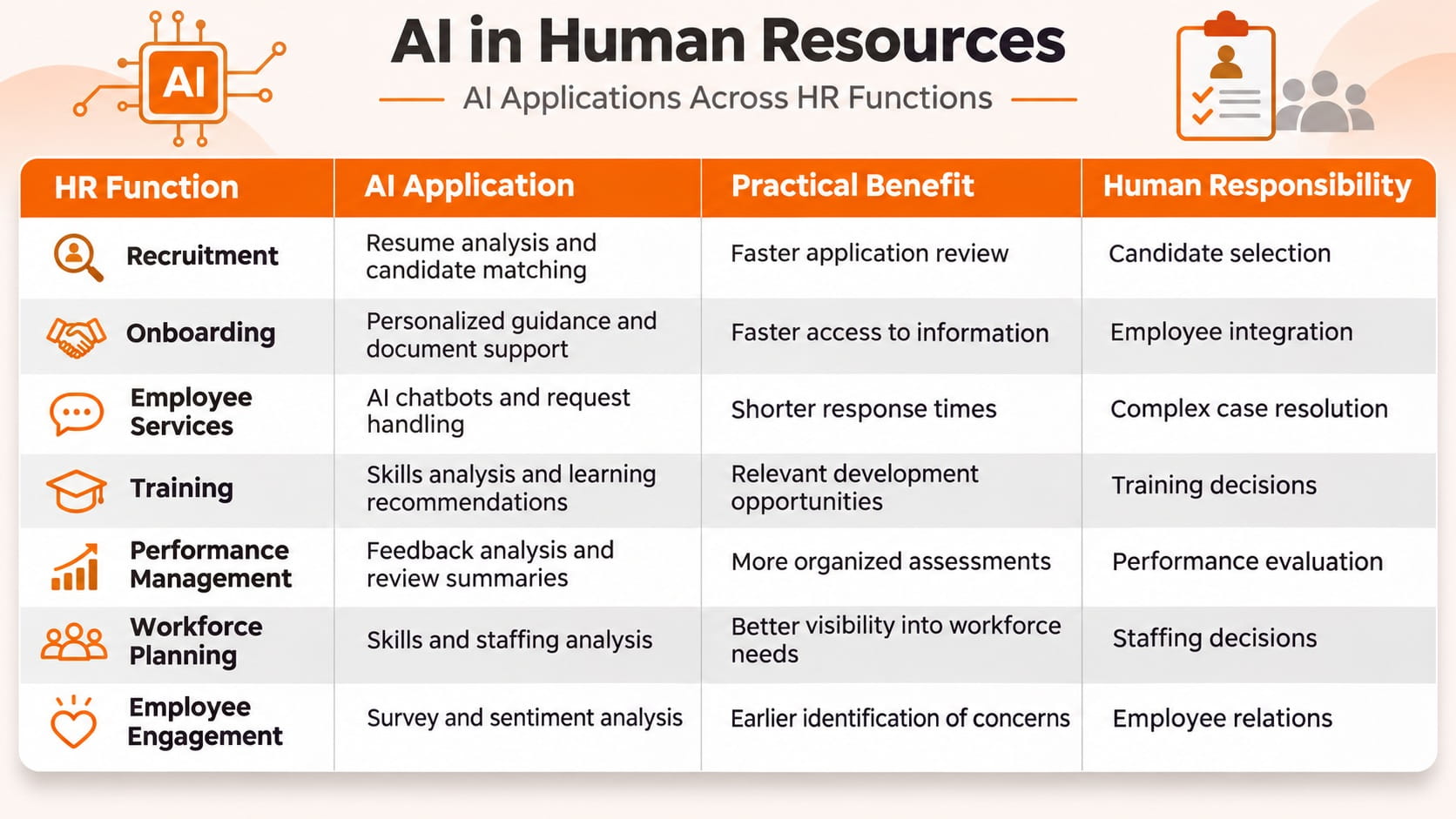
The distinction in the final column matters. AI can organize information and generate recommendations, but those recommendations do not establish that an employee should be hired, promoted, or dismissed.
AI in Recruitment and Hiring
Recruitment generates large amounts of information before a candidate reaches an interview. Recruiters can use AI Candidate Sourcing Tools to identify potential applicants before they submit a resume.
AI can extract skills and experience from resumes, compare applications with defined job requirements, prepare interview questions, and organize recruiter notes. AI Resume Screening supports that initial review of submitted applications.
Consider a company hiring software engineers across several departments. Its recruitment team needs to identify applicants with different technical backgrounds while maintaining consistent evaluation criteria. Once applicants are shortlisted, AI Interview Scheduling can help coordinate interview availability.
An AI system can help organize those applications according to relevant experience and documented requirements.
Recruiters still need to examine the underlying qualifications. A matching score cannot establish a candidate's ability to collaborate, solve unfamiliar problems, or perform the role successfully.
We would use AI to improve the consistency and efficiency of the review process, not to replace the evaluation itself.
AI in Employee Onboarding
New employees need access to company policies, training materials, benefits information, and internal procedures. AI in Employee Onboarding can make these resources easier to access.
An AI assistant connected to approved HR resources can explain onboarding requirements, direct employees to relevant documents, and guide them through administrative tasks.
This becomes especially useful in organizations operating across several locations.
Instead of sending repeated questions to HR, employees can receive information relevant to their workplace and employment status.
The benefit is a more accessible onboarding experience. Successful integration into a team, however, still depends on managers, colleagues, and meaningful human interaction.
AI in Employee Services
Employee support is one of the clearest applications of AI in HR because many requests follow established procedures.
Employees need help with leave policies, payroll questions, employment verification, and benefits administration.
AI assistants can retrieve approved information and initiate permitted transactions through connected business systems. AI HR Chatbots can provide this initial support before complex requests reach a specialist.
A request for an employment verification letter, for example, can move through an authorized automated workflow without requiring an HR specialist to prepare the same document manually.
Sensitive or exceptional cases need a clear route to a qualified HR professional.
AI in Employee Training and Development
AI helps HR teams identify skills, recommend learning resources, and connect employees with development opportunities.
A system can compare documented employee skills with the requirements of available internal roles.
This gives employees greater visibility into opportunities that would otherwise remain within individual departments.
Learning recommendations can also reflect the competencies required for a position rather than offering the same training materials to everyone.
We consider this valuable when employees retain control over their career interests and managers can review the recommendations.
AI in Performance Management
Performance reviews depend on evidence collected over time.
AI can organize documented achievements, summarize feedback, and help managers prepare review materials based on established assessment criteria. Tools described as AI for Performance Reviews can help managers organize this information.
For example, a manager reviewing several months of project records can use AI to identify completed objectives and organize supporting evidence.
The technology should not invent performance conclusions or replace a discussion with the employee.
The quality of a performance review depends on the relevance of the evidence and the manager's ability to interpret the circumstances behind it.
AI in Workforce Planning and Retention
HR departments need to understand workforce capacity, emerging skill requirements, and potential staffing shortages.
Predictive models can analyze historical workforce information to identify patterns in hiring, movement between roles, and employee turnover.
These insights support planning, but they do not establish why a particular employee will leave.
Individual circumstances are more complex than a statistical prediction.
The appropriate use of workforce analytics is to support organizational planning and investigate broader workforce conditions without treating individual predictions as established facts.
Real Examples of AI in Human Resources
Practical examples provide a stronger basis for evaluating AI than broad promises about automation.
Two implementations illustrate different ways artificial intelligence is being used in HR.
IBM AskHR: Automating Employee Services
IBM developed AskHR to simplify how employees and managers access HR information and complete routine requests.
The company initially introduced separate chatbots for common HR questions. As their number increased, employees faced the challenge of finding the correct service.
IBM consolidated those capabilities into a single interface and expanded the system to handle transactions.
AskHR now supports activities such as employment verification and employee transfers through connected business systems.
According to IBM's published case study, AskHR handled more than 11.5 million interactions in 2024 and achieved a 94% containment rate for common questions. IBM also reports a 75% reduction in support tickets compared with its historical baseline beginning in 2016.
Containment means interactions remained within the system rather than being transferred elsewhere. It should not be interpreted as independent proof that every response was correct.
The most useful lesson is how IBM developed the service. Connecting a conversational interface to reliable HR processes made it more valuable than a collection of isolated chatbots.
Ferring: AI for Internal Talent Mobility
Ferring, a global biopharmaceutical company, introduced Workday Talent Marketplace to improve visibility into employee skills and internal opportunities.
The platform uses skills information to recommend projects, development opportunities, and internal positions.
Managers can publish temporary projects and identify employees whose skills match the requirements.
This helps teams discover expertise outside their immediate departments.
Ferring's published experience describes how managers gained access to a broader internal talent pool, including during a period of restricted external hiring.
The case illustrates a different benefit from IBM's implementation.
Instead of concentrating on administrative efficiency, Ferring uses AI to connect employee capabilities with organizational needs.
Its experience demonstrates a practical application of talent matching, although the public case study does not establish a universal improvement in employee retention or productivity.
Benefits of AI in Human Resources
AI offers value when it improves a measurable HR process without weakening the quality of decisions or the employee experience.
Saving time matters, but a faster process is not necessarily a better one.
For example, reducing recruitment time provides limited value if the organization overlooks qualified candidates. Similarly, resolving employee questions through automation offers little benefit when the answers are inaccurate.
We would evaluate AI investments against both operational performance and the quality of the outcome.
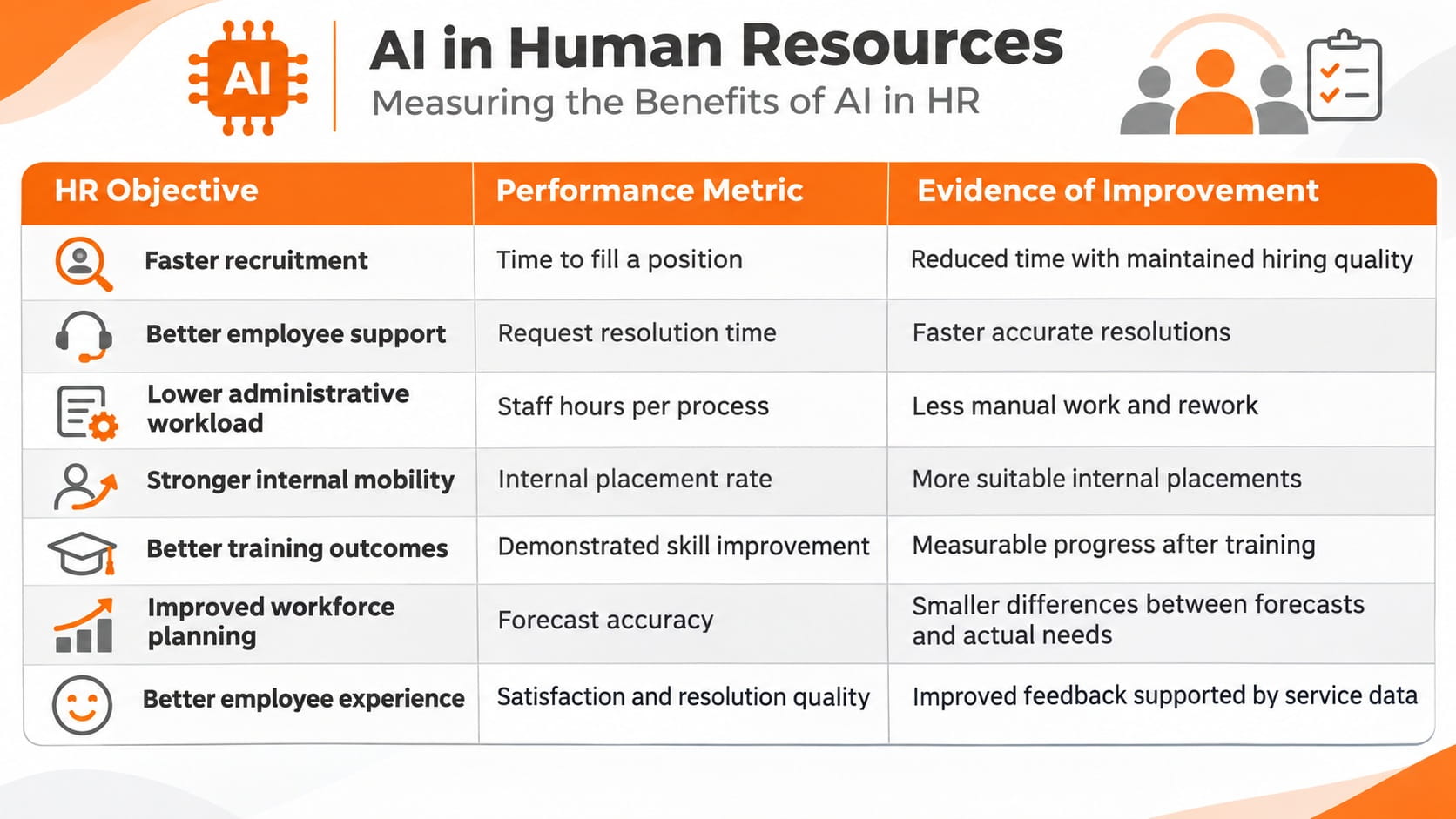
Without a baseline, an organization cannot reliably determine whether improvements came from AI or from changes to staffing, procedures, or workload.
We would also distinguish between vendor performance claims and outcomes independently measured within the company.
A successful implementation should demonstrate both efficiency and acceptable quality.
Types of Artificial Intelligence Used in HR
Not every system marketed as an AI HR tool uses the same technology.
Understanding the differences helps organizations choose an appropriate solution instead of purchasing features they do not need.
Machine Learning and Predictive Analytics
Machine learning identifies patterns in historical information and uses them to generate classifications or predictions.
In HR, these models support activities such as workforce forecasting, skill matching, and analysis of employee turnover patterns.
Their usefulness depends on data quality, the relevance of historical examples, and evaluation against current organizational conditions.
Natural Language Processing
Natural language processing enables systems to analyze written or spoken language.
HR departments use it to extract information from resumes, categorize employee requests, and examine written feedback.
Sentiment analysis is one application, but interpreting employee language requires care. AI Employee Sentiment Analysis can organize survey comments for human review.
A negative comment about a specific workplace problem does not automatically establish an employee's overall satisfaction or future behavior.
Generative AI
Generative AI creates new content from instructions and contextual information.
HR teams can use it to draft job descriptions, prepare training materials, summarize documents, and create responses to routine questions. An AI Job Description Generator can prepare an initial draft from documented role requirements.
The important distinction is that generated content requires verification.
A professionally written policy summary is not necessarily an accurate interpretation of the company's current rules.
AI Agents and Workflow Automation
AI agents combine language processing with tools that retrieve information or perform authorized actions.
An HR agent might identify an employee request, retrieve the relevant policy, and initiate an approved workflow.
Traditional automation can also complete repetitive tasks, but rule based automation is not necessarily artificial intelligence.
The difference matters when evaluating cost, complexity, and operational risk.
A straightforward automated workflow does not require an AI agent simply to move information between two systems.
Challenges and Risks of AI in Human Resources
AI in HR presents particular risks because employment decisions affect people's income, opportunities, privacy, and professional development.
These risks cannot be addressed through software accuracy alone.
Bias and Discrimination in Hiring
AI models trained on historical employment data can reproduce patterns found in earlier decisions.
If previous hiring practices disadvantaged particular groups, an automated system can reflect those disparities.
The United States Equal Employment Opportunity Commission has made clear that federal employment discrimination laws apply when employers use algorithms and AI to inform selection decisions.
Employers must evaluate the effects of their systems rather than assuming that automated decisions are neutral.
An additional concern is accessibility.
A recruitment assessment that depends on a particular form of speech, vision, or interaction can disadvantage candidates with disabilities who could otherwise perform the job.
Employee Privacy and Data Protection
HR systems process some of an organization's most sensitive records.
These include compensation information, performance assessments, employment histories, and information connected to employee benefits.
AI providers need appropriate contractual safeguards, access controls, and data handling procedures.
The United Kingdom Information Commissioner's Office also emphasizes fairness, transparency, and appropriate safeguards when organizations use AI in recruitment or monitor workers.
We would not upload employee records into an external AI service without confirming that the intended processing is authorized and protected.
Reliability of AI Recommendations
Generative systems can produce explanations that sound credible but do not accurately reflect the source information.
Predictive systems have a different problem: a statistical relationship is not necessarily a valid explanation of an individual's behavior.
For example, a model identifying patterns associated with turnover cannot determine an employee's personal intentions.
HR professionals need to examine the evidence behind recommendations and understand the system's limitations.
Accountability in Employment Decisions
The responsibility for employment decisions does not disappear when a company purchases AI software.
Recruitment, promotion, compensation, and termination require appropriate organizational oversight.
Human review must also be meaningful.
If a manager accepts every automated recommendation without examining the supporting information, the existence of a human approval step provides limited protection.
A responsible process makes it possible to examine and challenge a recommendation before it affects an employee or applicant.
AI Implementation in Human Resources
Introducing AI into HR requires more than selecting a popular platform.
The strongest starting point is a process with a clearly defined problem, reliable information, and a measurable outcome.
Selecting the First HR Process
We would begin with a task that creates substantial repetitive work but involves limited consequences when an error occurs.
An internal policy assistant is a useful example.
The organization can test whether employees receive correct answers, whether the system identifies questions beyond its scope, and whether unresolved cases reach the appropriate HR specialist.
This creates evidence before introducing AI into more consequential activities.
Preparing HR Data and Integrations
An AI system is only as useful as the information and permissions supporting it.
HR teams need to identify approved data sources, verify record accuracy, and establish who can access different types of information.
An employee benefits assistant should retrieve the policy that applies to the relevant employee.
It should not expose another worker's compensation information or provide outdated policy details.
For changing HR policies, connecting the assistant to an approved and regularly updated knowledge source is more appropriate than relying on the model's training data alone.
Evaluating Vendors and Internal Systems
Before adopting software, HR leaders should establish what information the system processes, how it generates recommendations, and which actions it can perform.
The provider should explain its security controls, data retention practices, supported integrations, and available evaluation evidence.
Organizations also need to understand whether the system can be restricted to specific users and whether its outputs can be reviewed.
A tool that performs well in a product demonstration has not yet demonstrated that it works reliably with the organization's employees, policies, and workflows.
Testing Before Wider Deployment
A controlled pilot makes it possible to compare AI supported work with the existing process.
The test should use representative tasks and assess both successful outcomes and failures.
For example, an HR assistant should be tested with straightforward policy questions, ambiguous requests, and cases requiring human intervention.
The following framework provides a practical method for evaluating deployment readiness.
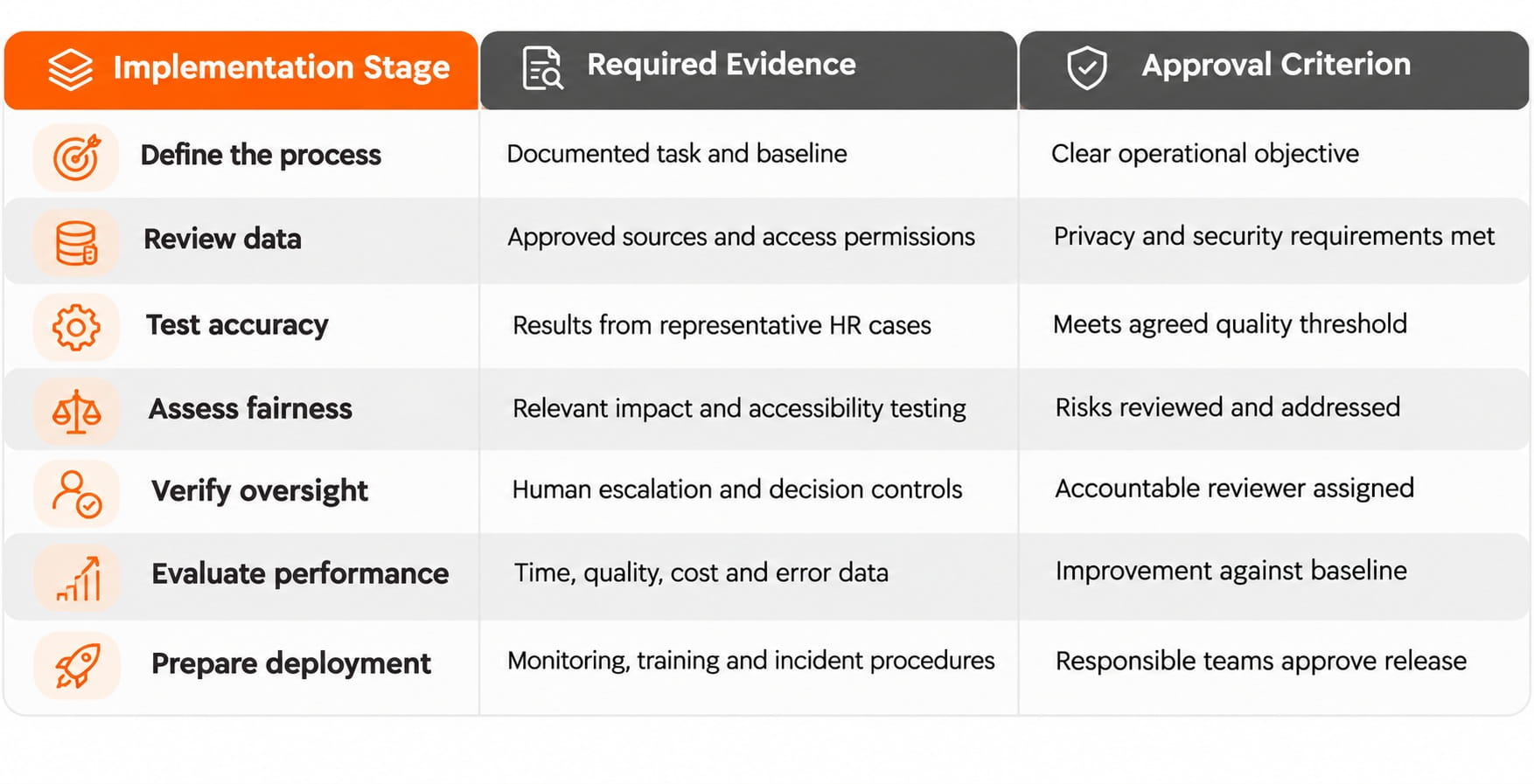
The approval criteria should be established before the test begins.
A company should not lower its requirements simply because the new system produces impressive demonstrations or reduces processing time.
Following deployment, performance needs continued monitoring as policies, employee requirements, and organizational systems change.
AI Compliance and Employment Regulations
AI adoption in human resources is subject to employment and data protection requirements that differ across jurisdictions.
A relevant example is New York City's Local Law 144, which regulates certain automated employment decision tools.
Covered employers and employment agencies must ensure that qualifying tools undergo a bias audit within the preceding year and that required information and notices are provided.
These requirements do not apply indiscriminately to every AI application used by an HR department.
A chatbot answering leave policy questions is different from a system substantially assisting employment selection decisions.
Organizations should evaluate the actual function of each tool before determining which rules apply.
The NIST AI Risk Management Framework also provides a useful structure for governance, risk measurement, and ongoing monitoring.
For HR teams, the practical principle is straightforward: legal responsibility and organizational accountability must be established before automated recommendations influence employment outcomes.
The Impact of AI on HR Professionals
AI changes the distribution of work within human resources.
Administrative activities involving information retrieval, document preparation, and routine requests can be supported through automation.
That allows HR professionals to devote more attention to employee relationships, organizational development, complex cases, and decisions requiring professional judgment.
However, greater automation also creates new responsibilities.
HR teams need to understand the data used by AI systems, recognize unreliable recommendations, participate in vendor evaluation, and explain how automated processes affect employees.
IBM's September 2026 research on chief human resources officers identified gaps in AI literacy, performance measurement, and change management capabilities within HR teams.
This highlights an important issue: purchasing technology does not create the organizational skills needed to use it effectively.
The future role of HR professionals depends increasingly on their ability to combine knowledge of people, employment practices, and technology.
Final Assessment
AI in human resources offers practical value across recruitment, employee services, professional development, performance management, and workforce planning.
IBM's AskHR demonstrates how intelligent automation can support HR services at scale, while Ferring's talent marketplace illustrates how AI can improve visibility into internal skills and opportunities.
Neither example suggests that technology should replace professional responsibility.
We would judge a successful HR implementation by the accuracy of its outputs, the quality of its decisions, its measurable operational value, and the safeguards protecting employees.
The goal is a more effective HR function in which artificial intelligence supports people rather than making people accountable to unexplained automated decisions.
FAQ
Can we start using AI in HR without buying expensive software?
Yes. An organization can begin with an approved AI service for preparing generic job descriptions, drafting internal communications, or developing training outlines.
The company should establish usage policies before introducing employee information. Purchasing specialized software becomes relevant when integration, access controls, transaction processing, or audit requirements exceed the capabilities of general tools.
Is it safe to put employee salary details into ChatGPT?
Salary records should only be processed through an approved service with appropriate confidentiality, access, retention, and contractual protections.
An employee's access to a general chatbot does not establish permission to upload confidential compensation information. The organization must assess the provider's applicable data handling terms and its own legal obligations.
Can AI secretly read our employees' Slack messages?
Technical access does not establish lawful permission to monitor employee communications.
Organizations must assess the legal basis, transparency requirements, necessity, and proportionality of monitoring. In jurisdictions such as the United Kingdom, data protection rules impose specific obligations concerning worker monitoring.
Do we have to tell applicants that AI is reviewing their applications?
Notification obligations depend on the jurisdiction and the technology's actual function.
For covered automated employment decision tools in New York City, employers must provide specified advance notices. Other jurisdictions impose different transparency and data protection requirements.
Employers should establish applicable disclosure obligations before introducing automated screening.
Can a candidate ask for a human to check an AI hiring decision?
The available rights depend on the applicable laws and circumstances of the decision.
Certain data protection regimes provide protections concerning qualifying automated decisions. Organizations should maintain a documented process for reviewing concerns, correcting information, and providing appropriate human intervention where required.
Can we record job interviews and use AI to write summaries?
Recording and transcription require appropriate legal authorization and compliance with applicable notice, consent, and privacy requirements.
The resulting summary should be checked against the original interview, and the organization should define who can access the recording, how long it will be retained, and how it will be deleted.
Can we train an HR AI system using our previous hiring decisions?
Historical hiring records can be used only when the organization has an appropriate legal basis and necessary rights to process that information.
Past hiring decisions can also contain discriminatory patterns. The dataset and resulting system require relevant fairness testing, documentation, and safeguards before deployment.
Can an AI HR assistant support employees in several languages?
Yes. Multilingual AI systems can provide employee support in different languages.
Organizations should evaluate the accuracy of each supported language, particularly for benefits, contracts, and policy explanations. Important legal and employment information requires reliable translation and appropriate review.
What happens to our HR data if we stop using an AI vendor?
The outcome depends on the service agreement and data processing terms.
Before purchasing, organizations should confirm data export options, deletion procedures, backup retention periods, and the treatment of generated records. Contract termination should not prevent the company from meeting its own recordkeeping obligations.
Who is responsible if an AI HR tool makes a harmful decision?
The organization using the system retains responsibilities under applicable employment and data protection laws.
The precise allocation of liability between employers and technology providers depends on the facts, contracts, and relevant legislation. Internal accountability should identify who approves the system, oversees its outputs, and handles complaints.

Fatemeh Jahangard
Technology & AI Writer at PinerookFatemeh Jahangard covers AI, emerging technologies, and digital innovation for Pinerook, focusing on how technology shapes startups and industries.
 Seen first.