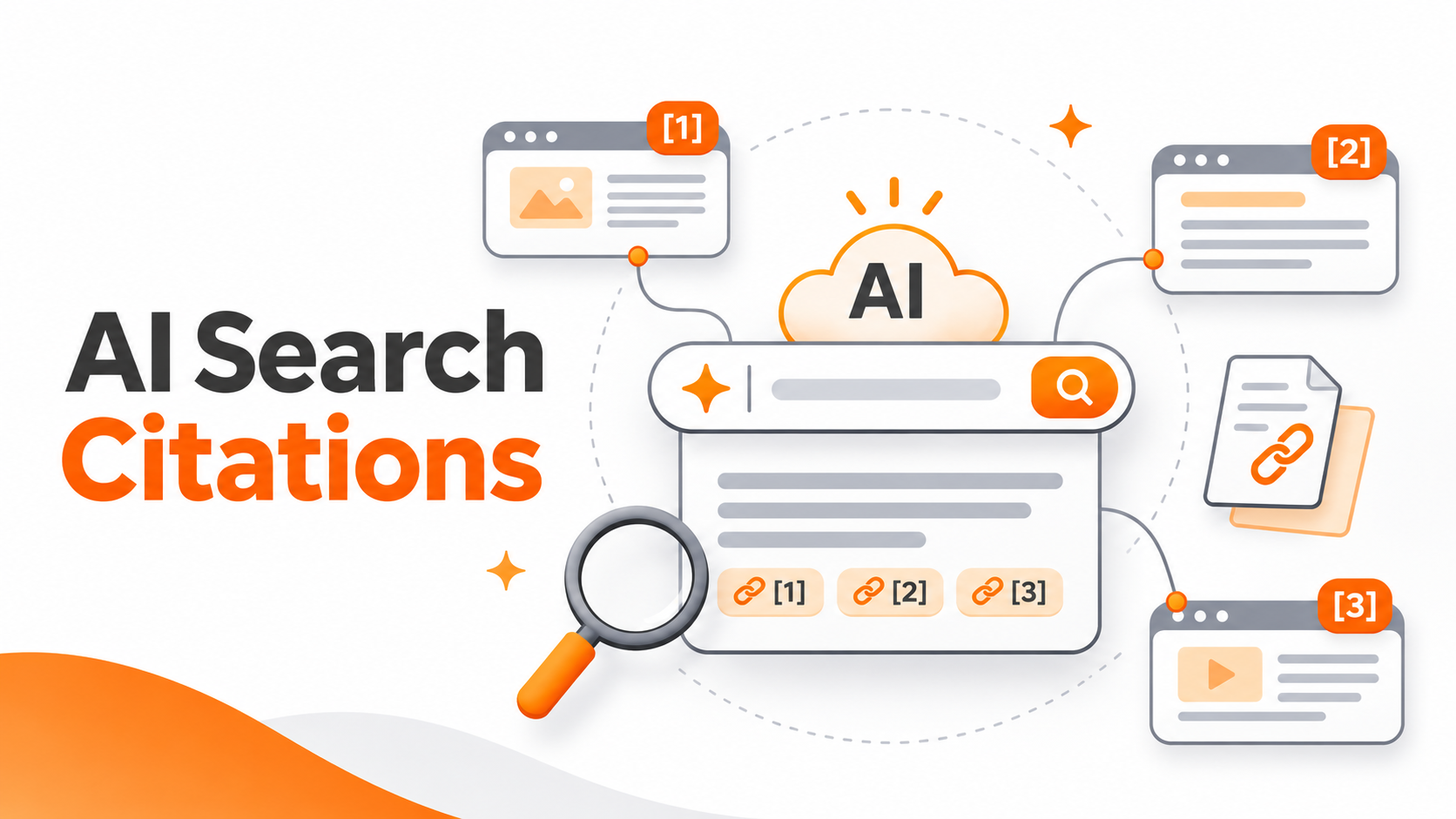
AI search citations are links to sources referenced in answers generated by ChatGPT, Perplexity, Google AI Search, and other AI systems. To earn these citations, a website needs relevant information, accessible pages, and evidence worth referencing. Original research, verified product details, and independent coverage give AI search systems useful material to draw from.
Getting mentioned is not the same as getting cited. An AI assistant can recommend a brand without linking to its website, or cite an independent review that discusses the company. Understanding that distinction is essential when deciding which pages and sources deserve attention.
How to Get Cited in AI Search
The most practical way to approach AI search citations is to identify what sources AI systems already reference and determine what information your website can contribute.
Publishing more articles without examining those sources does not address the reason a competitor's page is being selected.
We use five steps to structure the work:
Identify relevant questions. Focus on the questions customers ask when researching products, comparing providers, or looking for reliable information.
Examine existing citations. Review which websites and specific pages appear in AI answers to those questions.
Find the missing evidence. Determine which facts, comparisons, original findings, or explanations your website can provide that existing sources do not.
Publish accessible and verifiable information. Make the evidence available on relevant pages, with enough context for readers to evaluate it.
Check the resulting citations. Revisit the same questions and identify whether your pages or independent sources discussing your business appear.
Consider a company offering customer relationship management software.
If AI assistants cite independent software reviews when recommending CRM platforms, publishing another general article defining CRM software adds little to that comparison.
A more useful contribution would be verified integration details, documented reporting capabilities, pricing conditions, or original product testing that addresses the specific criteria buyers are evaluating.
The goal is to make the website a relevant source for a real question rather than trying to appear in every AI response.
How AI Search Engines Select Sources
AI search engines do not select citations through a single public ranking formula. Their retrieval systems, model behavior, and source presentation methods differ.
The process becomes easier to understand by separating source discovery, retrieval, and citation.
Source Discovery and Retrieval
When an AI search system uses external information, it retrieves material related to the user's question.
Google AI Mode and AI Overviews can use query fan out, which involves issuing multiple related searches to gather information about different parts of a request.
For example, someone asking for the best project management software for a remote team may need information about integrations, pricing, permissions, and reporting features.
The system can retrieve different sources for those individual information needs.
This explains why a page does not need to match the entire wording of a user's prompt to become relevant. It needs to provide useful evidence for the aspect of the question being researched.
Source Selection and Citations
Retrieving a page does not guarantee that it will appear as a cited source.
An AI system can consider multiple documents, use information from selected material, and display references to only part of what it retrieved.
The final citation depends on the platform's retrieval and response generation processes.
This distinction matters because citation counts are not a direct measure of how often a page was accessed or considered during answer generation.
Research published in 2026 has also demonstrated that source retrieval and citation behavior vary significantly between AI search systems.
The practical lesson is to improve a page's relevance to a specific information need and verify its actual appearance in answers rather than assuming a particular content format guarantees selection.
AI Citations and Brand Mentions
Two forms of AI visibility deserve separate attention.
A source citation is a visible reference to a webpage, document, or other source associated with an AI response.
A brand mention occurs when the response names a business, product, or organization.
For example, an AI assistant answering a question about payroll software can mention a specific provider while citing an independent comparison from a technology publication.
The company receives a mention, but the publisher receives the direct citation.
The opposite situation is also possible. An AI system can cite a company's technical documentation to explain a feature without mentioning the company's name in the main answer.
These outcomes have different implications.
A citation to an owned page creates a direct path to the business's website. A citation to independent coverage provides external context about the company, but the immediate link directs users to the publisher.
Both deserve attention, although neither guarantees referral traffic or customer acquisition.
Finding AI Citation Opportunities
The most useful citation research begins with the questions directly connected to a business's expertise.
A software company should examine product comparisons, technical requirements, integration questions, and purchasing decisions.
A professional services firm should examine the questions customers ask when evaluating service providers, qualifications, and project requirements.
For each important question, review the sources displayed by the selected AI platforms.
Competitor Citation Analysis
Competitor citations reveal which information AI systems are presenting as supporting evidence.
The objective is not to reproduce the cited article. It is to determine what made the source relevant to the user's question.
Consider an answer comparing three accounting platforms.
The cited sources include an independent product review, official integration documentation, and a pricing page.
Each contributes something different. The review supports comparison, the documentation establishes technical compatibility, and the pricing page provides purchasing information.
A business absent from that answer should first determine whether it has equivalent information available and whether the evidence is accurate and complete.
If the necessary information is missing, the opportunity is clearly defined.
Questions Without Strong Supporting Sources
Citation opportunities also exist where the available information does not fully answer the user's question.
A detailed technical question can expose gaps in published documentation. A product comparison can reveal missing compatibility information. An industry question can lack current data from a clearly identified source.
These gaps provide a reason to publish useful original material.
Within Generative Engine Optimization (GEO), source relevance matters more than increasing the volume of generic content. A page should contribute information that helps answer a defined question and can be independently evaluated.
AI Search Citation Opportunities by Source Type
Different questions require different forms of evidence.
The following table connects common citation opportunities to the information a publisher should provide. It is designed to help identify which existing resources deserve improvement and where a new source would add value.
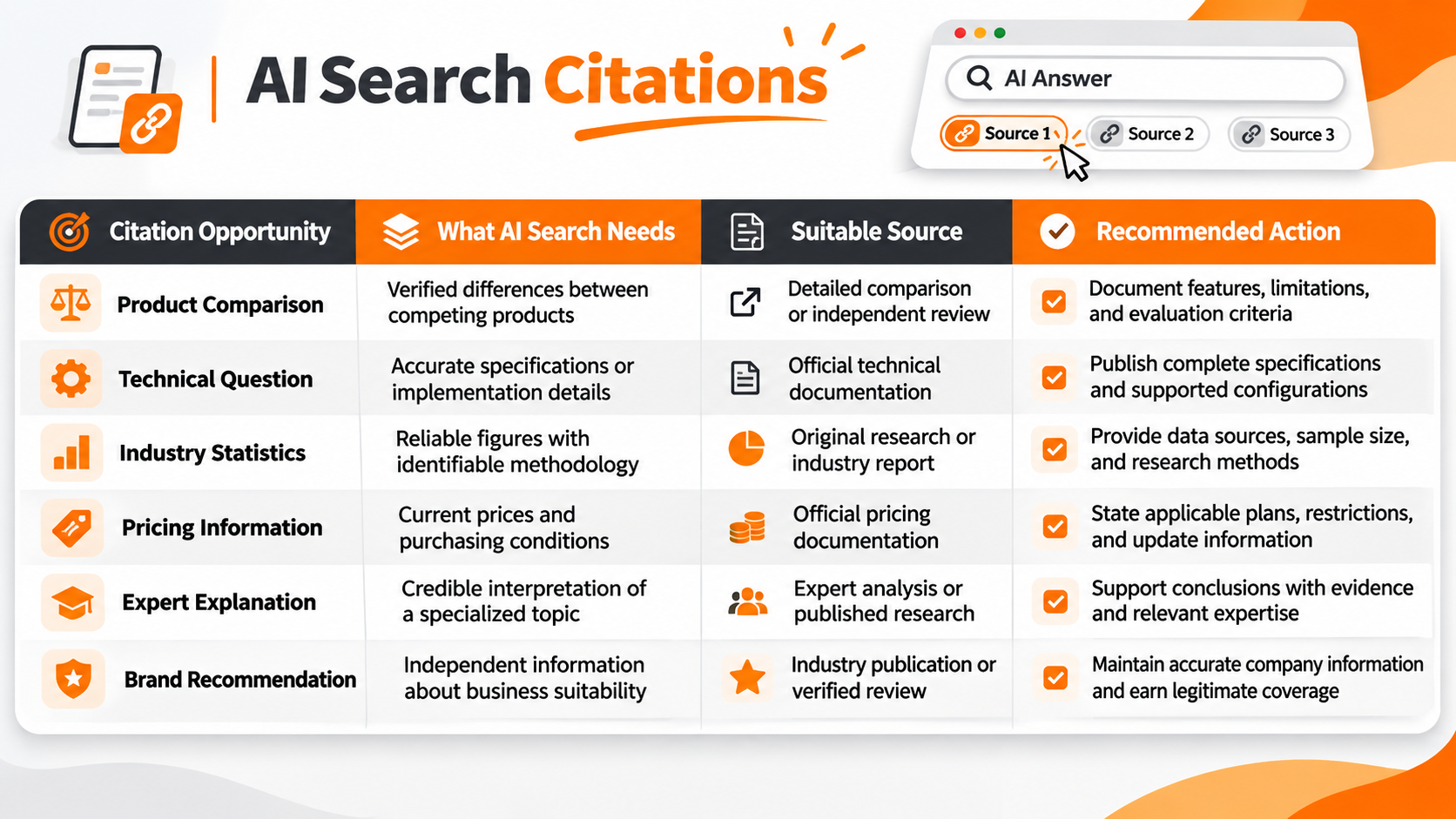
The most appropriate source depends on the question.
Official documentation is well suited to confirming a product specification. Independent reviews provide a different perspective when users want to compare providers.
A company's own website should not attempt to replace every independent source. Its responsibility is to publish accurate information that other publishers and search systems can verify.
Earning Citations Through Original Research
Original research gives a website an opportunity to become the primary source of information.
A report containing independently collected data has a different purpose from an article summarizing statistics published elsewhere.
Consider a cybersecurity company that evaluates the performance of several authentication methods.
A useful report would identify the tested systems, relevant conditions, measurement criteria, and observed results.
Other publishers can then refer to the findings without reproducing the testing process.
Research Methodology and Data Attribution
Research needs enough methodological detail for readers to understand what its findings represent.
Important information includes the study period, sample characteristics, measurement definitions, and limitations.
A statement such as "65% of businesses prefer automated reporting" has little evidential value without identifying where the percentage came from and how preferences were measured.
A clearly documented study gives readers a way to evaluate the claim.
This does not mean every article requires a new research project. Official product records, engineering documentation, and verified operational data can also provide valuable primary evidence.
Expert Contributions and Technical Evidence
Specialized knowledge becomes more useful when an explanation includes the reasoning and evidence behind it.
For technical subjects, that can involve documented test results, implementation requirements, or calculations based on stated assumptions.
For professional services, it can involve publicly shareable project findings, defined methodologies, or analysis of relevant regulations.
Expert commentary should explain something meaningful about the subject, not simply attach a person's name to generic statements.
Evidence is the reason a source deserves consideration.
Independent Sources and Third Party Citations
AI search citations extend beyond the website a business controls.
A company can appear in an answer because an independent source describes its products, evaluates its services, or references its research.
Industry publications, research organizations, specialist directories, and genuine customer reviews each contribute different types of information.
Independent Editorial Coverage
Relevant editorial coverage can establish information about a company beyond its own marketing claims.
For example, an independent publication evaluating enterprise software can explain implementation requirements, customer suitability, and limitations that are absent from product descriptions.
When that publication is cited, the AI response directs readers to the independent assessment.
This creates a different kind of visibility from receiving a direct link to the company's website.
The most defensible approach is to provide journalists and researchers with accurate information, original findings, and access to relevant subject expertise.
Paid placements and promotional articles should not be presented as independent evaluations.
Industry Reviews and Business Profiles
Industry specific review platforms provide useful context for questions involving product selection.
For software companies, relevant review directories can document product categories, supported features, and customer feedback.
Keeping these profiles accurate helps prevent inconsistencies between official product information and external descriptions.
Reviews should reflect genuine customer experiences. Artificial ratings or coordinated promotional responses undermine the reliability of the source itself.
The objective is to establish credible public information, not manufacture a particular citation.
Citation Differences Across AI Search Platforms
AI citation behavior depends on the platform generating the response.
The same page can appear as a source in one AI search experience and be absent from another because the systems retrieve and present information differently.
ChatGPT Search Citations
ChatGPT Search can provide linked citations and a sources view alongside answers that use web search.
OpenAI identifies OAI SearchBot as the crawler associated with search discovery. Making public content accessible to that crawler supports eligibility for inclusion in ChatGPT Search.
Access alone does not guarantee citation.
A page still needs to be relevant to the information requested, and ChatGPT determines which sources to display.
The distinction between search discovery and model training is also important. Allowing a search crawler is not equivalent to authorizing all forms of model training.
Google AI Overviews and AI Mode
Google's AI search features provide supporting links within the broader Google Search environment.
Google states that pages must be indexed and eligible to appear with a search snippet to qualify as supporting links in AI Overviews and AI Mode.
There is no separate AI citation schema or special markup required for inclusion.
This makes established search accessibility and useful content important foundations, but eligibility does not guarantee that a page will be shown.
The sources displayed in AI Overviews and AI Mode can also differ because the two experiences use different models and retrieval techniques.
Perplexity Citations
Perplexity presents responses with references to web sources, allowing users to inspect the information supporting an answer.
Its search system retrieves relevant pages and selects material associated with the question.
PerplexityBot supports the discovery and indexing of publicly accessible web content.
A website seeking visibility in Perplexity should ensure that its intended public information is accessible and accurately represented.
As with other platforms, successful crawling does not establish that the page will appear as a citation for a particular question.
Verifying AI Search Citations
The clearest evidence of a citation is an actual AI response containing a reference to the source.
When evaluating an important citation opportunity, preserve the question, platform, date, cited URL, and the statement the source is associated with.
Then inspect the cited page.
A link appearing beside an AI answer does not prove that the source supports every claim in that answer. Citations can be incomplete, outdated, or associated with information that requires further verification.
For businesses, the accuracy of the representation matters alongside the presence of a link.
If an AI system cites an outdated review containing incorrect pricing, the citation itself is not a successful outcome.
The source and the response need to be assessed together.
For Microsoft search experiences, Bing Webmaster Tools provides AI Performance reporting that identifies cited URLs and associated grounding queries. These reports offer useful evidence about citation activity across supported Microsoft AI experiences.
They do not provide a complete record of citation behavior across every AI search platform.
Detailed measurement of citation frequency, competitive visibility, and changes over time belongs within a broader reporting process.
A Sustainable Approach to AI Search Citations
AI search citations are not earned through a single technical setting or content template.
The most useful work begins with questions that matter to customers and continues by identifying the information needed to answer them accurately.
For a business with existing documentation, the next priority is to determine whether that documentation provides the evidence AI search systems and readers need.
For a business publishing original research, it is to make the findings understandable, verifiable, and accessible.
For a company relying on independent evaluations, maintaining accurate public information and contributing credible expertise are essential.
The objective is not to force an AI system to cite a website. It is to make the website a valuable source for questions where the business has reliable information to contribute.
That approach creates useful content regardless of whether a specific AI platform displays a citation in a particular response.
FAQ
Can our website get AI citations even if it's brand new?
Yes. A newly published website can become eligible for citations when its pages are publicly accessible and provide relevant information. A new domain does not automatically prevent source selection. However, no platform guarantees citation based on publication alone.
Can AI search cite our research if it's only available as a PDF?
Yes. AI search systems can reference accessible PDF documents when the relevant platform supports their retrieval and processing. A PDF containing extractable text is more useful for this purpose than one consisting entirely of scanned images. Public accessibility and platform indexing remain important.
What if another website copies our research and gets cited instead?
The original publisher should preserve evidence of authorship, publication dates, and the underlying research. Clear attribution within the original report helps establish provenance. Where unauthorized copying violates applicable rights, the publisher can use the appropriate correction or copyright process. AI citation selection itself cannot be controlled by the original publisher.
Will adding more external links to our article help it get cited?
External links do not directly guarantee citations. References can help readers verify supporting claims and identify the original sources of information. Their value depends on relevance and credibility, not the number of links included.
Can we request a correction if an AI citation links to the wrong page?
A website owner can report inaccurate responses through the feedback mechanisms provided by the relevant AI platform. If the problem originates from an incorrect redirect, canonical reference, or outdated website address, the publisher should correct that information as well. A correction request does not guarantee an immediate change to the displayed citation.

Fatemeh Jahangard
Technology & AI Writer at PinerookFatemeh Jahangard covers AI, emerging technologies, and digital innovation for Pinerook, focusing on how technology shapes startups and industries.
 Seen first.