AI search visibility tracking measures how often a brand appears, gets recommended, or receives citations in answers from ChatGPT, Perplexity, Google AI Search, and other AI platforms. The process starts with a consistent set of customer questions, records the answers, and compares brand visibility against competitors over time.
A brand can appear in an AI answer without receiving a website visit. That is why tracking mentions, citations, recommendations, and referral traffic separately gives us a more useful picture than relying on organic traffic alone.
How to Track AI Search Visibility
We approach AI search visibility tracking as a repeatable measurement process rather than a collection of isolated searches.
The starting point is a small group of questions that potential customers ask when researching a product, comparing providers, or making a purchasing decision.
From there, the process has five steps:
Choose the AI platforms. Start with ChatGPT Search, Perplexity, and Google AI Search, then add platforms relevant to the target audience.
Build a list of customer prompts. Include product comparisons, recommendations, buying criteria, and specific use cases.
Record the AI responses. Check whether the brand appears, whether it is recommended, and which websites are cited.
Measure the results. Calculate mention rate, citation rate, recommendation rate, and competitive share of voice.
Repeat the same checks. Use a consistent schedule and compare results against the original baseline.
A spreadsheet is enough to begin. Each observation should identify the platform, prompt, date, brand presence, competitor mentions, and cited URLs.
The important part is consistency. Changing the questions, platforms, and measurement rules between reports makes the results difficult to compare.
For example, a company selling accounting software should track questions about accounting software rather than unrelated searches about general business productivity.
The resulting data will describe visibility within a defined market, not an artificial score based on random AI responses.
Selecting Prompts for AI Visibility Tracking
Prompt selection determines the usefulness of the entire analysis.
If we only ask an AI assistant about our own brand, the results reveal little about whether the business appears when potential customers are exploring their options.
The prompt set needs to reflect real customer decisions.
Commercial and Comparison Prompts
For an accounting software company, useful prompts include:
Best accounting software for small businesses
Accounting software with inventory management
QuickBooks alternatives for growing companies
Accounting platforms for businesses with multiple currencies
Accounting software with automated invoice reminders
These questions represent different purchasing requirements.
A company could be visible for general recommendations but absent when buyers ask about a specific feature.
That difference provides a more useful direction for investigation than a single overall visibility score.
Branded and Unbranded Prompts
We separate prompts containing the company's name from prompts that do not.
A branded prompt such as "Does Acme Accounting support multiple currencies?" measures how the AI system describes a known business.
An unbranded prompt such as "Which accounting platforms support multiple currencies?" measures whether that business appears among relevant options.
Both have value, but they answer different questions.
The unbranded group deserves particular attention when the objective is attracting customers who have not selected a provider.
Keeping both groups separate prevents strong visibility for existing brand searches from hiding weak performance in broader product discovery.
Prompt Selection From Customer Data
Search Console queries, customer support requests, sales conversations, and internal website search provide useful starting material.
The final prompt should preserve the language and intent of the customer's question.
There is no benefit in filling a tracking list with dozens of artificial variations that describe the same requirement.
We prefer a defined set covering distinct customer needs, with each prompt assigned to a topic and search intent.
Recording Brand Mentions and Citations
Before calculating performance, we establish exactly what counts as visibility.
Three outcomes need separate records.
Brand mention: The response includes the company's name or a recognized product name.
Brand recommendation: The response presents the company as a suitable option for the user's stated requirement.
Source citation: The response displays a reference to a webpage or document associated with the answer.
These events are not interchangeable.
Consider an AI response listing five accounting platforms. Acme Accounting appears as one of the options, but the assistant cites an independent software comparison.
Acme receives a brand mention. The independent publication receives the direct source citation.
If the answer specifically recommends Acme for businesses requiring multiple currency support, that also qualifies as a recommendation.
A response that only mentions Acme while explaining why it lacks a required feature should not be classified as a positive recommendation.
This distinction makes the measurement more useful.
We also record whether a description is accurate. A brand appearing in an answer with incorrect pricing or unsupported product claims is not the same outcome as a correct recommendation.
AI Search Visibility Metrics
The most useful measurements can be calculated from a consistent collection of AI responses.
The following table provides a reporting framework. The figures are illustrative and represent a sample of 40 recorded answers, not actual performance data from a business.
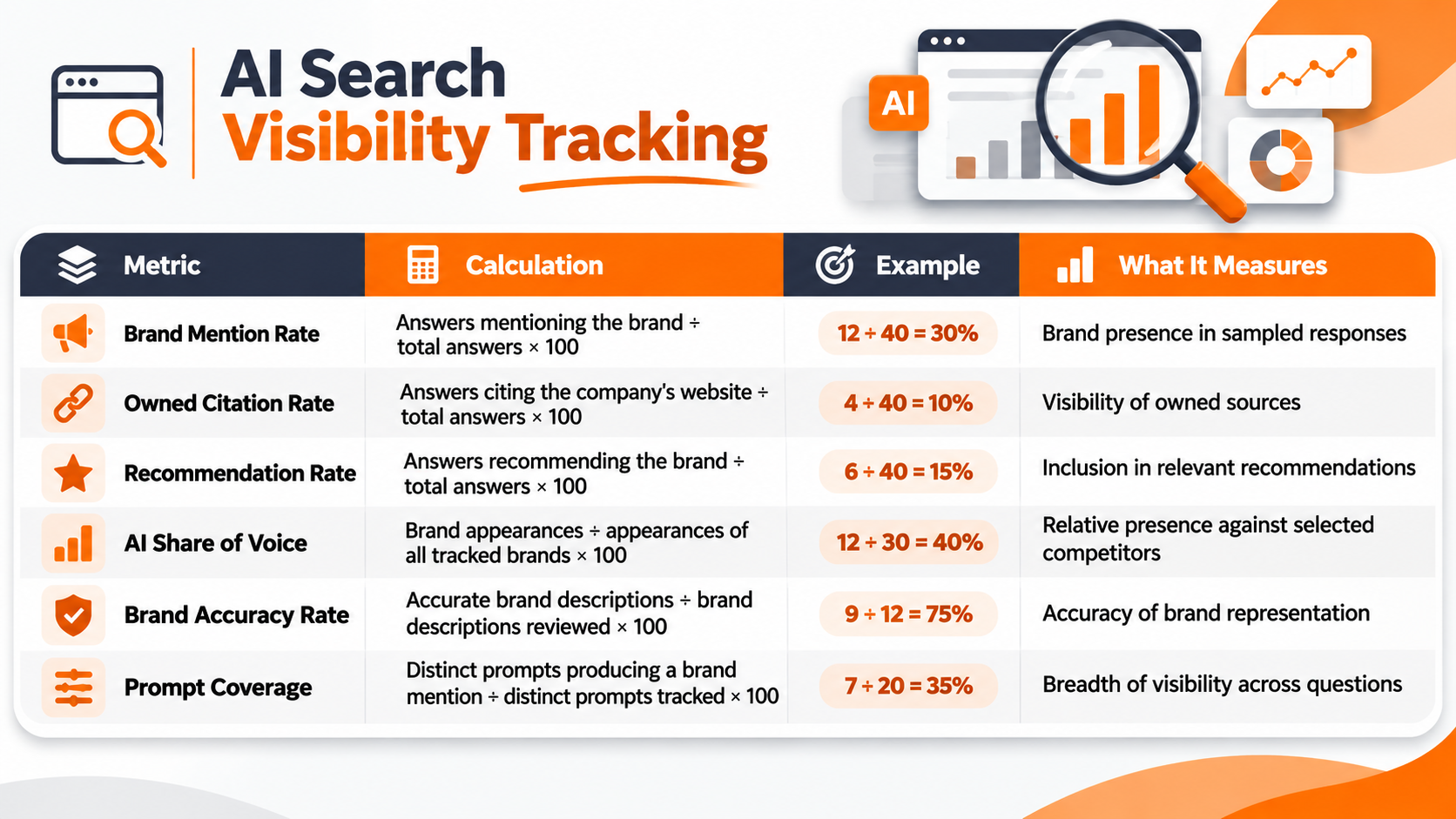
For share of voice, count each tracked brand once per answer and include every occurrence across the selected competitor group. One answer can contribute an appearance for more than one brand.
This metric represents share of appearances within the tracked sample, not total market share or a platform's actual search volume.
Mention rate and prompt coverage also answer different questions. Mention rate counts individual responses, while prompt coverage shows how many distinct questions produced at least one mention.
A brand could appear repeatedly for two prompts while remaining absent from eighteen others. Its mention rate might improve even though its topic coverage remains narrow.
This is why a single AI visibility score cannot explain the full result.
Measuring AI Share of Voice Against Competitors
Competitive analysis becomes useful when every business is evaluated against the same prompts and responses.
We start with competitors that buyers genuinely consider for the same product category.
For example, a company offering customer support software should not compare its visibility against every major technology brand. The relevant comparison is with businesses offering similar products to a comparable audience.
Competitive Visibility Gaps
Each tracked response can reveal one of three useful situations.
The brand and competitors both appear. The business is part of the answer, but its positioning and recommendation context deserve review.
Competitors appear without the brand. This identifies a potential visibility gap for a relevant customer question.
No tracked provider appears. The response may be informational rather than a recommendation, or the prompt may not match the intended buying journey.
The second situation deserves closer examination.
If competitors appear in answers about enterprise support software while the business is absent, the next step is to identify the information those answers rely on.
The gap could concern product capabilities, independent coverage, category relevance, or information that has not been published clearly.
Tracking identifies the gap. It does not establish its cause without further investigation.
Recommendation Quality
A brand's position in a response deserves attention, but AI search does not provide one standardized ranking system across platforms.
Being listed first in one generated answer does not establish a permanent first position.
We record the order when an answer presents an ordered list, while keeping recommendation quality separate from ordering.
A clear recommendation based on a matching customer requirement provides more meaningful context than a passing mention in a long list.
Tracking Visibility Across AI Platforms
AI platforms do not expose identical reporting data. A reliable tracking process accounts for these differences.
ChatGPT Search
ChatGPT Search can generate answers with linked sources and a separate sources view.
For manual tracking, we submit the selected prompts, record brand mentions, and inspect the citations displayed with each answer.
The records should distinguish a direct citation to the company's website from a reference to an independent publication discussing the company.
ChatGPT does not provide website owners with a universal public dashboard showing every brand mention, citation, and user prompt across all conversations.
Manual testing and third party visibility platforms therefore provide sampled observations rather than a complete record of ChatGPT activity.
Google AI Overviews and AI Mode
Google Search Console introduced a dedicated Generative AI performance report in June 2026, with worldwide rollout completed by August 31, 2026.
The report covers impressions in AI Overviews and AI Mode. Website owners can review which pages appeared, how visibility changed over time, and how impressions are distributed by country and device.
This is valuable because it reflects recorded Google Search activity rather than only manually generated prompts.
However, the dedicated report measures impressions. It does not provide a complete list of the exact prompts responsible for those impressions or a separate count of clicks from generative AI features.
Google continues to include AI feature activity in its broader Search performance data.
A property with insufficient eligible impressions may not display the dedicated report.
Bing and Microsoft Copilot
Bing Webmaster Tools introduced AI Performance reporting in February 2026.
The dashboard provides citation counts, cited pages, grounding queries, and changes in citation activity across supported Microsoft AI experiences.
In October 2026, Microsoft also introduced Topics Portfolio in beta.
This feature groups relevant grounding queries into topics and identifies opportunities where other sites receive citations but the tracked website does not.
Topics Portfolio is available when sufficient relevant data exists. Its topic estimates and opportunity figures should be treated as directional indicators rather than exact market measurements.
The report provides a useful complement to manual prompt tracking because it reflects activity within supported Microsoft systems.
Perplexity
Perplexity presents web sources alongside its generated answers.
For manual visibility monitoring, we inspect the response, identify brand mentions, and record the cited domains and pages.
These observations can be compared with the same prompt set used for other platforms.
The results should remain separated by platform. Combining all observations into one total without identifying their sources can hide important differences.
Building a Reliable Tracking Baseline
AI answers can change between requests, even when the wording remains identical.
Model updates, available information, retrieval behavior, user context, and the timing of a search can influence what appears.
For that reason, one response is not a reliable basis for claiming that a brand has gained or lost visibility across a platform.
Consistent Test Conditions
We document the conditions of each measurement period.
The record should include:
Exact prompt wording
AI platform and available model information
Date and time
Target country and language
Account or session conditions
Response text and cited sources
The rules used to classify mentions and recommendations
A manual process should use fresh conversations where appropriate and avoid introducing company preferences into the prompt history.
Repeated observations help reveal whether an appearance is consistent within the sample.
For comparisons across reporting periods, keep the original prompt set unchanged. New prompts can be added to a separate group without altering the historical baseline.
Interpreting Changes Over Time
Suppose a brand appears in 20% of the recorded answers during one measurement period and 35% during the next.
The observed increase is 15 percentage points.
That result describes the selected prompts and test conditions. It does not establish that 35% of all users on the platform are seeing the brand.
The next step is to identify where the change occurred.
An increase driven by a single prompt has a different implication from improved visibility across several commercially relevant topics.
Comparing results by prompt category makes the trend easier to interpret.
Measuring AI Referral Traffic and Conversions
Visibility is only one part of performance.
A business also needs to understand whether visitors arrive through AI assistants and what those visitors do afterward.
AI Assistant Traffic in Google Analytics 4
Google Analytics introduced a dedicated AI Assistant channel in May 2026.
Recognized referrals from services such as ChatGPT, Gemini, and other supported assistants can appear in this channel.
We review the Traffic acquisition report to examine sessions, landing pages, engagement, and key events associated with identifiable AI assistant traffic.
An important distinction is that Google's own AI Overviews and AI Mode are classified under Organic Search, not the AI Assistant channel.
Consequently, the AI Assistant channel alone does not measure all traffic influenced by AI search.
Referral information also depends on what the originating service and browser pass to the website.
If a visitor discovers a brand in an AI answer and later reaches the website directly, that discovery cannot automatically be attributed to the original AI interaction.
Connecting Visibility With Business Results
For a commercial website, useful outcomes include qualified leads, trial registrations, purchases, and other defined conversions.
We compare changes in identifiable AI referral traffic with the actions those visitors complete.
Branded search activity and direct visits provide additional context, but a simultaneous increase in those metrics does not prove that AI exposure caused it.
The distinction matters when reporting results to stakeholders.
A citation is evidence of visibility, a referral session is evidence of a visit, and a conversion is evidence of a completed business action.
Each requires its own measurement.
Turning Visibility Data Into Content Decisions
The purpose of AI search performance tracking is to determine where further investigation and improvement are justified.
The value of Generative Engine Optimization (GEO) becomes clearer when visibility data leads to specific decisions. Tracking reveals which customer questions bring a brand into AI answers, where competitors receive more attention, and whether the cited information is accurate. These findings help us prioritize meaningful improvements instead of making content changes based on assumptions.
For a website with strong mentions but few citations to its own pages, inspect the external sources appearing in relevant answers.
If competitors dominate an important product comparison, examine whether the website provides accurate and complete information for the comparison criteria.
If a page receives generative AI impressions but little measurable traffic, review the broader search data and the page's value to visitors rather than assuming the AI feature caused the difference.
The reporting process should produce clear decisions linked to specific evidence.
We prioritize topics according to commercial relevance, observed visibility gaps, and the quality of the available information.
There is no need to react to every change in a generated response. A repeated pattern across a defined sample provides a stronger basis for allocating editorial resources.
AI Search Visibility Reporting
A useful report should let readers understand the brand's position without reviewing every recorded response.
We organize findings around four questions:
Where does the brand appear across the selected AI platforms?
Which relevant customer questions produce recommendations or citations?
Where are competitors visible while the brand is absent?
What measurable visits and business outcomes accompany that visibility?
The report should clearly identify the sampled prompts, measurement period, platforms, and limitations.
It should also separate directly observed data from estimates produced by third party tools.
An overall trend becomes more meaningful when supported by evidence from the specific prompts and sources responsible for the change.
AI search visibility tracking is valuable because it replaces assumptions about brand presence with documented observations.
A consistent measurement framework gives teams a way to evaluate changes, investigate competitive gaps, and make informed decisions about their content and search investments.
FAQ
Can we track our brand in AI search if we don't have a website yet?
Yes. Brand mentions and recommendations can be recorded even without an owned website. The analysis should use the business name and relevant product identifiers. Direct citations to an owned website cannot be measured until such a website exists.
What if an AI assistant spells our brand name wrong?
Record the incorrect spelling separately from an accurate brand mention. A tracking system can include approved brand aliases, but an incorrect name should remain identifiable as a representation issue. Automatically treating every similar spelling as a valid mention can distort the results.
Can we track a brand in several languages at once?
Yes. Each language should have its own defined prompt set and reporting segment. Combining responses from different languages without separating them makes it difficult to identify where visibility has changed.
Is it safe to put our private customer questions into AI tracking tools?
Confidential customer information should not be submitted to external AI services without appropriate authorization and data protection controls. Convert customer questions into anonymized examples that preserve the underlying search intent without exposing personal or commercially sensitive information.
Can we use the same visibility report for two different products?
Yes, provided results are separated by product and relevant search intent. Each product should have its own prompts, recognized names, and competitive set. Combining unrelated product categories into a single score can conceal performance differences.

Fatemeh Jahangard
Technology & AI Writer at PinerookFatemeh Jahangard covers AI, emerging technologies, and digital innovation for Pinerook, focusing on how technology shapes startups and industries.
 Seen first.