The operating model in one paragraph
An AI-native startup does not begin by replacing job titles with software. It begins by mapping the capabilities required to build, sell, support, learn, and manage risk. Repetitive work is automated, judgment-heavy work is augmented, and high-stakes decisions retain explicit human ownership. Hiring happens when a bottleneck is persistent, consequential, context-heavy, and needs durable accountability. The result can be a smaller team, but small headcount is an outcome—not the strategy.
Why the startup operating equation changed
For much of the last decade, startup growth had a visible proxy: headcount. A larger engineering team suggested more product velocity, a larger sales team suggested more pipeline, and a new funding round often came with an aggressive hiring plan. In 2026, that relationship is weaker because some forms of output—research, coding, analysis, content operations, support triage, reporting, and workflow coordination—can be produced with far less human time than before.
Carta’s State of Startup Compensation: H2 2025, published in May 2026, gives the shift a measurable shape. The median seed-stage company on Carta now has four employees, while average Series B headcount fell from 53 in 2023 to 45 in 2025. Carta also reported that January 2026 was the slowest January for startup hiring on its platform since 2018. Those figures do not prove that every company should stay tiny, but they do show that the old relationship between capital, hiring, and output is being rewritten.
The more useful founder question is no longer “Which role do we hire next?” It is “Which capability is constrained, and what is the cheapest reliable way to remove that constraint without creating a larger one elsewhere?”
Design the company around capabilities, not job titles
A conventional org chart starts with functions: engineering, design, marketing, sales, support, finance, and operations. A stronger startup team structure starts one level deeper: discover customer problems, ship product, create demand, convert demand, support customers, collect revenue, manage risk, and learn faster than competitors.
That distinction matters because one person, one workflow, or one AI system can now cover pieces of several traditional roles. A founder who thinks only in titles may hire a marketer when growth slows. A founder who thinks in capabilities asks whether the real gap is positioning, content production, distribution, conversion, pricing, or enterprise relationships. Only some of those constraints require a new employee.
A capability map for an early-stage company
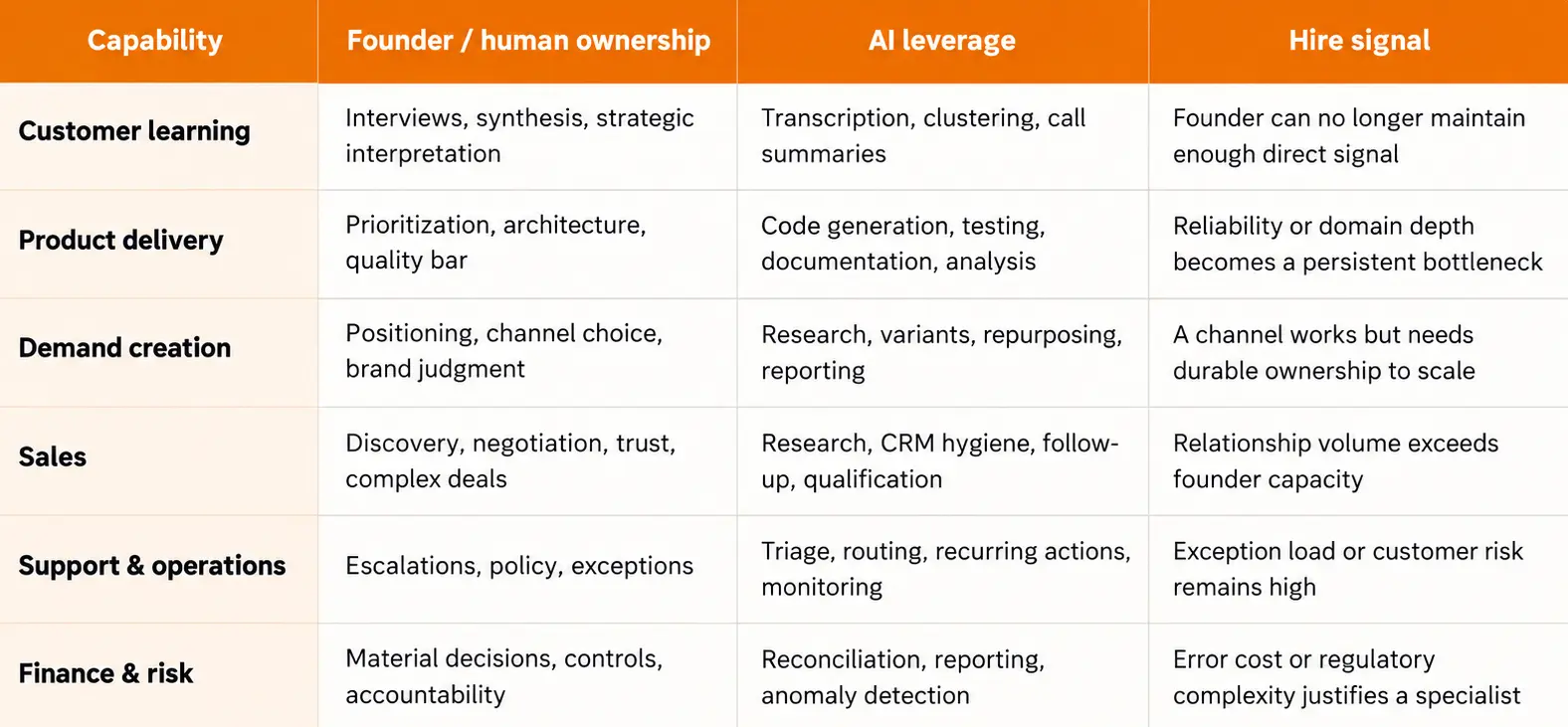
1. Founder judgment
The founder stays close to decisions where context is incomplete and the consequences are strategic: customer truth, product direction, positioning, key hires, major commercial commitments, and the company’s risk appetite.
2. Human specialists
People own functions where expertise, relationships, accountability, or accumulated context matter more than raw task volume. The goal is not to eliminate specialists; it is to make each specialist more leveraged.
3. AI augmentation
Models accelerate research, drafting, analysis, coding, testing, synthesis, and preparation while a person still frames the problem and owns the output. This layer compresses work without obscuring responsibility.
4. Automated workflows and agents
Repeatable work moves into systems that can execute with defined inputs, permissions, observability, and escalation paths. The best automation removes recurring attention, not merely keystrokes.
Use the automate–augment–own test before buying tools
The fastest way to waste money on AI is to automate work simply because it can be automated. Before adding software, classify the work itself.
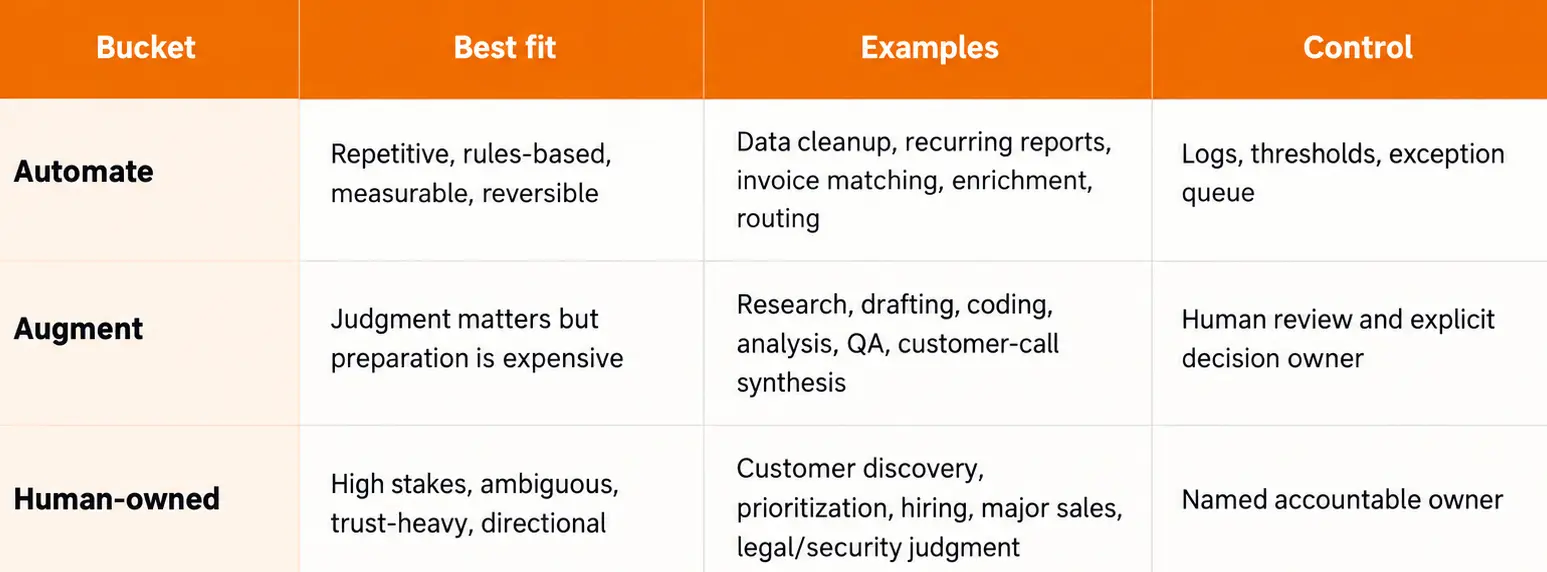
The discipline behind AI workflow automation for startups is therefore process design, not tool collecting. Run a workflow manually long enough to understand its inputs, failure modes, edge cases, and acceptable error rate. Then automate the stable core and make escalation visible.
Use agents only when a workflow is ready for action
The practical promise of AI agents for startups is not that an autonomous system can “run the company.” It is that a well-scoped agent can move a defined piece of work across tools with less prompting: inspect a support request, retrieve account context, update a CRM record, draft a response, create a follow-up task, and escalate when the case falls outside policy.
That is useful only when four conditions are true: the agent has current context, permissions are narrow, the outcome can be measured, and a person owns exceptions. A chatbot that produces text is not operational leverage if someone still has to manually carry every output through the rest of the workflow.
Start with narrow workflows where the downside is bounded. Support triage, CRM hygiene, recurring reporting, research preparation, onboarding checklists, internal knowledge retrieval, and anomaly detection are better first candidates than pricing decisions, contract approval, security changes, or customer promises.
Do not automate a bad process
Automation multiplies whatever is already there. A weak lead qualification process becomes bad qualification at higher speed. Poor support categories become faster misrouting. Vague product requirements become more code without more clarity. A founder who has not defined what “good” looks like should not expect a model to infer the operating standard consistently.
The rule is straightforward: stabilize before you automate. Document the desired outcome, define the minimum required context, list the common exceptions, set the quality threshold, and decide who is paged when the system is uncertain. In a lean team, observability is part of the product. A process you cannot inspect is hidden operational risk.
Keep proprietary learning close to the founders
Some activities produce more than an output; they produce the context from which future decisions are made. Founder-led customer discovery belongs in that category. AI can transcribe interviews, cluster objections, surface repeated language, and summarize dozens of calls. It should not replace the founder hearing hesitation, noticing contradictions, or asking the unexpected follow-up that changes the roadmap.
The same principle applies to the product’s core promise and the company’s highest-risk decisions. A model can generate landing-page variants, but it cannot be accountable for choosing the market you want to own. It can model price points, but it does not carry the commercial consequences of choosing the wrong one. It can draft a proposal, but it does not build the trust required for a consequential customer to sign.
Founders should preserve direct contact with three signals for as long as possible: customers, the product’s core promise, and the decisions that could materially change the company. Delegation is reversible. Losing the signal is harder to repair.
Hire when ownership—not task volume—is the bottleneck
A disciplined startup hiring strategy separates temporary workload from a capability that needs permanent ownership. AI makes that distinction more important because many spikes in workload can now be absorbed without adding a full-time role.
Use five tests before hiring:
Persistence: Has the bottleneck survived multiple process and tooling changes?
Frequency: Does it consume meaningful time every week rather than during a short spike?
Consequence: Does weak execution create material revenue, product, security, compliance, or reputational risk?
Context: Does success depend on accumulated company knowledge, relationships, or judgment that is difficult to reconstruct on demand?
Ownership: Does the function need someone who is continuously responsible for the outcome rather than someone who merely completes tasks?
If several answers are yes, another subscription may only postpone the real constraint. The right hire should remove a recurring category of founder attention, improve reliability, and create a capability that persists even when priorities shift.
The model changes by startup stage
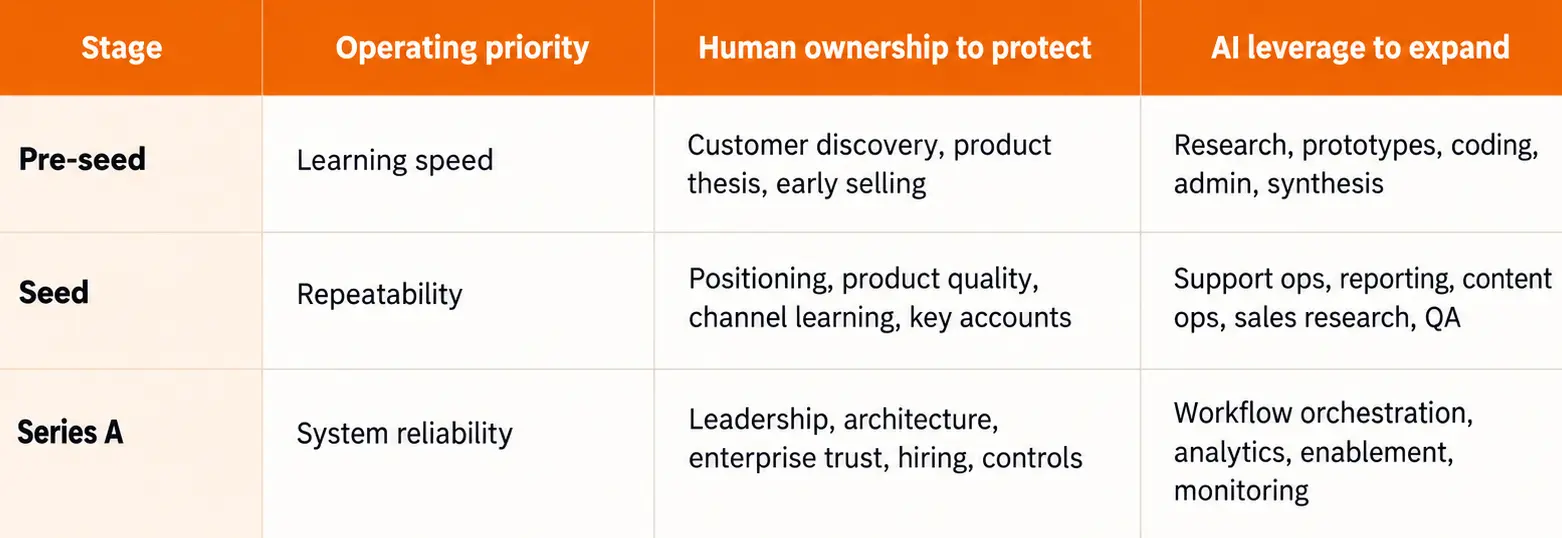
Pre-seed teams should optimize for learning, not apparent scale. Seed teams need repeatable execution without losing contact with the market. By Series A, the cost of fragility rises: permissions, data quality, security, ownership, and documentation become operating infrastructure rather than administrative overhead.
Measure leverage, not AI activity
Good startup productivity metrics do not count prompts, tools, or automated tasks. They show whether the company converts the same amount of founder attention, payroll, and time into better outcomes.
Product: Cycle time from customer signal to shipped change, deployment frequency, defect escape rate, rollback frequency.
Go-to-market: Qualified pipeline per person, speed to first response, conversion by channel, founder time spent per qualified opportunity.
Support and operations: Manual touches per transaction, exception rate, resolution time, percentage of cases escalated to a human.
Company: Revenue per employee alongside retention, gross margin, service quality, and runway—not revenue per employee in isolation.
Founder attention: Interruption rate: how often each week a process requires a founder to rescue, approve, or manually reconstruct it.
A workflow that runs only while the founder watches it is not automation. It is supervised labor with a new interface.
Lean teams need stronger controls, not fewer controls
The objective of AI risk management for startups is not enterprise bureaucracy. It is preventing a small team from creating invisible failure modes faster than it can detect them. The smaller the team, the more dangerous undocumented dependencies and over-broad permissions can become.
At minimum, operational AI systems should have a named owner, clear access boundaries, logs, a rollback path, a way to flag uncertainty, and a manual fallback. Sensitive customer data should not be routed through tools simply because integration is convenient. High-impact actions—payments, contract changes, account deletion, production configuration, security permissions, or external commitments—deserve explicit approval gates unless the risk has been deliberately engineered down.
Resilience matters too. A three-person team can move unusually fast, but it can also be one illness, one departure, or one undocumented workflow away from paralysis. Founder dependency is not efficiency. Small teams need stronger documentation, backup ownership, and recovery procedures precisely because there are fewer people available when something breaks.
Capital allocation changes when headcount is not the default answer
The rise of lean teams changes the logic of AI startup fundraising because founders can no longer assume that a larger round should primarily finance a larger org chart. A stronger capital story explains which capabilities have become cheap because of software and which constraints remain expensive because they require data, distribution, regulation, physical infrastructure, trust, or exceptional talent.
That may mean funding proprietary data, enterprise distribution, regulated-market work, hardware, security, customer guarantees, acquisitions, or simply enough runway to reach a difficult technical milestone. Hiring can still be the right use of capital, but headcount should be justified by the capability it unlocks—not treated as evidence of momentum by itself.
Where AI-native operating models fail
Tool sprawl: The team accumulates overlapping subscriptions without retiring old workflows or measuring time saved.
Automation before clarity: A process is automated before success criteria, inputs, and exceptions are understood.
No decision owner: AI contributes to a consequential decision, but nobody is explicitly accountable for the final call.
Context fragmentation: Company knowledge is scattered across chats, docs, CRMs, and prompts, producing inconsistent outputs.
Founder distance: The team automates customer learning and gradually loses firsthand understanding of the market.
False efficiency: Headcount falls, but customer quality, reliability, retention, or founder workload deteriorates.
Single-point-of-failure systems: Critical workflows depend on one person, one prompt, one integration, or one undocumented automation.
A 30-day operating audit for founders
Week 1 — Map recurring work
List the work that consumed meaningful time during the last four weeks. Group it by outcome—build, sell, support, operate, learn, manage risk—not by department.
Week 2 — Classify ownership
Mark each activity as automate, augment, or human-owned. Record frequency, error cost, exceptions, required context, and the current owner.
Week 3 — Run two contained experiments
Choose high-frequency, low-downside workflows with measurable inputs and outputs. Establish a baseline before changing anything: cycle time, error rate, conversion, response time, or hours spent.
Week 4 — Revisit the remaining bottlenecks
If a constraint is still persistent, consequential, context-heavy, and ownership-intensive, write the job description before buying more software. If it is repetitive and measurable, improve the system before expanding the team.
Repeat the audit quarterly. The AI model landscape will change faster than a healthy org chart should.
The founder decision checklist
• What capability is actually constrained?
• Is the work repetitive enough to standardize?
• What is the cost of a wrong output?
• Does a person need to own the relationship or judgment?
• Can the workflow be inspected, logged, and rolled back?
• Would a new hire remove a category of founder attention rather than simply add output?
• Are we improving customer outcomes, reliability, and learning speed—or only producing more activity?
The durable advantage is judgment
AI is lowering the cost of execution across many startup functions. As execution becomes cheaper, judgment becomes more valuable: choosing the right problem, recognizing a real customer signal, knowing when a metric is misleading, defining the quality threshold that matters, and deciding when an automated system has crossed from leverage into risk.
The strongest AI-native startups will not necessarily be the ones with the fewest employees or the most agents. They will have the clearest boundary between machine leverage and human accountability. They will automate aggressively where work is repeatable, keep people close to high-stakes learning and decisions, and hire when a person creates durable ownership that the system cannot reliably provide.
That operating discipline is more difficult than “stay lean.” It is also far more defensible.

Mohsen Avid
Founder & Editor, PinerookMohsen Avid is the founder of Pinerook, covering entrepreneurship, startup strategy, digital business, and the decisions behind building new ventures.
 Seen first.