Future technology trends in 2026 are being shaped less by isolated inventions and more by technologies converging around AI, computing infrastructure, robotics, cybersecurity, energy, science, and advanced hardware. The strongest shift I see is that technology is moving from experimentation into systems that can act, build, discover, and operate in the physical world.
When I follow technology trends, I do not rank them by how much attention they receive. I look for investment, technical progress, commercial deployment, infrastructure growth, and clear business use. By those measures, agentic AI, physical AI, AI infrastructure, scientific discovery, cybersecurity, quantum technology, advanced energy, and specialized computing deserve the most attention right now. McKinsey's 2026 outlook reaches a similar conclusion after analyzing search activity, research, patents, investment, talent demand, and adoption across 14 technology trends.
Future Technology Trends Shaping 2026 and Beyond
For readers who want the landscape at a glance, these are the technology shifts I would put at the top of the list.
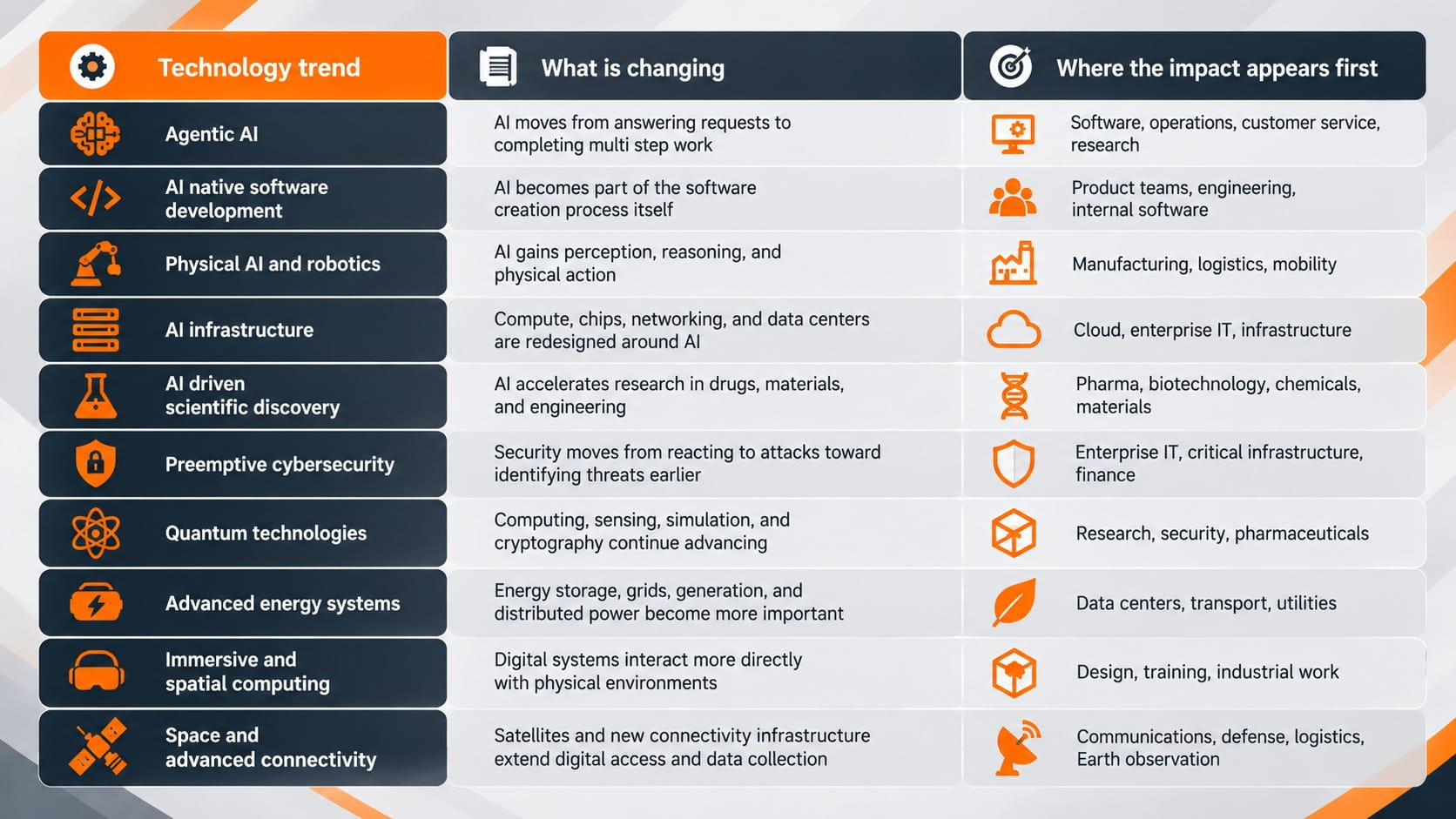
One point matters here: not every item on the list is at the same stage. AI infrastructure is already moving into large scale deployment, while quantum technology remains much earlier in enterprise adoption. McKinsey's current data places newer areas such as quantum, immersive reality, agentic AI, robotics, and space at earlier adoption stages even as investment and research activity increase.
Agentic AI and Multiagent Systems
Generative AI made software easier to talk to. Agentic AI changes what software can do after that conversation.
An AI agent can take a goal, break it into steps, interact with tools, retrieve information, execute actions, and continue working toward an outcome with less direct human input. Multiagent systems extend that idea by allowing specialized agents to coordinate across different parts of a task.
This is the trend I watch most closely because it changes the structure of software, not just its interface.
A customer support system no longer needs to stop after recommending a solution. An agent can check an account, update a record, trigger a refund, schedule a follow up, and document the result. A research agent can collect data, compare sources, run analysis, and prepare an output.
The gap between demonstration and production still matters. Deloitte reports that 11 percent of surveyed organizations have AI agents in production while 38 percent are piloting them. That makes 2026 a transition year from experimentation toward operational deployment rather than the endpoint of agent adoption.
AI Native Software Development
Software development is becoming one of the clearest examples of AI moving from assistant to active participant.
The first generation of coding tools helped developers complete lines of code or generate functions. The next generation works across larger parts of the development process: planning, generating code, testing, debugging, documentation, migration, and maintenance.
Gartner includes AI native development platforms among its strategic technology trends for 2026, describing platforms where AI models play a central role in creating software faster.
From a startup perspective, the bigger change is not simply developer productivity. Smaller teams can test products, rebuild internal systems, and launch specialized software with fewer engineering hours than older development models required.
That changes the economics of building software.
The limit moves elsewhere. Code can now be produced faster than organizations can review architecture, security, quality, and product decisions. McKinsey identifies that imbalance directly, noting that AI generated code can outpace an organization's ability to test and deploy it safely.
Physical AI and Robotics
The technology story is moving beyond screens.
Physical AI combines artificial intelligence with sensors, cameras, robotics, autonomous systems, and real time decision making. Instead of processing only digital information, these systems perceive and interact with physical environments.
This is where I see the clearest connection between AI and industrial change.
Manufacturing and logistics come first because the business case is measurable. A robot that handles material, inspects a product, moves inventory, or coordinates warehouse operations produces a direct operational result.
Deloitte highlights the same shift in its 2026 technology report, including Amazon's deployment of its millionth robot and BMW's use of autonomous vehicles inside manufacturing operations.
The next expansion goes into construction, agriculture, healthcare, mobility, and field operations. McKinsey also identifies physical AI as the next step after screen based AI, with machines gaining perception, reasoning, and action in real environments.
The key trend is not humanoid robots by themselves. It is intelligence becoming embedded in machines that perform physical work.
AI Infrastructure and Specialized Computing
The growth of AI is forcing a redesign of the infrastructure underneath software.
Models need chips. Chips need data centers. Data centers need networking, cooling, electricity, and large amounts of capital.
This creates a second technology cycle underneath the visible AI applications.
I would not describe cloud computing itself as a future technology trend anymore. McKinsey removed cloud and edge computing as a standalone trend from its 2026 frontier analysis because both have reached broad adoption. The next trend is the infrastructure being built on top of them for AI workloads.
That includes:
AI accelerators and application specific chips
AI supercomputing platforms
high performance networking
distributed inference
edge AI
hybrid computing
specialized data center infrastructure
new cooling and energy systems
Gartner lists AI supercomputing platforms among its major strategic trends for 2026, combining CPUs, GPUs, AI specific processors, memory, and orchestration into systems built for increasingly complex workloads.
McKinsey also reports that spending on AI infrastructure doubled in a year.
That makes compute capacity, power availability, and infrastructure efficiency part of technology strategy rather than background IT decisions.
AI Driven Scientific Discovery
One of the most important technology trends receives less consumer attention because much of the work happens inside laboratories and research organizations.
AI is increasingly being used to explore chemical structures, identify drug candidates, design materials, model biological processes, and narrow the search space before expensive physical testing begins.
McKinsey added AI for scientific discovery and engineering as a dedicated technology trend in its 2026 report.
The value comes from changing the economics of discovery.
Research teams can evaluate far more possibilities digitally before moving candidates into laboratories. That reduces the number of expensive experiments required to reach a useful result.
The physical world still sets the validation timeline. A model can identify a promising molecule quickly, but laboratories, clinical testing, manufacturing, and regulation still determine when a scientific result becomes a commercial product.
That distinction keeps this field grounded. AI accelerates discovery, while physical validation determines what survives.
Cybersecurity Moving Ahead of the Attack
Cybersecurity is changing because AI increases speed on both sides.
Attackers can automate reconnaissance, vulnerability discovery, social engineering, and exploitation. Defenders can use the same class of technology to monitor systems, detect abnormal behavior, search for vulnerabilities, and respond faster.
Gartner describes preemptive cybersecurity as a major 2026 trend and expects more security spending to move toward systems designed to act before attacks cause damage.
Another part of the trend is digital provenance.
As AI generated software, media, data, and automated decisions become more common, organizations need stronger ways to establish where digital assets came from, whether they were altered, and who created or approved them.
Security is therefore expanding from protecting access to proving authenticity.
For founders and technology teams, this affects product architecture directly. Security, model access, identity, permissions, data lineage, and provenance cannot be bolted onto AI systems after deployment.
Quantum Technology
Quantum computing attracts headlines long before its commercial maturity justifies mass adoption, so I separate technical progress from business readiness.
The technology is advancing across quantum computing, quantum communication, sensing, and simulation. Its long term importance comes from solving specific computational problems that classical systems handle poorly.
McKinsey continues to classify quantum technology as an early stage trend in 2026 while also tracking increasing commercial activity and investment.
The immediate business issue is not replacing conventional computers.
It is preparing for the security implications of future quantum capability and identifying industries where quantum simulation could create significant value, particularly pharmaceuticals, chemistry, materials, optimization, and scientific research.
This is also why post quantum cryptography belongs in current technology planning rather than distant speculation. Infrastructure created today can remain in service for years.
Energy Technology Becoming a Computing Issue
The expansion of AI has connected the future of computing with the future of energy.
More models, larger workloads, and more data centers mean more demand for electricity, transmission capacity, storage, cooling, and grid infrastructure.
McKinsey reports that energy technologies attracted close to $200 billion in investment in 2025. Its 2026 analysis also identifies power availability as a constraint on AI infrastructure growth.
This is why I would put energy technology inside a future technology discussion rather than treating it as a separate sustainability topic.
Important areas include:
grid modernization
energy storage
distributed energy resources
advanced nuclear technologies
high efficiency cooling
electricity management software
battery technologies
everything to grid systems
The World Economic Forum selected everything to grid energy as one of its top technologies for 2026. The concept turns vehicles, buildings, batteries, and other distributed assets into resources that can return electricity to the grid when demand rises.
The next generation of digital infrastructure will be shaped as much by access to power as access to computing hardware.
Immersive and Spatial Computing
Virtual reality did not disappear when consumer attention moved toward AI.
The technology is moving toward a more practical role inside design, training, engineering, remote collaboration, simulation, and physical operations.
The direction I pay attention to is the combination of immersive computing with AI.
A headset that only displays a virtual environment has a narrower role than a system that can understand the user's surroundings, recognize objects, interpret voice and gestures, and provide contextual assistance in real time.
McKinsey places immersive reality among the technologies still at an earlier adoption stage, while noting that these systems are increasingly interacting with both users and their physical environments.
This makes industrial environments a stronger near term use case than entertainment alone.
Training technicians, reviewing complex designs, visualizing facilities, assisting field workers, and simulating operational environments all connect digital information to physical work.
Space Technology and Advanced Connectivity
Space technology is becoming part of mainstream digital infrastructure.
Lower launch costs, larger satellite constellations, better sensors, and stronger data processing are expanding what businesses can do with communications, navigation, Earth observation, logistics, agriculture, insurance, defense, and environmental monitoring.
McKinsey identifies space technology as one of the areas on track for investment growth in 2026, with investment potentially more than doubling from 2025 based on its first half trajectory.
The part I find most important is not space exploration itself.
It is the movement of satellite infrastructure into ordinary business systems.
A logistics company can use satellite data to monitor routes. Agricultural platforms can combine Earth observation with AI. Telecommunications providers can extend coverage beyond terrestrial networks.
Space becomes more commercially important when it stops feeling like a separate industry.
Technology Convergence
The strongest future technology trend is convergence itself.
AI connects with robotics. AI infrastructure connects with semiconductors and energy. AI driven discovery connects computing with biotechnology and materials science. Spatial systems combine sensors, AI, connectivity, and physical environments.
This is where I use the broader landscape of emerging technologies as context. Looking at each technology separately misses the value created when several capabilities mature at the same time.
The World Economic Forum's 2026 research shows a similar pattern across fields. Scientific discovery is becoming more computational, technologies are becoming more distributed, and several innovations are moving from laboratories toward practical deployment.
A startup does not need to invent a new model, chip, robot, sensor, or energy system to benefit from this shift.
The business opportunity can sit at the intersection.
Signals Worth Tracking
I do not judge a future technology trend by announcements alone.
These are the signals I follow:
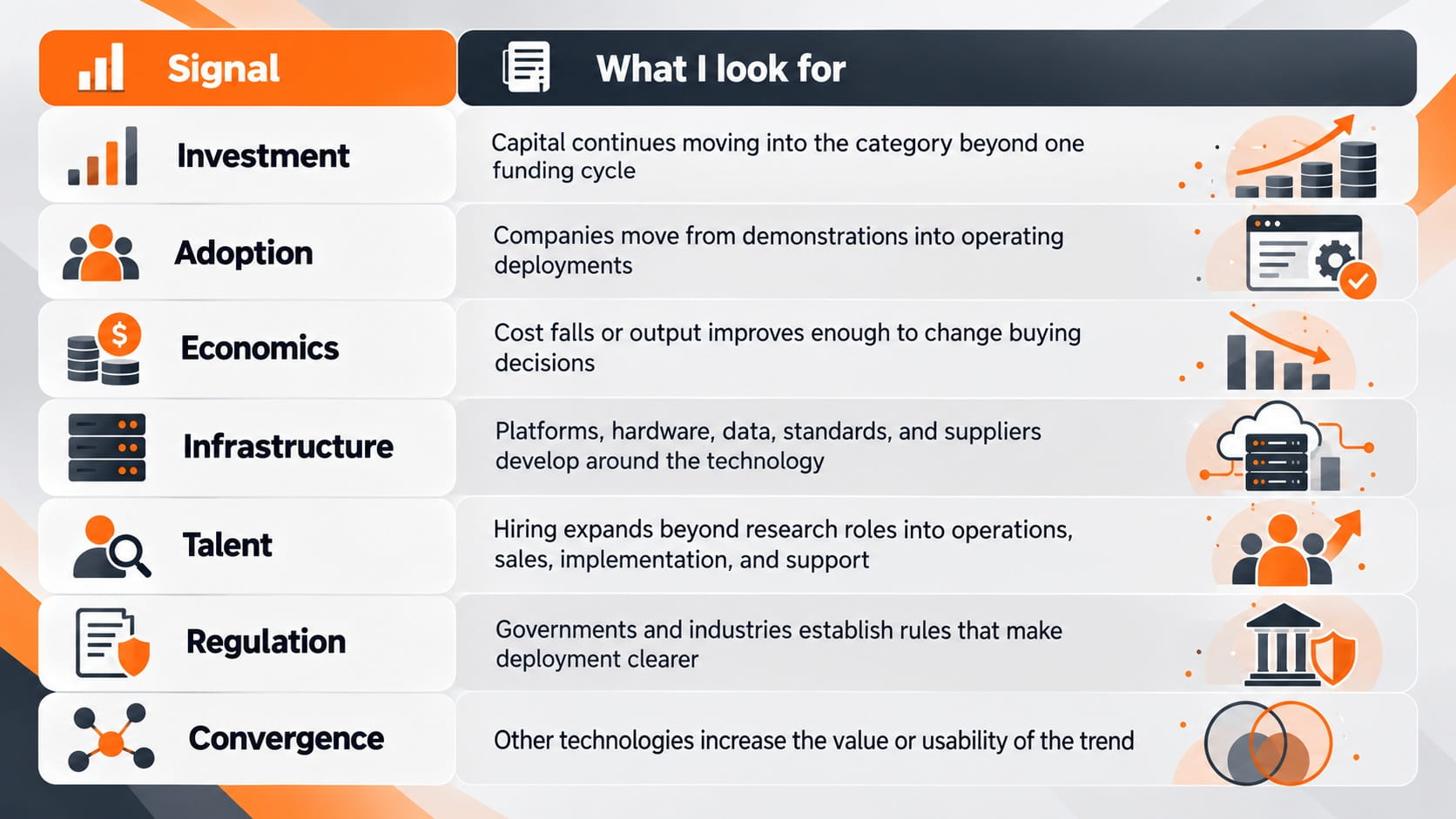
McKinsey's 2026 data shows that connectivity, cybersecurity, energy, life sciences, and mobility already have more than half of their related job postings outside research and development. In its AI related categories and application specific semiconductors, more than 75 percent of postings remain in R&D. That gives a useful view of which areas are closer to operational scaling and which remain heavily focused on technical development.
Business Impact
From a business perspective, the future technology landscape is moving toward five changes I would prepare for now.
Smaller teams gain more leverage. AI development and automation increase the amount of work a focused team can execute.
Software gains more autonomy. Applications move from helping users perform tasks toward completing defined work on their behalf.
Digital technology enters physical operations. Robotics, sensors, AI, mobility, and spatial computing connect software directly with real environments.
Infrastructure becomes strategic. Compute, chips, energy, security, and connectivity increasingly determine what digital products can deliver.
Technology cycles accelerate. Businesses have less time between identifying a useful capability and seeing competitors deploy it.
Deloitte's 2026 research captures the operational side of this transition well: companies are moving from asking what AI can do toward demanding measurable business impact from it.
That is the standard I would use for every future technology trend. A technology becomes strategically important when it changes what a company can build, how efficiently it can operate, or what customers are willing to pay for.
Technology Priorities by Time Horizon
Not every trend deserves the same response today.
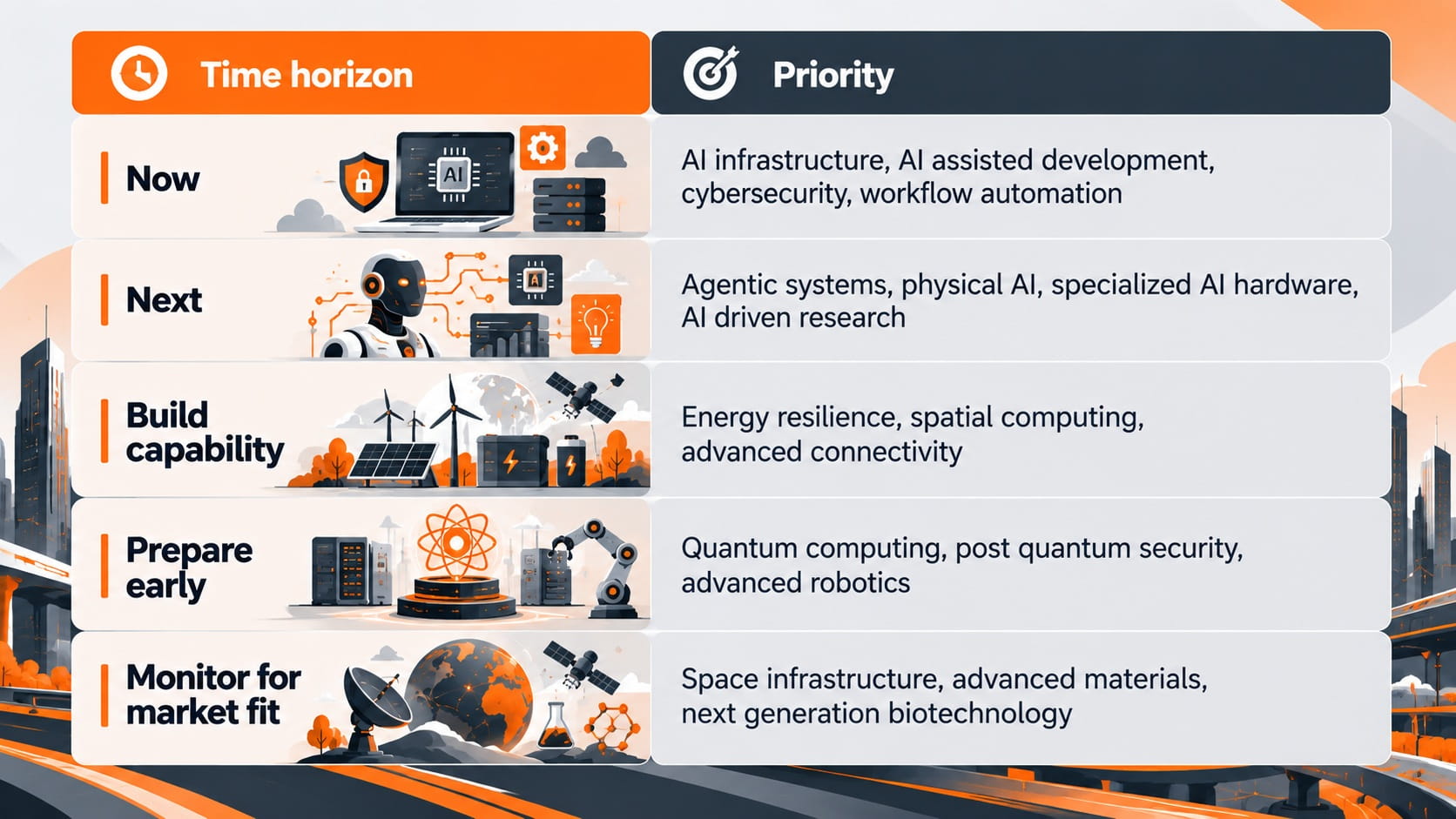
I use these horizons to decide what deserves deployment, what deserves a pilot, and what deserves research.
A company wastes resources when every trend becomes an immediate project.
The better approach is to match action to maturity.
Future Technology Direction
The technology landscape heading beyond 2026 is becoming more autonomous, more physical, more computationally intensive, and more connected to scientific and industrial systems.
AI sits at the center, but AI alone does not explain the shift.
The next stage depends on chips, energy, robotics, security, networks, scientific computing, and the infrastructure required to turn intelligence into real world action. McKinsey's latest outlook reaches the same broader conclusion: the boundaries between AI, compute, connectivity, and advanced engineering are increasingly blurred.
When I track future technology trends, that is where I focus. Not on the loudest prediction, but on the technologies crossing from technical capability into repeatable economic value.
FAQ
If we’re a small startup, which technology trend should we focus on first?
Start with the technology that solves your biggest operational or product bottleneck. If development speed is the constraint, AI native development may have the highest value. If repetitive operations consume time, automation or agentic systems may be more relevant.
Do companies need a separate budget for future technology trends?
A dedicated budget is not required. Technology exploration can sit inside product, engineering, strategy, or innovation budgets. What matters is separating experimentation from essential operating infrastructure.
How can I tell if a technology trend is still too early for my industry?
Look at production deployments, experienced vendors, implementation talent, customer adoption, standards, and proven economics. If those elements are missing, the technology has not reached strong commercial readiness.
Do we need a technical team to track future technology trends?
No. Leadership teams can track adoption, business use cases, investment, regulation, and competitive activity. Technical expertise becomes necessary when the company begins evaluating implementation, security, integration, and architecture.
Which technology trends could create the most jobs over the next few years?
AI engineering, cybersecurity, robotics, data infrastructure, semiconductors, energy systems, and AI enabled software development are expanding across both technical and operational roles.

Fatemeh Jahangard
Technology & AI Writer at PinerookFatemeh Jahangard covers AI, emerging technologies, and digital innovation for Pinerook, focusing on how technology shapes startups and industries.
 Seen first.