Early stage startups rarely lack ideas. They lack reliable evidence about which ideas deserve more time, money, and attention.
That is why customer discovery should stay unusually close to the founders in the early stages. In an AI native startup, software can accelerate research, transcription, synthesis, and follow up, but it does not remove the founder's need to hear customers describe the problem in their own words.
Founder led customer discovery is not a ritual where a founder collects ten interviews and declares an idea validated. It is a repeatable decision process: define what you believe, talk to the right people, look for evidence in real behavior, update the hypothesis, and decide what to do next.
The goal is not to hear that people like your idea. The goal is to learn enough about the customer's reality that you are willing to change your product, market, positioning, or even your original assumption.
What Founder Led Customer Discovery Actually Means
Customer discovery is the process of testing assumptions about who the customer is, what problem they experience, how they deal with it today, and whether the problem is important enough to support a business.
Founder led discovery adds an important ownership rule: the founder remains directly involved in the learning loop instead of outsourcing the most important early stage questions to a research agency, a junior employee, or a dashboard.
This is consistent with the original customer development approach. Steve Blank's customer discovery materials explicitly frame discovery as founder work because the value is not only in the interview itself; it is in how quickly the founder can connect new evidence to product and business decisions.
The founder does not need to personally conduct every interview forever. But before the company has a stable customer profile, a repeatable sales motion, and strong product evidence, delegating discovery too early can create distance exactly when the company needs proximity.
Why Founders Should Lead Discovery Before They Delegate It
The advantage of founder led discovery is speed of interpretation.
A researcher can deliver a report. A founder can hear one unexpected sentence on Monday, change a product assumption on Tuesday, and test the revised hypothesis in the next three conversations. That compressed loop matters when the company is still searching for the right problem, segment, and offer.
Direct conversations also expose details that are easy to lose in summaries: hesitation, workarounds, political constraints inside a company, the gap between the buyer and the user, or the moment a supposedly painful problem turns out to be only mildly inconvenient.
The point is not that founders are naturally better interviewers. In fact, founders carry strong bias because they are emotionally invested in the idea. The advantage is that they are also the people who can immediately change the company when the evidence challenges that idea.
Start With a Decision, Not With a List of Questions
Weak discovery begins with, “What should I ask customers?” Strong discovery begins with, “What decision am I trying to make?”
Before recruiting anyone, write down the assumptions behind the decision. That prevents interviews from turning into interesting conversations with no operational value.
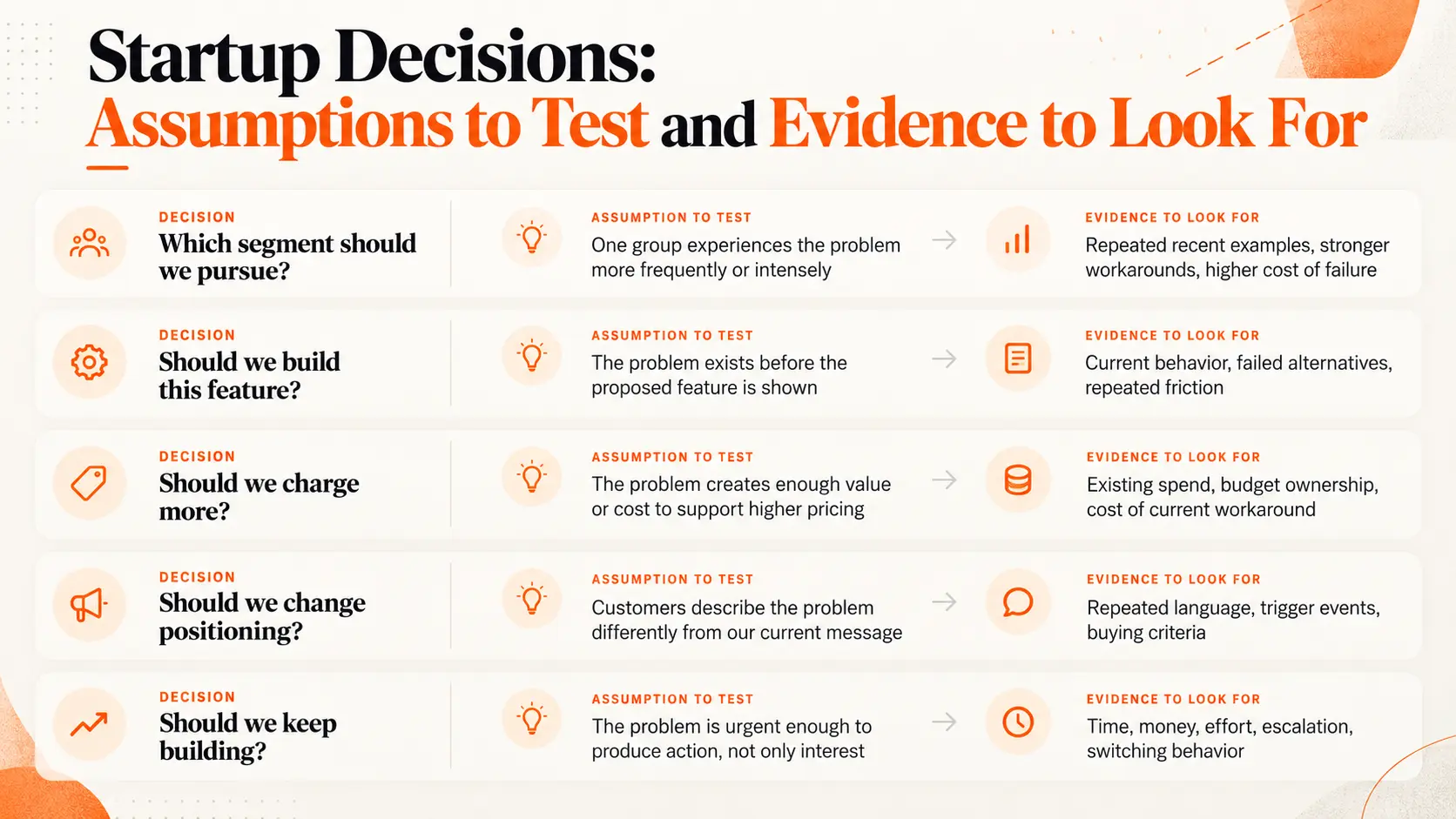
A discovery interview is useful only when the evidence can change a decision. If no possible answer would change what the team plans to do, the interview is probably being used for reassurance rather than learning.
Talk to People Who Have Experienced the Problem, Not People Who Fit a Demographic
The quality of discovery depends more on participant selection than on the interview script.
A broad audience creates broad, contradictory feedback. “Small business owners” can include a two person design studio, a local retailer, and a 100 person services company. They may use the same words while living with entirely different problems.
Recruit based on behavior and context. Look for people who have dealt with the problem recently, repeatedly, or at meaningful cost.
They experienced the problem in the recent past, not only in theory.
They already use a workaround, tool, spreadsheet, service, or manual process.
They have spent time, money, or political capital trying to solve it.
They are involved in the workflow rather than commenting from a distance.
In B2B markets, they are either the user, the economic buyer, or an important decision maker in the purchase.
For B2B startups, interviewing both the operator and the buyer is often important. The person suffering from the workflow may not control the budget, while the person controlling the budget may care about a different outcome.
Ask About Behavior Before You Ask About Opinions
The most dangerous answers in customer discovery are often positive ones.
A customer can sincerely say an idea sounds useful and still never use it, pay for it, or make room for it in an existing workflow. Hypothetical questions make that problem worse because they ask people to predict future behavior in a polite conversation.
Good discovery questions pull the conversation toward specific past events.
Tell me about the last time this happened.
What did you do first?
What made that situation difficult, expensive, or risky?
How often does it happen?
What do you use today to deal with it?
What have you tried before?
Who else gets involved when this becomes a problem?
What happens if you do nothing?
Have you paid for anything to solve this already?
What would cause you to replace the current approach?
The follow up matters more than the prepared list. When a customer says a process is “painful,” ask what happened the last time. When they say the current tool is “bad,” ask why they still use it. When they say a problem is “important,” ask what they have already done about it.
A Simple Founder Led Discovery Interview Flow
A 30 minute conversation is usually enough to learn a great deal if the discussion stays focused on the customer's world rather than the founder's pitch.
1. Set the frame. Explain that you are trying to understand how the person currently handles a problem, not sell them something.
2. Understand the context. Ask about their role, workflow, goals, and the environment around the problem.
3. Go deep on one recent event. Specific examples reveal more than general opinions.
4. Explore the current solution. Understand workarounds, alternatives, costs, frustrations, and why the customer has not changed already.
5. Understand the decision process. In B2B, ask who owns the budget, who influences the decision, and what would block a change.
6. End with open space. Ask what you should have asked but did not, then document the strongest evidence immediately after the call.
Avoid turning the second half into a demo just because the conversation is going well. Once the product appears, the customer's behavior changes from describing reality to reacting to your proposed solution.
Learn to Separate Evidence From Encouragement
Not all customer feedback deserves the same weight. Founder led discovery becomes more useful when the team ranks evidence by what the customer has actually done.
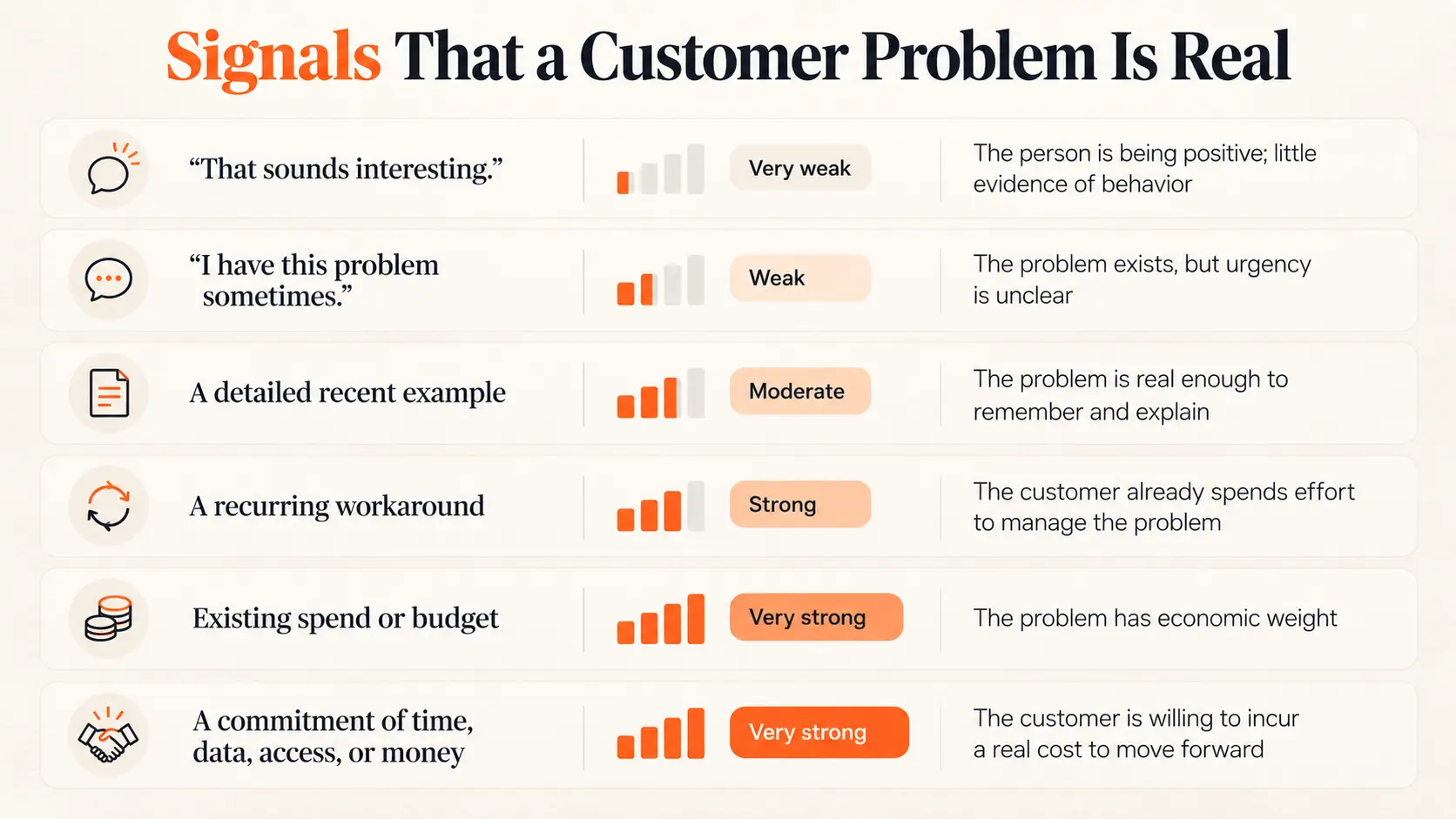
This does not mean money is the only valid signal. In some early markets, customers may not yet have a budget category. But real behavior should still exist: manual work, internal escalation, lost revenue, compliance exposure, repeated frustration, or another visible cost.
How Many Customer Interviews Are Enough?
There is no universal interview count that turns a hypothesis into truth.
Competitor guides often recommend a fixed number, but the useful stopping condition is pattern stability within a clearly defined segment. If the same triggers, workarounds, objections, and buying constraints keep appearing and new interviews add little new information, the team is beginning to see a reliable pattern.
If every interview sounds different, do not automatically schedule 30 more. The problem may be the sample. Your segment may be too broad, the hypothesis too vague, or the interview questions too abstract.
For high stakes decisions, discovery should also be combined with other evidence such as usage data, conversion behavior, paid pilots, retention, and actual purchase decisions. Interviews help explain behavior; they should not be treated as a substitute for market behavior.
Turn Every Discovery Cycle Into a Decision
A folder full of transcripts is not customer discovery. The value appears when the team changes what it believes or what it does.
After every few interviews, summarize the evidence at the hypothesis level rather than producing a generic research report.
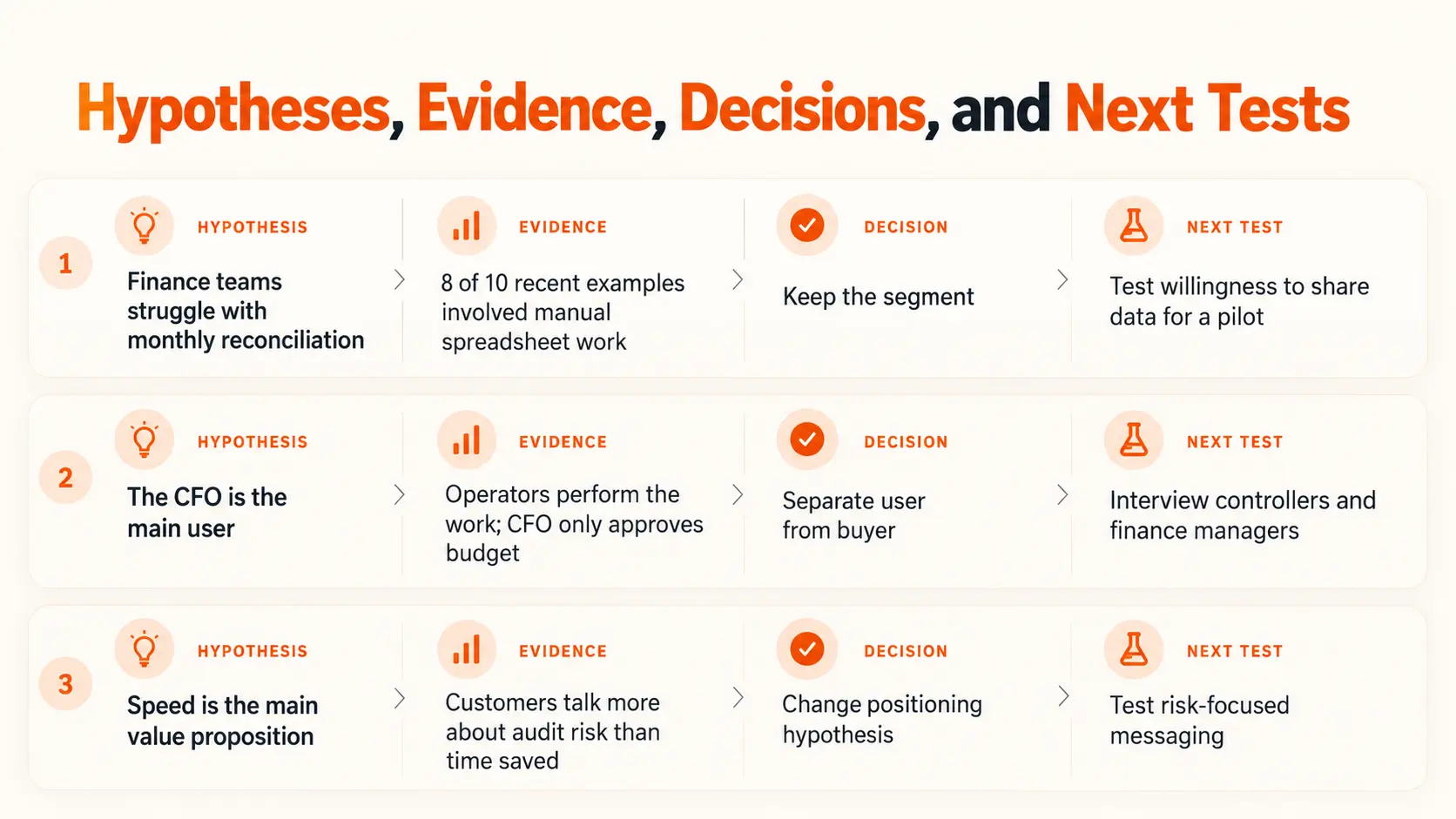
A useful discovery note should make it obvious what the team learned, what changed, and what uncertainty remains.
Know When Discovery Becomes Solution Testing
Customer discovery and product feedback are related, but they answer different questions.
Discovery asks whether the problem, context, and customer behavior are real. Solution testing asks whether a proposed product solves that problem effectively.
Showing a prototype too early can contaminate the conversation because customers begin reacting to your design rather than describing their existing behavior. Once you understand the problem well enough, showing a prototype becomes useful — but call it what it is: a solution test.
This distinction helps founders avoid a common false positive: users liking a demo of a product that solves a problem they were never motivated to solve in the first place.
Founder Bias Is the Biggest Risk in Founder Led Discovery
The same founder proximity that makes discovery powerful can also make it unreliable.
Founders know what they want to hear. They can unintentionally lead the participant, interpret vague comments as validation, or ignore evidence that threatens months of work.
A few operating rules reduce that risk:
Write the hypothesis before the interview so you cannot rewrite it after hearing the answer.
Separate direct evidence from your interpretation in the notes.
Record calls with permission so important details can be reviewed later.
Ask the same core questions across a segment before changing the script too quickly.
Actively look for evidence that would make you stop, narrow, or change direction.
Review patterns with a cofounder or teammate who was not emotionally responsible for the original idea.
The purpose of discovery is not to protect the idea. It is to reduce the cost of being wrong.
Use AI to Compress the Research Work, Not the Customer Relationship
AI can make founder led discovery much more efficient without removing the founder from the learning loop.
Useful applications include transcription, call summaries, tagging repeated themes, comparing interviews, searching across transcripts, extracting customer language, and preparing follow up questions.
The risk appears when automation replaces direct exposure too early. A summary can tell you that six customers mentioned onboarding. It may not communicate which customer sounded frustrated, which one considered the issue minor, or which hidden constraint changed the meaning of the comment.
Early on, founders should use AI after or around the conversation rather than as a reason to avoid the conversation. As evidence becomes more stable and interview volume grows, AI assisted research can help the company scale the process.
When Should Founders Start Delegating Customer Discovery?
Founder led does not mean founder only forever.
Delegation becomes safer when the company has a clearer ICP, recurring customer problems, a more stable product, and enough shared context that another person can run interviews without turning discovery into a disconnected reporting function.
Product managers, researchers, customer success teams, and sales teams can eventually contribute valuable customer evidence. The founder's role changes from personally conducting every interview to staying connected to strategically important conversations and reviewing the patterns that could change company direction.
A useful rule is that execution can be delegated before strategic listening is fully delegated. If the company is still deciding who the customer is or what problem deserves to define the roadmap, founders should remain directly involved.
Common Customer Discovery Mistakes Founders Make
Pitching instead of learning
When the founder spends most of the call explaining the product, the customer has little room to reveal how they currently behave.
Interviewing friends or easy contacts
Convenient participants often create flattering data. The right participant is someone who genuinely experiences the problem, even if they are harder to recruit.
Treating one enthusiastic customer as a market
A powerful anecdote can reveal a useful hypothesis, but the founder still needs to know whether the pattern exists across a coherent segment.
Mixing different customer segments too early
If users, buyers, industries, and company sizes are combined in one sample, repeated patterns become harder to interpret.
Confusing feature requests with problem evidence
Customers are useful sources of problems and context, but feature suggestions should be translated back into the underlying need before becoming roadmap commitments.
Collecting insights without changing decisions
Discovery becomes theater when interviews continue but product, positioning, ICP, and priorities never change.
A Two-Week Founder-Led Discovery Sprint
Founders who have not built a discovery habit can start with a short sprint rather than designing a permanent research program.
1. Day 1: Write the decision you need to make and the three to five assumptions underneath it.
2. Day 2: Define one narrow participant segment using recent behavior, role, and context.
3. Days 3-5: Recruit and conduct the first interviews. Do not change the hypothesis after every call.
4. Day 6: Review patterns, contradictions, and missing evidence. Tighten the interview guide if needed.
5. Days 7-10: Conduct the next set of interviews with the same segment.
6. Day 11: Separate customer evidence from founder interpretation and identify the strongest repeated signals.
7. Day 12: Make one explicit decision: continue, narrow, change the problem, change the segment, or run a stronger behavioral test.
1. Days 13-14: Design the next experiment — prototype, pilot, pricing test, onboarding test, or additional segment research.
The sprint is successful when it changes the quality of a decision, not when it produces a certain number of interviews.
Stay Close Enough to Be Surprised
Founder led customer discovery is valuable because early stage startups are still searching for the truth about their market.
The founder does not need to accept every piece of feedback or build every requested feature. The responsibility is to stay close enough to customers to recognize when the company's assumptions no longer match reality.
Strong discovery focuses on behavior instead of compliments, narrow segments instead of broad audiences, evidence instead of interview counts, and decisions instead of transcripts.
AI can make that loop faster. Teams can eventually help run it. But before the business becomes repeatable, founders should be cautious about delegating away the conversations that can still change what the company becomes.
FAQ
What is founder led customer discovery?
Founder led customer discovery is a process where founders stay directly involved in conversations and evidence gathering used to test assumptions about customers, problems, current behavior, and buying decisions.
Why should founders conduct customer discovery themselves?
Early stage founders can connect customer evidence directly to product, positioning, market, and strategy decisions. Direct involvement also reduces the delay between learning something important and testing a new hypothesis.
How many customer discovery interviews should a founder do?
There is no universal number. A better signal is whether patterns are becoming stable within a narrow segment and whether new interviews continue to produce meaningful new information.
What questions should founders ask in customer discovery interviews?
Focus on recent behavior: what happened, what the customer did, what it cost, what they use today, what they have already tried, and who is involved in the decision.
Should founders show their product during customer discovery?
Usually not at the beginning. First understand the problem and current behavior. Once that is clear, prototypes and demos can be used for solution testing.
Can AI replace customer discovery interviews?
AI can help with transcription, synthesis, tagging, and analysis, but early stage founders still benefit from direct exposure to customers, especially while the problem and customer segment remain uncertain.
When should customer discovery be delegated?
Delegation becomes safer after the company has a clearer customer profile, recurring patterns, and enough shared context for another team member to conduct research without separating learning from strategy.

Mohsen Avid
Founder & Editor, PinerookMohsen Avid is the founder of Pinerook, covering entrepreneurship, startup strategy, digital business, and the decisions behind building new ventures.
 Seen first.