Small teams rarely struggle because they lack ambition. They struggle because the same people are responsible for building products, understanding customers, managing operations, creating demand, and making strategic decisions at the same time.
As a startup grows, repetitive workflows begin to consume the attention that founders need for higher value work. The challenge is not finding another software tool. The challenge is designing systems that help a small team move faster without creating unnecessary complexity.
This is where AI workflow automation for startups becomes valuable. The same thinking behind an AI-native startup applies here: companies gain an advantage by organizing work around capabilities, outcomes, and clear ownership rather than simply adding more tools.
The right question is not “Which AI tool should we use?” It is “Which workflow is slowing the company down, and where can automation create meaningful leverage?”
AI Workflow Automation Is More Than Task Automation
Many startups confuse automation with replacing a single manual action.
Task automation usually handles one simple step:
Sending an email after a form submission
Creating a calendar event
Updating a database field
Workflow automation connects multiple steps into a repeatable system.
For example, instead of manually handling a new sales lead, an AI-powered workflow can:Research the company
Summarize relevant information
Organize CRM data
Prepare follow up context
Highlight important signals for the sales owner
The goal is not removing people from the process. The goal is reducing unnecessary execution work around important decisions.
The AI Workflow Framework: Automate, Assist, or Own
Before introducing AI into a workflow, founders should define the role technology should play.
A useful framework is to divide workflows into three categories.
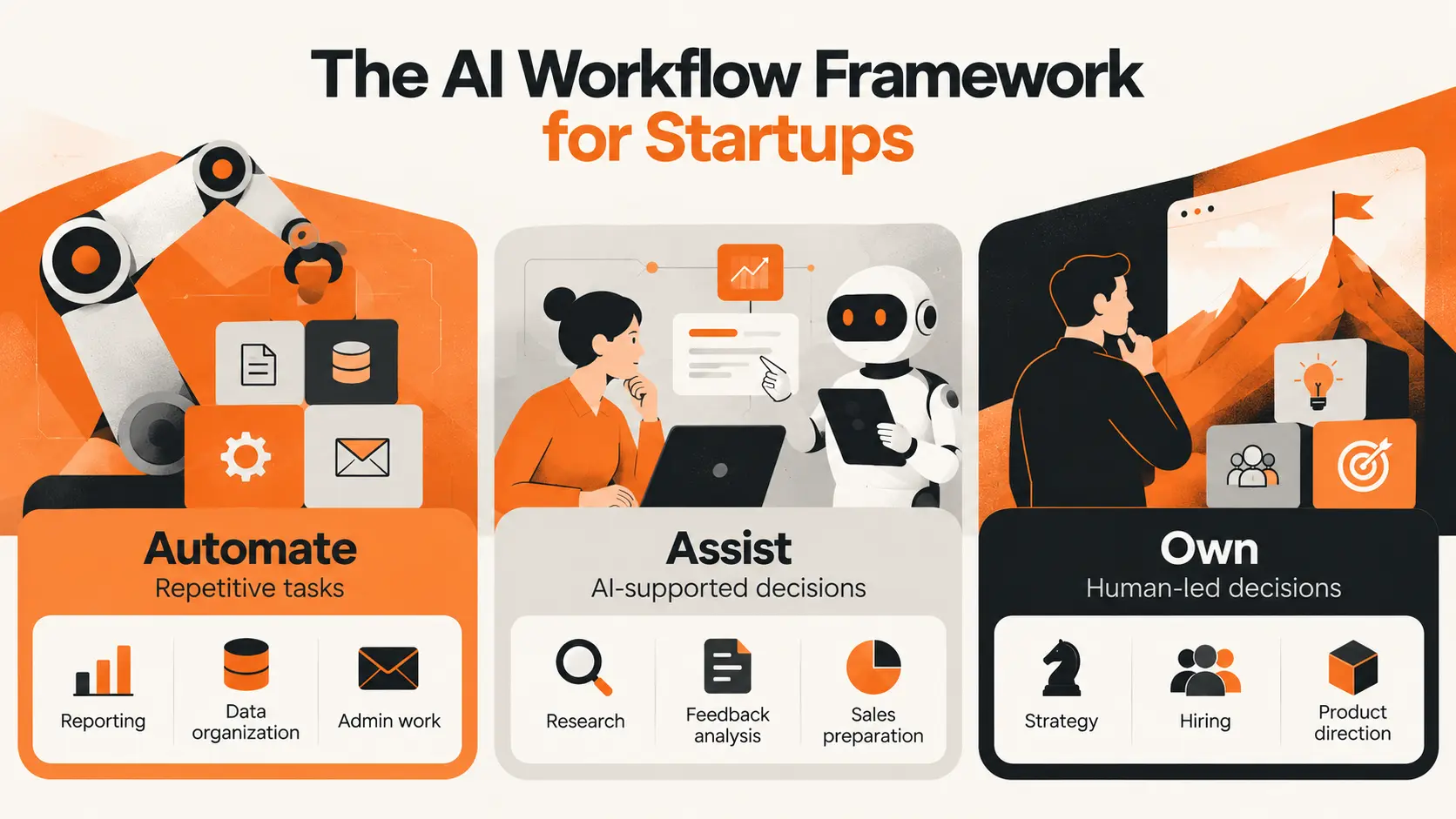
Automate: Repetitive Execution
Automation works best when a workflow has clear inputs, predictable steps, and measurable outputs.
Examples:
Reporting
Meeting summaries
Data organization
Routine administrative tasks
These workflows usually create immediate time savings because they do not require significant judgment.
Assist: AI Supported Decision Making
Many valuable startup workflows are not fully automated. Instead, AI improves the speed and quality of human decisions.
Examples:
Customer feedback analysis
Market research
Sales preparation
Content research
In these cases, AI processes information while founders and operators decide what action should follow.
Own: Human Led Strategic Work
Some workflows should remain close to people because they depend on context, trust, and business judgment.
Examples:
Product direction
Customer strategy
Hiring decisions
Pricing decisions
Company priorities
The purpose of AI is to remove unnecessary work, not remove ownership from the areas that define the company.
Where AI Creates Real Leverage in Early Stage Startups
Customer discovery:
AI can help organize interviews, summarize conversations, identify repeated problems, and reveal patterns across customer feedback. However, founders should remain close to customer signals because early insights shape product direction.
Sales operations:
AI can support lead research, CRM updates, meeting preparation, and follow-up organization. The relationship-building side of sales still requires human judgment.
Marketing systems:
AI can improve research, reporting, content workflows, and campaign analysis. Positioning and understanding the customer remain human responsibilities.
Internal operations:
AI can reduce time spent searching for information, documenting processes, preparing reports, and managing repetitive coordination.
How Founders Should Decide What to Automate
Not every inefficient process needs AI. Before automating a workflow, founders should evaluate four areas:
Frequency:
Does this task happen often enough to justify improvement?
Clarity:
Is the workflow already understood, or is the company trying to automate confusion?
Risk:
What happens if the workflow produces a wrong result?
Ownership:
Who is responsible for checking the outcome?
A broken process should be redesigned before it is automated.
What Startups Should Not Automate Too Early
Some workflows look repetitive but contain valuable learning.
Customer conversations, product decisions, hiring choices, and strategic planning often create knowledge that early-stage companies cannot afford to lose.
Removing humans too early can reduce learning speed instead of increasing operational efficiency.
Building reliable AI workflows also requires clear risk management and human oversight, principles that are highlighted in the NIST AI Risk Management Framework.
The strongest systems use AI where execution can be improved while keeping important decisions close to the people who understand the business.
Building the First AI Workflow System
A practical implementation process:
1. Map existing workflows.
Identify where the team spends repetitive time.
2. Find operational bottlenecks.
Focus on tasks that slow execution or create repeated friction.
3. Define the desired outcome.
Understand what improvement should look like before selecting technology.
4. Choose the right AI role.
Decide whether the workflow should be automated, AI-assisted, or human-owned.
5. Create review points.
Important workflows need clear responsibility.
6. Measure the impact.
Track improvements in speed, quality, cost, or decision-making.
Common AI Workflow Mistakes Startups Make
Automating unclear processes:
AI can make a weak workflow faster without fixing the underlying issue.
Choosing tools before understanding the problem:
The technology should follow the business need.
Creating workflows without ownership:
Every automated process still needs someone responsible for the result.
Optimizing activity instead of outcomes:
The number of AI tools used matters less than the value they create.
AI Workflow Automation and Startup Growth
For lean teams, AI workflow automation creates leverage by increasing what a small group can accomplish.
However, automation should support the company's operating model. A startup does not become efficient by adding more systems. It becomes efficient when workflows become clearer, decisions become faster, and people spend more time on work that creates value.
Final Thoughts
AI workflow automation for startups is not about replacing teams with software. It is about building a smarter operating system for companies that need to move quickly.
The startups that benefit most will not be the ones using the most AI tools. They will be the ones that understand where automation creates leverage and where human judgment remains essential.
FAQ
What is AI workflow automation?
AI workflow automation uses artificial intelligence to improve repeatable business processes and reduce manual work.
Why should startups use AI automation?
It helps small teams save time, reduce repetitive tasks, and focus on higher-value decisions.
What workflows should startups automate first?
Start with repetitive processes like reporting, documentation, research, and administrative tasks.
Is AI workflow automation only for large companies?
No. Small startups can benefit by increasing team capacity without adding unnecessary complexity.
What is the difference between automation and AI workflow automation?
Automation follows fixed rules, while AI workflows can analyze information and support more flexible processes.
Should startups automate every workflow?
No. Strategic decisions, customer understanding, and important business choices should remain human-owned.
How do founders choose the right AI workflow?
They should start with a clear bottleneck, define the desired outcome, and evaluate where AI can create real value.

Mohsen Avid
Founder & Editor, PinerookMohsen Avid is the founder of Pinerook, covering entrepreneurship, startup strategy, digital business, and the decisions behind building new ventures.
 Seen first.