
Early stage startups are usually not limited by ideas. They are limited by capacity.
A small team often needs to handle customer discovery, product decisions, operations, sales, support, and internal processes at the same time. As the company grows, founders need systems that allow them to increase execution without immediately increasing team size.
This is where AI agents for startups become valuable. The same principles behind an AI native startup apply here: the goal is not replacing people with software, but creating systems where technology can handle repeatable execution while humans remain responsible for strategy, judgment, and important decisions.
The key question is not “Where can we add an AI agent?” The better question is “Which workflow creates enough friction that delegating part of it creates meaningful leverage?”
What Are AI Agents?
AI agents are systems that work toward a defined goal by using information, tools, and multiple steps to complete a task.
Unlike simple automation, which follows fixed instructions, AI agents can interpret information, decide the next action within defined limits, and interact with connected systems.
A useful AI agent usually includes:
• A clear objective
• Access to relevant information
• Defined permissions
• Specific actions it can perform
• Human review when needed
The value of an AI agent comes from handling workflows that require multiple steps, not just completing one isolated action.
AI Agents vs Traditional Automation
Many startups confuse AI agents with traditional automation, but they solve different problems.
Traditional automation works best when the process is predictable. It follows predefined rules and completes a specific action.
Examples include:
• Sending an email after a form submission
• Creating a calendar event after a booking
• Updating a database field after a user action
AI agents are useful when a workflow requires interpretation and multiple connected actions.
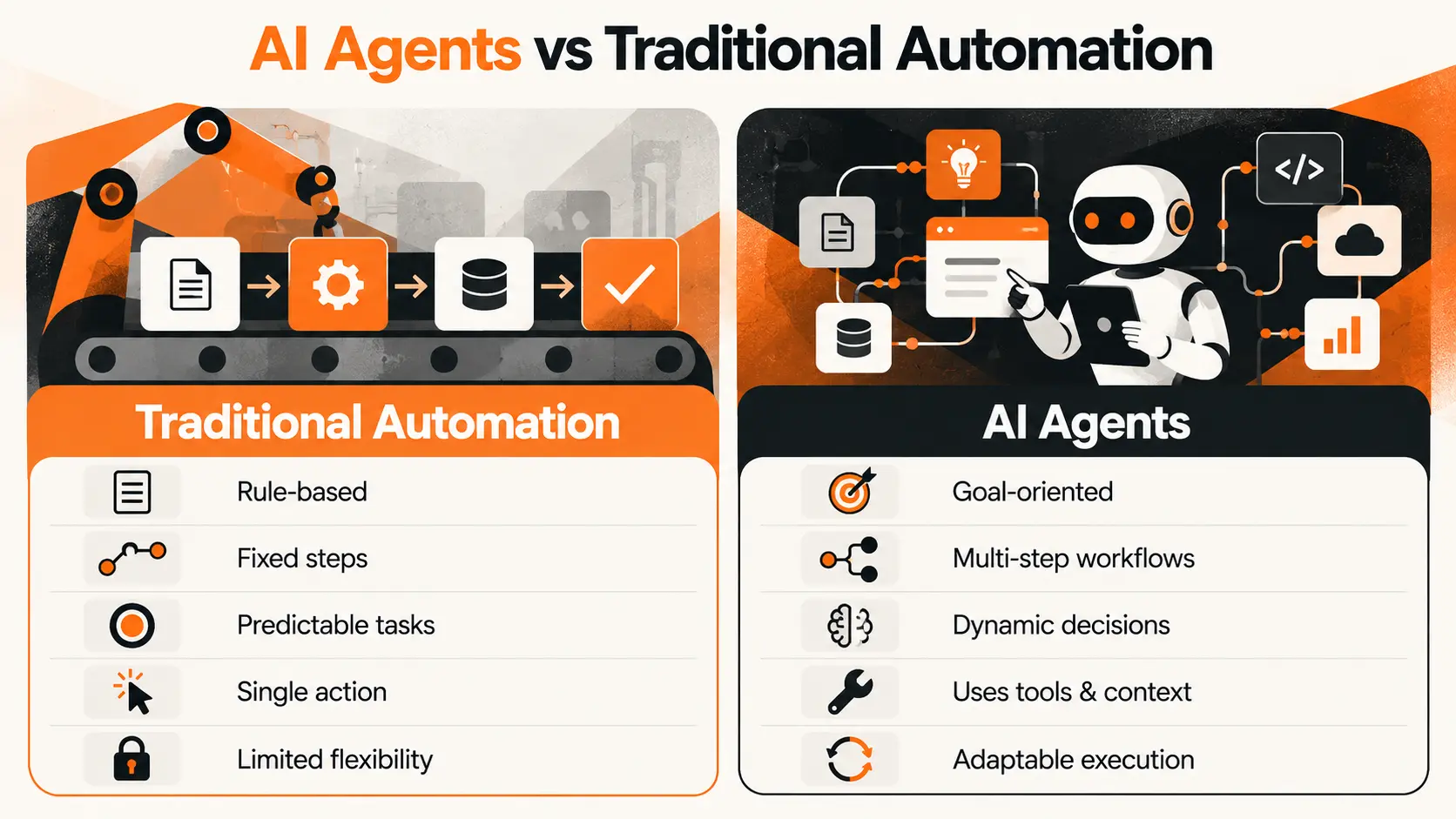
For example, a traditional automation may notify a sales team about a new lead. An AI agent can research the company, summarize relevant information, update CRM data, and prepare a follow-up recommendation.
The difference is not that AI agents replace automation. They extend automation into workflows where flexibility and decision support are required.
Where AI Agents Create Real Value for Startups
AI agents create the most value when they support workflows that consume significant time but do not require constant strategic decisions.
Customer Support
AI agents can classify customer requests, search internal knowledge bases, prepare responses, and identify issues that require human attention.
The goal is not removing human interaction from customer relationships. It is reducing repetitive support work so teams can focus on complex customer needs.
Sales Operations
Sales teams often spend large amounts of time researching prospects, preparing meetings, updating CRM systems, and organizing follow-ups.
AI agents can support these activities by collecting information, creating summaries, and preparing sales context while salespeople remain responsible for relationships and conversations.
Market Research
Startups need continuous information about competitors, customers, and market changes.
AI agents can collect information, compare sources, summarize findings, and organize research. However, founders still need to interpret those insights based on their strategy and market understanding.
Internal Operations
Small teams spend significant time managing documentation, reports, internal knowledge, and coordination.
AI agents can reduce this operational burden by organizing information and handling repeatable internal workflows.
The AI Agent Decision Framework for Founders
Before introducing an AI agent, founders should evaluate whether the workflow is actually suitable.
Frequency:
Does this happen often enough to justify creating an agent?
Clarity:
Is the desired outcome clearly defined?
Information:
Does the agent have access to reliable data and context?
Risk:
What happens if the agent produces an incorrect result?
Ownership:
Who is responsible for reviewing the outcome?
A workflow should be understood before it becomes delegated to an AI system.
What Startups Should Not Delegate to AI Agents Too Early
Some areas should remain human-owned because they depend on experience, relationships, and strategic judgment.
Examples include:
• Product strategy
• Customer relationships
• Hiring decisions
• Pricing decisions
• Major business direction
The purpose of AI agents is not maximum autonomy. The purpose is creating useful autonomy while keeping important decisions close to the people who understand the business.
Building Your First AI Agent Workflow
A practical implementation process:
1. Identify a bottleneck
Choose a workflow that repeatedly consumes team time.
2. Define the agent role
Clarify what the agent should achieve and what actions it is allowed to take.
3. Set permissions
Give access only to the information and systems required.
4. Add human checkpoints
Important workflows should include review before major actions.
5. Measure impact
Track improvements in speed, quality, cost, or execution.
6. Expand carefully
Increase autonomy only after reliability is proven.
Common AI Agent Mistakes Startups Make
Building agents before understanding the workflow:
AI cannot fix unclear processes.
Giving agents too much access:
Unnecessary permissions can create operational risk.
Removing human ownership:
Every AI workflow needs someone accountable.
Using agents where simple automation is enough:
Not every workflow requires an autonomous system.
AI Agents and Startup Growth
For lean teams, AI agents can increase operating capacity by handling complex and repeatable workflows.
However, successful startups do not use agents everywhere. They identify where delegation creates measurable value while keeping important decisions close to the people responsible for the business.
The advantage comes from combining AI capability with clear ownership and strong operating processes.
Final Thoughts
AI agents for startups represent a shift from using AI as a simple assistant to using it as part of the company's operating system.
The startups that benefit most will not be those that delegate everything to AI. They will be those that understand where agents create leverage and where human judgment remains essential.
FAQ
What are AI agents used for in startups?
AI agents can support workflows such as research, customer support, sales operations, reporting, and internal coordination.
How are AI agents different from chatbots?
Chatbots mainly respond to requests, while AI agents can complete multi-step workflows using tools and information.
Should startups replace employees with AI agents?
No. Agents are designed to extend team capacity and reduce repetitive work, not remove human ownership.
When should a startup use an AI agent?
A startup should consider an agent when a workflow is repetitive, measurable, and has a clear outcome.
Are AI agents safe for startup operations?
They can be useful when permissions, review processes, and ownership are clearly defined.
What is the best first AI agent for a startup?
Usually, a workflow that consumes significant time but does not require strategic decision-making is the best starting point.

Mohsen Avid
Founder & Editor, PinerookMohsen Avid is the founder of Pinerook, covering entrepreneurship, startup strategy, digital business, and the decisions behind building new ventures.
 Seen first.