
Hiring feels like progress because it is visible. A bigger team looks like momentum. But for an early stage company, headcount is one of the most expensive ways to solve the wrong problem.
That trade off matters even more now. Carta’s 2026 compensation data shows that the median seed stage startup on its platform has just four employees, while hiring across venture backed companies remains far below the 2021–2022 pace. Leaner teams are not simply a temporary reaction to tighter capital; they are increasingly a deliberate operating choice. Carta’s H2 2025 startup compensation data reinforces the point: the old assumption that growth should automatically produce more headcount is weakening.
For an AI native startup, the hiring question is therefore not “How many people should we add?” It is “Which constraint has become expensive enough that a person is now the best way to remove it?” Sometimes the answer is a hire. Sometimes it is a contractor, an automated workflow, a clearer process, or simply more founder learning.
The practical rule: hire when the work has become repeatable enough to own, important enough to matter, and expensive enough to keep on the founder’s plate.
Hiring Is a Constraint Decision, Not a Headcount Decision
Founders often start with a role: “We need marketing,” “We need another engineer,” or “We need someone in operations.” A stronger hiring strategy starts one step earlier: identify the outcome that is currently constrained.
A startup should not hire because the team feels busy. Busyness can come from weak priorities, duplicated work, bad handoffs, or a process that should not exist. A hire makes sense when a persistent constraint is blocking something the company already knows it needs to do well.
Product is validated, but releases are consistently delayed because one founder is the only person who can ship critical work.
The company has a repeatable sales motion, but qualified leads are going cold because nobody owns follow up.
Customers are arriving, but onboarding and retention are weakening because support has become a recurring operating load.
The founders spend a meaningful part of every week on stable operations that no longer require founder judgment.
This framing keeps the article separate from org chart thinking. The question is not which box should exist next. It is which constraint is costing the company the most learning, revenue, quality, or founder attention.
The Hiring Readiness Test
A full time hire becomes much easier to justify when four signals appear at the same time.
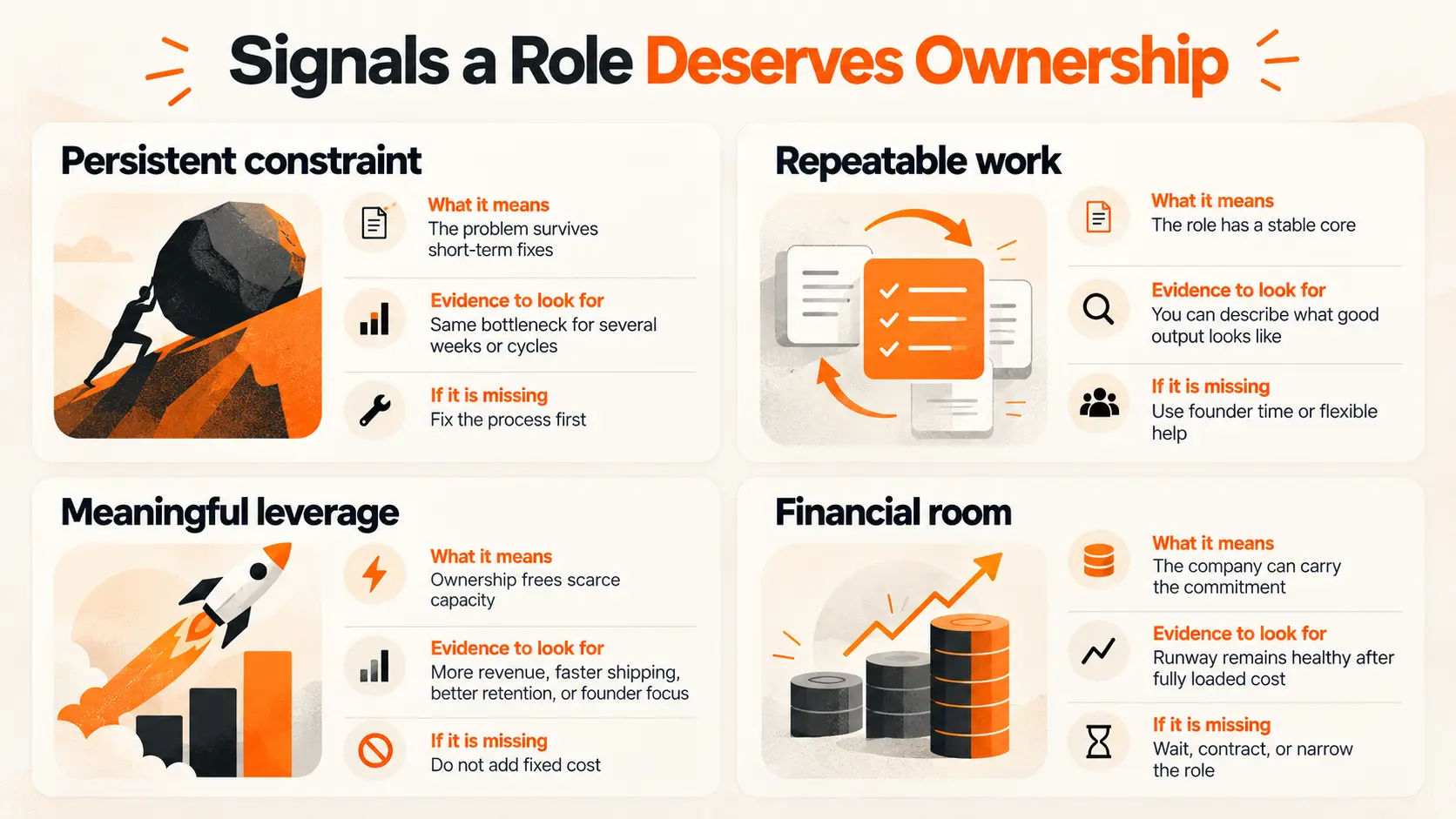
The important word is combination. A founder can be overloaded without the work being ready for a hire. A workflow can be repeatable without being important enough to justify payroll. Hiring becomes compelling when the problem is persistent, the role is teachable, the leverage is clear, and the company can afford the commitment.
Choose Between a Hire, Contractor, Automation, or Process Fix
One of the most useful hiring decisions is deciding not to hire. Before opening a role, compare four ways to remove the constraint.
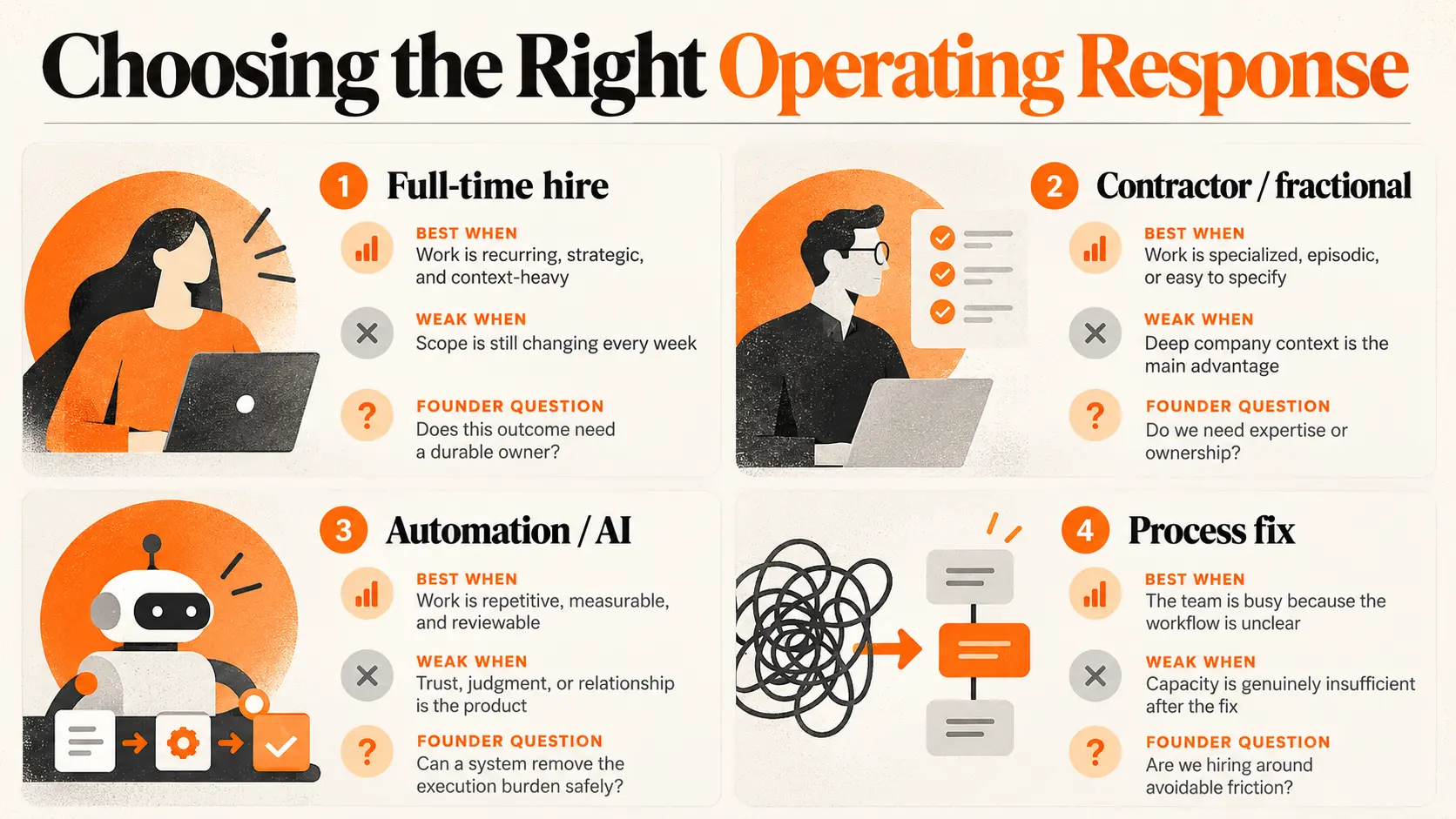
This comparison matters because early teams often turn uncertainty into payroll. If the founder is still discovering the playbook, hiring someone to “own” it can simply move ambiguity from one person to another. A contractor can help test the scope. Automation can remove repetitive execution. A process change can reveal that the team never needed another person in the first place.
Hire Against the Bottleneck, Not a Standard Sequence
There is no universal list of the first five startup roles. Founder strengths, product type, sales model, technical complexity, and customer expectations all change the sequence. The repeatable part is the decision logic.
If product demand exists but shipping is the constraint, a strong product minded engineer may create more leverage than a growth hire.
If founders can close deals but cannot cover a growing qualified pipeline, a commercial generalist or salesperson may be the next owner.
If acquisition is working but activation or retention is weak, customer success or a product operator may protect more value than adding more top of funnel spend.
If founders are losing large blocks of time to stable company operations, an operations generalist can return attention to product, customers, and recruiting.
The role should remove a category of recurring founder attention, not merely add another pair of hands. If the new person still needs the founder to make every routine decision, the company has increased headcount without transferring ownership.
Generalists Early, Specialists When the Problem Stabilizes
Early stage work changes shape quickly. A channel that matters this month may disappear next month; a product problem can turn into an onboarding problem; a person hired for one function may need to cover three. That uncertainty usually favors people with range, judgment, and a high tolerance for ambiguity.
This is consistent with early team lessons shared by founders and operators through Y Combinator and First Round: the earliest hires often succeed because they can own broad outcomes, not because they arrive with the most specialized title. Once a function becomes repeatable, specialization becomes more valuable because depth can compound a known playbook.
A useful distinction is simple: generalists help discover the system; specialists help scale the system.
The Cases Where Waiting Is the Better Decision
Hiring too late can cost growth, but hiring too early is not neutral. It consumes runway, management attention, and equity while making the organization harder to change. Waiting is usually the better decision when one of these conditions is true:
The role exists mainly because the founders feel overwhelmed, but the underlying work has not been prioritized.
The company cannot explain what success in the role should look like after 90 days.
The function is still in discovery for example, hiring a growth specialist before the company understands a repeatable acquisition lever.
The workload is real but intermittent, making a contractor or fractional specialist more efficient.
The company would need the next fundraise to arrive on schedule just to carry the new payroll commitment.
Waiting does not mean doing nothing. It means using the time to clarify the role, document the workflow, test the need, and begin building a candidate pipeline before the constraint becomes urgent.
Founder Led Hiring Matters More in the First Ten
Early employees do more than perform a function. They shape how decisions are made, how much ownership people take, what quality feels normal, and what later candidates expect from the company. That is why delegating early hiring too aggressively can be expensive.
YC founder stories repeatedly emphasize direct founder involvement in the earliest hires. The reason is practical: founders understand the mission, trade offs, and working environment better than an external recruiter can. They are also the strongest person to convince an unusually good candidate to take an unusually risky job.
A minimum viable early stage hiring process should still be structured:
1. Define the outcome. Write what this person must own, not a shopping list of tasks.
2. Write the evidence. Decide what past behavior or work would demonstrate the ability to own that outcome.
3. Use consistent evaluation. Ask candidates comparable questions so the team can discuss evidence instead of impressions.
4. Test ownership. Use a realistic work discussion or problem scenario to see how the candidate thinks under ambiguity.
5. Close with the real job. Be explicit about runway, uncertainty, pace, and how much responsibility the role actually carries.
Make the First 90 Days an Ownership Transfer
A hiring strategy fails if the company recruits well but never transfers ownership. Early employees need context quickly, but they also need a clear path from shadowing to independent decisions.
First 2 weeks: absorb context customer calls, product decisions, operating rhythms, and the history behind current priorities.
Weeks 3–6: own a contained outcome with explicit decision boundaries and fast feedback.
Weeks 7–12: take responsibility for a recurring result, including the trade offs and follow up decisions around it.
The test at the end of onboarding is not whether the employee is busy. It is whether a meaningful category of work can now move without the founder being the default router.
How the Hiring Strategy Changes as the Startup Grows
The principles stay the same, but the constraint changes with stage.
Pre seed: optimize for learning. Keep the team small, use broad owners, and avoid hiring ahead of evidence.
Seed: hire against repeatable bottlenecks. Ownership becomes more explicit as product, go to market, and customer delivery develop recurring workloads.
Early scale: add specialists and management where coordination or depth has become a real constraint. Do not add hierarchy simply because headcount crossed an arbitrary number.
YC’s guidance on dedicated HR, for example, suggests that a full time people function often becomes more relevant around 20–30 employees or after Series A, although company specific hiring velocity can move that point earlier. The larger lesson is that support functions should appear when the workload earns them, not because a generic org chart says they should exist.
The Best Hire Removes a Real Constraint
A strong startup hiring strategy is not a plan to grow headcount. It is a system for deciding when human ownership is the highest leverage answer to a business constraint.
Hire when the problem is persistent, the work is repeatable, the outcome matters, and the company can support the commitment. Use flexible help when the need is temporary. Use automation when execution is repetitive. Fix the process when the team is busy because the system is unclear.
The goal is not to build the smallest team possible. It is to make every new person create more clarity, capacity, and momentum than complexity.
FAQ
When should a startup make its first hire?
When a recurring, important bottleneck has become expensive to keep on the founders’ plate and the company can afford a durable owner.
Who should a startup hire first?
The role that removes the company’s biggest validated constraint. There is no universal first hire sequence.
Should early startups hire generalists or specialists?
Generalists often fit changing early stage work better. Specialists become more valuable once a function is stable and ready to scale.
When is a contractor better than a full time hire?
When the work is specialized, episodic, still being tested, or does not yet need deep company context.
Can AI or automation delay startup hiring?
Yes, when the bottleneck is repetitive and measurable. It should not replace roles where trust, judgment, or durable ownership are the core value.
How much runway should a startup have before hiring?
There is no universal number, but founders should model the fully loaded cost and avoid a hire that makes the company dependent on a perfectly timed next round.
When should a startup hire managers?
When coordination, coaching, and cross team dependencies have become a recurring workload rather than an occasional founder task.

Mohsen Avid
Founder & Editor, PinerookMohsen Avid is the founder of Pinerook, covering entrepreneurship, startup strategy, digital business, and the decisions behind building new ventures.
 Seen first.