
A startup team structure should make a small company faster, not make it look more established. In the earliest stages, that usually means fewer reporting layers, broader roles and very clear ownership of the work that keeps the company alive: learning from customers, building the product, creating demand, serving users and managing risk. The same principle sits at the heart of an AI-native startup: organize around capabilities and outcomes before you organize around titles.
The useful question is therefore not, “What should our org chart look like?” It is, “Which decisions and outcomes need a clear owner at our current stage, and where is coordination starting to cost us speed?” This guide gives founders a structure they can actually use—from a two-person founding team through the point where functional leads begin to make sense.
The startup team structure in one view
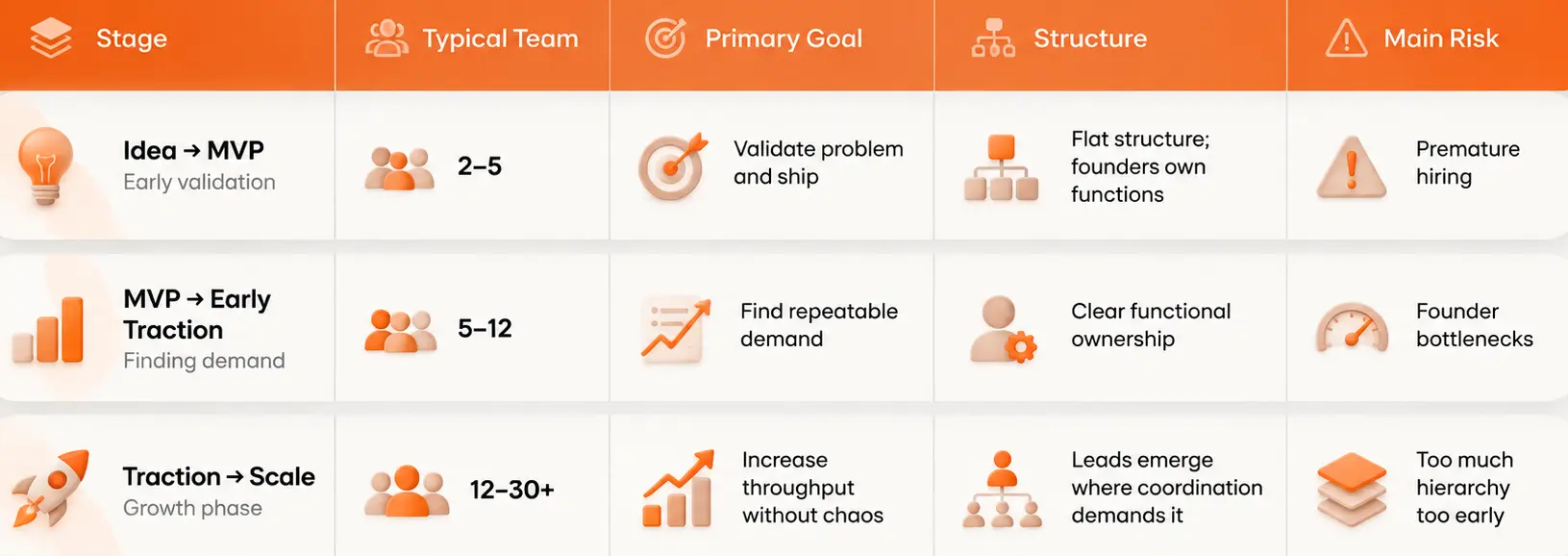
Start with functions, not job titles
Most weak startup org charts begin with familiar titles—CEO, CTO, Head of Marketing, COO—and then try to fit the actual work underneath them. Early-stage teams should work in the opposite direction. Map the functions the business must perform, then decide who owns each one.
For most software and digital startups, the minimum capability map is simple:
Customer learning — interviews, objections, usage patterns and problem validation.
Product and technology — deciding what to build, shipping it and keeping it reliable.
Demand — finding customers, selling, distribution and growth experiments.
Customer delivery — onboarding, support, retention and implementation where relevant.
Company operations — finance, hiring administration, legal coordination and basic risk management.
One person can own several of these functions. That is normal. What causes trouble is when a function has activity but no owner. If two founders both “kind of” own sales, customer follow-up gets missed. If everyone can change the roadmap, product priorities become negotiations rather than decisions.
Separate ownership from reporting lines
A startup can remain flat and still have clear authority. Reporting lines answer who supports and manages a person; decision rights answer who gets the final call. In a five-person company, the second question matters more.
For every critical function, define three things:
Outcome owner: the person accountable for the result.
Decision owner: the person who can make routine calls without asking the entire team.
Escalation boundary: the decisions that are important enough to return to the founders.
For example, a product lead may own roadmap execution and feature sequencing, while pricing, a major architecture change or entry into a new market remains a founder-level decision. Clear boundaries prevent a small team from turning every choice into a meeting.
How team structure should change by startup stage
Pre-seed: design for learning
Before product-market fit, the team should be optimized for learning speed. Founders should stay close to customers and the product, and early hires should usually be able to cover broad surfaces rather than wait for perfectly defined scopes. This is why generalists often work well in the first team: the company’s problems are still changing faster than job descriptions can.
A common structure is one founder leaning commercial and customer-facing, another leaning technical or product, plus one to three builders or high-agency generalists. External specialists can cover accounting, legal work, recruiting support or design projects when those needs are intermittent.
Seed: introduce explicit ownership
Once the product exists and demand is becoming visible, informal coordination starts to break. The next hire should not be selected because a standard org chart says “marketing comes next.” Hire against the constraint. If users are arriving but onboarding is failing, customer success may matter more than growth. If the founders can sell but shipping is slow, engineering capacity may be the real bottleneck.
At this stage, write down who owns product, engineering, go-to-market, customer delivery and operations—even if one person still owns two of them. The goal is not departments. The goal is to remove recurring ambiguity.
Early scale: add management only where coordination has become work
A manager is justified when coordinating people has become a real job: priorities conflict, specialists need coaching, cross-team dependencies are increasing, or a founder is spending too much time routing routine decisions. Adding a management layer before those conditions exist creates overhead without removing a constraint.
A useful rule is to promote structure after the coordination problem appears, not before. The org chart should describe the work the company has earned—not the company founders hope to resemble in two years.
Choose the first hires by bottleneck, not sequence
There is no universal “first five hires” list because founder skills, product type and distribution model change the answer. What is repeatable is the decision process. Before opening a role, ask what outcome is constrained, whether the constraint is persistent, and whether a full-time owner will improve it more than a tool, contractor or founder process change.
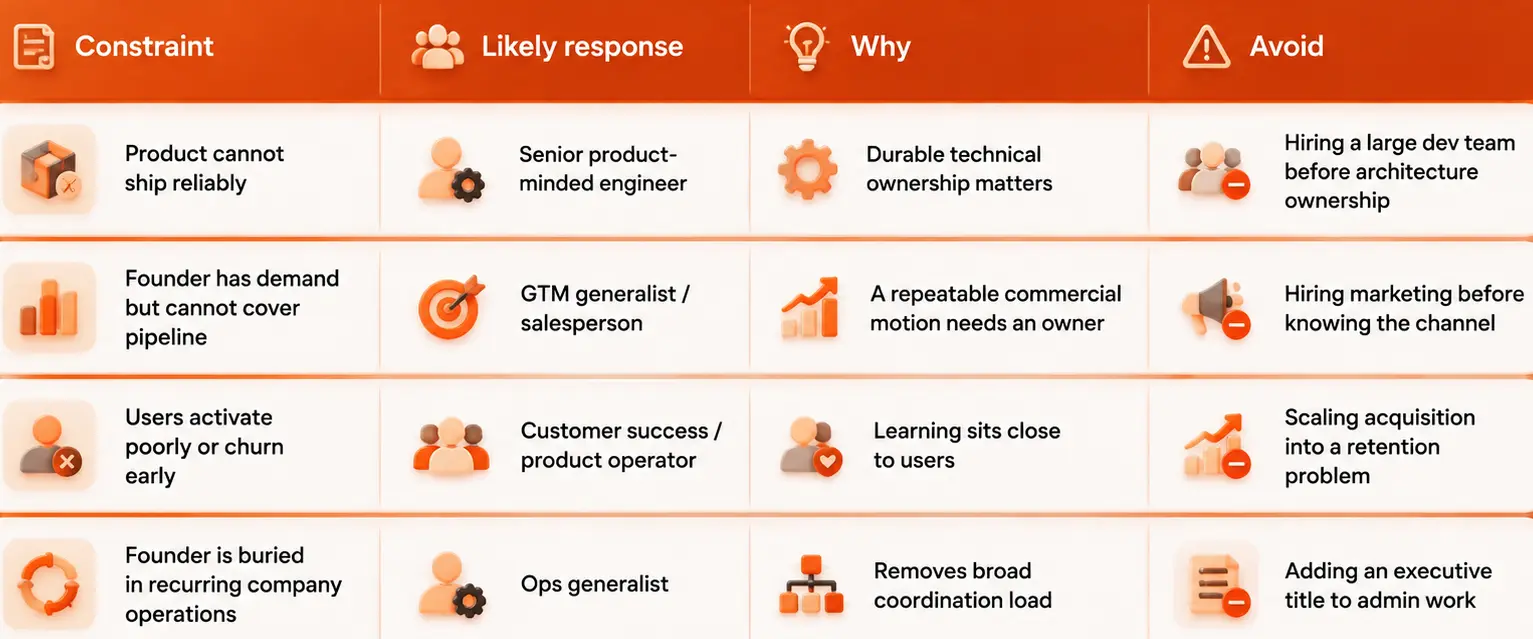
The first employees also shape operating norms disproportionately. Early hires need enough autonomy to act without a mature process, but enough judgment to know when not to. That tends to favor high-agency generalists early and deeper specialists once the company has a stable problem that rewards specialization.
Keep core learning in-house; flex the rest
Not every capability deserves a permanent seat on the org chart. A useful split is based on frequency, strategic importance and how much company-specific context the work accumulates.
Keep work in-house when it is frequent, central to the product or customer promise, or creates proprietary learning. Use contractors, agencies or fractional specialists when the work is episodic, highly specialized or easy to specify and evaluate. Use automation when the task is repetitive, measurable and reversible.
This distinction matters because the cheapest option in a spreadsheet is not always the cheapest operating model. Outsourcing customer discovery, for example, can save founder time while also removing the founder from the very signal the company needs most. Conversely, hiring a full-time legal, finance or recruiting specialist far before the workload exists can lock the startup into fixed cost without creating more learning or throughput.
Design communication around the team you have now
Small teams usually do not need more meetings; they need fewer ambiguous handoffs. A lightweight operating rhythm is enough: one place for priorities, one owner per outcome, written decisions for choices that will matter later, and a short recurring review of blockers and customer signals.
As the team grows, the warning sign is not simply headcount. Watch the number of dependencies. If an engineer needs three approvals to ship, a founder is required in every customer decision, or two teams routinely discover conflicts late, the structure is no longer supporting execution.
Seven signs your startup has outgrown its current structure
The same founder is the default approver for unrelated functions.
Two people regularly believe they own the same decision.
Important work sits between functions because nobody owns the handoff.
A specialist spends a large share of the week coordinating instead of doing specialist work.
New hires cannot tell where to get a decision without asking a founder.
Customer or product information is trapped in individual conversations rather than shared systems.
Adding people increases meetings faster than it increases output.
When several of these appear at once, do not start by adding titles. Redraw ownership first. Sometimes the fix is a team lead; sometimes it is a clearer decision boundary, a better operating process or the removal of a duplicated responsibility.
A simple structure founders can implement this week
Create a one-page responsibility map with five columns: capability, outcome, current owner, decisions they can make alone, and the trigger for adding or changing ownership. Review it monthly while the company is small. The document should change more often than the formal org chart.
Then run one question across every function: “If this owner disappeared for two weeks, would the rest of the team know what decisions to make?” If the answer is no, the issue is not only staffing. It is operating design.
The best structure is the smallest one that preserves clarity
A good startup team structure does not eliminate overlap. Early companies need people who can cross boundaries. What it eliminates is uncertainty about ownership. Founders should keep the organization flat while decisions are simple, add dedicated owners when recurring bottlenecks appear, and introduce management only when coordination itself becomes meaningful work.
The result is not a perfect org chart. It is a team where people know what they own, decisions move without unnecessary escalation, and every new hire removes a real constraint instead of adding another box.
FAQ
What is the best startup team structure for an early-stage company?
Usually a flat structure with founders and a small number of broad, high-ownership contributors. The exact roles depend on the company’s current bottleneck, but customer learning, product, demand and delivery should all have clear owners.
How many people should an early-stage startup have?
There is no correct headcount. Before product-market fit, the team should generally stay as small as possible while still covering the capabilities needed to learn, build and sell. Team size should follow workload and constraints, not fundraising stage alone.
When should a startup add managers?
When coordination has become a repeatable workload: priorities conflict, specialists need coaching, cross-team dependencies are slowing execution, or founders have become routing points for routine decisions.
Should startups hire specialists or generalists first?
Generalists are often more useful while the company’s problems are still changing. Specialists become more valuable when a function is stable, frequent and important enough to reward depth.
What should a startup outsource?
Episodic or specialized work such as legal, accounting, some recruiting, and certain design or technical projects can often stay external early. Core product ownership, customer learning and other sources of proprietary knowledge usually need to remain close to the company.

Mohsen Avid
Founder & Editor, PinerookMohsen Avid is the founder of Pinerook, covering entrepreneurship, startup strategy, digital business, and the decisions behind building new ventures.
 Seen first.