AI lets small teams move faster, but speed changes the shape of operational risk. A model can generate a wrong answer in seconds. An agent can repeat the wrong action across hundreds of records. A convenient integration can expose data that was never meant to leave an internal system.
In an AI native startup, that risk cannot be treated as a problem for a future security or compliance team. The more work a small company delegates to models, automations, and agents, the more important it becomes to define where AI is allowed to act, what can go wrong, and who is responsible when it does.
AI risk management for startups is therefore not about eliminating uncertainty. That would defeat the purpose of building quickly. It is about making failure visible, bounded, and recoverable so the company can use AI aggressively without allowing one bad output, permission, vendor decision, or hidden dependency to create disproportionate damage.
The practical goal is simple: use the lightest control that matches the consequence of failure.
AI Risk Management Is Not Enterprise Bureaucracy
Large organizations often discuss AI governance through policies, committees, standards, and formal approval structures. A five person startup does not need to reproduce that machinery.
It does need the underlying discipline.
The National Institute of Standards and Technology organizes its AI Risk Management Framework around four functions: govern, map, measure, and manage. For a startup, those ideas can be translated into a much simpler operating loop: know where AI is used, understand the possible failure, put controls around the important risks, test them, and keep watching after launch.
For founders, the distinction matters. A policy that says “AI outputs must be reviewed” is not a control if nobody knows which outputs, who reviews them, or what happens when the reviewer disagrees.
Start With the Consequence, Not the Model
A startup does not need to classify every AI system with the same level of rigor. The fastest way to overbuild governance is to treat an internal summarization tool and an autonomous production agent as if they create the same risk.
Start with the use case and ask what happens if the AI is wrong.
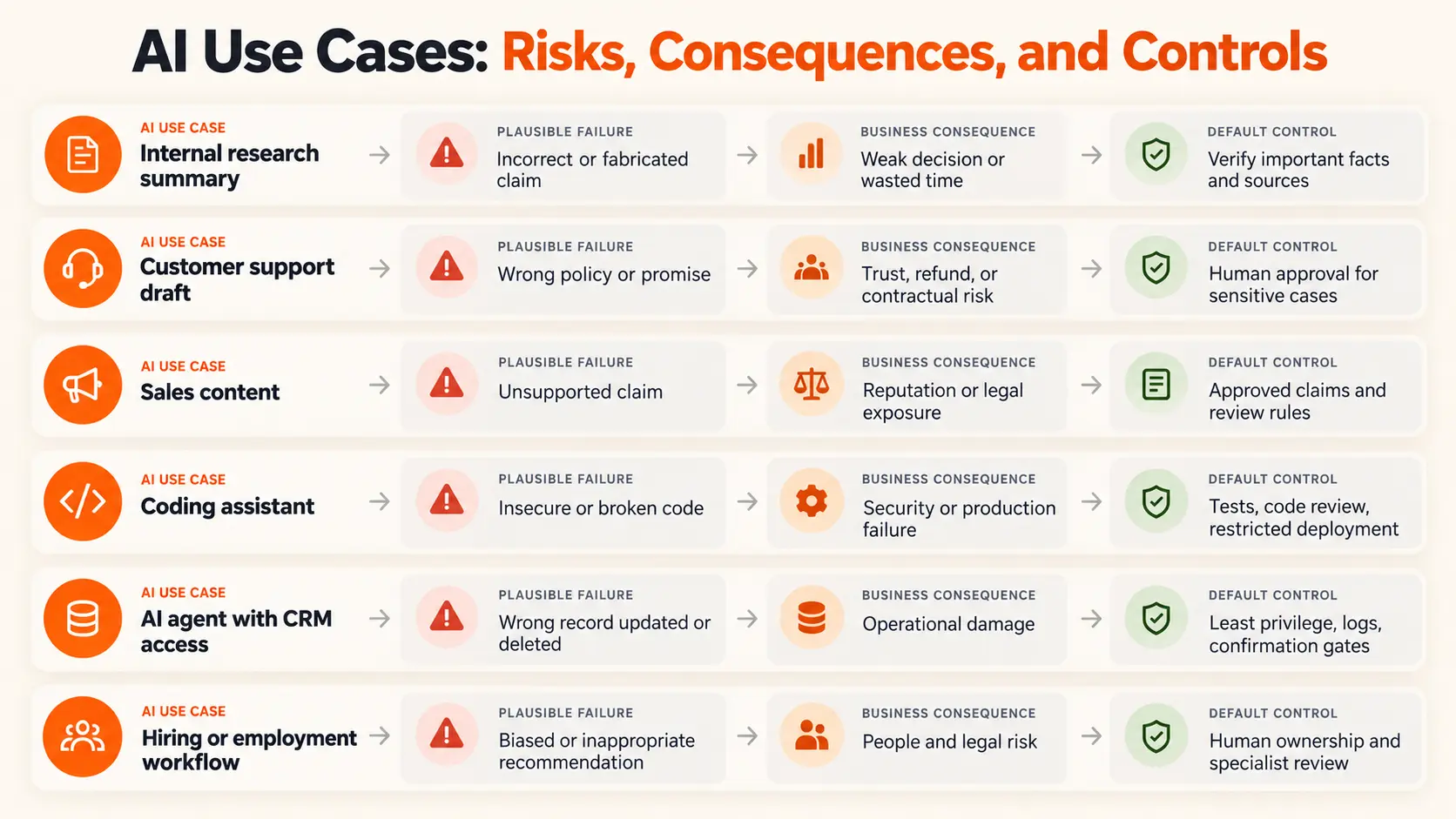
The most important variables are impact, likelihood, detectability, and reversibility.
A wrong internal summary that can be checked in five minutes is fundamentally different from an agent that can transfer money, change permissions, delete production data, or make an external commitment on behalf of the company.
The AI Risks Startups Actually Need to Manage
Founders do not need a hundred category risk taxonomy. Most startup AI risk can be understood through a small number of recurring failure modes.
Output reliability. Models can produce confident but inaccurate answers, miss important context, or behave inconsistently when inputs change. The business risk depends on where the output goes next.
Data and privacy. Employees can paste customer, employee, financial, source code, or confidential business data into tools without understanding retention, training, or access rules. A useful AI feature is not automatically an acceptable destination for sensitive information.
Security and prompt injection. An AI system that consumes untrusted text, documents, webpages, or messages can encounter instructions designed to manipulate its behavior. The risk becomes more serious when the model can call tools or access sensitive systems.
Permissions and excessive agency. The more an agent can read, write, send, approve, delete, or execute, the larger the blast radius of a mistake. In the OWASP 2025 guidance, excessive agency is linked to excessive functionality, permissions, or autonomy.
Vendor and model dependency. A startup may build a critical workflow around a provider whose model behavior, pricing, limits, terms, availability, or data practices can change. Vendor risk is operational risk when the company cannot easily switch or fall back.
Human overreliance. A weak control can look strong on paper if the person assigned to review AI outputs simply accepts them. Human oversight only works when the reviewer has enough context, time, and authority to reject the system.
Legal, regulatory, and reputational risk. AI can affect claims, disclosures, employment decisions, intellectual property, privacy, customer commitments, and sector specific obligations. The risk is not limited to fines; a small company can lose enterprise trust long before a regulator becomes involved.
Use Risk Tiers Instead of One Policy for Everything
A lightweight startup framework should make low risk AI easy to use while putting friction around high consequence actions.
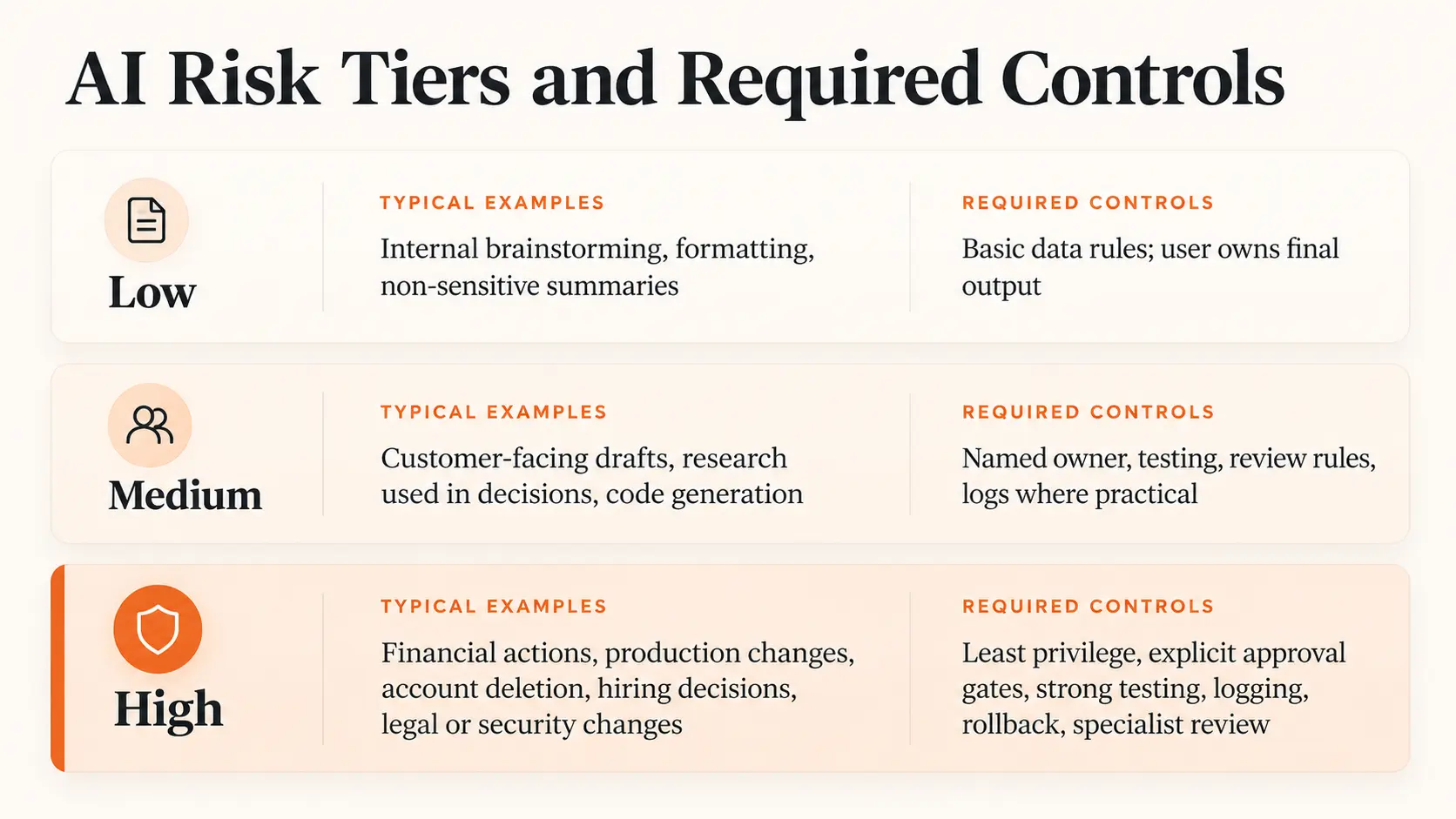
The point is not to ban high risk AI. The point is to make the startup deliberate about autonomy. A high impact workflow should earn its autonomy through evidence, not receive it because the model is impressive in a demo.
The Minimum Viable AI Risk System
A startup can establish a useful control system without creating a new department. Seven practices cover most early stage needs.
1. Create an AI inventory. List the models, vendors, agents, automations, and internal tools that materially affect work. Include shadow tools used by employees if they handle company data.
2. Assign a named owner. Every meaningful AI use case needs one person responsible for the outcome, even when several teams contribute to the workflow.
3. Classify the data. Decide which information is public, internal, confidential, or restricted and define which AI tools may receive each class.
4. Limit permissions. Give systems the minimum data, tools, and actions required to complete the job. Separate read access from write access whenever possible.
5. Define approval gates. Require explicit human confirmation before actions with material financial, legal, security, customer, or production consequences.
6. Test realistic failure modes. Evaluate normal cases, edge cases, adversarial inputs, missing context, tool failures, and vendor outages before trusting the workflow at scale.
7. Monitor and maintain a fallback. Track failures after launch and make sure the process can be paused, rolled back, or completed manually when the AI is unavailable or behaving unexpectedly.
This is enough to move a startup from informal AI usage to a basic operating system for accountability.
Agent Risk Is Mostly a Question of Permissions
AI agents deserve special attention because they move the model from recommendation to execution.
A chatbot that drafts a message creates one kind of risk. An agent that can send the message, update the CRM, create a refund, modify a production setting, or call another tool creates a different class of exposure.
The safest starting point is narrow agency:
Give the agent only the tools needed for one workflow.
Prefer read only access until write access is necessary.
Do not give broad administrative credentials to make integration easier.
Require approval before irreversible or externally binding actions.
Log tool calls and the identity under which the action occurred.
Set limits on spend, volume, frequency, and other dimensions that can create runaway impact.
Create a clear escalation path when confidence is low or required context is missing.
A small team should be especially cautious about agents that inherit founder or administrator credentials. Convenience can quietly turn one AI mistake into company wide access.
Hallucination Is an Operating Design Problem
Founders often treat hallucination as a model quality problem that will disappear when the next model arrives. Better models help, but a production system should be designed around the assumption that some outputs will still be wrong.
The right control depends on the task.
Use retrieval or trusted source material when factual grounding matters.
Require citations or source links for research that will influence decisions.
Use structured outputs when downstream systems expect a fixed format.
Validate numbers, identifiers, permissions, and other critical fields with deterministic checks.
Allow the system to abstain or escalate instead of forcing an answer.
Measure performance on examples taken from the real workflow rather than relying on generic benchmark scores.
A model does not need to be perfectly accurate to be useful. It does need an error rate that is acceptable for the consequence of the task.
Data Risk Comes Before Model Risk
Many startup AI incidents do not begin with a sophisticated model failure. They begin with someone putting the wrong data into the wrong tool.
Before adopting an AI product or connecting a new integration, founders should be able to answer five questions:
What data will enter the system?
Where is that data stored and for how long?
Can the provider use it to train or improve models?
Who inside the company and at the vendor can access it?
How can the startup delete, export, or stop sending the data later?
Sensitive information should not flow into an AI system simply because the workflow is convenient. Customer contracts, employee data, credentials, source code, financial records, and regulated information may require different treatment from public marketing content.
Treat Third Party AI Vendors as Part of Your Product
A startup can outsource the model but not the business consequence.
If a vendor sits inside a critical product or workflow, basic diligence should cover:
Data retention and model training practices
Security controls and access management
Subprocessors and important dependencies
Logging and auditability
Service availability and rate limits
How model changes are communicated
Whether the company can export data or switch providers
What happens to the workflow during an outage
Vendor evaluation should become stricter as the workflow becomes harder to replace. A tool used for brainstorming can fail for a day with little consequence. A model that sits inside customer support, fraud detection, production operations, or a paid product needs a more serious fallback plan.
Build a Risk Register That People Will Actually Use
A startup risk register should fit on one page or live in a simple shared table. If maintaining it becomes a project, the team will stop updating it.
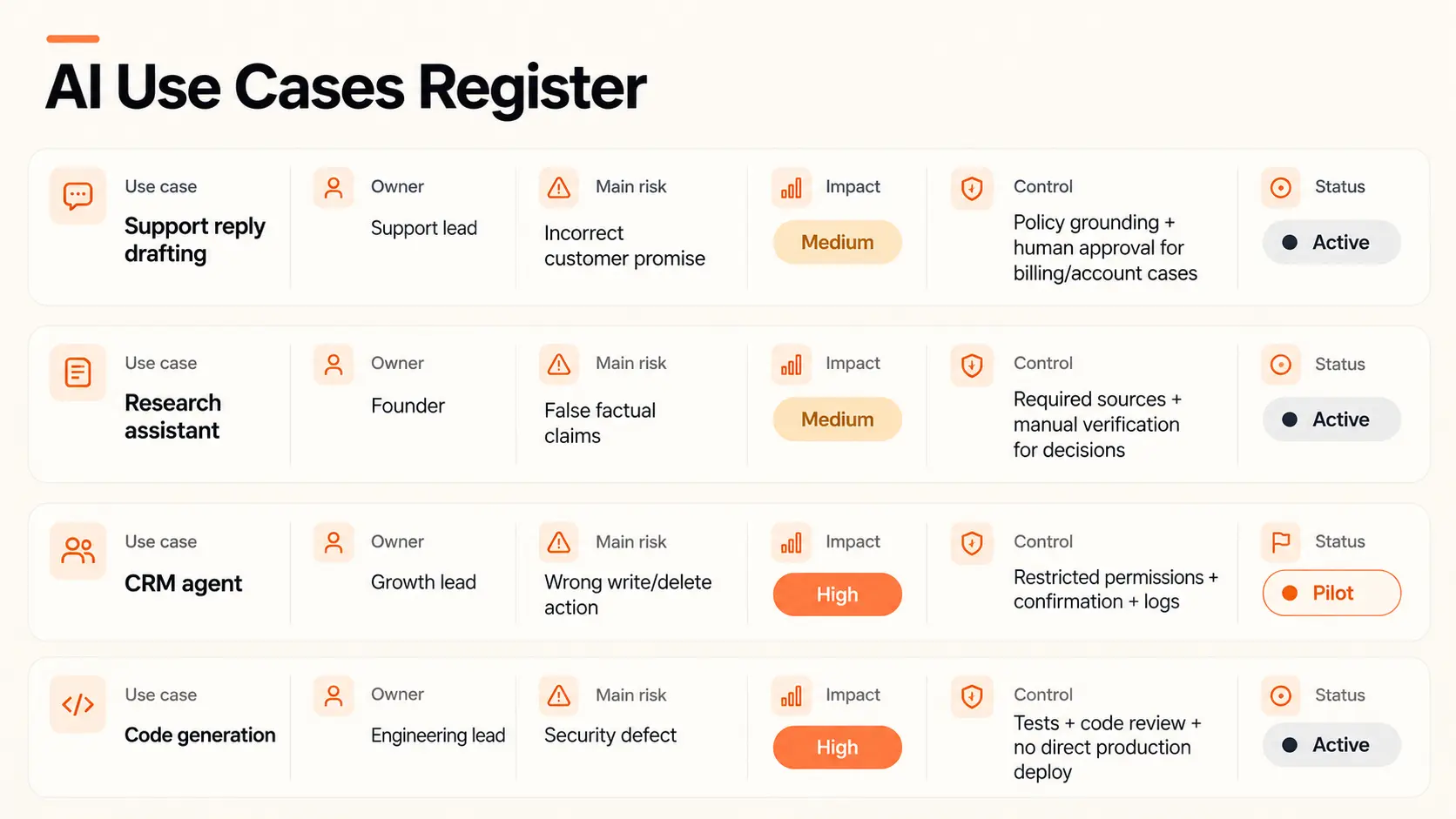
The purpose is not documentation for its own sake. The register should answer three questions quickly: where AI is being used, what could hurt the company, and whether the control is strong enough for the consequence.
Test Failure Before You Scale Success
AI prototypes are usually tested on the happy path. Risk appears in the cases the demo never saw.
Before increasing autonomy or volume, test the workflow against:
Ambiguous and incomplete inputs
Incorrect or stale source data
Adversarial instructions and prompt injection
Very long or unusual inputs
Tool or API failures
Permission errors
Conflicting instructions
Provider outages
Unexpected model updates
Cases where a human should take over
For agentic systems, testing should include what happens after the first wrong step. A small initial error can cascade when the agent uses its own previous output as the context for the next action.
Monitoring Matters More After Launch
A workflow that passed testing can still degrade when customers, prompts, data, vendors, or models change.
Useful production signals include:
Error and correction rate
Human escalation rate
Approval rejection rate
Unauthorized or unexpected tool call attempts
Customer complaints linked to AI outputs
Manual override frequency
Latency and vendor outage frequency
Unexpected token, API, or agent spend
Performance changes after a model or prompt update
Founders should also define stop conditions. If a workflow crosses an agreed failure threshold, the team should know whether to reduce autonomy, switch to human review, roll back a change, or disable the system entirely.
Regulation Is Becoming an Operating Requirement
Startups should avoid treating regulation as a future problem that begins at scale. The relevant obligations depend on jurisdiction, industry, role in the AI value chain, and the specific use case, but several requirements are already operational.
In the European Union, for example, AI Act transparency requirements for certain AI systems began applying on August 2, 2026. The European Commission states that users must be informed in specified situations when they are interacting with AI, while other high risk requirements have later application dates.
Even when a specific regulation does not apply, enterprise customers increasingly ask practical questions that look like risk management: What data enters the model? Who owns the output? Can the system be audited? What happens when it fails? A startup that can answer those questions clearly is easier to trust.
Common AI Risk Management Mistakes
Writing a policy without changing the system. A document cannot limit permissions, validate output, or stop an unsafe action. Controls must exist in the workflow.
Applying the same rules to every use case. Over controlling low risk work encourages teams to bypass the policy, while under controlling high risk actions creates hidden exposure.
Treating accuracy as the only risk. An accurate model can still leak data, use excessive permissions, create legal exposure, or become an operational dependency.
Using human review as a vague safety label. Review is useful only when the reviewer has the context, authority, and time to detect and reject a bad output.
Giving agents broad access during prototyping. Prototype credentials have a habit of becoming production credentials. Permission boundaries should be designed early.
Ignoring model and vendor changes. A workflow can change even when the startup changes nothing. Providers update models, limits, pricing, and policies.
Having no fallback. A critical AI workflow without a manual or alternate path turns a vendor outage into a company outage.
Move Fast, but Make Failure Bounded
AI risk management for startups should not become a reason to slow every experiment. It should make the company confident about which experiments can move quickly and which actions deserve more friction.
The strongest early stage control system is not the one with the most policies. It is the one where every meaningful AI workflow has clear ownership, appropriate data access, bounded permissions, realistic testing, visible failures, and a path back to human control.
As AI takes on more execution, the startup's advantage comes from designing the boundary between machine autonomy and human accountability before that boundary is tested by a real failure.
FAQ
What is AI risk management for startups?
It is the process of identifying where AI can create meaningful business harm, prioritizing those risks, adding proportionate controls, and monitoring the system as usage and autonomy grow.
What AI risks should startups focus on first?
Start with output reliability, sensitive data, security, permissions, vendor dependency, human overreliance, and high impact legal or customer consequences.
Do small startups need an AI governance framework?
They need governance discipline, but not necessarily enterprise bureaucracy. A simple inventory, named owners, risk tiers, data rules, approval gates, testing, and monitoring can cover many early stage needs.
How should startups manage AI agent risk?
Use narrow tool access, least privilege permissions, approval gates for consequential actions, detailed logs, spend and volume limits, and clear escalation or rollback procedures.
How can startups reduce AI hallucination risk?
Ground important tasks in trusted sources, require citations where relevant, validate critical fields, test on real examples, allow abstention, and keep human review around high consequence outputs.
When should a startup involve legal or security specialists?
Bring in specialists when AI touches regulated data, employment, financial or legal decisions, security controls, health or safety, high impact customer commitments, or jurisdictions with specific AI obligations.

Mohsen Avid
Founder & Editor, PinerookMohsen Avid is the founder of Pinerook, covering entrepreneurship, startup strategy, digital business, and the decisions behind building new ventures.
 Seen first.