
Startup finance is the foundation of nearly every important business decision a founder makes. It determines how long a company can continue operating, how much it can invest in growth, whether its customers generate sustainable economic value, and when additional capital may become necessary. Yet financial management is often treated as a secondary responsibility, particularly during the early stages when founders are concentrating on building products and attracting customers.
The challenge is that business growth and financial stability do not always move in the same direction. A startup can increase revenue while running out of cash, acquire thousands of customers while losing money on each relationship, or secure substantial investment without establishing a sustainable operating model. Understanding these differences is essential because financial problems frequently develop long before they become visible in the company's bank balance.
Startup finance brings financial planning, cash management, performance measurement, and funding decisions into one framework. It helps founders understand how money moves through the business, which activities create economic value, and how financial resources should be allocated under uncertain conditions. This guide explains the principles behind that framework, the financial information founders need to understand, and how to use it to support responsible startup growth.
What Is Startup Finance?
Startup finance refers to the management of a young company's financial resources, obligations, operating performance, and future capital requirements. It includes understanding revenue and expenses, forecasting cash needs, evaluating customer economics, allocating investment, and deciding how the business should be financed. While these responsibilities exist in established companies, startups face additional uncertainty because their products, customer relationships, pricing, and operating processes may still be developing.
An established business can often forecast performance using years of operating history. A startup may have only a few months of customer data, making its financial assumptions much less reliable. Revenue may depend on a small group of customers, development costs may change unexpectedly, and hiring decisions can substantially increase recurring expenses. Financial management must account for these conditions rather than assume that past performance will continue unchanged. The purpose of startup finance is not to eliminate uncertainty but to make its consequences understandable. Founders need to know what they can afford, which assumptions matter most, and how quickly the company must respond when actual results differ from expectations.
Financial Planning and Resource Allocation
A financial plan translates a startup's business objectives into expected costs, revenue, cash requirements, and operating priorities. It should begin with what management intends to accomplish rather than with an arbitrary spending budget. A company developing its first commercial product may prioritize engineering and customer research, while a business with an established product may allocate more resources to sales, support, and infrastructure. The appropriate financial plan depends on the objectives and evidence available at the company's current stage.
Effective planning connects expenditure with milestones that can be evaluated. For example, recruiting additional sales employees should be supported by assumptions about recruitment time, training, customer conversion, and the revenue those employees may eventually generate. Founders should also examine what happens if the anticipated results arrive later than expected. The dedicated guide to startup financial planning explores how budgets, financial priorities, and operating forecasts can be organized around business objectives. At the broader level, planning enables founders to distinguish spending that supports meaningful progress from commitments that increase costs without addressing the company's most important uncertainties.
The Financial Statements Every Startup Founder Should Understand
Three financial statements provide the foundation for understanding a company's performance and financial position: the income statement, balance sheet, and cash flow statement. They describe different aspects of the same business, which means founders should examine them together rather than relying on a single measure of success. The income statement reports recognized revenue and expenses over a period, helping management understand profitability and how operating costs affect financial results. The balance sheet presents assets, liabilities, and equity at a particular date, showing the resources the company controls and the obligations it must satisfy.
The cash flow statement explains changes in cash through operating, investing, and financing activities. This distinction is especially important for startups because investment proceeds, accounting revenue, and available operating cash are not interchangeable. A company may recognize revenue before receiving payment, purchase equipment using cash without recognizing the entire amount as an immediate expense, or increase its cash balance by issuing shares to investors. Founders do not need to perform every accounting task themselves, but they should understand what each statement measures and why the figures may differ. Together, these reports provide a more reliable picture of financial health than revenue growth or bank balances alone.
Revenue, Profit, and Available Cash
Revenue, profit, and cash are often discussed as though they represent the same financial result, but they answer different questions. Revenue measures income recognized from business activity under applicable accounting principles. Profit reflects revenue after recognized expenses have been considered, while cash represents money available to meet obligations or fund company activities. Differences between these measures can become substantial when customer payments, supplier expenses, and accounting recognition occur at different times.
Consider a startup that provides a service to a customer and issues an invoice for $40,000 with payment due in 60 days. Depending on the accounting circumstances, the business may recognize the revenue before receiving the cash. Meanwhile, it still needs to pay employees, infrastructure providers, and other suppliers. The company can therefore show improving revenue while facing immediate liquidity pressure. The reverse can also occur when customers pay in advance for services the company must provide over a longer period. Understanding these timing differences prevents founders from treating reported income as money that can automatically be spent. Sustainable financial management requires visibility into both economic performance and the actual availability of cash.
Understanding Cash Burn
Startups frequently spend more cash than they generate, particularly when they are developing technology, entering markets, or investing in customer acquisition. This pattern is not automatically a sign of poor management. A company may deliberately use investment capital to finance activities expected to create value later. However, management must understand the pace of cash consumption and whether the results justify the spending.
Two concepts are useful when discussing burn. Gross burn generally refers to cash outflows during a defined period, while net burn reflects the amount by which relevant cash outflows exceed cash inflows. Definitions should be applied consistently, particularly when companies report these figures to investors. The startup burn rate guide examines the calculations, reporting differences, and decisions associated with cash consumption. For financial management purposes, burn should be evaluated alongside business progress rather than in isolation. An increase in spending may be reasonable if it supports validated demand and produces measurable improvements, but it can become dangerous when management cannot explain how the additional expenditure advances the business. Founders should monitor changes in burn as operating plans evolve and avoid assuming that present spending will remain constant.
Cash Runway and Financial Flexibility
Cash runway estimates how long a startup can continue operating using its available cash under specified assumptions about future consumption. A simplified calculation divides available cash by the monthly net cash burn. If a startup has $720,000 in cash and consumes $60,000 per month, its estimated runway is 12 months. This figure is useful for understanding financial flexibility, but it should not be interpreted as a guaranteed survival period. Hiring, customer payments, supplier obligations, taxes, and unexpected expenses can all change the actual outcome.
Runway becomes most valuable when founders use it to make decisions before cash pressure becomes urgent. A company with declining liquidity may need to slow recruitment, adjust discretionary spending, improve collections, or consider financing alternatives. The detailed startup runway guide examines calculation methods and the effects of changing assumptions. Within the wider financial framework, runway is a measure of how much time management has to pursue its objectives and respond to unexpected developments. Founders should understand not only the current estimate but also the conditions that could shorten it. A startup that recognizes financial pressure early retains more options than one that waits until its remaining cash can cover only a few obligations.
Managing the Timing of Cash Movements
Cash management requires more than measuring how much money enters and leaves the business during a month. The timing of transactions can determine whether a startup can pay employees and suppliers even when its longer term commercial outlook appears attractive. A company may hold valuable customer contracts but face liquidity problems because invoices are collected after payroll and infrastructure payments are due. Businesses that purchase inventory can experience similar pressure when suppliers must be paid before finished products generate sales.
Founders should understand customer payment terms, recurring obligations, outstanding invoices, and the expected timing of major expenditures. A forecast that identifies anticipated receipts and payments can reveal temporary funding gaps that would be hidden in a simple annual budget. The specialized startup cash flow management article explores methods for organizing these movements and improving financial visibility. At the pillar level, the essential lesson is that growth must be supported by adequate working capital. A profitable transaction does not necessarily provide immediate cash, and a strong sales forecast cannot pay an obligation that becomes due before customers settle their invoices. Financial planning must therefore consider both the amount and timing of expected transactions.
Revenue Models and Financial Performance
A revenue model explains how a business earns money from the products or services it provides. Common approaches include subscriptions, direct sales, transaction fees, licensing, advertising, and usage based pricing. Each model creates different patterns of revenue recognition, customer payments, operating costs, and commercial risk. A subscription business may benefit from recurring customer relationships, while a transaction platform may depend on activity volume and the percentage of each transaction retained as revenue.
The choice of revenue model affects financial planning because it influences how predictable income is and what resources are required to deliver it. A business collecting annual subscription payments in advance may enjoy stronger immediate liquidity but must still provide services throughout the contractual period. A company selling physical products may need to finance inventory and distribution before receiving customer payments. The dedicated startup revenue model guide examines these structures and their financial implications in greater detail. For founders, the important question is not simply how much customers are willing to pay. It is whether the chosen monetization approach produces reliable revenue, supports the cost of delivery, and can develop into a commercially sustainable business.
Gross Margin and the Economics of Delivering Value
Revenue growth provides an incomplete picture of financial performance unless founders understand the costs directly associated with generating that revenue. Gross profit represents revenue remaining after deducting the applicable cost of goods sold or cost of revenue, while gross margin expresses the result as a percentage of revenue. For example, a company with $100,000 in revenue and $35,000 in cost of revenue has $65,000 in gross profit and a gross margin of 65%. This does not mean the business has earned $65,000 in net profit, because other expenses may still need to be deducted.
Gross margin helps founders assess whether increasing sales improves the company's capacity to cover operating costs. A business with low margins may require substantial transaction volume to support its organization, while a company with higher margins may have more resources available for development and customer acquisition. Neither outcome guarantees financial sustainability because other costs and customer behavior remain important. Founders should examine margin changes over time, particularly when new products, pricing changes, or delivery requirements alter the economics of the business. A startup can increase revenue while creating relatively little additional gross profit if delivery costs rise at a similar pace.
Unit Economics and Sustainable Growth
Company wide financial results can conceal differences in the profitability of individual customers, products, or transactions. Examining the economics of a defined unit helps founders understand whether additional activity creates economic value or increases losses. The relevant unit depends on the business model. A subscription company may analyze an account, an online retailer may examine an order, and a marketplace may evaluate a completed transaction.
The purpose is to connect the revenue associated with a unit to the costs required to acquire and serve it. A business can expand rapidly while producing unfavorable economics on every additional sale, particularly when discounts, support requirements, or delivery expenses exceed expectations. At the same time, founders should distinguish contribution level calculations from overall profitability because shared operating expenses may not be included in a particular unit analysis. The separate unit economics article explores definitions, calculation methods, and their practical limitations. Within startup finance, this analysis provides an important link between growth and sustainability. It helps founders recognize when greater transaction volume strengthens the business and when expansion may simply increase financial pressure.
Customer Acquisition Costs and Marketing Efficiency
Customer acquisition often requires substantial spending before the financial benefits become clear. Advertising, sales employees, commissions, marketing software, and promotional activities can contribute to acquisition costs, depending on the company's business model and calculation method. Founders need to understand whether these investments generate customers whose expected economic value justifies the resources spent to acquire them.
Customer acquisition cost, commonly abbreviated CAC, should be calculated using consistent definitions and a relevant measurement period. Timing is important because expenditure may occur weeks or months before a customer makes a purchase. A startup with a lengthy enterprise sales process may produce misleading results if it compares one month's sales and marketing spending only with customers acquired during that same period. Our detailed guide, customer acquisition cost startup, examines these calculations and the assumptions founders should verify. CAC becomes particularly meaningful when evaluated alongside customer retention, gross margins, and the time needed to recover acquisition spending. A low acquisition cost does not guarantee attractive economics if customers leave quickly, while a higher cost may be reasonable when relationships generate substantial long term value.
Understanding Customer Lifetime Value
Customer lifetime value estimates the economic contribution a customer may generate during the relationship with a business. The calculation can be based on revenue, gross profit, or contribution profit, and those approaches should not be confused. For financial decisions about acquisition spending, the costs associated with serving customers are particularly important because revenue alone does not represent the economic benefit retained by the company.
Retention assumptions strongly influence lifetime value estimates. A business with recurring purchases and durable customer relationships may produce different economics from one that relies on occasional transactions. Early stage startups often lack enough historical information to estimate customer lifetime reliably, making apparently precise projections potentially misleading. The dedicated lifetime value startup guide explains different approaches and their limitations. Founders should regard these estimates as decision support rather than guaranteed future revenue. Comparing expected customer value with acquisition and servicing costs can help management evaluate marketing investments, but the analysis should remain sensitive to retention changes, pricing adjustments, and differences between customer groups. A metric built on optimistic assumptions should not be used to justify unlimited acquisition spending.
Financial Metrics That Matter Most
Founders can monitor dozens of financial indicators, but an effective dashboard should emphasize information that supports meaningful business decisions. A startup still developing its first product may need to prioritize available cash, spending commitments, and development milestones. A growing subscription company may place more emphasis on recurring revenue, retention, gross margins, and customer acquisition efficiency. The objective is not to collect the largest possible number of metrics but to understand the financial relationships that determine the company's operating flexibility and commercial progress.
The following table summarizes important measures and their main management applications. Their relevance will depend on the business model, and founders should maintain consistent definitions when tracking changes. The detailed startup financial metrics guide covers calculation methods and interpretation in greater depth.
Essential Startup Finance Metrics
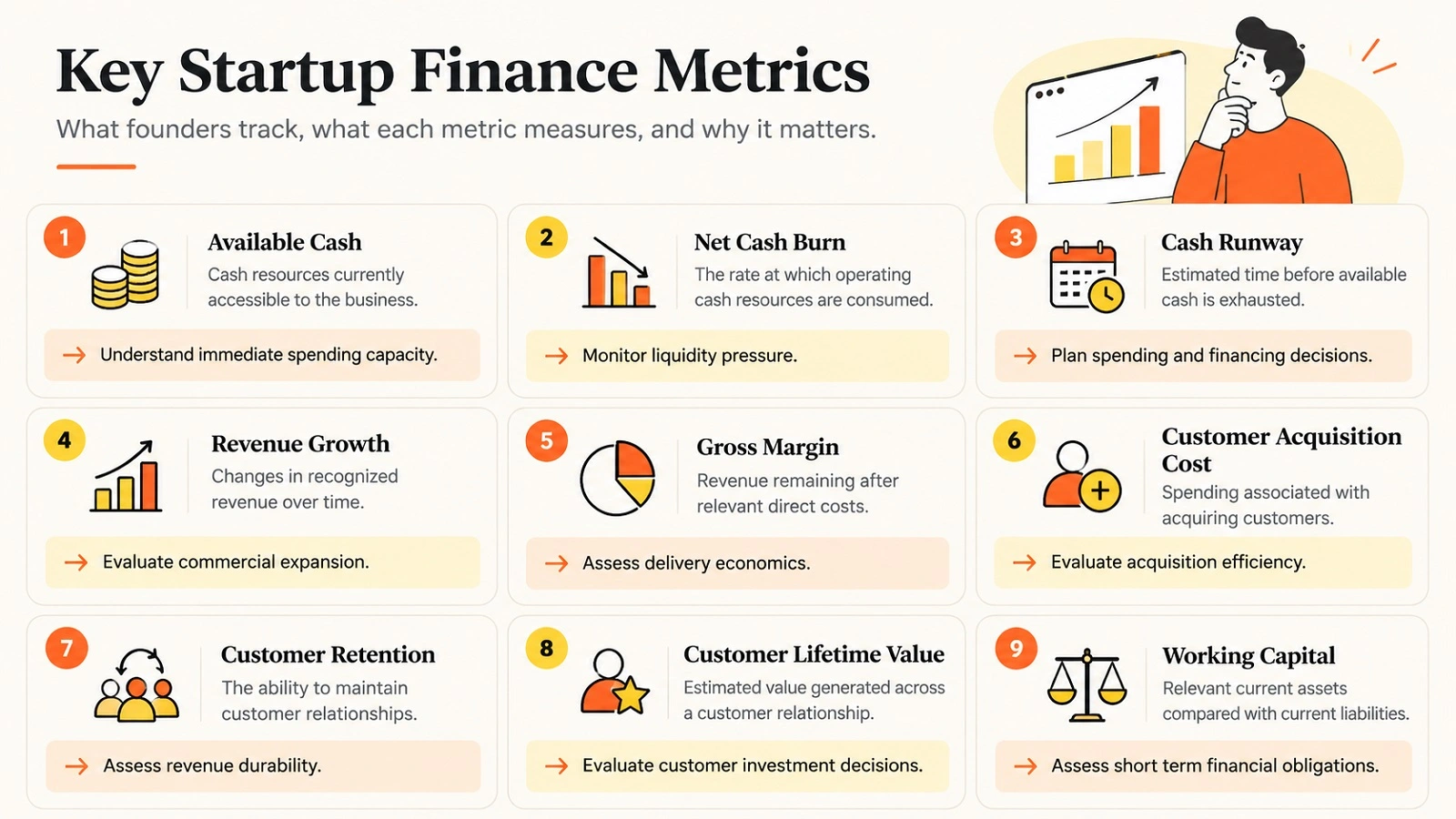
A dashboard is useful only when it leads to analysis and decisions. If cash consumption increases, management should identify the spending responsible and evaluate whether it supports meaningful progress. If gross margins decline, founders should examine pricing, delivery costs, and changes in customer activity. Metrics should help explain what is happening inside the business rather than serve as isolated measures of success.
Building Forecasts and Financial Scenarios
Financial forecasting connects operating assumptions with possible future outcomes. A startup can estimate customer growth, expected payments, recruitment, infrastructure costs, and other obligations to understand how its financial position may change. Because these assumptions are uncertain, founders should avoid treating a single forecast as a guaranteed result. Comparing alternative scenarios allows management to see how spending and revenue changes affect available cash and financial flexibility.
Consider a hypothetical company with $720,000 in cash. The following scenarios use different monthly cash receipts and payments to illustrate how operating decisions influence runway. Each estimate assumes that monthly net cash consumption remains constant and that no additional funding enters the business.
Startup Cash Runway Scenario Comparison

The expansion case generates higher cash receipts than the base case, but greater spending shortens the runway. The efficiency case creates more financial flexibility, although lower expenditure may also affect development capacity or growth opportunities. These outcomes are not predictions or instructions to prioritize one strategy over another. They demonstrate why financial decisions should consider both expected benefits and the resources required to achieve them. The specialized financial model for startups guide explains how founders can organize these assumptions, construct projections, and update scenarios as new information becomes available.
Financing Decisions and Capital Structure
Startups may finance their activities using founder capital, customer revenue, grants, borrowing, equity investment, or combinations of these sources. Each option affects the business differently. Customer revenue can reduce reliance on outside capital, but not every company can generate sufficient cash during development. Debt may provide funding without immediately changing equity ownership, but it introduces repayment obligations and may involve interest, security requirements, or contractual restrictions.
Equity financing can support investment in uncertain growth opportunities without creating ordinary scheduled loan repayments, but it changes ownership and may establish investor rights affecting governance or future financing. Founders should evaluate these consequences alongside the company's operating needs rather than choosing a source solely because capital is available. A business with predictable cash collections may have financing options that would be unsuitable for a startup with limited revenue and substantial development costs. Financial analysis should help founders determine how much capital is required, what it will support, and whether the proposed financing structure is compatible with the company's risks. Raising money is not inherently evidence of success; the important question is whether the financing improves the business's ability to achieve meaningful objectives.
Financial Controls, Reporting, and Compliance
As a startup grows, informal financial practices can become increasingly difficult to maintain. Additional employees, customers, suppliers, and financing arrangements create more transactions and obligations, increasing the importance of accurate records and reliable internal processes. Founders should establish appropriate procedures for recording income and expenses, approving material payments, reconciling accounts, and reviewing outstanding liabilities. The complexity of these controls should reflect the company's size and risks rather than introducing unnecessary administrative work.
Financial management also requires attention to obligations that may not appear prominently in a growth dashboard. Taxes, payroll requirements, employee benefits, debt repayments, contractual commitments, and regulatory responsibilities can affect the company's cash position. Requirements vary by jurisdiction and business structure, making qualified professional advice important where obligations are uncertain. Founders should not treat money reserved for known liabilities as freely available growth capital. Clear reporting and consistent records support both operating decisions and external reviews by investors or lenders. More importantly, they allow management to identify financial problems before those problems create urgent cash shortages or unexpected legal and contractual complications.
Financial Priorities Across Startup Stages
The financial information most useful to a startup changes as the company develops. During product development, available cash, spending requirements, and the costs of reaching technical milestones may dominate management decisions. Once commercial activity begins, attention often shifts toward pricing, customer demand, revenue quality, and the costs of delivering the product. As the business expands, retention, acquisition efficiency, margins, and operational capacity become increasingly important.
These stages do not follow the same pattern in every industry. A company developing medical technology may require substantial investment before generating revenue, while a software business may begin collecting subscription payments relatively early. Founders should select financial indicators according to the uncertainties facing their business rather than automatically adopting the reporting structure of a much larger company. The underlying responsibility remains consistent: management needs to understand the resources available, how those resources are being used, and whether current decisions support the company's next important objectives. Financial processes should become more sophisticated as the business grows, but they should always remain connected to practical management decisions.
A Practical Example of Startup Financial Management
Consider a hypothetical software startup called RelayDesk, which provides workflow software for small professional service companies. The business has paying customers, a functioning product, and encouraging revenue growth. Its founders want to accelerate expansion by recruiting additional sales employees and increasing marketing expenditure. Initially, they evaluate the decision mainly through the number of new customers they expect to acquire. However, an examination of the company's financial position reveals that growth could create more immediate pressure than management anticipated.
RelayDesk has $720,000 in available cash. During a representative month, it receives $80,000 and makes $150,000 in cash payments, creating net consumption of $70,000. Under a simplified constant burn assumption, this provides approximately 10.3 months of runway. The proposed expansion is expected to increase customer receipts, but it would also raise recurring spending. By comparing the expansion and efficiency scenarios, the founders realize that higher sales do not automatically extend the company's financial flexibility.
They decide to examine customer acquisition performance, retention, and the time required to recover marketing expenditure before approving the complete expansion plan. They also introduce a regular cash forecast and begin comparing actual results with operating assumptions. RelayDesk is fictional, but the situation illustrates an important principle: financial management does not exist to prevent investment in growth. It helps founders understand whether the company has sufficient resources to pursue that growth and what risks must be managed along the way.
Establishing a Financial Management Routine
Financial reports become valuable when they are reviewed consistently and used to support decisions. A startup should establish a reporting routine that reflects its operating complexity and financial condition. Cash balances and near term payment obligations may require frequent attention, particularly when runway is limited. Revenue, expenses, margins, and customer economics should be examined over appropriate reporting periods using stable definitions that allow meaningful comparisons.
Management should compare actual performance with financial expectations and investigate significant differences. When expenses rise unexpectedly, founders need to understand whether the increase reflects planned investment, operational inefficiency, or timing differences. When revenue falls below expectations, they should examine customer activity and the assumptions underlying their forecasts rather than simply replacing projections with more optimistic figures. The review process should establish what changed, why it changed, and whether the company needs to adjust its plans. Reliable financial information does not make every business decision straightforward, but it helps founders distinguish between temporary fluctuations and developments that require a more substantial response.
Building a Financially Sustainable Startup
Financial sustainability does not necessarily require a startup to become profitable immediately. Some businesses need substantial development investment before commercial activity can support their operating costs, while others may generate revenue early and finance a significant portion of their growth internally. The appropriate financial path depends on the industry, cost structure, market opportunity, and capital available.
What matters is whether management understands the economic relationships underlying the business. Founders should know how revenue is generated, what it costs to serve customers, how much cash is being consumed, and which assumptions must hold for the company to achieve its objectives. They should also consider how financial risks change when the business expands. Increasing revenue while weakening margins or accelerating cash consumption may create new vulnerabilities, whereas improving operating efficiency can provide additional flexibility even when growth is more moderate. Financial sustainability comes from aligning spending, commercial evidence, and available resources with a credible development plan. It is not simply a matter of reducing costs or pursuing the highest possible revenue growth.
Final Thoughts on Startup Finance
Startup finance gives founders a practical way to connect commercial ambition with financial reality. Understanding financial statements reveals how the business performs, while cash forecasts and runway estimates show how much flexibility remains. Revenue models, margins, and customer economics explain whether commercial activity can support future growth, and financial planning helps management determine which investments are justified by the company's objectives.
These tools cannot remove the uncertainty associated with building a startup. Customer behavior may change, expenses can exceed expectations, and financing opportunities may not materialize when anticipated. However, founders who regularly evaluate reliable financial information are better equipped to recognize those changes and respond before they become critical. The ultimate purpose of financial management is to help a company allocate resources responsibly, pursue worthwhile opportunities, and maintain enough flexibility to build a durable business.
FAQ
What is startup finance?
Startup finance is the management of a startup's financial resources, operating performance, cash requirements, and funding decisions. It includes financial planning, cash forecasting, analysis of revenue and expenses, evaluation of customer economics, and decisions about how the business should obtain and use capital. The objective is to support informed decisions under uncertain conditions.
How is startup finance different from accounting?
Accounting records and reports financial transactions under applicable standards, while startup finance uses accounting information alongside operating data, forecasts, and business assumptions to guide management decisions. Accounting provides important historical information, but financial management also examines future cash requirements, growth investments, financing alternatives, and the risks associated with different operating plans.
What financial metrics should startup founders track?
Important indicators often include available cash, net cash burn, runway, revenue growth, gross margin, acquisition costs, customer retention, and customer lifetime value. The most relevant metrics depend on the company's stage and business model. Founders should prioritize information that helps them understand liquidity, commercial performance, and the economic consequences of growth.
Why can a startup grow in revenue and still run out of cash?
Revenue growth does not guarantee immediate cash availability. Customers may pay after invoices are issued, operating expenses may increase before the related revenue arrives, and investments in hiring or infrastructure can consume significant resources. A startup may therefore report increasing revenue while experiencing negative cash flow and declining reserves.
Can a startup grow without external investment?
Yes. Some startups finance their development through founder capital, customer revenue, or other suitable sources without issuing equity to external investors. The feasibility of this approach depends on the company's development costs, cash generation, growth objectives, and financial risks. Businesses requiring substantial upfront investment may have different financing needs from companies that can generate meaningful customer revenue early.

Mobina Khanki
Venture & Funding Writer at PinerookMobina Khanki covers venture capital, startup funding, fundraising, and startup finance for Pinerook, focusing on founders and investors.
 Seen first.


