Startup runway measures how long a company can continue operating before its available cash runs out. For founders, understanding runway is essential because it reveals how much time remains to reach important milestones, improve financial performance, or secure additional capital. A startup may have promising products, increasing revenue, and growing customer demand while still approaching a cash shortage that threatens its ability to operate.
The challenge is that available cash does not always decline at a predictable rate. Hiring decisions, customer payment delays, product development costs, and expansion plans can significantly change future cash requirements. Within the broader framework of Startup Finance, runway helps founders connect financial resources with business priorities and upcoming obligations. Understanding how to calculate it is important, but knowing how to use the result when making decisions is what makes the metric valuable.
This guide explains how startup runway works, how to calculate and forecast it, what influences the amount of time a company has remaining, and how founders can extend their financial flexibility. It also includes a six month financial example and practical scenarios demonstrating how operating decisions affect available cash and the timing of financial constraints.
What Is Startup Runway?
Startup runway is the estimated amount of time a company can continue operating with its available cash under specific assumptions about future cash receipts and payments. It is commonly measured in months and is especially relevant to businesses that consume more cash than they generate through normal operations.
For example, a startup with $600,000 in unrestricted cash and monthly net cash consumption of $50,000 has approximately 12 months of runway if that rate remains unchanged. This estimate helps management understand how long current resources could support operations without additional financing.
However, runway is not a guaranteed period of survival. The calculation depends on assumptions that can change as the business develops. Customer payments may arrive later than expected, additional employees may increase payroll, and unexpected investments can accelerate cash consumption.
Runway also represents financial flexibility. A company with sufficient time remaining may be able to test new products, improve customer acquisition, and prepare financing alternatives without immediate pressure. As runway becomes shorter, founders have fewer opportunities to adjust spending or respond to unfavorable business outcomes.
The purpose of calculating runway is therefore not simply to predict when money will run out. It is to identify financial constraints early enough for management to make informed decisions.
How to Calculate Startup Runway
The basic runway calculation compares the amount of cash available with the rate at which the startup consumes cash.
Startup runway = Available cash ÷ Monthly net cash burn
If a company has $750,000 in available cash and consumes $75,000 each month, its estimated runway is 10 months.
Although the formula is straightforward, the accuracy of the result depends on using appropriate cash balances and realistic spending assumptions.
Step 1: Identify Available Cash
Begin by reviewing the company's bank accounts and other readily accessible cash holdings. The starting amount should reflect funds that can genuinely be used to support business operations.
Restricted funds or investments that cannot be accessed when needed should not automatically be included. Founders must also consider upcoming financial obligations, including payroll, taxes, supplier payments, and contractual commitments.
These obligations should appear in the future cash forecast. If they are already included as projected payments, they should not also be deducted from opening cash, because doing so would count the same obligation twice.
For example, a company holding $800,000 across its accounts may have only $700,000 available for general operations if $100,000 is legally restricted. The runway calculation should use the amount that can actually support future spending.
Step 2: Calculate Monthly Net Cash Consumption
The next step is determining how much cash the startup consumes during a representative month.
Net cash burn is calculated by subtracting operating cash inflows from operating cash outflows.
Net cash burn = Operating cash outflows less operating cash inflows
Suppose a startup spends $130,000 on normal business operations while receiving $60,000 from customers. Its monthly net operating cash burn is $70,000.
The calculation should use actual cash movements rather than recognized accounting revenue. A company might report $100,000 in revenue but collect only $70,000 during the month because some invoices remain unpaid.
Investment proceeds and new borrowing should also be distinguished from operating receipts. Raising capital increases available funds but does not necessarily improve the cash generated by normal business activities.
When possible, founders can examine several months of spending to understand recurring cash consumption. However, historical averages should be adjusted when future commitments are expected to change.
Step 3: Estimate the Remaining Runway
Once available cash and monthly net cash consumption have been established, divide the first amount by the second.
Consider a startup with $840,000 in unrestricted cash and average monthly net burn of $70,000.
Startup runway = $840,000 ÷ $70,000 = 12 months
This means the company has approximately one year of runway if future net cash consumption remains constant.
The estimate does not account for additional hiring, major investments, changing customer collections, or other developments that may influence cash balances. Founders should therefore treat the calculation as a starting point and use a forward cash forecast for more important financial decisions.
Why Runway and Burn Rate Are Different
Burn rate and runway are closely related, but they describe different aspects of a startup's financial condition.
Burn rate measures how quickly cash is consumed during a particular period. Runway estimates how much time remains before available cash is exhausted under specific assumptions about that consumption.
A company can extend its runway by reducing monthly cash spending, improving recurring collections, or obtaining additional capital. Conversely, increasing operating commitments may shorten runway even when the current bank balance remains unchanged.
The distinction matters when founders evaluate future decisions. Hiring an employee may increase monthly costs before that position generates additional revenue. The company's historical cash consumption may appear manageable, but its projected runway could become substantially shorter.
Understanding runway therefore requires more than measuring past spending. Founders need to consider the timing and financial consequences of future operating decisions.
How Much Runway Should a Startup Have?
There is no universal runway target appropriate for every startup. The amount of time a company needs depends on its business model, development stage, operating commitments, financing options, and the milestones it intends to reach.
A company developing complex technology may require considerable time before meaningful revenue becomes available. A startup selling an established service may generate operating cash earlier and have different financial requirements.
Runway targets should also reflect how long it may take to achieve important business milestones. A startup planning to complete product development in eight months may need additional time to test customer demand, make necessary improvements, and prepare financing alternatives.
The uncertainty surrounding those milestones matters. If development is delayed or customers adopt the product more slowly than expected, the company may consume cash for longer than originally planned.
Financing conditions create another consideration. Fundraising may require preparation, investor discussions, due diligence, negotiations, and legal documentation. The process can take longer than founders anticipate.
Instead of relying on a fixed industry benchmark, startups should calculate the time required to reach their next meaningful milestone and include an appropriate allowance for uncertainty.
A company that expects to complete an important development stage in nine months may need considerably more than nine months of financial capacity if additional financing will be required afterward.
How to Forecast Runway When Spending Changes
The standard runway formula assumes that monthly net cash consumption remains unchanged. In practice, this assumption often becomes inaccurate as startups hire employees, expand marketing, invest in infrastructure, and generate additional customer revenue.
A more realistic method is to forecast cash balances month by month.
The calculation for each period is:
Closing cash = Opening cash + Cash receipts less cash payments
The closing balance becomes the opening balance for the next period. Repeating the calculation allows founders to see how available cash changes as spending and collections develop.
A practical forecast should include expected customer payments, payroll, supplier obligations, marketing expenses, taxes, debt payments, and major investments.
For example, if a company plans to hire employees during month four, the additional payroll expenses should appear beginning in that month. Applying the new spending level to earlier periods would distort the forecast.
Customer collections should also reflect realistic payment dates. A business may recognize revenue before receiving the corresponding cash, creating temporary liquidity pressure even while reported sales increase.
Many early stage startups benefit from a monthly forecast covering the next 12 months. Companies with limited liquidity or irregular payments may also require a shorter weekly forecast to identify near term financial constraints.
The objective is to understand when available resources may become insufficient, not merely calculate an average period of cash consumption.
A Practical Six Month Startup Runway Example
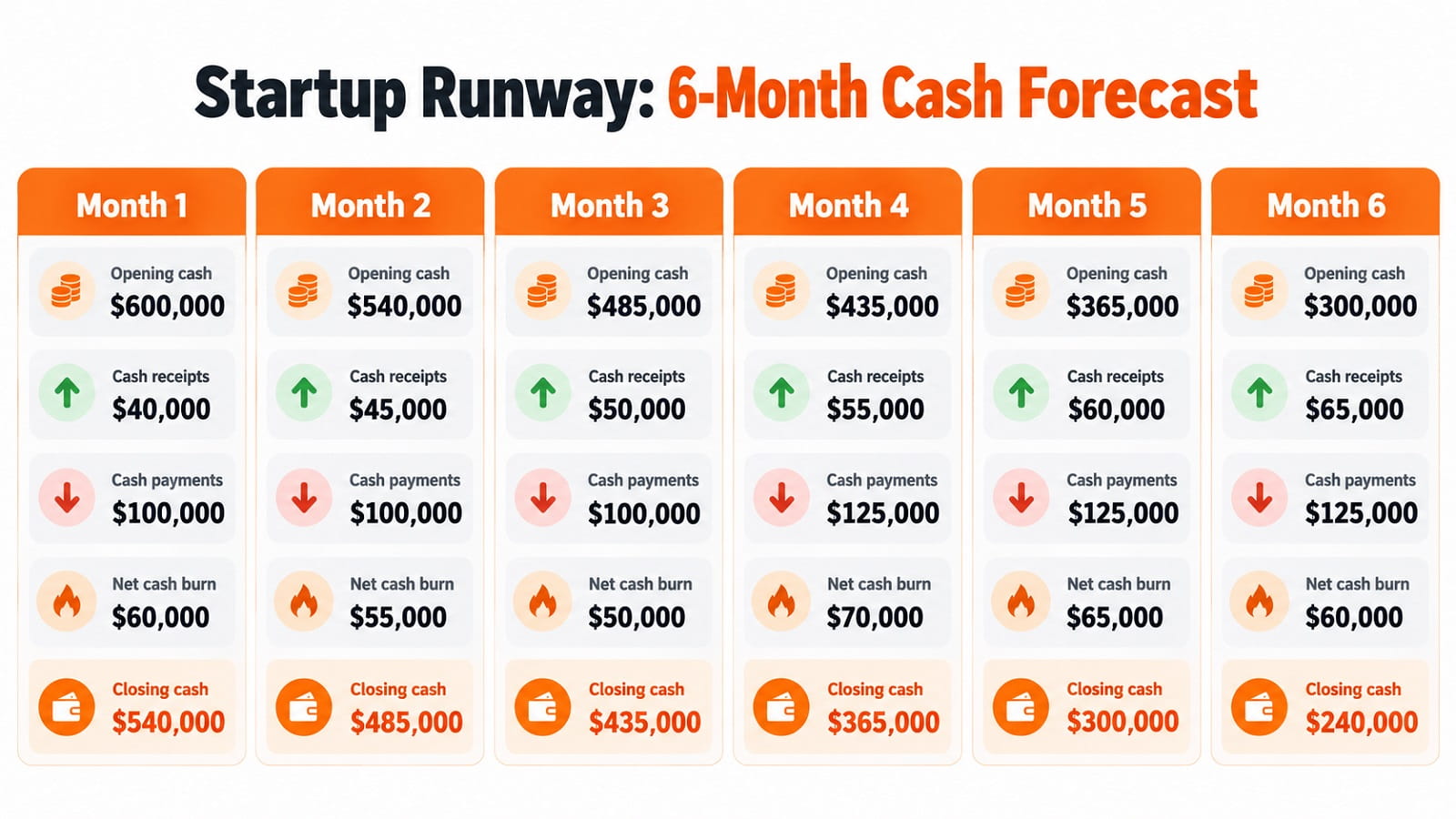
Consider Northbridge Labs, a fictional software startup beginning with $600,000 in unrestricted cash. The company has paying customers but continues spending more money than it collects during normal operations.
Management expects customer payments to increase as the business develops. However, it also plans to expand its team beginning in month four, creating additional recurring operating expenses.
For the first three months, Northbridge expects operating cash payments of $100,000 per month. Beginning in month four, payments increase to $125,000 because of additional staffing and operating commitments.
Customer collections are projected to increase from $40,000 in the first month to $65,000 in the sixth month.
The following example excludes financing proceeds, investing activities, and exceptional cash movements so the relationship between operating cash consumption and available resources remains clear.
During the first three months, Northbridge's net cash consumption gradually declines as customer collections improve. However, spending increases in month four, causing net cash burn to rise again despite continued growth in customer receipts.
By the end of month six, the company has $240,000 remaining from its original $600,000. It has consumed $360,000 in cash during the forecast period.
If future customer receipts remain at $65,000 and operating payments remain at $125,000, the company would continue consuming $60,000 per month.
Its simplified remaining runway would therefore be:
Remaining runway = $240,000 ÷ $60,000 = 4 months
Under those assumptions, Northbridge would exhaust its cash around the end of month ten, counting from the beginning of the original forecast.
This example reveals why historical runway estimates can be misleading. During the first three months, the company appeared to be reducing cash consumption. However, planned hiring changed the future spending pattern, resulting in a shorter period of financial flexibility.
Why the Minimum Cash Reserve Matters
The point when a startup reaches zero cash is not necessarily the point when its financial problems begin.
Businesses need sufficient liquidity to meet payroll, suppliers, taxes, and other operating commitments. Waiting until the bank balance approaches zero can leave founders with too little time to make effective changes.
A practical financial plan can therefore include a minimum operating cash reserve. This represents an internal threshold below which management does not want the company's available balance to fall.
Suppose Northbridge establishes a minimum reserve of $200,000 based on its obligations and financial uncertainty.
At the end of month six, the startup has $240,000 remaining, only $40,000 above that reserve.
If it continues consuming $60,000 per month, its closing balance would fall to $180,000 during month seven.
Although the company would not exhaust its cash until approximately month ten, it would cross its chosen reserve threshold much earlier.
This distinction changes the timing of management decisions. Northbridge cannot reasonably treat the entire four months as unrestricted time for new commitments if preserving the reserve is a central financial requirement.
The appropriate reserve differs across companies. It should reflect operating obligations, revenue reliability, payment uncertainty, and access to additional capital rather than a universal fixed amount.
How to Extend Startup Runway
Extending runway means increasing the time a company can continue operating with its available financial resources. This can involve reducing cash payments, improving collections, delaying selected commitments, or securing additional capital.
However, extending runway should not automatically mean eliminating spending. Some investments are essential to product development, customer retention, or future revenue.
The goal is to protect financial flexibility while preserving the activities most likely to support meaningful business progress.
Review Recurring Operating Expenses
Recurring expenses can gradually increase as startups add software subscriptions, suppliers, infrastructure services, and employees.
Management should examine whether existing services are actively used, whether contracts remain appropriate for current operations, and whether spending supports important business objectives.
Unused subscriptions, duplicated services, and unnecessary infrastructure capacity may offer opportunities to preserve cash without materially affecting customers.
However, costs should be reviewed alongside contractual obligations and operational consequences. Canceling a service that appears unnecessary may create larger problems if it supports an essential business function.
Adjust Hiring and Investment Timing
Hiring creates continuing financial commitments that can significantly influence future cash balances.
Before recruiting additional employees, founders should evaluate the fully loaded cost, expected start date, and the business milestone the position is intended to support.
Delaying a position may preserve cash, but postponing a critical hire can also slow product development or weaken customer support.
The financial forecast should therefore account for both the cash saved and any likely consequences for future business performance.
Similar considerations apply to entering new markets, purchasing equipment, or expanding infrastructure. Postponing investments can increase financial flexibility when the company can still achieve its most important objectives.
Improve Customer Collections
Cash runway can improve when a startup collects payments more efficiently.
Delayed invoices, lengthy payment terms, and inconsistent collection processes can create liquidity pressure even when customer revenue remains stable.
Founders should monitor outstanding receivables, review overdue payments, and understand which customers are responsible for significant collection delays.
However, receiving a previously overdue payment creates a temporary improvement in cash unless future collection behavior also changes.
Financial forecasts should distinguish one time payment improvements from sustainable increases in recurring operating cash generation.
Improve the Economics of Growth
Generating additional revenue can extend runway when the resulting cash receipts exceed the spending required to produce them.
However, revenue growth does not always improve financial sustainability. Acquiring customers through expensive marketing campaigns or delivering products with weak contribution margins may increase cash requirements rather than reduce them.
Founders should evaluate whether additional customers generate enough economic value to justify acquisition and delivery costs.
Improving pricing, reducing unnecessary delivery expenses, and retaining economically valuable customers may strengthen future cash generation.
The objective is to support growth that improves the company's financial position rather than simply increasing reported sales.
Comparing Different Runway Extension Scenarios
Northbridge finishes month six with $240,000 in cash and maintains a minimum reserve of $200,000.
Management wants to understand how changes in recurring expenses and collections might affect its remaining runway.
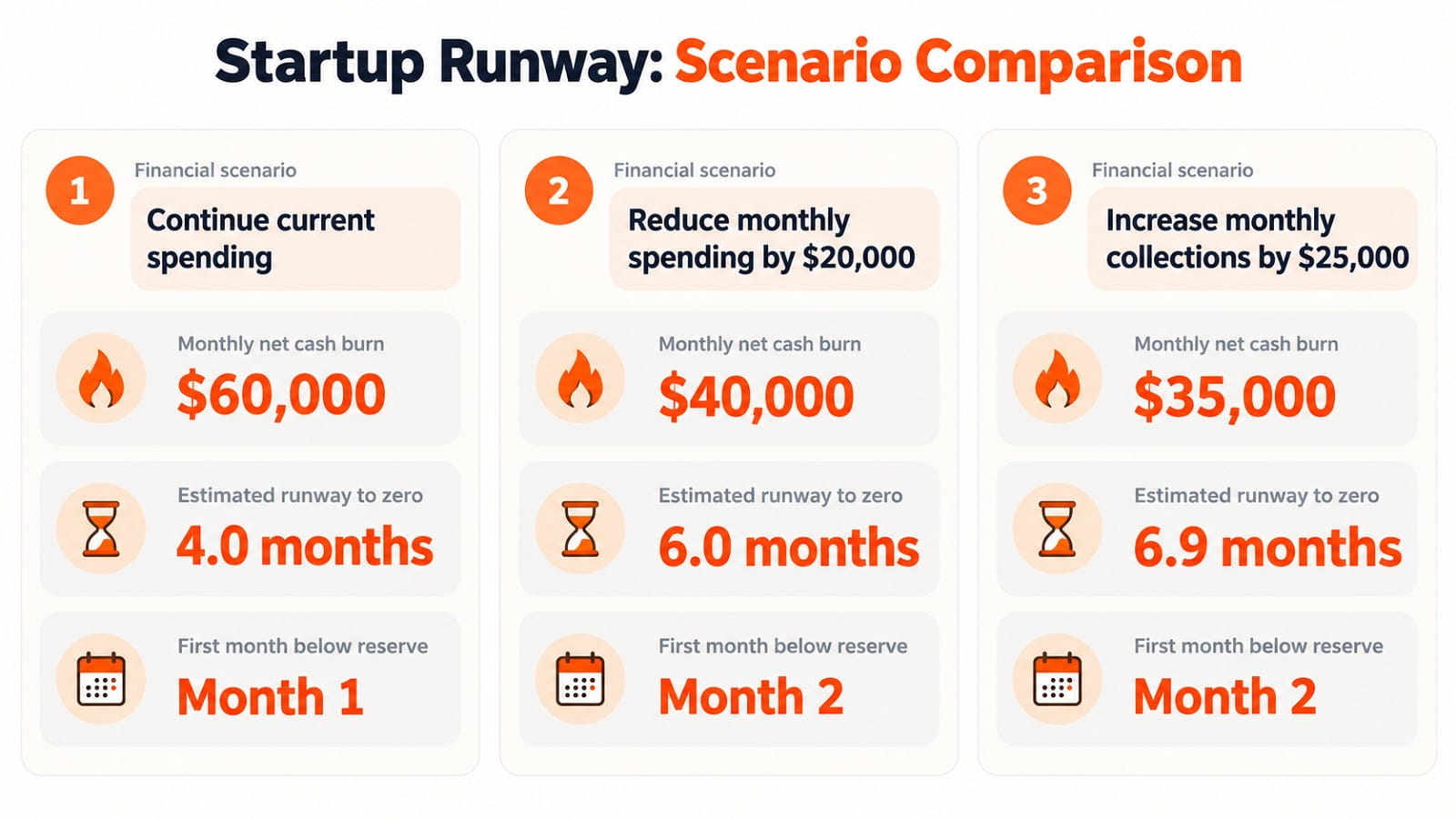
The calculations begin at the end of month six. The final column identifies the first subsequent month when projected closing cash falls below the $200,000 minimum reserve.
Reducing recurring expenses by $20,000 extends the simplified runway from four to six months. Increasing recurring customer collections by $25,000 per month extends the estimate to approximately 6.9 months.
However, neither change immediately eliminates the company's financial constraints. Under both alternatives, the cash balance still falls below the minimum reserve during the second subsequent month.
The comparison also depends on whether the improvements can continue. A one time customer payment cannot automatically be treated as a permanent increase in monthly collections, while reducing essential spending could affect future revenue.
The value of scenario analysis lies in understanding how much additional time each decision creates and whether that time is sufficient to reach the company's next milestone.
When Should a Startup Start Fundraising?
Runway is particularly important when founders need to determine when additional financing may become necessary.
The appropriate timing depends on available cash, planned spending, business milestones, financing conditions, and the time required to complete a funding transaction.
A startup should work backward from the date when additional capital would need to be available.
This means allowing time for financial preparation, investor discussions, due diligence, negotiations, and potential delays.
For illustration, suppose founders expect two months of preparation, five months to complete fundraising discussions and documentation, and another two months as a contingency.
Under those assumptions, the company would need approximately nine months of financial capacity when beginning the preparation process.
These periods are illustrative and should not be treated as universal fundraising timelines. Actual requirements vary significantly between companies, financing structures, and market conditions.
A startup with only seven months of projected runway would need to reconsider such a financing schedule rather than assume new capital will arrive before existing resources become insufficient.
Founders should also consider the milestones investors may expect the company to achieve before committing additional funds.
Extending runway can be especially valuable when the additional time allows a startup to demonstrate stronger customer demand, improved retention, or more sustainable operating performance.
The central principle is to begin evaluating financing options before declining cash becomes an immediate constraint.
When Runway Becomes a Financial Warning
A shortening runway does not always indicate that a startup is failing, but it can signal that management has less flexibility to respond to uncertainty.
Financial pressure becomes more serious when cash consumption rises without corresponding business progress, customer collections weaken, or the company approaches the minimum balance required to meet essential obligations.
Another concern arises when future operations depend on financing that has not been secured. A prospective investment may appear likely, but the company cannot use those funds to pay obligations until the transaction is completed and the cash becomes available.
Founders should also pay attention to customer concentration. A startup relying on a small number of large customers may experience a substantial liquidity problem if one customer delays payment or ends a contract.
When runway declines more quickly than expected, management should update its cash forecast and identify the cause. The appropriate response depends on whether the problem is temporary, such as a delayed payment, or structural, such as recurring expenses consistently exceeding sustainable cash generation.
The earlier these changes are identified, the more options management may have available.
Common Startup Runway Calculation Mistakes
One frequent mistake is including cash that is restricted or cannot be accessed when needed. This can make the startup appear to have more financial flexibility than it actually possesses.
Another is relying on recognized revenue rather than collected cash. A company may report strong sales while customers still owe substantial amounts, meaning those sales cannot yet finance upcoming payments.
Founders may also calculate runway using one unusual month. Annual contract payments, exceptional expenses, or delayed invoices can temporarily distort cash consumption. Reviewing several periods provides more context, although historical averages should still be adjusted for known future changes.
Ignoring planned spending is another important error. If a startup intends to hire employees, purchase equipment, or increase marketing expenditure, the forecast needs to reflect the additional cash requirements.
It is also misleading to treat the date when cash reaches zero as the only relevant financial deadline. Minimum operating reserves and unavoidable commitments can create constraints substantially earlier.
Finally, founders should avoid assuming that longer runway automatically means better business performance. Reducing essential investment may preserve cash temporarily while damaging the company's ability to develop its product or attract customers.
The objective is to maintain financial capacity while allocating resources toward activities supported by credible business evidence.
How Often Should Founders Review Runway?
Runway should be reviewed regularly because the calculation can change whenever cash balances, customer collections, or operating commitments change.
For many early stage startups, a monthly review of actual cash consumption and projected runway provides a practical starting point.
Companies with limited liquidity or unpredictable payments may need to review cash balances and upcoming obligations weekly or more frequently.
A useful review compares actual receipts and payments with the previous forecast. If expenses increase because of additional hiring, future cash projections should reflect that commitment. If customers begin paying later than expected, the forecast should update collection assumptions accordingly.
Management should monitor both the estimated date of cash exhaustion and the earlier date when the business may fall below its chosen operating reserve.
The review should also connect financial changes to business decisions. If runway shortens materially, founders should understand which assumptions changed, how much flexibility remains, and what actions can realistically improve the outlook.
This transforms runway from a number calculated occasionally into an ongoing financial management tool.
Final Thoughts
Startup runway helps founders understand how much time their financial resources can support operations, but its value extends beyond a simple calculation. It provides a practical framework for evaluating spending commitments, planning future investments, and recognizing when important financial decisions must be made.
The Northbridge example demonstrates why forward cash forecasting matters. Customer collections improved during the six month period, yet additional operating commitments increased cash consumption and reduced financial flexibility. A simple historical estimate could not fully capture the consequences of those decisions.
A reliable runway forecast should therefore reflect realistic customer collections, known obligations, planned investments, and an appropriate minimum operating reserve. Reviewing these factors regularly allows founders to identify potential constraints before they become immediate problems.
The goal is not to preserve cash indefinitely at the expense of business development. It is to ensure that the startup has enough financial capacity to pursue meaningful milestones, adapt when assumptions change, and make important decisions while viable alternatives remain available.
FAQ
What Does Startup Runway Mean?
Startup runway is the estimated amount of time a company can continue operating using its available cash under specific assumptions about future spending and collections. It helps founders understand when financial constraints may arise and whether additional capital or operating adjustments could become necessary.
How Do You Calculate Startup Runway?
Divide available cash by average monthly net cash burn. For example, a startup with $600,000 in unrestricted cash and monthly net burn of $50,000 has approximately 12 months of simplified runway. The calculation assumes that cash consumption remains unchanged during the period.
How Much Runway Should a Startup Have?
There is no universal target. The appropriate amount depends on the company's development stage, financial obligations, business milestones, revenue reliability, and access to financing. Founders should account for the time required to achieve important objectives and allow for possible delays.
Can a Startup Have Runway Without Revenue?
Yes. A startup without revenue can calculate runway using its available cash and expected operating payments. Its financial resources may be consumed by product development, employee compensation, infrastructure, and other commitments before customer payments begin.
What Happens When a Startup Has Negative Net Burn?
Negative net burn means operating cash receipts exceed operating cash payments under the chosen calculation. The standard runway division formula does not produce a meaningful finite exhaustion date in this situation. However, future investments, debt obligations, and changes in customer collections can still affect available cash.
Can Raising Capital Extend Startup Runway?
Yes. Additional financing can increase available cash and extend the period during which a startup can support operations. The actual effect depends on spending, future collections, and any repayment obligations associated with the financing. Prospective funding should not be treated as available cash before it is secured.
How Can Founders Extend Runway Without Raising Money?
Founders can extend runway by reducing unnecessary recurring expenses, improving customer collections, adjusting hiring schedules, postponing selected investments, and strengthening sustainable operating cash generation. Each action should be evaluated for its financial benefits and potential effects on future business performance.
Is Longer Runway Always Better?
Not necessarily. Longer runway generally provides greater financial flexibility, but achieving it by eliminating essential investments can damage product development or customer growth. The objective is to maintain enough time and resources to reach meaningful business milestones while managing financial risk.

Mobina Khanki
Venture & Funding Writer at PinerookMobina Khanki covers venture capital, startup funding, fundraising, and startup finance for Pinerook, focusing on founders and investors.
 Seen first.