
A startup can increase sales every month and still move further away from profitability. The reason is often hidden in the economics of individual transactions. A business might spend more acquiring and serving each customer than it eventually earns from that relationship. When this happens, attracting more customers can increase losses rather than improve financial performance.
Unit economics helps founders understand whether the fundamental activities of their business create financial value. Within the broader framework of Startup Finance, it connects pricing, operating costs, customer acquisition, and repeat purchases with the financial consequences of growth. Instead of evaluating the company only through total revenue, founders can examine what happens when one additional product is sold, one transaction is completed, or one customer is acquired.
This guide explains how to calculate unit economics, identify the costs that belong in the calculation, measure contribution margin, and evaluate whether a business model can scale sustainably. It also includes a detailed financial example showing how customer acquisition costs, repeat purchases, and changing expenses affect profitability.
What Is Unit Economics?
Unit economics is the analysis of the revenue and costs associated with a single measurable unit of business activity. That unit may be a customer, an order, a subscription, a booking, or another transaction that represents how the company generates revenue.
The objective is to determine whether the economic value created by a unit exceeds the costs directly associated with generating and delivering it.
For example, an online retailer may earn $120 from an order but incur substantial product, shipping, payment processing, and customer service costs. The remaining contribution is more useful for evaluating the economics of that order than revenue alone.
Unit economics becomes especially valuable when a startup plans to expand. If each additional transaction generates a positive contribution, increasing volume may help cover fixed expenses. If the contribution is negative, growing transaction volume can increase losses unless pricing or costs change.
However, positive unit economics does not automatically mean the entire company is profitable. Salaries, product development, administration, and other fixed expenses may still exceed the contribution generated by customers.
Choosing the Right Unit for Your Business
The first step is identifying the business activity that should be measured.
The appropriate unit depends on how customers interact with the product, how revenue is generated, and which costs can be attributed to individual transactions.
Unit Economics per Customer
Customer level analysis measures the financial value generated throughout a customer relationship.
This approach is particularly useful for subscription businesses and companies that depend on repeat purchases.
The calculation should consider revenue, the costs of serving the customer, acquisition expenditure, and the duration or frequency of the relationship.
Unit Economics per Order
Order level analysis evaluates the financial contribution of an individual purchase.
It is especially relevant for ecommerce companies where product costs, fulfillment expenses, payment processing, and returns directly affect the profitability of each transaction.
However, a positive contribution from one order does not establish that acquiring the customer was economically worthwhile. The company must also consider whether future purchases can recover acquisition expenses.
Unit Economics per Transaction
Marketplaces, payment platforms, and other transaction businesses often calculate the contribution generated by each completed transaction.
The relevant revenue may be a commission or transaction fee rather than the full amount paid by the buyer.
Selecting the correct unit prevents founders from drawing conclusions based on transaction values that the company does not actually retain.
How to Calculate Unit Economics
The basic calculation begins with revenue earned from a unit and subtracts the variable costs associated with delivering it.
Unit contribution = Net revenue per unit less variable cost per unit
This calculation measures the contribution available to cover customer acquisition spending, fixed operating expenses, and potentially operating profit.
However, founders should also calculate the financial effect of acquiring new customers, especially when acquisition represents a substantial portion of spending.
Step 1: Calculate Net Revenue per Unit
Begin with the revenue actually attributable to the selected unit, using consistent accounting assumptions.
For an ecommerce order, this may require adjusting the selling price for discounts, refunds, and other reductions in recognized revenue.
Suppose a product has a listed price of $120 but the average realized revenue after discounts and refunds is $110.
The unit economics calculation should begin with $110 rather than the original listed price.
Using the larger figure would overstate the financial contribution generated by each order.
Step 2: Identify Variable Costs
Variable costs generally change with transaction volume or customer activity.
Depending on the business model, these may include purchased products, packaging, shipping, payment fees, usage based infrastructure, and customer support directly associated with transactions.
Only costs that are appropriate for the defined unit should be included. Fixed salaries and corporate administration may need separate treatment unless a portion genuinely varies with the activity being measured.
Cost classification should remain consistent between reporting periods.
Step 3: Calculate Contribution Margin
After identifying revenue and variable costs, calculate contribution per unit.
Contribution margin per unit = Net revenue per unit less variable cost per unit
To express the result as a percentage:
Contribution margin ratio = Contribution per unit ÷ Net revenue per unit × 100
If each order generates $110 in revenue and requires $66 in variable expenses, the contribution is $44.
The corresponding contribution margin ratio is 40%.
This means 40% of net order revenue remains after the specified variable costs.
Step 4: Account for Customer Acquisition
Acquiring a customer usually creates additional costs that are not necessarily incurred on every subsequent order.
Customer acquisition cost, or CAC, measures the relevant expenditure required to obtain a new paying customer.
The important distinction is that acquisition spending belongs to the customer relationship, while order delivery costs arise from individual transactions.
Charging the full acquisition cost to every repeat purchase would overstate expenses. Ignoring acquisition spending entirely would overstate profitability.
Founders should therefore examine order contribution before acquisition alongside customer contribution after acquisition.
Step 5: Evaluate Repeat Purchases
For a business with repeat customers, a useful simplified calculation is:
Customer contribution after acquisition = Total contribution from customer orders less customer acquisition cost
The calculation must use a defined observation period or defensible forecast.
A new customer's first order may not recover acquisition spending. Subsequent purchases may improve the economics, provided they generate sufficient contribution without requiring equivalent acquisition expenditure again.
This is why customer retention and purchasing frequency are important when evaluating whether an acquisition strategy can support profitable growth.
Gross Margin vs. Contribution Margin
Gross margin and contribution margin are related but answer different questions.
Gross margin measures revenue remaining after the direct costs classified as cost of revenue. It helps founders understand how efficiently products or services are delivered.
Contribution margin focuses on the revenue remaining after costs that vary with the defined unit or activity.
Depending on the accounting structure, contribution analysis may include costs such as transaction processing, fulfillment, or variable support that are classified differently in financial statements.
The two figures should not be treated as interchangeable.
A startup may report an attractive gross margin while generating much smaller contribution after payment processing, returns, transaction incentives, and other variable costs.
For scaling decisions, founders need to understand the additional economic contribution created by increasing activity, while also maintaining accurate accounting financial statements.
A Practical Unit Economics Example
Consider BriteCart, a fictional ecommerce startup selling consumer products through its own website.
The company wants to understand whether acquiring additional customers will improve profitability.
Its average realized order revenue is $110 after discounts and refunds. The business also incurs product, fulfillment, processing, customer support, and return handling expenses.
The example assumes these figures are average amounts per order and that return related handling costs do not duplicate refunds already reflected in net revenue.
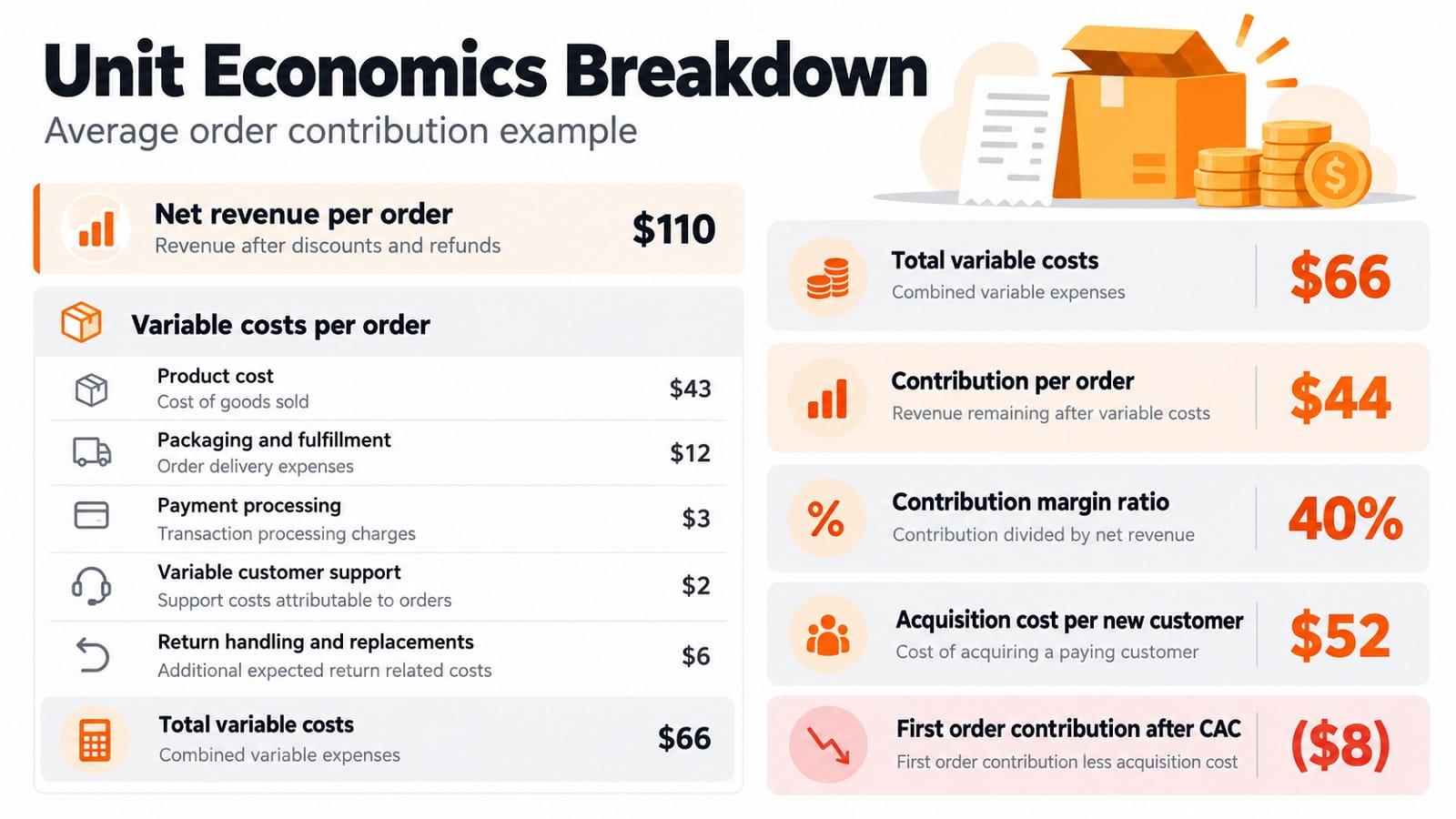
The table reveals that BriteCart generates $44 in contribution from an average order before customer acquisition costs.
However, the company spends $52 to acquire a new customer.
If that customer makes only one purchase, the transaction and acquisition activity produce a negative contribution of $8 before fixed operating expenses.
The business may still have attractive economics if customers return and make additional purchases. However, that outcome depends on actual purchasing behavior rather than assumptions about future loyalty.
This is why unit economics should distinguish between first purchase profitability and the economics of the broader customer relationship.
How Repeat Purchases Change Unit Economics
Suppose BriteCart acquires 100 new customers, spending $5,200 in total acquisition costs.
During the following six months, customer purchasing behavior develops as follows.
Sixty customers make one purchase, 30 customers make two purchases each, and 10 customers make three purchases each.
The cohort generates 150 orders in total.
With an average contribution of $44 per order, those orders produce $6,600 in contribution before acquisition spending.
After deducting the $5,200 spent acquiring the customers, the cohort has generated $1,400 in contribution before fixed operating expenses.
That equals $14 per acquired customer during the observed six month period.
The result is positive, but it is considerably smaller than the $44 contribution from an individual order.
It is also an observed six month contribution, not a prediction of the customer's entire lifetime value.
If repeat purchasing weakens or fulfillment costs increase, the outcome could change substantially.
Unit Economics Under Different Growth Scenarios
Founders should avoid assuming that current customer behavior, acquisition spending, and variable costs will remain unchanged.
Scenario analysis shows how changes in these assumptions influence the economics of acquiring customers.
For BriteCart, the following scenarios compare average orders per acquired customer, contribution per order, and acquisition cost.
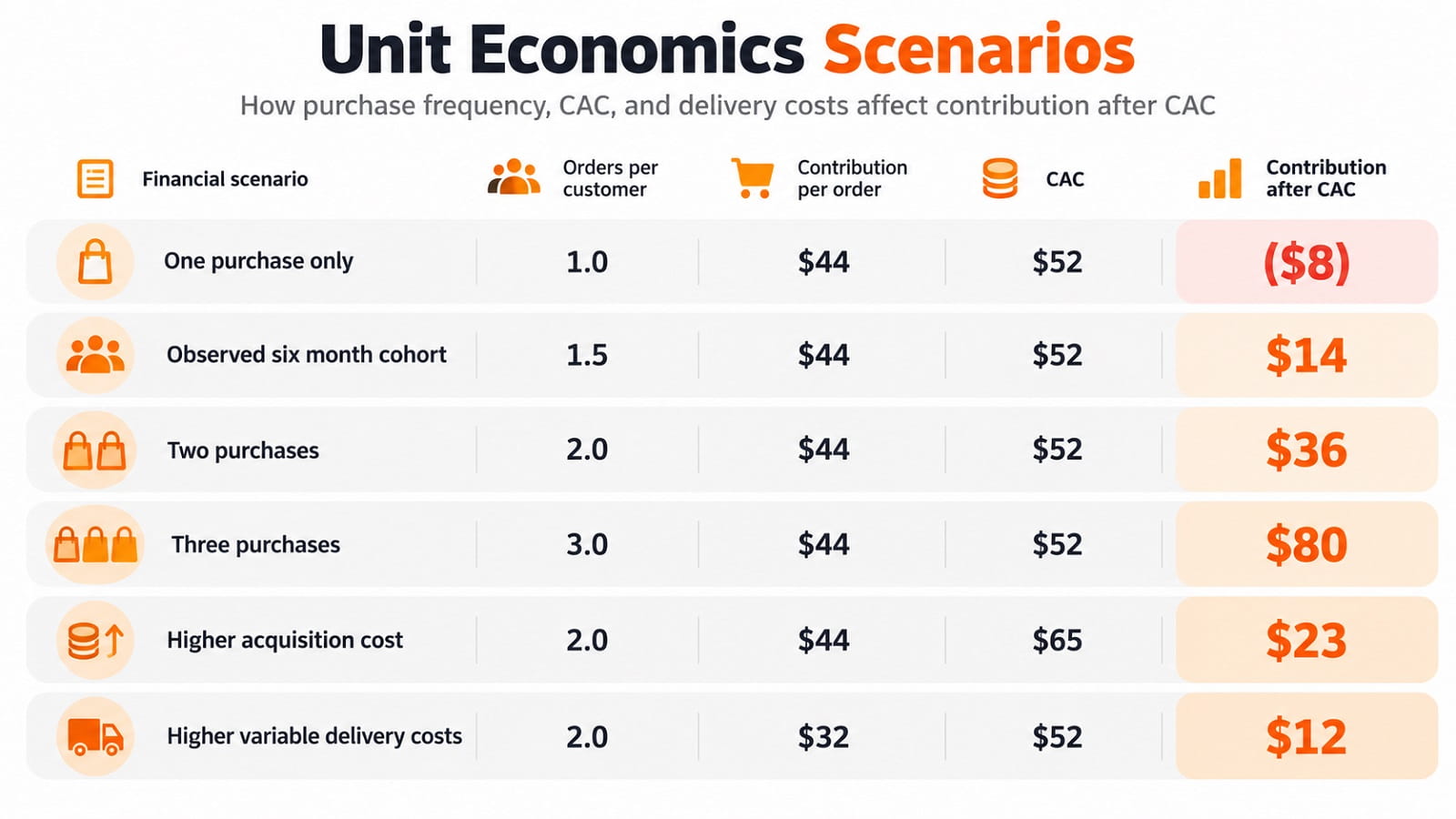
Each calculation multiplies average orders by contribution per order and then subtracts acquisition cost.
The comparison demonstrates that repeat purchasing can improve customer economics, but higher acquisition spending and delivery costs can reduce the benefit.
A customer who purchases twice at the original contribution level generates $36 after acquisition costs. If the contribution per order falls from $44 to $32, the same purchasing behavior generates only $12.
This difference matters when planning marketing budgets or fulfillment expansion.
Increasing order volume does not guarantee attractive customer economics if the costs associated with each order are also increasing.
Positive and Negative Unit Economics
Positive unit economics means the defined unit creates contribution after the costs included in the calculation.
Negative unit economics means those costs exceed the value generated by the unit.
The distinction is important because scaling a business with negative incremental contribution can increase losses.
However, the interpretation depends on what the calculation includes.
An individual first order may produce negative contribution after acquisition spending while the customer relationship generates positive contribution through later purchases.
Conversely, an order may produce positive contribution before acquisition while the overall customer relationship remains unprofitable.
Founders should clearly label which expenses are included and distinguish observed results from future expectations.
How Unit Economics Affects Break Even
Positive contribution helps a startup cover fixed expenses, but it does not automatically establish operating profitability.
To estimate operating break even, management must consider both the contribution generated by activity and fixed operating costs.
Suppose BriteCart continues generating $44 in contribution per order before acquisition spending.
Assume 40% of orders come from newly acquired customers, each requiring $52 in acquisition spending, and the remaining 60% are repeat orders without additional acquisition costs.
Under this simplified sales mix, average contribution after allocated acquisition spending is:
$44 less (40% × $52) = $23.20 per order
If monthly fixed operating costs are $23,200, the company would need approximately 1,000 orders per month to cover those costs under the stated assumptions.
At that volume, total contribution before acquisition would be $44,000. Acquisition spending for 400 new customers would be $20,800, leaving $23,200 to cover fixed operating costs.
This illustration assumes the sales mix and unit contribution remain constant and that no other relevant costs have been omitted.
Actual break even requirements may differ because of customer behavior, operating capacity, financing costs, taxes, and changes in spending.
Unit Economics Across Different Startup Models
The underlying principle remains consistent across industries, but the unit and relevant costs change according to the business model.
SaaS Unit Economics
Software subscription companies often evaluate monthly contribution per customer and the time required to recover acquisition spending.
Suppose a subscription customer pays $80 each month while usage based infrastructure, payment processing, and variable support cost $22.
The monthly contribution is $58 before customer acquisition and fixed operating costs.
If acquisition costs $290, the customer would need five months of constant contribution to recover the initial acquisition expenditure.
This simplified estimate assumes the customer remains subscribed, payments are collected, and contribution stays unchanged.
Ecommerce Unit Economics
Ecommerce companies frequently measure contribution per order and per customer.
Product costs, fulfillment, shipping, transaction fees, returns, and discounts can all affect profitability.
Customer purchasing frequency matters because acquisition spending may be recovered over multiple orders rather than the first transaction.
A business with strong first purchase revenue may still have unattractive economics if returns are frequent or delivery costs are unusually high.
Marketplace Unit Economics
Marketplaces commonly analyze the revenue retained from completed transactions.
For example, a marketplace facilitating a $150 purchase may receive an 12% commission, generating $18 in platform revenue under an illustrative agency model.
If transaction processing, support, and other variable expenses total $6, the contribution before acquisition is $12.
The full $150 transaction value should not automatically be treated as the marketplace's revenue.
Marketplace analysis should also distinguish the economics of acquiring buyers, acquiring sellers, and supporting transactions.
How to Improve Unit Economics
Improving unit economics involves increasing the economic value generated by each unit, reducing its associated costs, or improving the relationship between acquisition spending and customer contribution.
The appropriate approach depends on the company's operating model.
Improve Pricing and Discounts
Pricing directly affects contribution, provided additional revenue is not offset by lower demand or higher costs.
Founders should examine whether discounts attract customers who generate sufficient long term value.
A discount that produces additional orders may improve total contribution, but excessive discounts can reduce the economic return from each transaction.
Pricing decisions should therefore be evaluated using changes in contribution and customer behavior rather than revenue alone.
Reduce Variable Operating Costs
Variable costs can often be improved through more efficient fulfillment, better supplier arrangements, lower processing fees, or reduced service complexity.
For a software business, optimizing computing usage may increase contribution without changing subscription prices.
For an ecommerce startup, reducing packaging expenses or avoidable return costs may improve contribution per order.
However, cost reductions that damage product quality or customer satisfaction can weaken retention and reduce future value.
Improve Retention and Repeat Purchasing
Repeat purchases can help recover acquisition spending across more transactions.
Subscription businesses may improve customer economics by reducing cancellations or supporting valuable account expansion.
Ecommerce companies may benefit from relevant repeat purchases that do not require the same acquisition investment as the initial order.
However, founders should measure actual repeat behavior. Future purchasing assumptions should not be treated as guaranteed contribution.
Evaluate Acquisition Channels Separately
Customer acquisition costs can vary substantially across advertising platforms, referrals, partnerships, and organic sources.
An overall acquisition average may conceal channels that attract expensive customers with limited retention.
Founders should compare customer contribution and acquisition cost for different channels over comparable observation periods.
Increasing spending on a channel is most defensible when the incremental customers are expected to create sufficient additional contribution.
Why Customer Cohorts Matter
An average customer calculation can hide substantial differences between groups acquired at different times.
A cohort groups customers according to a shared characteristic, often the period in which they first purchased.
Comparing cohorts can reveal whether recent customers are becoming more or less valuable than earlier customers.
For example, customers acquired during a promotional campaign may make an initial purchase but return less frequently than customers acquired through referrals.
Both groups can produce similar first order revenue while generating different contribution over six months.
Cohort analysis also prevents founders from assuming that the behavior of established customers will necessarily apply to newer customers.
When sufficient historical data is unavailable, observed contribution over a fixed period can be more dependable than an ambitious prediction of lifetime value.
Unit Economics and Scaling Decisions
Unit economics provides a useful foundation for deciding whether to increase sales volume, expand into new markets, or invest more heavily in customer acquisition.
However, founders should examine incremental economics rather than relying exclusively on historical averages.
The next 1,000 customers may be more expensive to acquire than the first 1,000. Fulfillment costs may rise when existing capacity is exceeded, and entering a new market may require additional infrastructure.
Conversely, greater purchasing volume may allow a business to negotiate better supplier pricing or improve operational efficiency.
A credible expansion decision should therefore consider expected contribution at the new scale, additional fixed commitments, available cash, and uncertainty surrounding the assumptions.
Attractive unit economics is an important condition for sustainable growth, but it is not a guarantee that the company can finance its expansion.
Building a Reliable Unit Economics Review Process
A useful unit economics model begins with a clearly defined unit and consistent cost classifications.
Founders should collect transaction data, identify relevant variable expenses, reconcile revenue and refunds, and calculate contribution using the same definitions across reporting periods.
Customer acquisition spending should be reviewed separately and connected to the customers acquired through the relevant channels.
Where repeat purchases matter, management should monitor cohorts over consistent periods rather than comparing customers with substantially different relationship lengths.
The model should be updated when prices, supplier contracts, fulfillment costs, acquisition spending, or customer behavior change.
It is also important to compare forecasts with observed results. If the financial plan assumes two purchases per customer but actual cohorts average only 1.3 purchases, the expected contribution and growth strategy need to be reconsidered.
Where Unit Economics Calculations Go Wrong
Unit economics becomes misleading when important costs are excluded or revenue is overstated.
Using the full selling price while ignoring discounts and refunds can inflate contribution. Excluding fulfillment, processing, or variable support costs can produce a similar problem.
Another concern is counting acquisition spending more than once or failing to include it when evaluating customer profitability.
Some startups also rely on ambitious lifetime value estimates that are unsupported by actual retention history.
Average metrics may conceal important differences between customer segments or acquisition channels.
Finally, positive contribution should not be confused with positive operating profit or cash flow. Fixed costs, financing requirements, and the timing of payments can still create substantial financial pressure.
Reliable analysis requires clear definitions, conservative assumptions, and regular comparison with actual business activity.
Final Thoughts
Unit economics helps founders understand whether the fundamental activities of their business generate enough financial value to support growth. By examining revenue, variable costs, customer acquisition, and repeat purchases together, management can identify problems that total sales figures may conceal.
The BriteCart example demonstrates that a profitable order does not necessarily mean the first customer purchase is profitable after acquisition spending. The economic outcome depends on the contribution generated across subsequent transactions and the reliability of customer behavior.
A sound approach combines accurate cost classifications, realistic purchasing assumptions, customer cohort analysis, and regular financial reviews. Founders can then evaluate whether additional sales are likely to strengthen the business or simply increase its financial commitments.
The objective is not to maximize transaction volume at any cost. It is to build a business in which growth creates sufficient contribution to support operations, recover acquisition investments, and move toward sustainable profitability.
FAQ
What Is Unit Economics in a Startup?
Unit economics measures the revenue and relevant costs associated with one unit of business activity, such as a customer, order, or transaction. It helps founders determine whether those activities generate positive financial contribution and support a viable business model.
How Do You Calculate Unit Economics?
A basic calculation subtracts variable costs from net revenue per unit. When evaluating newly acquired customers, founders should also account for acquisition spending and the contribution generated through subsequent purchases or subscriptions.
What Is a Good Unit Economics Ratio?
There is no universal ratio appropriate for every startup. The relevant assessment depends on the business model, contribution definition, acquisition costs, retention, payback timing, and fixed operating requirements. A positive ratio alone does not guarantee company profitability.
Can a Startup Have Negative Unit Economics?
Yes. A startup may spend more acquiring or serving a unit than the value that unit currently generates. This can occur during early customer acquisition, but management needs evidence that future activity can recover the initial costs.
What Is the Difference Between Gross Margin and Unit Economics?
Gross margin measures revenue remaining after costs classified as cost of revenue. Unit economics examines the financial contribution and related costs associated with a defined business unit, potentially including additional variable expenses and customer acquisition.
Why Is Repeat Purchasing Important for Unit Economics?
Repeat purchases can generate additional contribution without requiring the original customer acquisition expense again. Their value depends on purchase frequency, variable costs, discounts, and the customer's actual purchasing behavior.
Does Positive Unit Economics Mean a Startup Is Profitable?
No. A company can generate positive contribution from each transaction while remaining unprofitable because total contribution does not cover fixed operating expenses and other financial requirements.
How Often Should Founders Review Unit Economics?
Monthly reviews are useful for many startups, with more frequent monitoring when pricing, acquisition costs, or operating expenses change rapidly. Customer cohort analysis may require longer observation periods to produce meaningful results.

Mobina Khanki
Venture & Funding Writer at PinerookMobina Khanki covers venture capital, startup funding, fundraising, and startup finance for Pinerook, focusing on founders and investors.
 Seen first.


