A startup can acquire hundreds of customers and still struggle to build a financially sustainable business. Some customers make one purchase and never return, while others renew subscriptions, purchase additional products, or remain active for years. These differences mean that two customers generating identical initial revenue can create very different financial outcomes. Understanding what happens after the first purchase is essential when deciding how much to invest in growth.
Customer lifetime value, commonly known as LTV or CLV, estimates the value a customer generates throughout the relationship with a business. Within the broader framework of Startup Finance, this metric connects customer retention, revenue, delivery costs, and acquisition spending with long term financial sustainability. It helps founders evaluate customer relationships based on their expected financial contribution rather than initial sales alone.
This guide explains how to calculate customer lifetime value for startups, distinguish historical results from forecasts, interpret customer retention, and compare LTV with acquisition costs. It also includes a detailed subscription cohort example and practical scenarios showing how changes in churn, revenue, and gross margin affect projected customer value.
What Is Customer Lifetime Value?
Customer lifetime value measures the total revenue or financial contribution a customer generates during the entire relationship with a company.
It is commonly abbreviated as LTV, CLV, or CLTV. Although these terms generally describe the same concept, companies may calculate them differently.
For example, a customer paying $100 each month for two years generates $2,400 in subscription revenue. However, that amount does not represent the profit earned from the relationship because delivering the service also creates expenses.
For financial decision making, founders should distinguish revenue based lifetime value from calculations that account for gross profit or customer contribution.
The objective is to understand how much economic value customers create over time and whether that value justifies the resources spent acquiring and serving them.
Why Customer Lifetime Value Matters for Startups
Customer acquisition frequently requires investment before a startup receives enough revenue to recover the initial expense.
A customer may appear unprofitable after the first purchase but become valuable through recurring payments or repeat orders. Conversely, a customer generating substantial initial revenue may contribute little if delivery costs are high or the relationship ends quickly.
Lifetime value helps founders evaluate these differences.
It also provides context for retention initiatives, pricing decisions, and customer segmentation. When customers remain active longer or purchase more frequently, their financial contribution may increase without an equivalent increase in acquisition spending.
However, LTV is not guaranteed future revenue. Its accuracy depends on assumptions about retention, spending, costs, and customer behavior. Founders should use it alongside observed financial results rather than treating a forecast as money already earned.
Revenue Based LTV and Gross Profit LTV
The first important distinction is whether customer lifetime value measures revenue or gross profit.
Revenue Based Lifetime Value
Revenue based LTV estimates total customer spending across the relationship.
Suppose a customer pays $120 each month and remains subscribed for an expected 20 months.
Revenue LTV = $120 × 20 = $2,400
This figure describes projected customer revenue but ignores the expenses required to deliver the service.
It can help explain purchasing behavior, although it is insufficient for evaluating acquisition profitability.
Gross Profit Lifetime Value
Gross profit LTV adjusts customer revenue for the direct costs of providing the product or service.
If the same company maintains a 75% gross margin, the customer's monthly gross profit is $90.
Gross profit LTV = $90 × 20 = $1,800
This estimate is more useful when evaluating acquisition spending because it identifies the value remaining after direct delivery costs.
However, gross profit LTV still excludes acquisition expenditure and other operating expenses. A business may have attractive gross profit LTV while remaining unprofitable overall.
Founders should document which definition they use and apply it consistently across reports.
Customer Lifetime Value Formulas
Different business models require different calculation methods. Subscription companies commonly use recurring revenue and churn, while businesses with individual purchases often rely on purchase frequency and customer lifespan.
LTV Formula for Repeat Purchase Businesses
A common revenue based formula is:
LTV = Average order value × Annual purchase frequency × Customer lifespan in years
Suppose an ecommerce customer spends $80 per order, purchases three times annually, and remains a customer for two years.
Revenue LTV = $80 × 3 × 2 = $480
If the company maintains a 50% gross margin, estimated gross profit LTV becomes $240.
This calculation assumes that purchase frequency, order value, and gross margin remain representative throughout the relationship.
LTV Formula for Subscription Startups
Subscription businesses can use a simplified formula based on monthly customer churn.
Gross profit LTV = (Average monthly revenue per customer × Gross margin) ÷ Monthly customer churn rate
Suppose a startup generates $120 in monthly revenue per customer, maintains a 75% gross margin, and has monthly customer churn of 5%.
Monthly gross profit = $120 × 75% = $90
Estimated LTV = $90 ÷ 0.05 = $1,800
The calculation implies an average customer lifetime of 20 months.
This simplified model assumes constant churn, revenue, and gross margin. It is useful as an initial estimate, but it can become misleading when those assumptions do not reflect actual customer behavior.
How to Calculate Customer Lifetime Value Accurately
Define the Customer Group
Begin by identifying which customers belong in the calculation.
A subscription company may count paying accounts, while an ecommerce startup may measure individual purchasers.
Customers who have registered for a free trial without making a purchase should not automatically be included in a paid customer LTV calculation.
Founders should also consider whether customers belong to different segments. Enterprise accounts and small businesses may have substantially different revenue, retention, and service costs.
Combining them into one average can conceal important financial differences.
Measure Customer Revenue
Determine the average revenue generated by customers during a consistent period.
Subscription businesses commonly use monthly recurring revenue per account. Ecommerce companies may use average order value and purchase frequency.
The calculation should treat discounts, refunds, credits, and cancellations consistently.
Historical revenue from established customers should not automatically be assumed to represent the future spending of newly acquired customers.
Identify Direct Costs and Contribution
Determine the costs associated with delivering the product or service.
Software companies may include hosting, payment processing, usage based infrastructure, and qualifying support costs. Ecommerce businesses generally need to account for products, fulfillment, payment fees, and return related expenses.
Gross profit or contribution is more informative than revenue alone when assessing acquisition economics.
Avoid combining revenue assumptions from one customer group with margin assumptions from another.
Estimate Customer Retention
Retention determines how long customers continue creating value.
Monthly customer churn is calculated by dividing customers lost during the month by the customer count at the beginning of that month.
If a startup begins with 400 paying accounts and loses 20, monthly churn is 5%.
The simplified lifetime estimate is one divided by the churn rate, producing 20 months.
This approximation becomes less reliable when churn varies significantly by customer age or when historical information is limited.
Validate the Assumptions
Once LTV is calculated, founders should compare projected values with observed customer behavior.
If the model assumes customers remain subscribed for two years but most recorded customers are only three months old, the estimate contains substantial uncertainty.
The appropriate response is to report the assumptions clearly and revise them as additional retention data becomes available.
A Practical Customer Lifetime Value Example
Consider MapleCloud, a fictional subscription software startup providing productivity tools to small businesses.
The company earns an average of $120 in monthly recurring revenue per paying account and maintains a 75% gross margin.
Each active account therefore generates $90 in monthly gross profit.
MapleCloud recently acquired 100 new customers at a total acquisition cost of $60,000, equivalent to $600 per customer.
Management wants to understand how much gross profit this group produces during its first six months.
For simplicity, customers active at the beginning of each month generate the full monthly contribution, and cancellations occur at the end of that month.
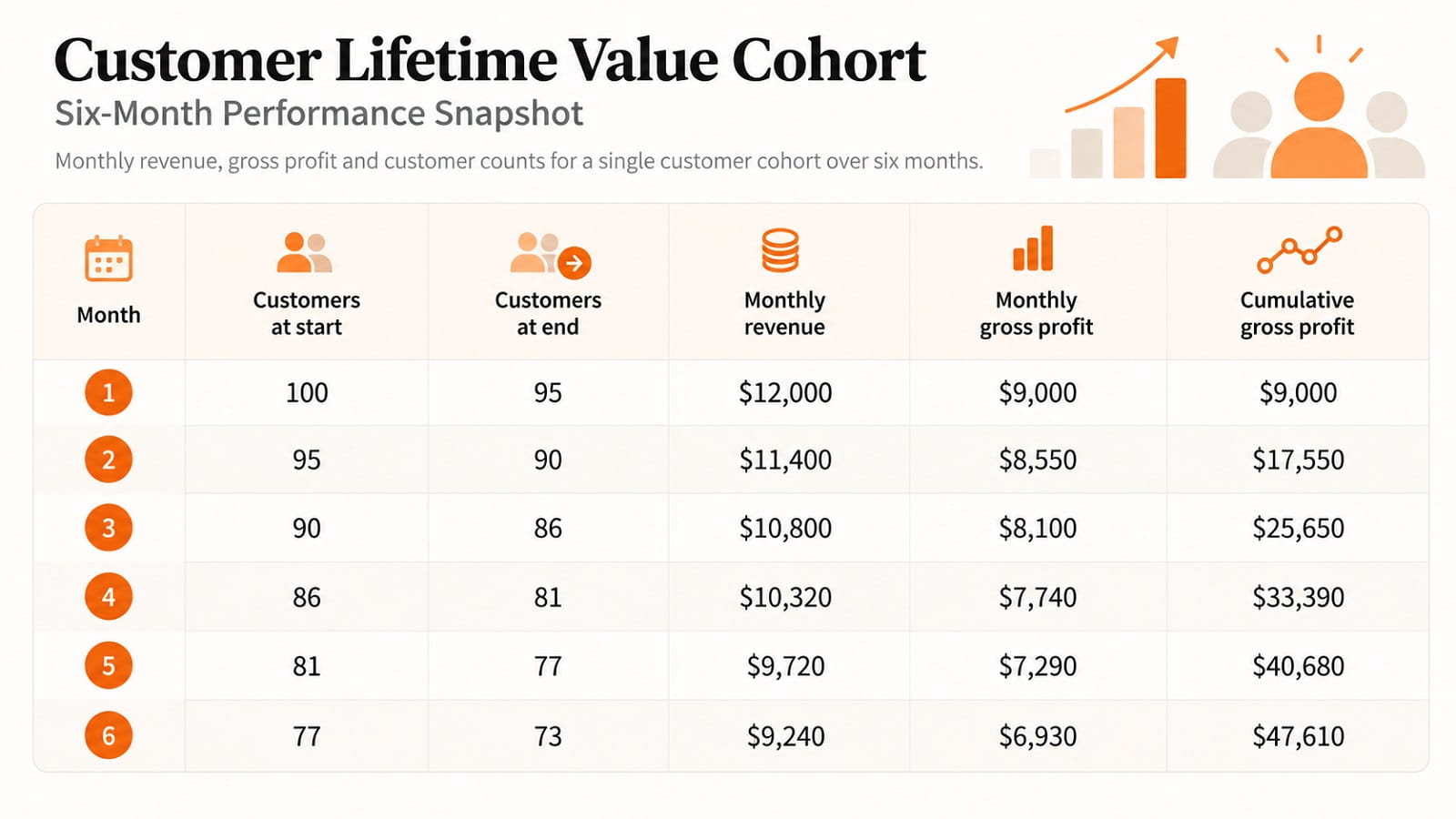
After six months, 73 of the original 100 accounts remain active.
The cohort has generated $47,610 in cumulative gross profit, equivalent to $476.10 per originally acquired customer.
However, MapleCloud spent $60,000 acquiring the cohort.
The difference between observed gross profit and acquisition expenditure is $12,390. The company has not yet recovered the original acquisition cost through this cohort's gross profit.
This does not establish that the customer relationships will ultimately be unprofitable. It means the observed contribution during the first six months has not yet covered acquisition expenditure.
The distinction between historical contribution and projected lifetime value is essential for accurate financial reporting.
Historical LTV vs. Predictive LTV
Historical LTV measures value already generated by customers over an observed period.
Predictive LTV estimates the contribution customers may generate in the future.
For MapleCloud, observed six month gross profit per acquired customer is $476.10. Its simplified lifetime model, based on monthly gross profit of $90 and constant churn of 5%, projects $1,800 in gross profit LTV.
These figures are not contradictory. They measure different things.
The historical result records contribution already generated. The predictive estimate includes future contribution that depends on customers continuing their subscriptions.
A reliable report should distinguish the two and identify the assumptions used in forecasting.
This is especially important when founders use projected LTV to justify marketing expenditure. Expected future contribution cannot automatically be treated as available cash.
How Customer Churn Changes Lifetime Value
Retention has a substantial effect on estimated LTV because it influences how long customers continue generating financial contribution.
For MapleCloud, assume the baseline monthly revenue remains $120, gross margin remains 75%, and acquisition cost remains $600 per customer unless the scenario states otherwise.
The following scenarios use the simplified subscription LTV formula.
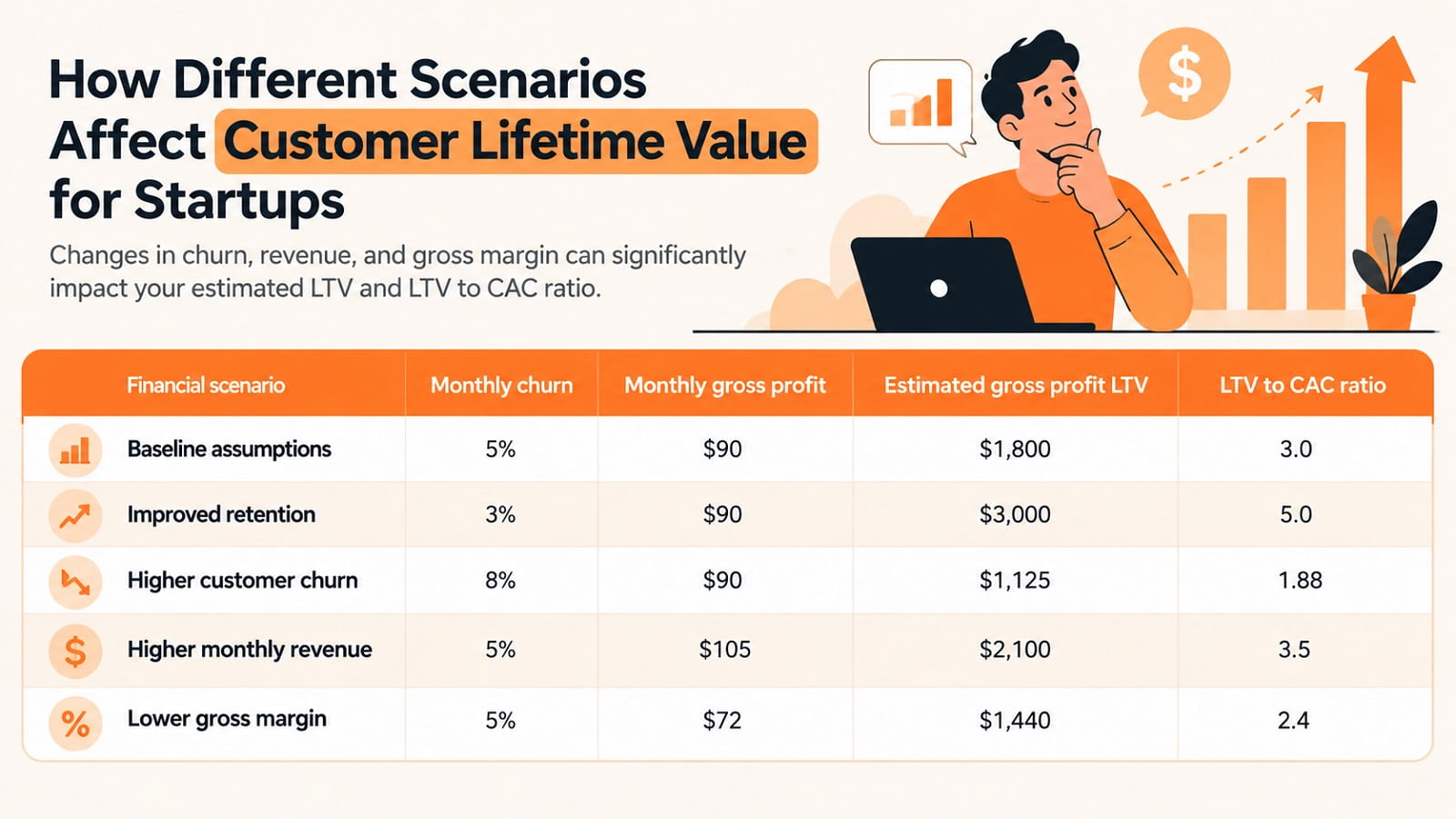
Reducing monthly churn from 5% to 3% increases estimated LTV from $1,800 to $3,000 under the model.
Increasing churn to 8% reduces estimated lifetime gross profit to $1,125.
The higher revenue scenario assumes monthly revenue increases to $140 while gross margin remains 75%. The lower margin scenario assumes the original $120 in monthly revenue but a reduced gross margin of 60%.
These estimates demonstrate how sensitive lifetime value can be to changes in retention, revenue, and delivery costs.
They should not be interpreted as guaranteed outcomes because the model assumes constant financial conditions throughout the projected customer relationship.
Customer Lifetime Value vs. Customer Acquisition Cost
Customer lifetime value measures the financial contribution expected from a relationship, while customer acquisition cost measures the expenditure required to obtain that relationship.
Comparing the two helps founders evaluate acquisition economics.
LTV to CAC ratio = Gross profit LTV ÷ Customer acquisition cost
MapleCloud's baseline projected LTV is $1,800, while CAC is $600.
LTV to CAC ratio = $1,800 ÷ $600 = 3
The projected gross profit LTV is three times acquisition expenditure.
However, a ratio of 3 does not mean the business earns three dollars in net profit for every dollar spent acquiring customers.
Other operating expenses, financing costs, and payment timing remain relevant.
There is also no universal ratio that is suitable for every business. A sustainable result depends on margins, retention reliability, cash requirements, and the time needed to recover acquisition expenditure.
LTV and Customer Acquisition Payback
Projected lifetime contribution is only one part of customer acquisition economics. Founders also need to know how quickly customers recover their acquisition costs.
A simplified CAC payback calculation divides acquisition cost by monthly gross profit per customer.
MapleCloud's estimate is:
CAC payback = $600 ÷ $90 = 6.7 months
However, this calculation assumes each customer continues generating the full monthly contribution. It does not adjust for cancellations during the recovery period.
The cohort example demonstrates the limitation. After six months, customers have produced $47,610 in gross profit against $60,000 in acquisition spending.
The cohort has therefore not reached payback.
A startup with limited cash should examine actual cohort contribution and recovery timing alongside predicted lifetime value.
A customer relationship can appear financially attractive over several years while still requiring substantial capital during its early months.
Customer Lifetime Value Across Different Business Models
SaaS Startups
Subscription software businesses commonly calculate LTV using monthly revenue, gross margin, and customer churn.
When accounts expand through additional users or upgrades, founders may need a cohort model that captures changing revenue rather than assuming constant monthly spending.
Customer retention and revenue retention should be evaluated separately because losing a large account can have a greater financial effect than losing several small accounts.
Ecommerce Startups
Ecommerce businesses generally use average order value, purchasing frequency, customer lifespan, and gross margin.
Customer purchasing behavior is often irregular, making a simple monthly churn formula less appropriate.
Founders should analyze repeat purchases, discounts, refunds, and the contribution generated across customer orders.
Customers acquired through different channels may also have different purchasing patterns.
Marketplace Startups
Marketplaces should calculate lifetime value using revenue attributable to the platform rather than automatically treating total transaction value as company revenue.
A marketplace facilitating a $200 sale may retain only a commission or transaction fee.
Buyer and seller relationships may also require separate models because their financial roles and associated costs differ.
Using Customer Cohorts to Improve LTV Accuracy
Cohort analysis groups customers according to a shared characteristic, commonly the month in which they made their first purchase.
It allows founders to compare customer behavior at equivalent relationship ages.
For example, customers acquired in January and February should be compared after both groups have completed six months rather than comparing a six month cohort with one that has only existed for two months.
Founders can measure customer survival, recurring revenue, gross profit, and cumulative contribution within each cohort.
This approach can reveal whether newer customers retain better than earlier customers or whether acquisition channels attract customers with different financial characteristics.
Cohort analysis also helps identify when average calculations conceal important differences between customer segments.
Forecasting Lifetime Value When Data Is Limited
Early stage startups often lack enough historical information to estimate customer lifespan reliably.
A company with three months of subscription records cannot confidently establish a multiyear relationship from those observations alone.
Instead of relying entirely on one lifetime estimate, management can evaluate several plausible retention and margin scenarios.
Forecasts should use a defined observation horizon and distinguish recorded customer behavior from assumptions about future activity.
When churn is unusually low or temporarily zero, dividing contribution by the observed churn rate can produce an unrealistic result or no finite estimate at all.
More advanced models can forecast contribution for individual future periods and discount it to account for the timing and uncertainty of future value.
However, greater mathematical complexity does not compensate for unreliable assumptions. Improving the quality of retention and customer contribution data should remain the priority.
How to Increase Customer Lifetime Value
Improve Customer Retention
Keeping customers active for longer can increase lifetime contribution when those customers continue generating positive gross profit.
Better onboarding, reliable product performance, relevant features, and responsive support may reduce cancellations.
However, retention initiatives also create costs. A program that improves customer lifespan but requires excessive service expenditure may not increase contribution as much as expected.
Increase Customer Spending
Relevant product upgrades, additional services, and increased usage can improve lifetime revenue.
For ecommerce businesses, complementary products and repeat purchases can create additional value without requiring the original acquisition expense again.
The financial benefit should be evaluated after accounting for the costs associated with delivering additional products or services.
Improve Gross Margin
Reducing delivery costs can increase LTV even when customer spending remains unchanged.
Software businesses may improve infrastructure efficiency, while retailers can review fulfillment expenses and supplier arrangements.
Cost reductions should not compromise product reliability or customer satisfaction in ways that damage retention.
Reduce Involuntary Churn
Some subscription cancellations result from failed payments rather than intentional customer decisions.
Appropriate payment reminders, retry procedures, and convenient methods for updating payment details may help prevent avoidable subscription losses.
Founders should distinguish these cases from customers who intentionally cancel because the product no longer meets their needs.
Common Customer Lifetime Value Calculation Mistakes
One frequent mistake is presenting revenue based LTV as if it represents profit. Revenue must first cover relevant delivery costs before contributing toward acquisition spending and other expenses.
Another is estimating customer lifespan using limited historical evidence and presenting the result as a reliable prediction.
Comparing cohorts of different ages can also distort conclusions because established customers have had more time to generate revenue.
Ignoring discounts, refunds, changing customer behavior, and differences between customer segments can produce similarly misleading results.
A further problem arises when founders focus on projected lifetime value without considering how long it takes to recover acquisition expenditure.
Reliable LTV analysis requires consistent definitions, realistic assumptions, and regular comparison with observed customer activity.
How Often Should Startups Review LTV?
The appropriate review frequency depends on customer volume, purchasing patterns, and available historical data.
Subscription businesses may review retention and customer contribution monthly, while ecommerce companies with less frequent purchasing may require longer observation periods.
A useful reporting process separates historical contribution from projected future value and compares customer cohorts over equivalent periods.
Founders should update LTV assumptions when pricing, gross margins, retention patterns, or customer acquisition strategies change materially.
The purpose is to determine whether customer relationships are becoming more valuable and whether the improvement is supported by actual evidence.
Frequently Asked Questions About Customer Lifetime Value
What Is Customer Lifetime Value for Startups?
Customer lifetime value estimates the total revenue or financial contribution a customer generates throughout the relationship with a startup. It helps founders evaluate retention, acquisition economics, and the financial value of customer relationships.
How Do You Calculate Customer Lifetime Value?
For repeat purchase businesses, multiply average order value by purchase frequency and expected customer lifespan. For subscription businesses, a simplified gross profit calculation divides average monthly gross profit per customer by monthly customer churn.
What Is the Difference Between LTV, CLV, and CLTV?
LTV, CLV, and CLTV generally refer to customer lifetime value. Different companies may use different methods, so the formula and included costs matter more than the abbreviation.
What Is a Good LTV to CAC Ratio?
There is no universally appropriate ratio. Founders should compare estimated gross profit LTV with acquisition spending while considering retention uncertainty, payback timing, operating costs, and available cash.
How Does Customer Churn Affect LTV?
Higher customer churn generally shortens expected customer relationships and reduces projected lifetime value. Lower churn can increase estimated LTV when customer revenue and gross margin remain stable.
Can a Startup Calculate LTV Without Historical Data?
A startup can develop an initial estimate using conservative assumptions, but it should not present that figure as verified performance. Observed customer contribution and scenario analysis provide a more reliable starting point until sufficient history becomes available.
Is Customer Lifetime Value the Same as Customer Profit?
No. Revenue based LTV measures customer spending, while gross profit LTV accounts for direct delivery costs. Neither automatically includes every operating expense required to determine net profit.
How Can Startups Improve Customer Lifetime Value?
Startups can improve LTV through better retention, repeat purchases, relevant account expansion, higher customer contribution, and more efficient delivery costs. The results should be measured against the expenses required to achieve those improvements.
Final Thoughts
Customer lifetime value helps founders evaluate customer relationships beyond the initial purchase. It connects revenue, retention, direct costs, and customer behavior with the financial potential of the business.
The MapleCloud example illustrates why observed contribution and predicted lifetime value must remain separate. A customer can have attractive projected economics while the company has not yet recovered the original acquisition expenditure.
A reliable LTV model combines accurate revenue and cost information, realistic retention assumptions, customer cohort analysis, and regular forecasting updates.
The objective is not to produce the highest possible lifetime value estimate. It is to understand which customer relationships create sustainable financial contribution and use that evidence to make better decisions about acquisition, retention, and growth.

Mobina Khanki
Venture & Funding Writer at PinerookMobina Khanki covers venture capital, startup funding, fundraising, and startup finance for Pinerook, focusing on founders and investors.
 Seen first.