A SAFE agreement allows investors to provide capital to a startup today in exchange for contractual rights to receive equity when specified future events occur. SAFE stands for Simple Agreement for Future Equity, an instrument developed by Y Combinator to simplify early stage fundraising. Unlike a conventional loan, a standard SAFE does not carry ordinary interest payments or a maturity date. However, it can significantly affect founder ownership when the company completes a future equity financing.
Within Startup Debt and Alternative Funding, a SAFE agreement serves founders who want to raise early capital without immediately negotiating a complete priced equity round. Investors provide funding under terms that determine how their investment will be treated when the company issues shares in the future. Although the arrangement can reduce initial transaction complexity, valuation caps, conversion provisions, and additional investor rights require careful attention.
This guide explains the structure of SAFE agreements, the main contractual terms, and the events that determine how investors receive equity or other proceeds. It also uses a practical capitalization example to show how multiple SAFE investments affect founder ownership before and after a priced financing round.
What Is a SAFE Agreement?
A SAFE agreement is a contract between a startup and an investor that provides the investor with rights to receive equity or specified proceeds when certain contractual events occur. It is commonly used when a company is raising early capital but has not yet established the terms of a conventional priced equity financing.
Under a standard Y Combinator SAFE, the investor transfers an agreed purchase amount to the company. In return, the investor receives contractual rights governed by the agreement, rather than shares issued immediately at signing.
The investor typically becomes a shareholder when the company completes a priced equity financing and the SAFE converts into the applicable class of preferred stock. Other events, including an acquisition or dissolution, can produce different outcomes under the contract.
Importantly, a standard SAFE is neither a conventional loan nor an immediate issuance of stock. The investment does not accrue ordinary loan interest, and the company is not generally required to repay it on a predetermined maturity date.
These features can make SAFE financing attractive to companies that need early capital but are not ready for a complete priced investment round.
How a SAFE Agreement Works
The SAFE financing process begins when the startup and investor agree on the purchase amount and the applicable contractual form. The parties execute the agreement, and the investor provides the agreed capital.
The company can then use the funds for permitted business purposes. The investor's contractual rights remain outstanding until an event specified in the agreement determines the next outcome.
Signing and Funding the Agreement
Before signing, the parties establish the purchase amount and select the appropriate SAFE structure. Depending on the form, the agreement may contain a valuation cap, conversion discount, or most favored nation provision.
The startup should maintain accurate records of the executed agreement, investor identity, investment amount, and all relevant contractual terms.
A company that completes several SAFE investments must track each agreement separately, particularly when investors receive different valuation caps or other negotiated conditions.
Conversion During an Equity Financing
A priced equity financing is the most common event that causes a standard SAFE to convert into shares.
When the company raises capital through the issuance of preferred stock at an established price, outstanding SAFEs generally convert automatically under their contractual formulas.
The shares issued to SAFE holders may have economic characteristics that differ from the shares purchased by new investors, even when they belong to a related preferred stock series.
The final share calculation depends on the SAFE form, capitalization definitions, financing price, and any other outstanding convertible instruments.
What Happens Before Conversion?
Before conversion, a SAFE investor is not automatically a shareholder merely because the investor funded the agreement.
The SAFE itself does not ordinarily provide the voting rights associated with holding issued shares. Additional rights may arise through separate agreements, but they should not be assumed to exist.
Likewise, the absence of ordinary monthly repayments does not mean the investment has no financial consequences.
The future issuance of shares can reduce the ownership percentages of founders and existing shareholders.
Types of SAFE Agreements
SAFE agreements can use different mechanisms to determine how the investor's contractual rights are treated during a future equity financing.
Y Combinator currently provides three principal post money SAFE forms for United States companies: a valuation cap form, a discount form, and an uncapped form containing a most favored nation provision.
SAFE With a Valuation Cap
A valuation cap establishes the valuation basis used to determine a potentially favorable conversion price for the investor.
For example, a startup might raise $300,000 under a SAFE with a $6 million post money valuation cap.
Under the standard cap based ownership calculation, the investment represents 5% of the company's capitalization immediately before the new money in the priced financing and any associated new option pool increase, assuming the cap mechanism determines conversion pricing.
A valuation cap does not guarantee that the company will later receive a financing valuation equal to that amount. It establishes a contractual pricing mechanism for the investor.
SAFE With a Discount
A discount SAFE provides investors with a reduced conversion price relative to the price paid by new investors in a qualifying equity financing.
For example, if the new investors pay $4 per share and the SAFE provides a 20% discount, the discounted conversion price would be $3.20.
The investor consequently receives more shares for the same purchase amount than would be received at the full financing price.
The standard YC discount form does not also include a valuation cap. Founders using customized documents must review the exact conversion calculation rather than assuming the two mechanisms are automatically combined.
SAFE With an MFN Provision
An MFN provision, meaning Most Favored Nation, is designed to protect an early investor when the company later issues qualifying SAFE instruments with more favorable contractual terms.
An investor holding an uncapped MFN SAFE may have the right to adopt applicable terms from a later SAFE, according to the amendment mechanism and conditions established in the agreement.
This structure allows the company to raise capital without immediately agreeing on a valuation cap or discount.
However, founders should understand the potential effect of later financing documents. Issuing a new SAFE on more favorable terms may also affect earlier MFN investors.
Key SAFE Agreement Terms Founders Should Review
Although SAFE documents are generally shorter than comprehensive priced equity financing agreements, their definitions can materially affect future ownership and investor entitlements.
Founders should pay particular attention to the purchase amount, conversion mechanism, capitalization definitions, and treatment of major corporate events.
The following table identifies the principal contractual terms and the questions founders should resolve before accepting SAFE funding.
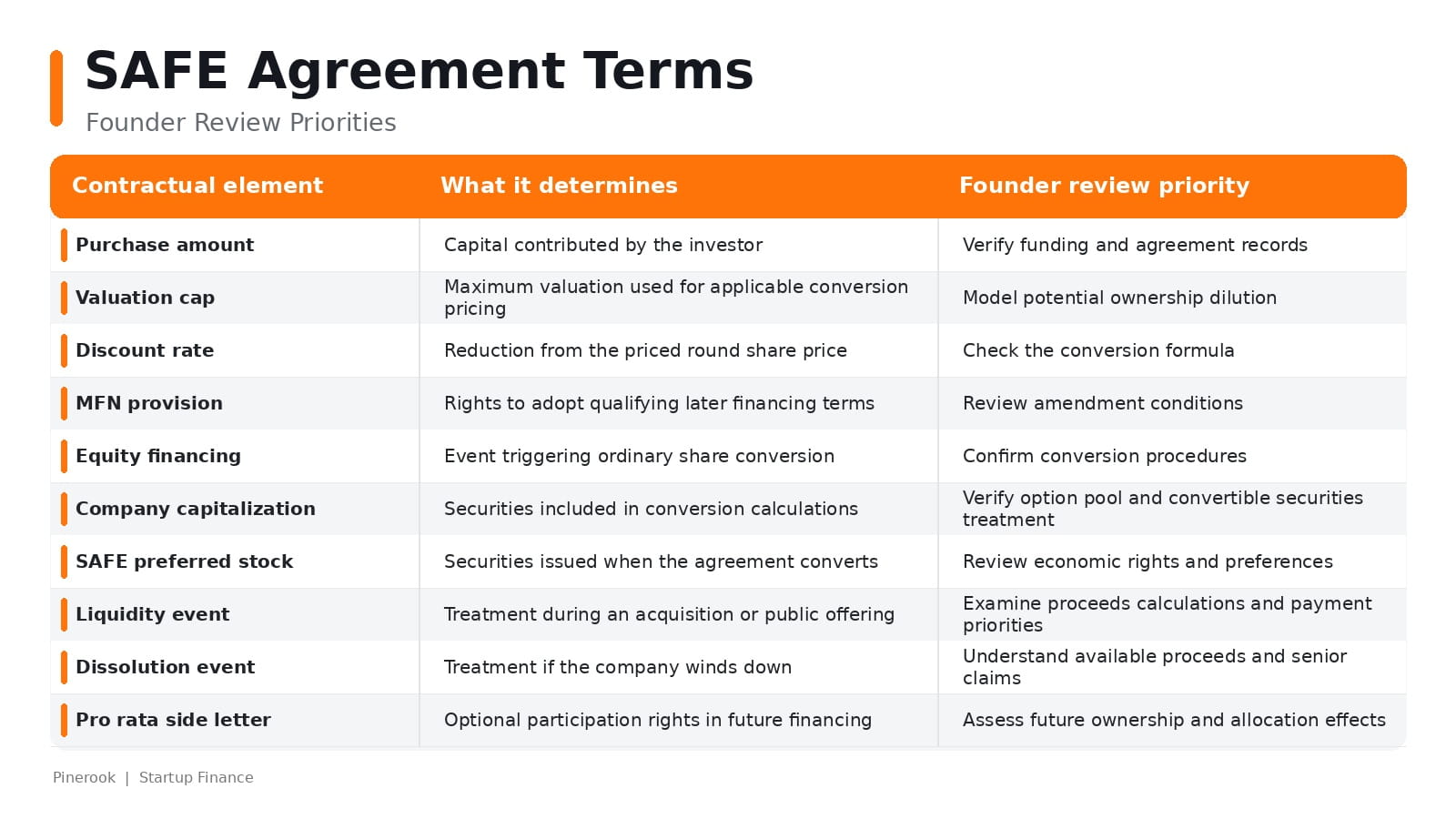
These provisions determine how the SAFE operates across different financing outcomes. A valuation cap can make the potential ownership effect easier to estimate, while discount and MFN arrangements depend more heavily on subsequent financing conditions. Liquidity and dissolution provisions become relevant when a priced equity round does not occur before another major corporate event. Founders should therefore review both the expected conversion scenario and the alternative outcomes.
Understanding Post Money SAFE Ownership
The post money SAFE structure is important because it allows founders and investors to estimate the ownership represented by a valuation cap SAFE with greater clarity.
For a standard post money valuation cap SAFE, the simplified ownership calculation is:
\[ \text{SAFE Ownership}=\frac{\text{Investment Amount}}{\text{Post Money Valuation Cap}}\times100 \]
For example, a $250,000 investment at a $5 million post money valuation cap represents 5% under the standard cap based calculation.
This percentage describes the ownership attributable to that SAFE before dilution from new money in the priced financing and any newly created or increased option pool associated with that round.
It does not mean the investor will necessarily own 5% after the priced financing closes.
Why Multiple SAFEs Matter
When a company raises capital through several post money valuation cap SAFEs, each investment can represent an additional ownership allocation.
Suppose a founder issues three SAFEs representing 3%, 4%, and 5% under their respective contractual calculations. Together, these arrangements represent 12% of the company before subsequent priced round dilution, assuming the cap based calculations apply.
The ownership allocated to existing shareholders consequently decreases even though the company has not yet completed its priced financing.
Founders should calculate the combined effect of outstanding SAFEs rather than reviewing each agreement independently.
The Impact of Employee Option Pools
An employee option pool reserves equity for employee compensation. Changes to the pool can affect the ownership percentages of founders, investors, and other shareholders.
Under the standard YC post money SAFE framework, the existing option pool is included in the relevant capitalization calculation.
However, a new or increased option pool created in connection with the priced financing can dilute existing holders, including SAFE investors, according to the transaction structure.
This makes the timing and size of option pool changes important when modeling capitalization.
A Practical SAFE Agreement Conversion Example
Consider NovaBridge Technologies, a fictional software startup preparing for its first institutional equity financing.
The company initially belongs entirely to its existing shareholders, including its founders. To support product development and customer acquisition, management raises capital using two post money valuation cap SAFE agreements.
The first investor provides $300,000 with a $6 million valuation cap. A second investor subsequently contributes $200,000 under a SAFE with an $8 million valuation cap.
Assume both valuation caps determine conversion pricing, there are no other convertible instruments, and no option pool adjustments are made during the financing.
Calculating Ownership Before the Priced Round
The first investment represents 5% of the capitalization under the assumed SAFE conversion calculation.
The second investment represents 2.5%.
Together, the two SAFEs account for 7.5%, leaving 92.5% attributable to existing shareholders immediately before new priced round money is introduced.
These percentages help management understand the equity represented by the outstanding agreements.
Introducing the Series A Investment
NovaBridge then negotiates a priced Series A financing in which new investors contribute $2 million at an $8 million pre money valuation.
For this simplified example, assume the new investors receive 20% of the company following the financing, with the valuation and share calculations structured consistently with that outcome.
Existing shareholders and SAFE investors collectively retain the remaining 80%.
The following table shows how this produces different ownership percentages before and after the new financing.
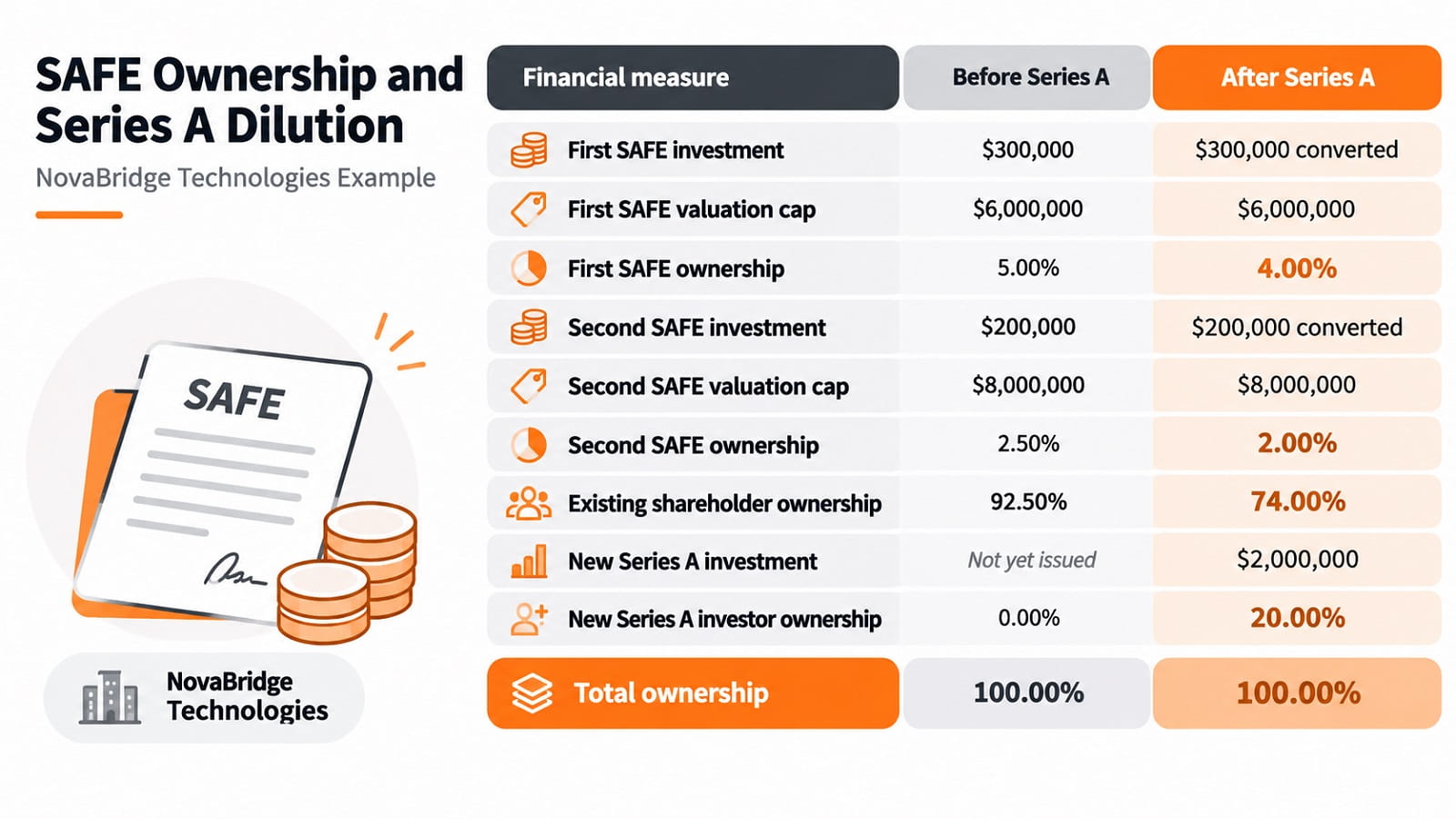
The example demonstrates two stages of dilution. First, the SAFEs allocate a combined 7.5% of the company's capitalization before the priced investment. Second, the new Series A investment dilutes existing shareholders and SAFE investors proportionately under the simplified assumptions. After the financing, existing shareholders retain 74%, the two SAFE investors collectively own 6%, and the new investor owns 20%. Actual outcomes may differ because of capitalization definitions, option pool adjustments, additional securities, and financing negotiations.
What This Means for Founders
NovaBridge receives $500,000 from its two SAFE investors without immediately completing a priced equity financing.
However, the agreements establish future ownership consequences that must be considered when negotiating the Series A.
If management had looked only at the absence of immediate share issuance, it might have underestimated the amount of equity already committed to investors.
A capitalization model allows founders to assess this consequence before accepting additional SAFE funding.
What Happens During a SAFE Liquidity Event?
A liquidity event can occur before a SAFE converts through a conventional priced financing. Under the standard YC documentation, qualifying events include certain acquisitions, mergers, and public offerings.
The agreement establishes how the SAFE holder participates in the proceeds of the transaction.
For a standard valuation cap SAFE, the investor may be entitled to the greater of the original purchase amount or the applicable value calculated as though the investment had converted into common shares, subject to the agreement's payment priority and available proceeds.
This does not mean the investor is guaranteed to recover the full original investment.
The outcome depends on the value of the transaction, outstanding creditor claims, other securities, and the payment distribution rules.
Founders should evaluate these provisions when considering an acquisition before completing a priced equity round.
What Happens if a Startup Dissolves?
If the company shuts down before a SAFE has converted or otherwise terminated, the agreement establishes how the investor's contractual claim is treated.
Under the standard YC structure, the SAFE holder has a right associated with recovering the purchase amount, subject to payment priority and funds available for distribution.
Creditors and outstanding debt generally rank ahead of SAFE holders. The SAFE investor may therefore recover only part of the investment or nothing if the company's remaining assets are insufficient.
A dissolution provision should not be confused with an ordinary loan repayment promise.
Founders should understand the relative priority of outstanding obligations, particularly when a company has raised capital through several instruments.
Investor Rights Under a SAFE Agreement
A SAFE investor receives contractual rights defined by the agreement. These rights are not identical to those of a shareholder holding issued preferred stock.
Before conversion, the standard SAFE does not ordinarily grant an investor automatic board representation, general shareholder voting rights, or unrestricted access to company information.
Additional privileges may be negotiated through side letters or separate financing documents.
Pro Rata Participation Rights
Pro rata rights can allow a qualifying investor to purchase additional securities in a future equity financing to help maintain an ownership percentage.
Under YC's standard approach, these rights are addressed through an optional side letter rather than being automatically included in every SAFE.
The company should consider how participation commitments affect the amount of the future financing available to new investors.
Information Rights and Other Side Letters
Some investors request financial reporting, access to company information, or other contractual protections.
The company may agree to such provisions separately, subject to negotiation and applicable law.
Founders should understand which obligations arise from the SAFE itself and which are created by additional documents.
Keeping these arrangements clearly documented reduces uncertainty when the company completes subsequent fundraising.
When a SAFE Agreement Is Appropriate
SAFE agreements can be suitable for early stage startups that need capital before establishing the terms of a priced equity financing.
They may be particularly useful when a company is funding product development, validating customer demand, or preparing for a larger institutional investment round.
Their relatively straightforward structure can reduce some of the initial negotiation involved in setting a complete equity price and shareholder rights package.
However, SAFEs are not automatically appropriate for every transaction.
A company expecting to remain privately funded without completing a priced round should consider how outstanding SAFEs may remain unresolved for an extended period.
Founders must also assess whether investors are comfortable with contractual rights that may not immediately produce issued shares.
The decision should reflect the startup's capital requirements, likely financing path, and the ownership consequences of the proposed terms.
Negotiating SAFE Agreements as a Founder
The first negotiation priority is understanding the selected SAFE form. A valuation cap agreement produces different conversion economics from a discount or MFN arrangement.
Founders should evaluate the proposed purchase amount and valuation cap together, rather than considering either figure in isolation.
The company should also review capitalization definitions and model the combined effect of existing and proposed SAFEs.
If investors request additional rights, management should evaluate whether those privileges are appropriate for the investment size and consistent with existing commitments.
Before signing, founders should confirm the agreement's treatment of equity financing, liquidity events, dissolution, and amendments.
Using an established form can simplify documentation, but it does not eliminate the need to evaluate whether the terms are suitable for the company's circumstances.
Common SAFE Agreement Mistakes
One frequent mistake is assuming that a SAFE does not dilute founders because shares are issued later. The economic dilution is deferred rather than eliminated.
Another is confusing a valuation cap with the startup's current market valuation. A cap establishes contractual conversion economics and does not independently determine what the business is worth today.
Founders may also issue several SAFE agreements without maintaining a consolidated capitalization model. Small individual investments can collectively represent a substantial portion of future ownership.
A further mistake is assuming every SAFE automatically includes participation rights or investor governance privileges. Additional arrangements must be identified in the relevant documentation.
Finally, founders sometimes overlook the consequences of an acquisition or company dissolution before a priced financing. These events can trigger contractual payment or settlement provisions that differ from ordinary share conversion.
Final Thoughts
A SAFE agreement can provide early stage startups with access to capital while postponing the pricing and issuance of equity until a future financing event.
Its simplicity, however, does not eliminate important financial and legal considerations. Valuation caps, conversion mechanics, side letters, and liquidity provisions all influence the rights investors receive and the ownership founders retain.
Founders should evaluate the complete agreement and maintain an accurate capitalization model that includes every outstanding SAFE. Understanding these consequences before signing helps ensure that early financing supports growth without creating unexpected ownership commitments during later investment rounds.
FAQ
What Does SAFE Stand for in Startup Financing?
SAFE stands for Simple Agreement for Future Equity. It is a contractual instrument that allows investors to provide startup capital in exchange for rights relating to future equity issuance or other defined outcomes.
Is a SAFE Agreement Legally Binding?
Yes. A properly executed SAFE can create enforceable contractual rights and obligations, subject to applicable law and the agreement's terms.
Does a SAFE Agreement Have an Interest Rate?
A standard Y Combinator SAFE does not accrue ordinary loan interest. Its economic consequences arise primarily through conversion pricing and other contractual provisions.
Does a SAFE Agreement Have a Maturity Date?
A standard YC SAFE does not contain an ordinary loan maturity date. It remains outstanding until a contractual event causes conversion, settlement, or termination.
How Does a SAFE Valuation Cap Work?
A valuation cap establishes a pricing mechanism that may allow the investor to convert at a more favorable price than new investors in a later financing. Under a standard post money valuation cap SAFE, the investment amount divided by the cap provides a useful estimate of the ownership represented before later dilution.
Can a SAFE Investor Receive Voting Rights?
Holding an unconverted standard SAFE does not automatically provide ordinary shareholder voting rights. Additional rights may arise from separate agreements or after the SAFE converts into shares.
What Happens if a Startup Never Raises a Priced Round?
A standard SAFE may remain outstanding because it has no ordinary maturity date. Its eventual treatment depends on whether another contractual event, such as a liquidity or dissolution event, occurs.
Can Multiple SAFEs Dilute Founders?
Yes. Multiple agreements can collectively commit significant future ownership to investors. Founders should model their combined effects before issuing additional SAFEs.

Mobina Khanki
Venture & Funding Writer at PinerookMobina Khanki covers venture capital, startup funding, fundraising, and startup finance for Pinerook, focusing on founders and investors.
 Seen first.