A startup can develop an innovative product, attract thousands of users, and generate considerable market interest without establishing a reliable source of income. Customer demand is important, but it does not automatically explain who will pay, what they will purchase, or how frequently revenue will be generated. Founders need a clear connection between the value their product creates and the money customers are willing to spend.
A startup revenue model defines how a company earns income from its products, services, or customer relationships. Within the broader framework of Startup Finance, it connects customer demand, pricing, purchasing behavior, and expected revenue with the financial resources required to operate a business. Selecting the right model involves understanding how customers receive value and whether the resulting income can support the company's activities.
This guide explains the main types of startup revenue models, how to select and validate an approach, and how to forecast revenue using realistic operating assumptions. It also includes a detailed financial example showing how subscriptions, usage charges, and onboarding services contribute to total revenue.
What Is a Startup Revenue Model?
A startup revenue model explains the mechanism through which a business generates income. It identifies the paying customer, what the customer pays for, how charges are calculated, and when revenue is earned.
For example, a software company may charge a monthly subscription for access to its platform. An ecommerce business typically earns revenue from product sales, while a marketplace may collect commissions on transactions.
These models create different relationships between customer activity and financial performance. A subscription depends on continued customer participation, while a transaction model depends on the frequency and value of individual purchases.
A useful revenue model should be specific enough for founders to calculate expected income from measurable customer activity.
However, earning revenue does not automatically mean earning profit. Product delivery, customer acquisition, infrastructure, and operating costs must still be considered when assessing financial sustainability.
Revenue Model vs. Business Model vs. Pricing Model
Although these terms are related, they describe different aspects of a company.
A business model explains how a company creates, delivers, and captures value. It includes its target customers, products, distribution channels, resources, and operating structure.
A revenue model focuses on how the business earns income from that activity.
A pricing model determines the amount customers pay and the rules used to calculate their charges.
Consider a cloud software startup serving small businesses. Its business model may involve providing an online platform supported by software development and customer service.
Its revenue model could combine subscriptions with additional usage charges.
Its pricing model might specify a $100 monthly subscription plus $0.02 for each billable operation.
Distinguishing these concepts helps founders identify whether a financial problem requires changes to pricing, monetization, or the broader business structure.
Types of Startup Revenue Models
Startups can generate revenue through several mechanisms. The appropriate choice depends on customer behavior, purchasing frequency, delivery costs, and the benefits customers receive.
Subscription Revenue Model
A subscription model charges customers recurring fees for continued access to a product or service.
Payments may occur monthly, annually, or according to another agreed schedule.
This structure is common in software, digital services, and membership businesses because it connects revenue with ongoing customer relationships.
Subscriptions can improve revenue visibility, but cancellations and unsuccessful renewals can reduce expected income. Founders must continuously deliver value that justifies continued payment.
Transaction Revenue Model
A transaction model generates revenue when customers purchase products or services.
Ecommerce stores, digital product businesses, and many service providers use this approach.
Revenue depends on the number of transactions and the recognized revenue associated with each purchase.
The model can suit customers who prefer paying only when they need a product, although revenue may fluctuate when demand changes.
Commission Revenue Model
Commission models generate revenue by charging a fee for facilitating transactions between buyers and sellers.
For example, a marketplace facilitating a $200 transaction with a 10% commission may earn $20 in platform revenue when it acts as an agent under the relevant arrangement.
The full transaction amount should not automatically be treated as the marketplace's revenue.
Commission income depends on transaction activity, the applicable fee structure, and whether customers continue using the platform.
Usage Based Revenue Model
Usage based models charge customers according to consumption.
A software infrastructure company might bill for API requests, storage, processing, or computing activity.
This approach can align customer charges with actual product usage.
However, revenue may become less predictable when consumption changes, and customers may need tools to understand and control their bills.
The company must also ensure that usage revenue grows appropriately relative to the cost of providing additional capacity.
Advertising Revenue Model
Advertising models earn income from organizations seeking access to a platform's audience.
Payments may depend on impressions, clicks, sponsorship agreements, or other defined commercial outcomes.
This approach can support products that are free to end users.
However, audience growth does not guarantee advertising income. Advertiser demand, audience quality, and the available advertising inventory determine the commercial potential.
Licensing Revenue Model
Licensing allows customers or business partners to pay for defined rights to use technology, software, intellectual property, or other assets.
It may involve recurring agreements or payments linked to specific licensing arrangements.
This model can work for startups developing technology that other businesses want to integrate into their products.
However, licensing agreements may require complex negotiations, technical support, and careful management of usage rights.
Freemium Model
Freemium gives customers access to a basic product without payment while charging for premium capabilities or additional usage.
The free version can encourage adoption and allow potential customers to experience the product.
However, freemium is primarily a product access and conversion strategy. Actual revenue comes from paid subscriptions, upgrades, usage charges, advertising, or another monetization mechanism.
Founders must determine whether the contribution from paying customers can justify the cost of supporting free users.
Hybrid Revenue Model
A hybrid model combines multiple revenue streams.
A software startup might charge subscriptions, additional usage fees, and separate onboarding fees.
A retailer could combine individual product sales with optional recurring memberships.
Hybrid structures provide flexibility but can complicate customer communication, billing, accounting, and forecasting.
Additional revenue streams should solve genuine customer needs rather than introduce complexity without clear economic benefits.
Comparing Startup Revenue Models
Each approach creates different revenue opportunities and operating requirements. The following comparison summarizes the central mechanisms and questions founders should consider.
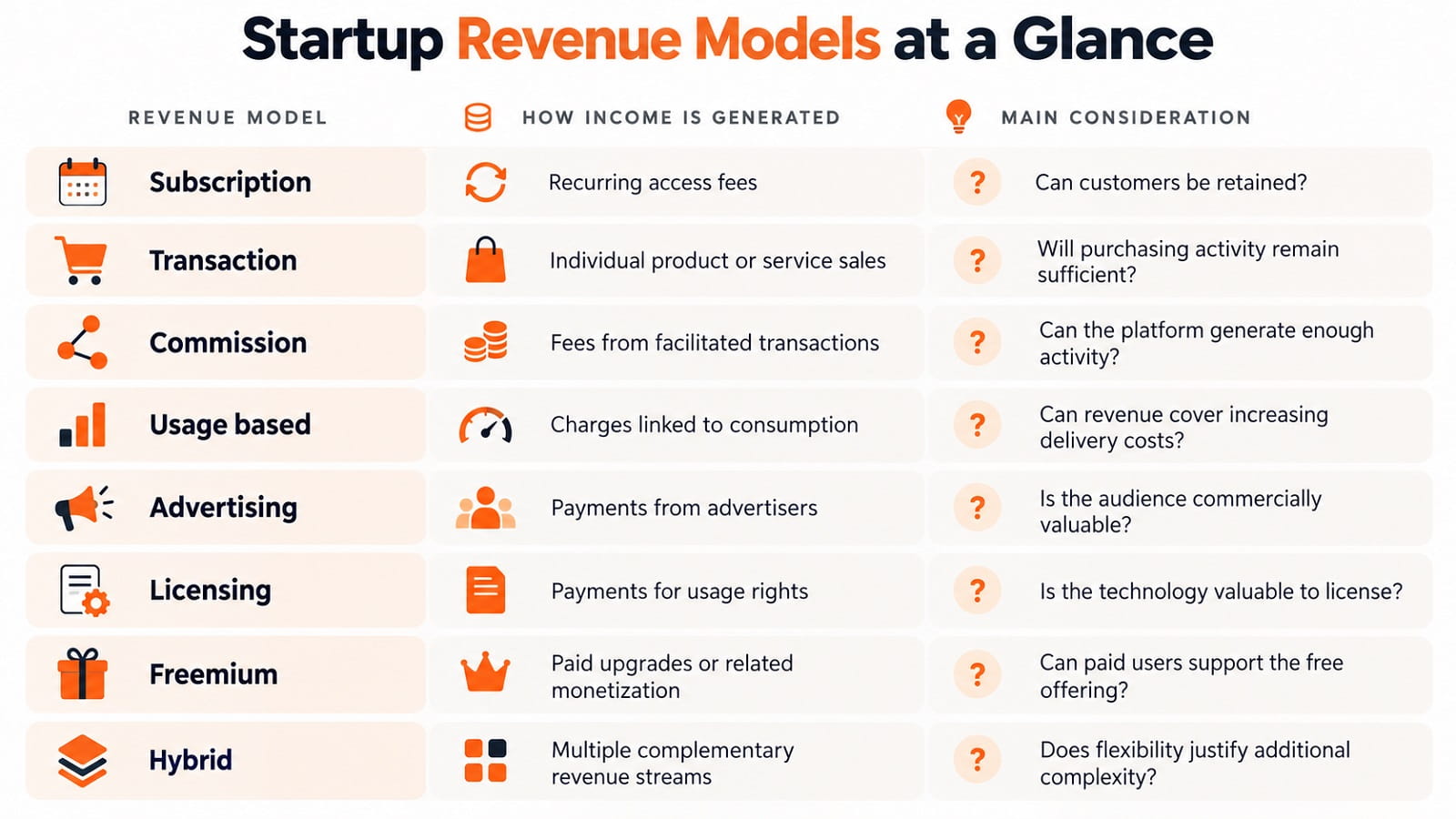
No model is universally better.
A subscription can create recurring income but depends on retention. Transaction revenue may be simpler for occasional purchases but less predictable.
The right model is one that customers understand, are willing to pay for, and that the business can deliver economically.
How to Choose the Right Startup Revenue Model
Choosing a revenue model should begin with evidence about customers rather than assumptions based on competitors.
Identify Who Pays and Why
The person using a product is not always responsible for payment.
Employees may use business software purchased by their employer. Consumers may use a free platform funded by advertisers.
Founders should identify who receives value, who controls the purchasing decision, and why payment is justified.
These answers determine how the company should design its offer and commercial relationships.
Understand Purchasing Frequency
Products used continuously may support subscriptions, while products purchased occasionally may be better suited to individual transactions.
However, frequent use does not automatically mean customers want recurring billing.
Founders should investigate whether customers prefer predictable payments, charges tied to consumption, or individual purchases.
Match Charges to Customer Value
The pricing structure should reflect benefits customers understand.
A collaboration platform may charge according to the number of users. An infrastructure service may charge according to computing activity.
A relevant pricing unit helps customers understand what they receive for their money.
Charges that are difficult to predict or explain can discourage purchasing even when the underlying product is valuable.
Evaluate Delivery Costs
A revenue model must be assessed alongside the costs required to deliver the service.
A fixed subscription can become expensive to support if some customers consume substantially more resources than others.
Usage charges may help connect revenue with consumption, although they introduce additional billing complexity.
Founders should determine whether increased customer activity generates sufficient additional contribution.
Consider Customer Retention and Financial Capacity
Some models depend on customers making repeated payments before acquisition expenditure is recovered.
Founders need realistic assumptions about continued purchasing, cancellations, and payment timing.
A model that produces attractive projected revenue may still create cash pressure if substantial spending occurs before customers pay.
The chosen approach should fit both customer behavior and the startup's financial resources.
How to Validate a Startup Revenue Model
A revenue model should be tested before management commits substantial resources to scaling it.
Customer interviews can reveal preferences, but stated interest is not equivalent to willingness to purchase.
Actual transactions provide stronger evidence.
Test a Specific Paid Offer
Present a defined product, clear benefits, and an understandable price to potential customers.
A paid pilot, initial subscription, or commercial agreement can reveal whether customers are willing to exchange money for the value offered.
Founders should record conversion results, objections, and whether customers understand the proposed charges.
Compare Alternative Pricing Structures
A startup may compare fixed subscriptions with consumption based charges or test different service tiers.
The analysis should consider actual purchases, recognized revenue, customer satisfaction, and delivery costs.
Higher conversion is not necessarily preferable if the associated contribution becomes substantially weaker.
Measure Continued Customer Behavior
For subscriptions, founders should examine renewals, cancellations, and changes in account spending.
For transaction businesses, repeat purchasing and order frequency provide additional evidence.
A model becomes more credible when customers continue paying because the product delivers meaningful value.
Establish Clear Validation Criteria
Before testing, define what evidence would support continuing, changing, or abandoning the proposed model.
Relevant criteria may include paid conversion, customer retention, revenue per customer, contribution margin, and the cost of delivering the product.
A successful test should produce a decision supported by observed results rather than general enthusiasm.
How to Forecast Revenue for a Startup
A revenue forecast estimates income expected from customer activity under defined assumptions.
The calculation depends on the chosen model.
Subscription revenue = Billable accounts × Subscription price
Transaction revenue = Completed purchases × Recognized revenue per purchase
Usage revenue = Billable units consumed × Price per unit
Commission revenue = Qualifying transaction value × Applicable commission rate
For commission arrangements, this simplified calculation assumes the commission represents revenue earned by the platform.
Hybrid models require separate calculations for each revenue stream before combining the results.
Founders should identify the operational assumptions underlying these formulas, including customer additions, cancellations, purchasing frequency, and billable usage.
Applying a general growth percentage without explaining the activities that generate revenue produces a weaker forecast.
A Practical Startup Revenue Model Example
Consider NovaFlow, a fictional software startup providing workflow automation tools to small businesses.
The company operates a hybrid revenue model.
Customers pay $100 per month for software access, $0.02 per billable operation, and a separate $200 fee for a completed onboarding service.
Management prepares a forecast covering five months.
Establishing Customer Growth Assumptions
Before month one begins, NovaFlow has 90 existing paying accounts.
The company expects to acquire 10, 12, 15, 14, and 16 new paying accounts during months one through five.
Cancellations effective before the relevant monthly service periods are expected to total 0, 2, 5, 4, and 6 accounts respectively.
For this simplified example, new customers begin receiving their full monthly subscription service on the first day of their acquisition month, while cancellations take effect before the month begins.
This produces 100, 110, 120, 130, and 140 billable accounts across the five months.
Each new customer also purchases a distinct onboarding service that is completed within the same month. Therefore, completed onboarding services equal the number of new paying accounts, even when net customer growth is lower because other customers cancel.
Establishing Revenue Assumptions
Expected billable usage is 20,000 operations in month one, followed by 24,000, 27,000, 33,000, and 38,000 operations.
Subscription revenue is recognized for the service delivered during each month. Usage revenue is recognized for qualifying activity performed during the period.
For the example, the separate onboarding service is recognized when completed. Actual contracts may require additional accounting analysis, including allocation of the transaction price between promised services.
The forecast represents recognized revenue, not money necessarily collected from customers during those months.
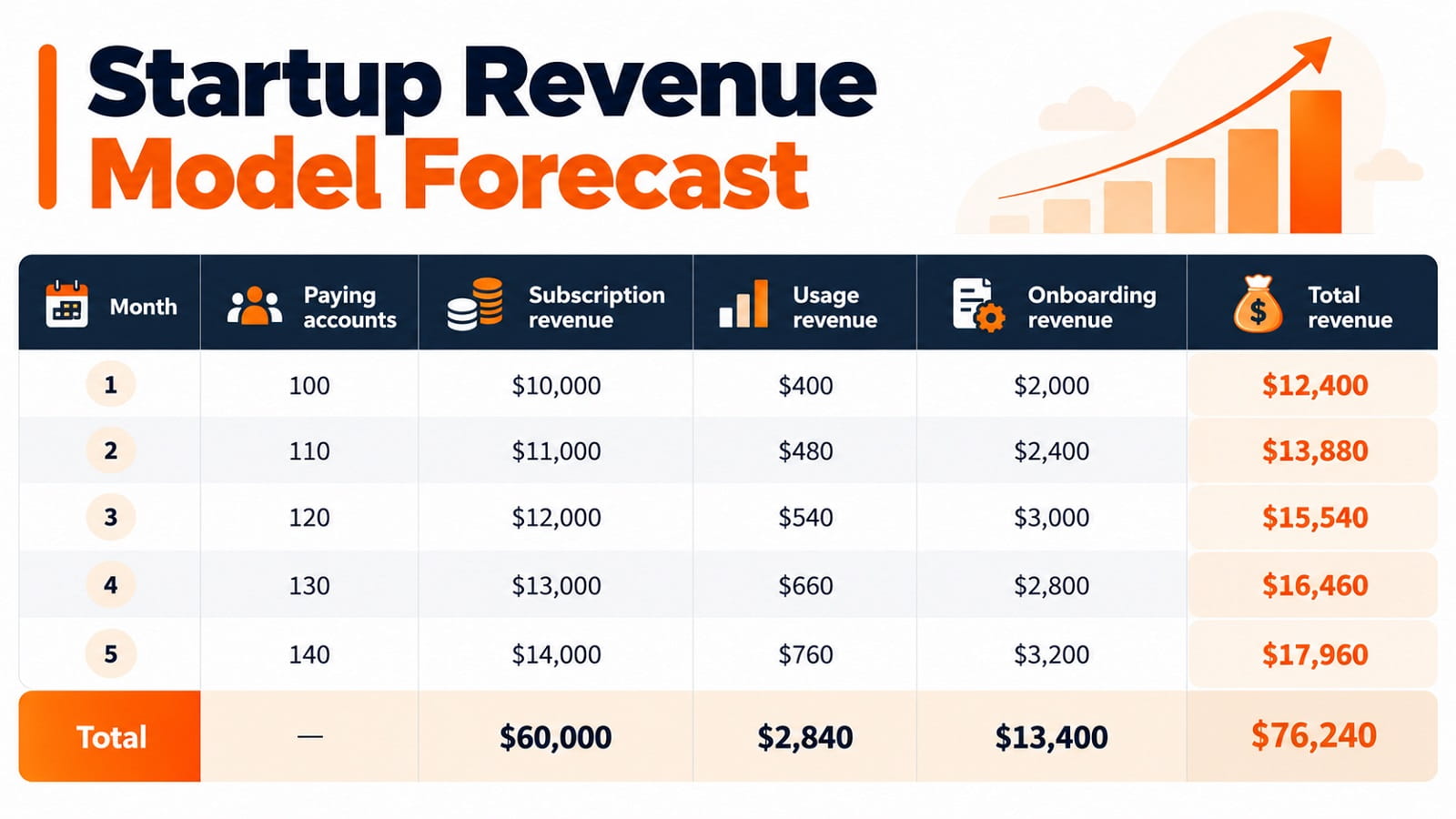
Across five months, NovaFlow projects $76,240 in recognized revenue.
Subscriptions generate $60,000, usage charges contribute $2,840, and completed onboarding services generate $13,400.
The figures demonstrate why each revenue stream should be forecast separately.
Subscriptions depend on billable accounts, while usage revenue depends on actual consumption. Onboarding revenue depends on completed services rather than the total number of existing customers.
This distinction also explains why new customer acquisitions do not always equal net customer growth.
How to Evaluate Revenue Model Profitability
A revenue forecast explains expected income, but it does not determine whether the company is profitable.
NovaFlow must also account for the direct costs of delivering subscriptions, processing usage, and completing onboarding services.
Assume monthly direct subscription delivery costs are $20 per paying account. Usage creates direct costs of $0.008 per operation, while each completed onboarding service costs $100.
In month five, subscription delivery costs total $2,800, usage costs are $304, and onboarding costs are $1,600.
Combined direct costs are therefore $4,704.
With recognized revenue of $17,960, gross profit is $13,256.
Gross margin = $13,256 ÷ $17,960 × 100 = approximately 73.8%
This calculation shows the contribution remaining after the specified direct costs.
Sales, marketing, administration, product development, and other operating expenses must still be considered before evaluating overall profitability.
A sustainable revenue model should produce income that can support its delivery costs and contribute toward broader financial obligations.
How to Stress Test Revenue Forecast Assumptions
Founders should test how changes in customer behavior affect expected income.
For NovaFlow, month five subscription revenue assumes 140 billable accounts.
If the company has only 125 billable accounts, subscription revenue falls from $14,000 to $12,500.
Holding usage and completed onboarding activity unchanged solely to isolate the subscription effect, total monthly revenue falls from $17,960 to $16,460.
In practice, fewer paying accounts might also reduce usage and onboarding activity.
A more complete scenario should therefore revise related assumptions together.
Management can examine slower customer acquisition, higher cancellations, lower usage, reduced pricing, or delays in service completion.
The purpose is to understand which assumptions have the greatest impact on expected revenue and whether the company can respond if actual results differ.
Revenue Recognition vs. Cash Collection
Revenue is not always recognized when money enters the company's bank account.
Under accrual accounting, revenue recognition generally reflects the transfer of promised goods or services to customers rather than payment timing.
A startup may recognize subscription revenue throughout a service period even when customers pay in advance.
Similarly, usage charges may be recognized when qualifying services are delivered, even if payment arrives later.
If a customer prepays $1,200 for a twelve month subscription, an illustrative model may recognize $100 per month as the service is delivered rather than recording the entire payment as revenue immediately.
Actual accounting treatment depends on contract terms and applicable standards.
This distinction matters when interpreting NovaFlow's forecast.
The projected $76,240 represents revenue recognized under the stated assumptions. It does not establish that the same amount of cash will be collected during the five months.
Founders should maintain a separate cash forecast covering payment terms, outstanding invoices, advance payments, and overdue collections.
When Should a Startup Change Its Revenue Model?
A revenue model may need revision when customer behavior consistently contradicts the assumptions supporting it.
A subscription company may discover that customers prefer charges based on actual usage. A transaction business may find that customers value an ongoing membership.
However, weak sales do not necessarily mean the revenue model is wrong.
Problems may originate from pricing, product quality, customer targeting, or distribution.
Founders should investigate the cause before making major changes.
A controlled experiment with a defined customer group can provide evidence without immediately disrupting existing contracts or customer expectations.
Model changes should be evaluated for their effect on revenue, delivery costs, customer retention, and operational complexity.
Common Startup Revenue Model Mistakes
A frequent mistake is choosing a revenue model solely because a successful competitor uses it.
Another is assuming that free users will eventually become paying customers without evidence from actual conversions.
Founders may also mistake total marketplace transaction value for revenue earned by the platform.
Revenue forecasts become unreliable when customer additions are counted without cancellations or when one time onboarding income is treated as recurring revenue.
Ignoring delivery costs can make high revenue growth appear more economically attractive than it is.
Finally, businesses may confuse recognized revenue with collected cash, leading to inaccurate conclusions about their ability to fund operations.
Reliable monetization decisions require consistent definitions, realistic assumptions, and regular comparison with actual customer behavior.
Final Thoughts
A startup revenue model explains how the value delivered to customers becomes business income. Selecting the right approach requires understanding customer behavior, willingness to pay, delivery costs, and the financial consequences of different monetization methods.
The NovaFlow example demonstrates how subscriptions, usage charges, and onboarding services can contribute to revenue within the same business. It also shows why founders must account for customer cancellations, distinguish recurring income from completed service fees, and separate recognized revenue from cash collections.
A reliable revenue model should be supported by actual customer transactions, consistent financial assumptions, and regular performance reviews.
The objective is not to create the greatest number of revenue streams. It is to establish a commercially credible and financially sustainable way for the startup to earn income from the value it provides.
FAQ
What Is a Startup Revenue Model?
A startup revenue model defines how a business earns income from its products, services, or transactions. It identifies who pays, what customers purchase, and how the company determines its charges.
What Are the Main Types of Revenue Models?
Common approaches include subscriptions, transactions, commissions, usage charges, advertising, and licensing. Freemium can support conversion to paid revenue streams, while hybrid models combine several complementary mechanisms.
How Do You Choose a Revenue Model for a Startup?
Founders should examine customer needs, willingness to pay, purchasing frequency, delivery costs, and the relationship between customer activity and revenue. Paid tests help determine whether the chosen approach is commercially viable.
Is a Revenue Model the Same as a Business Model?
No. A business model describes how the company creates, delivers, and captures value. A revenue model focuses on how income is generated, while a pricing model determines customer charges.
Can a Startup Use Multiple Revenue Models?
Yes. A software company may combine subscriptions, usage fees, and professional services. Each stream should create customer value and be evaluated separately for its revenue potential and delivery costs.
Is Subscription Revenue Better Than Transaction Revenue?
Neither approach is universally superior. Subscriptions can provide greater visibility when retention is strong, while transaction models may better match customers who purchase occasionally.
How Can a Startup Validate Its Revenue Model?
Founders can test paid offers, compare pricing structures, measure completed purchases, and evaluate customer retention. Actual payment behavior provides stronger evidence than statements of interest alone.
How Do You Forecast Startup Revenue?
Identify the activities that produce income, such as paying subscriptions, completed transactions, or billable usage. Apply realistic prices and customer assumptions to each stream, then combine the results into a consistent forecast.

Mobina Khanki
Venture & Funding Writer at PinerookMobina Khanki covers venture capital, startup funding, fundraising, and startup finance for Pinerook, focusing on founders and investors.
 Seen first.


