SAFE vs convertible note is an important financing decision for startups raising capital before their first priced equity round. Both instruments allow founders to receive investment without immediately negotiating a complete equity valuation, but they create different legal obligations and financial consequences. A standard SAFE provides contractual rights to future equity without ordinary loan interest or a maturity date, while a convertible note begins as debt and commonly includes interest, maturity, and repayment provisions.
Within Startup Debt and Alternative Funding, choosing between these instruments requires more than comparing legal documentation or fundraising speed. Founders need to understand how each option affects future ownership, what happens if the expected financing is delayed, and which protections investors receive before conversion. The most appropriate structure depends on the startup's financial position, fundraising timeline, investor expectations, and tolerance for contractual risk.
This guide compares SAFEs and convertible notes across their principal legal and economic characteristics, examines the implications of conversion pricing, and explains when one structure may be preferable. A numerical example also demonstrates how similar investment amounts can produce different ownership outcomes when interest and valuation cap definitions are taken into account.
SAFE vs Convertible Note: The Main Difference
The fundamental difference is the legal nature of the investment. A standard Simple Agreement for Future Equity establishes an investor's contractual right to receive equity or other specified consideration when defined events occur. It is not structured as an ordinary loan, and it does not accrue interest or require repayment on a conventional maturity date.
A convertible note is a debt instrument with provisions governing conversion into equity. The investor advances money to the company, and the outstanding debt may convert during a qualifying financing under the agreed pricing mechanism.
Both instruments postpone the final issuance or pricing of equity, but they distribute financial risk differently. A SAFE can remain outstanding without a scheduled debt maturity, while a convertible note may create repayment or renegotiation pressure if its maturity arrives before the expected financing.
Neither structure eliminates dilution. Investors may eventually receive shares, and the number issued depends on valuation caps, discounts, accrued interest where applicable, and the contractual definition of company capitalization.
The practical decision is therefore not simply about which agreement is easier to sign. It concerns the obligations founders are willing to accept while the startup works toward its next financing milestone.
Direct Comparison of SAFE and Convertible Note Terms
Founders can identify the main differences by examining the economic and contractual features of each financing arrangement. The legal treatment matters because two investments of the same amount may have different consequences before an equity round occurs.
The following table compares a standard Y Combinator style SAFE with a typical convertible promissory note. Actual agreements may vary, particularly when investors negotiate customized provisions.
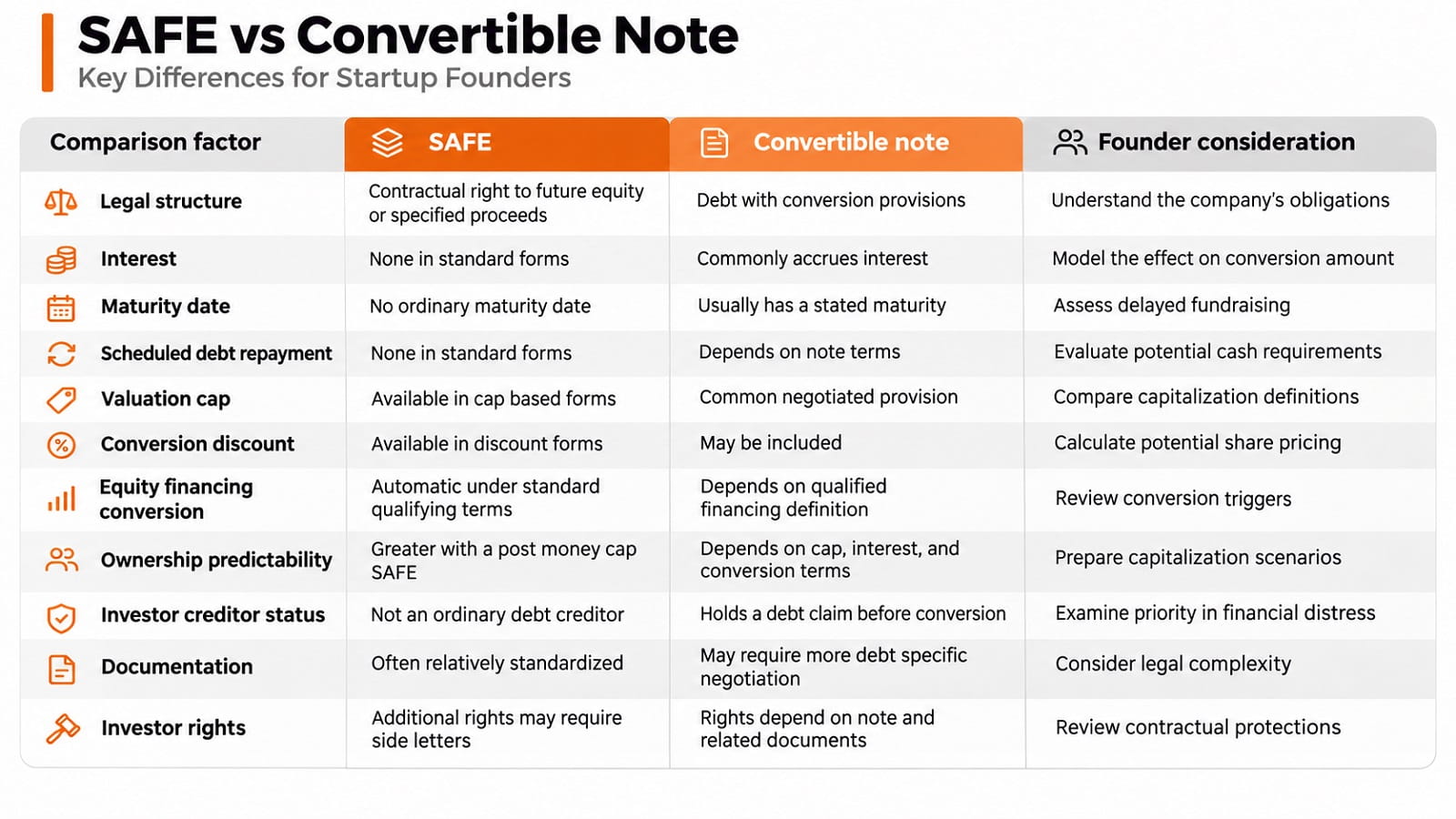
The most consequential differences involve interest, maturity, and the legal position of the investor before conversion. A SAFE generally avoids conventional debt repayment pressure, while a convertible note gives the investor a debt claim that may become important if the company encounters financial difficulties. However, neither financing structure should be evaluated without examining its valuation provisions and the ownership consequences of conversion.
How Financing Timelines Affect the Choice
The expected timing of the next priced financing can influence whether a SAFE or convertible note is more appropriate.
A startup that expects to raise institutional equity but cannot predict exactly when the round will occur may prefer a standard SAFE because it has no ordinary maturity date. The company can continue operating without a contractual loan deadline becoming due solely because fundraising takes longer than expected.
A convertible note introduces a different consideration. If the instrument matures before a qualified financing takes place, the agreement may provide for repayment, extension, conversion at maturity, or another negotiated outcome.
These provisions can give investors additional protections but may also expose the company to financial pressure at a difficult time.
When the Next Financing Is Delayed
Suppose a startup originally expects to raise a priced round within 12 months, but customer development and market conditions delay that financing by another year.
Under a standard SAFE, the passage of time does not ordinarily increase the investment amount through interest or trigger a loan maturity. The agreement remains outstanding until an applicable conversion, liquidity, dissolution, or other termination event occurs.
Under a convertible note, interest may continue accruing during the delay. The parties may also need to address the note's maturity provisions before the anticipated financing takes place.
This difference can become especially important when the company is consuming cash and has limited resources available for repayment.
Why Investor Expectations Matter
Some investors prefer convertible notes because the debt structure establishes contractual creditor rights before conversion. Others may accept standard SAFEs because they are familiar with the documents and comfortable receiving equity only after a specified event.
Investor preference should not override the company's financial interests. Founders should assess whether additional repayment rights are justified by the investment terms and whether the resulting obligations remain manageable.
The negotiation should also establish how investors expect to participate in future financing and whether any additional rights are granted through separate documents.
Valuation Caps, Discounts, and Ownership Dilution
Both instruments can provide investors with favorable conversion economics, but the method used to determine the conversion price is important.
A valuation cap can establish a pricing ceiling that benefits the early investor when a later financing values the company above that cap. A discount may provide the investor with shares at a reduced price compared with the price paid by new investors.
The instruments do not necessarily apply these mechanisms in the same way.
Post Money SAFE Ownership
For a standard post money valuation cap SAFE, the investment amount divided by the cap provides a useful measure of the ownership sold before dilution from new capital in the priced financing and certain related option pool increases.
For example, a $200,000 investment at a $4 million post money valuation cap represents 5% under the standard cap based calculation.
This ownership estimate is relatively transparent because the post money framework accounts for the relevant SAFE financing in its capitalization calculations.
However, the percentage does not represent guaranteed ownership after the future priced round. New equity investment and changes to the employee option pool may reduce it.
Convertible Note Ownership
A convertible note generally requires a different calculation. The principal and applicable accrued interest determine the amount that converts, while the agreement's valuation cap or discount establishes the conversion price.
The valuation cap must be interpreted using the contract's capitalization definition. A $4 million cap in a note is not automatically economically equivalent to a $4 million post money SAFE cap.
Convertible notes commonly use different capitalization conventions, and their conversion calculations can be influenced by outstanding securities, option pools, and financing terms.
Founders should therefore avoid comparing the two instruments using valuation cap amounts alone.
Why Interest Changes the Calculation
Interest can increase the balance that converts into equity under a convertible note.
A note with $200,000 in principal and 6% annual simple interest would accrue $18,000 over 18 months.
If both principal and interest convert, the total amount used in the share calculation becomes $218,000.
A standard SAFE with the same initial investment would not accumulate an additional $18,000 through ordinary loan interest.
Nevertheless, that difference alone does not determine which instrument creates greater founder dilution. The comparison must also account for the conversion prices and capitalization definitions.
A Practical SAFE vs Convertible Note Example
Consider Luma Analytics, a fictional software startup that wants to raise $200,000 before completing its first institutional equity round.
The founders are evaluating two hypothetical proposals. One investor offers to invest through a standard post money valuation cap SAFE. Another proposes a convertible note with interest and a valuation cap.
Both proposals provide the same initial capital. However, their conversion mechanics differ.
For the SAFE, assume a $4 million post money valuation cap and that the cap determines the conversion outcome.
For the note, assume a $4 million pre money valuation cap, 6% annual simple interest, and conversion after 18 months. The illustration uses 4 million existing shares as the agreed pricing denominator and assumes all accrued interest converts.
To isolate the mechanics, the example excludes additional convertible securities, option pool adjustments, fees, and the new shares issued to priced round investors.
Comparing the Two Structures
The SAFE's simplified ownership calculation is $200,000 divided by $4 million, producing 5%.
The convertible note accrues $18,000 in simple interest over 18 months, producing a conversion balance of $218,000.
Using the assumed pre money note capitalization, dividing the $4 million valuation cap by 4 million existing shares produces a conversion price of $1 per share. The investor consequently receives 218,000 shares.
The following table presents the calculation and the resulting ownership before new priced round shares are issued.
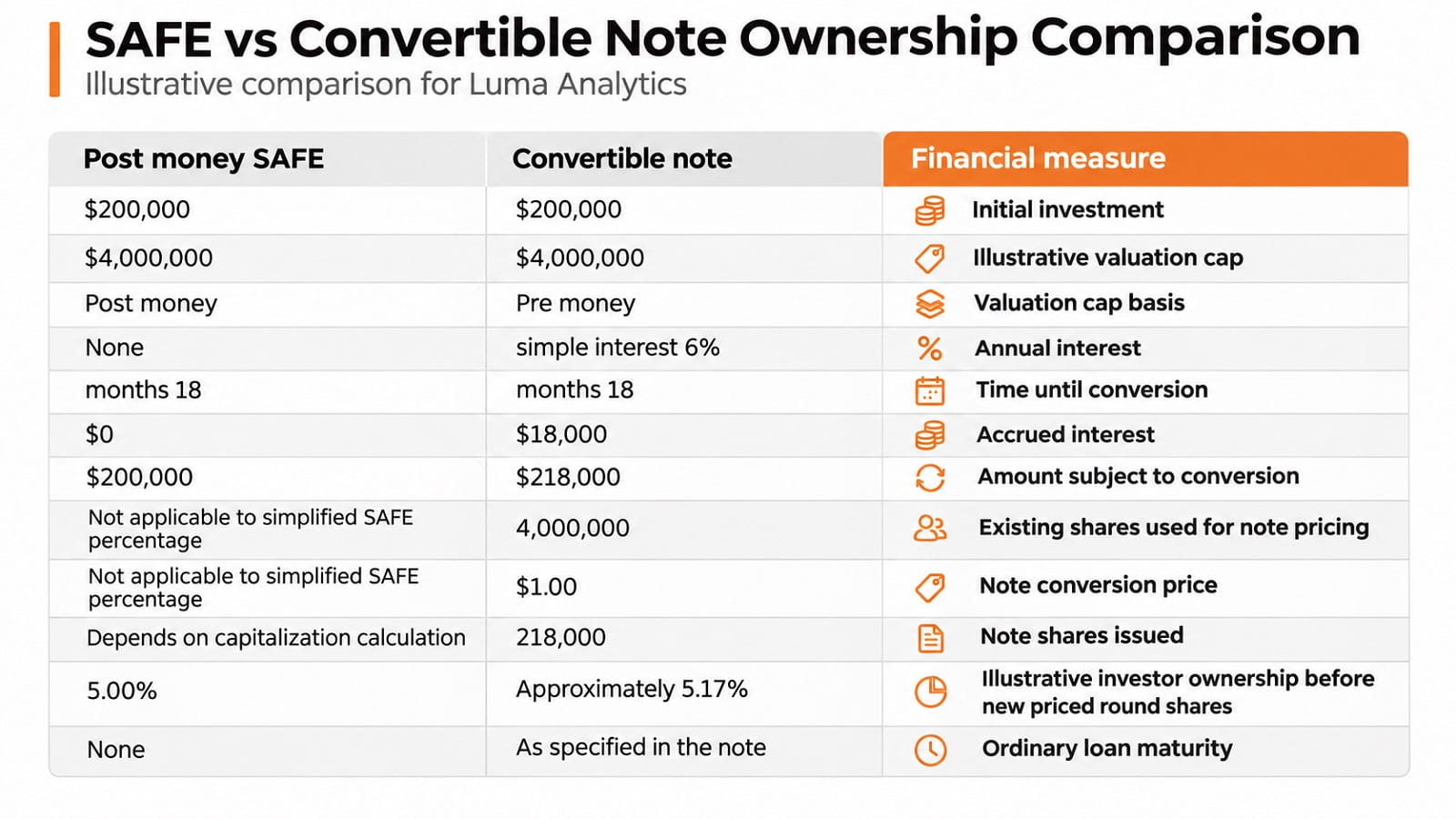
The note investor's illustrative ownership is calculated by dividing 218,000 shares by 4,218,000 total shares immediately after conversion and before any new priced round issuance. The SAFE percentage comes from the standard post money cap formula. These percentages are not a comparison of economically identical caps because the agreements use different valuation bases. They demonstrate why founders must normalize capitalization assumptions before comparing competing offers.
Interpreting the Results
Both investors contribute $200,000, but the contractual structures produce different calculations.
The SAFE provides a 5% ownership estimate under the stated cap assumptions without an interest component. The convertible note creates an additional $18,000 conversion amount through interest and produces approximately 5.17% ownership under the simplified share calculation.
The result does not establish that SAFEs always create less dilution. A lower SAFE valuation cap could create greater ownership dilution than a note carrying interest but converting at a higher price.
Likewise, a convertible note's discount could become more favorable than its valuation cap, depending on the financing valuation and the agreement.
The correct comparison requires a common capitalization model that incorporates the actual contract definitions and expected financing terms.
What Happens if the Company Is Acquired Before Conversion?
An acquisition before the priced equity round introduces another important difference.
A standard YC SAFE includes liquidity event provisions governing what the holder may receive if a qualifying sale or other liquidity transaction occurs before ordinary conversion.
Depending on the SAFE form and transaction, the investor may receive an applicable cash amount or proceeds based on the contractual conversion calculation, subject to the agreement's priority rules and available consideration.
A convertible note may instead provide for repayment of outstanding debt, a conversion election, a negotiated premium, or another treatment upon a change of control.
These outcomes are not interchangeable.
The company should review how each instrument operates when a sale occurs at a relatively low valuation, particularly when existing debt and preferred shareholders also have claims on the transaction proceeds.
The presence of a contractual payment right does not guarantee full recovery if the company's available assets or sale proceeds are insufficient.
Which Instrument Is Better for Early Stage Fundraising?
A standard SAFE may be more appropriate when founders want a relatively straightforward financing structure, investors accept the absence of conventional debt rights, and the company cannot predict when its next priced round will occur.
A convertible note may be appropriate when an investor requires debt treatment or the company has negotiated specific maturity and repayment protections that both parties consider acceptable.
The decision should be based on actual financing circumstances rather than assuming the instrument most commonly used in the market must be the best option.
Choose a SAFE When Simplicity and Timing Flexibility Matter
A startup that is still validating its product may find a SAFE attractive because there are no ordinary interest or maturity obligations.
This can reduce the need to renegotiate debt terms if commercial development takes longer than anticipated.
However, the company must understand how much future ownership it is committing, particularly when raising multiple SAFEs at different valuation caps.
Consider a Convertible Note When Debt Terms Are Deliberately Negotiated
Some financing transactions involve investors who specifically require creditor rights or prefer a formal debt arrangement.
A convertible note may satisfy those expectations while permitting conversion at a future equity financing.
Founders should ensure that the maturity date and repayment terms remain realistic. A note that provides favorable initial financing terms but creates an unaffordable maturity obligation may not serve the company's interests.
Evaluate Jurisdiction and Investor Requirements
SAFE and convertible note documentation should be assessed under the laws applicable to the company and transaction.
Y Combinator provides standardized SAFE forms for certain jurisdictions, but those documents are not automatically suitable for every country or corporate structure.
Tax treatment, securities compliance, corporate approvals, and accounting classification can also vary.
Founders should obtain jurisdiction specific advice before relying on a standardized document or adopting terms from another market.
Mistakes Founders Should Avoid
One common mistake is selecting a SAFE solely because it has no interest. Although that removes one source of increasing financing obligations, a low valuation cap can still create substantial future ownership dilution.
Another mistake is comparing valuation caps without checking whether they use comparable pre money or post money capitalization definitions. Identical headline values can produce different economic outcomes.
Founders may also underestimate the significance of a convertible note's maturity date. An expected financing round is not guaranteed, and the company may need to negotiate with investors or satisfy debt obligations if that round does not occur.
A further problem arises when startups issue SAFEs and convertible notes without reviewing their interaction. Debt claims may rank ahead of SAFE entitlements in a sale or dissolution, while different conversion provisions can complicate later financing calculations.
Finally, founders sometimes focus on signing quickly without preparing a consolidated capitalization model. Even standardized agreements should be assessed alongside existing investor rights, outstanding securities, and anticipated financing arrangements.
Final Thoughts
The SAFE vs convertible note decision ultimately concerns the balance between financing flexibility, investor protection, and future ownership dilution.
A standard SAFE avoids conventional interest and maturity obligations, making it useful for some early stage companies with uncertain fundraising timelines. A convertible note provides a debt structure with contractual repayment and conversion provisions that may better match certain investor requirements.
Neither instrument eliminates the need to understand valuation caps, capitalization definitions, and the consequences of a future financing. Founders should compare realistic conversion outcomes, identify obligations that may arise before conversion, and ensure that the financing arrangement supports the company's development rather than creating avoidable financial pressure.
FAQ
Is a SAFE Better Than a Convertible Note?
A SAFE can be preferable when founders want a financing instrument without ordinary interest or maturity obligations. A convertible note may be more suitable when investors require a debt structure. Neither instrument is universally better.
Is a SAFE Considered Debt?
No. A standard Y Combinator SAFE is not a conventional debt instrument. It provides contractual rights relating to future equity or specified settlement events without ordinary loan interest or maturity.
Which Causes More Founder Dilution?
Neither instrument inherently causes more dilution in every situation. The outcome depends on investment amounts, valuation caps, discounts, accrued interest, capitalization definitions, and subsequent equity financing.
Do Convertible Notes Always Have a Maturity Date?
Convertible notes generally include a maturity date because they are debt instruments. The consequences of reaching maturity depend on the agreement, including repayment, extension, and possible conversion provisions.
Can a Startup Use Both SAFEs and Convertible Notes?
Yes, although combining them can create additional complexity. Founders should review conversion terms, repayment priorities, existing contractual restrictions, and their combined effect on the capitalization table.
Which Is Faster to Complete?
A standard SAFE may involve less documentation and negotiation than a customized convertible note. However, completion time depends on investor requirements, company approvals, legal review, and the complexity of the financing.
What Happens if the Startup Never Raises Another Equity Round?
A standard SAFE may remain outstanding until another contractual event occurs. A convertible note may reach maturity and require repayment, extension, conversion, or another settlement according to its terms.
Do SAFE Investors Receive Shares Immediately?
No. A standard SAFE gives the investor contractual rights before conversion. Shares are generally issued when a qualifying equity financing occurs or another applicable provision requires a different settlement.

Mobina Khanki
Venture & Funding Writer at PinerookMobina Khanki covers venture capital, startup funding, fundraising, and startup finance for Pinerook, focusing on founders and investors.
 Seen first.