Synthetic data is artificially generated information designed to reproduce specific patterns, structures, or characteristics of real-world data. Companies use it to train AI models, test software, simulate scenarios, and develop products when real data is limited, sensitive, or expensive to collect. It can take the form of customer records, financial transactions, images, text, or entire simulated environments.
Its value lies in creating information for a defined purpose. The important distinction is that synthetic data can reproduce useful characteristics of reality without being a direct record of an actual event. Whether it is accurate enough to support a product decision depends on how it was generated and tested.
Synthetic Data Generation Process
Synthetic data generation begins with a defined purpose: identifying the information a system needs and the characteristics that information must preserve.
Consider a financial technology startup developing a fraud detection model. Its transaction database contains thousands of legitimate payments but very few confirmed fraudulent transactions. Training a model only on the available records leaves it with limited examples of fraudulent behavior.
A synthetic data generator can create additional transaction records with specified fraud patterns. Those records can represent combinations of transaction amounts, account activity, payment locations, and behavioral signals that the original dataset does not adequately cover.
The generated records are not evidence that those transactions occurred. They provide controlled examples for model development and testing.
The generation process follows five stages:
Define the objective: Establish whether the data will support AI training, software testing, simulation, or analysis.
Identify the source information: Use permitted real datasets, statistical specifications, business rules, or simulated environments.
Select the generation method: Choose an approach capable of reproducing the required structures and relationships.
Generate the dataset: Create records or simulated observations according to the selected method.
Validate the output: Test statistical consistency, practical usefulness, and privacy risks before using the data.
The source information is especially important. If a dataset contains incorrect relationships, outdated patterns, or incomplete examples, a model trained on it can reproduce those weaknesses.
Synthetic data does not automatically correct problems inherited from its source.
Methods Used to Generate Synthetic Data
There is no single algorithm responsible for synthetic data generation. Different techniques solve different problems, from generating basic customer records to producing realistic driving environments.
Rule-Based Generation
Rule-based generation creates information according to predefined conditions.
An online store testing its checkout system can generate thousands of fictional customers with valid email formats, delivery addresses, product identifiers, and purchase histories.
Rules determine which values are permitted and how they relate to one another. For instance, an order cannot have a delivery date earlier than its purchase date.
This approach works well when the objective is to test functionality or reproduce specific business scenarios without learning statistical relationships from a real dataset.
Statistical Modeling
Statistical generation uses probability distributions and relationships to construct new observations.
A retail company could generate transaction amounts based on historical purchasing patterns while maintaining relationships between product categories, order values, and customer segments.
Methods such as distribution sampling and probabilistic modeling are useful when statistical behavior matters more than reproducing individual records.
Their reliability depends on how well the selected model represents the relationships needed for the intended analysis.
Generative AI Models
Machine learning approaches such as Generative Adversarial Networks (GANs), Variational Autoencoders (VAEs), diffusion models, and transformer-based systems can generate more complex synthetic datasets.
GANs use a generator and discriminator during training to improve the realism of generated samples. VAEs learn compressed representations from which new observations are sampled. Diffusion models generate data through a learned denoising process, while transformer-based models can produce structured text, conversations, and other sequences.
These methods are useful when simple rules cannot represent the complexity of the desired information.
However, greater model complexity also introduces training costs, validation requirements, and the risk of reproducing unwanted patterns from source data.
Simulation-Based Generation
Simulation creates data by modeling an environment, its objects, and their interactions.
An autonomous vehicle developer can simulate roads, pedestrians, weather conditions, and traffic situations. The simulation produces camera images, sensor observations, and corresponding labels.
The advantage is control over conditions that would be difficult, expensive, or dangerous to reproduce physically.
The limitation is equally important: a simulated environment must represent the relevant aspects of reality accurately enough for the intended use.
Types of Synthetic Data
Synthetic data can be classified by how much information is generated and how much original data remains in the resulting dataset.
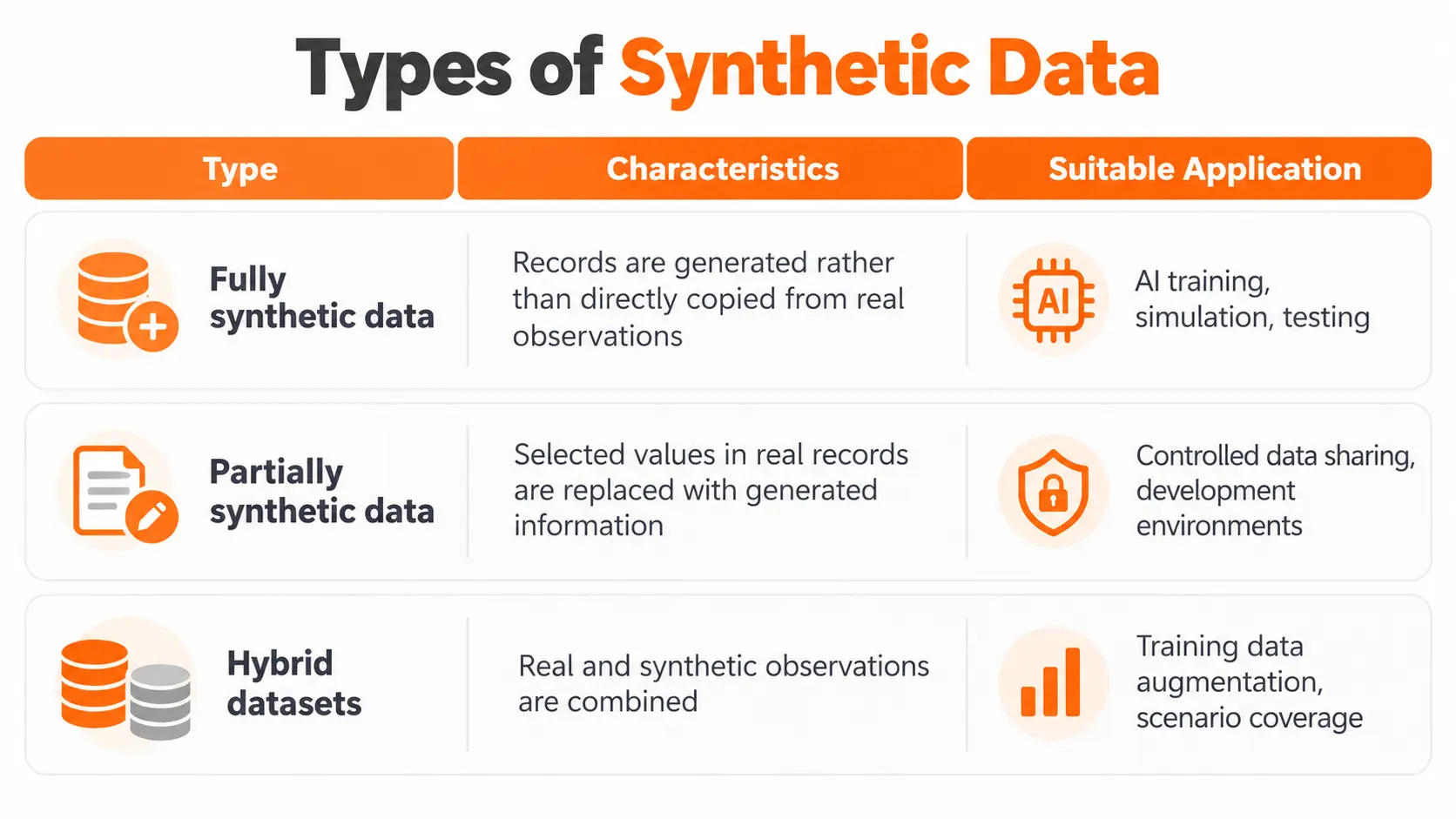
These categories describe how datasets are constructed, not whether they are automatically safe to share.
Fully synthetic data can be generated from defined rules or from a model trained on sensitive records. In the second case, the generator's behavior still requires privacy assessment.
The format of the output introduces another distinction.
Structured data consists of records organized into defined fields, such as transactions, account balances, or customer information.
Synthetic Tabular Data is particularly relevant to companies developing analytical systems and machine learning products using database tables. A generator can reproduce relationships across fields and, with the appropriate approach, between connected tables.
Unstructured data includes images, audio, and free-form text. These formats require different generation and evaluation techniques because their useful characteristics cannot be reduced to database field constraints.
Synthetic data also includes time-series information, such as sequences of sensor measurements, electricity consumption, and equipment activity. For these datasets, the order and timing of observations matter as much as their individual values.
Synthetic Data vs Real-World Information
The distinction behind Synthetic Data vs Real Data is not which dataset looks more convincing. It is whether the information represents actual observations or artificially constructed examples.
Real data records events, measurements, and behavior that occurred. Synthetic data creates observations according to a defined generating process.
Both have a role in developing reliable AI systems.
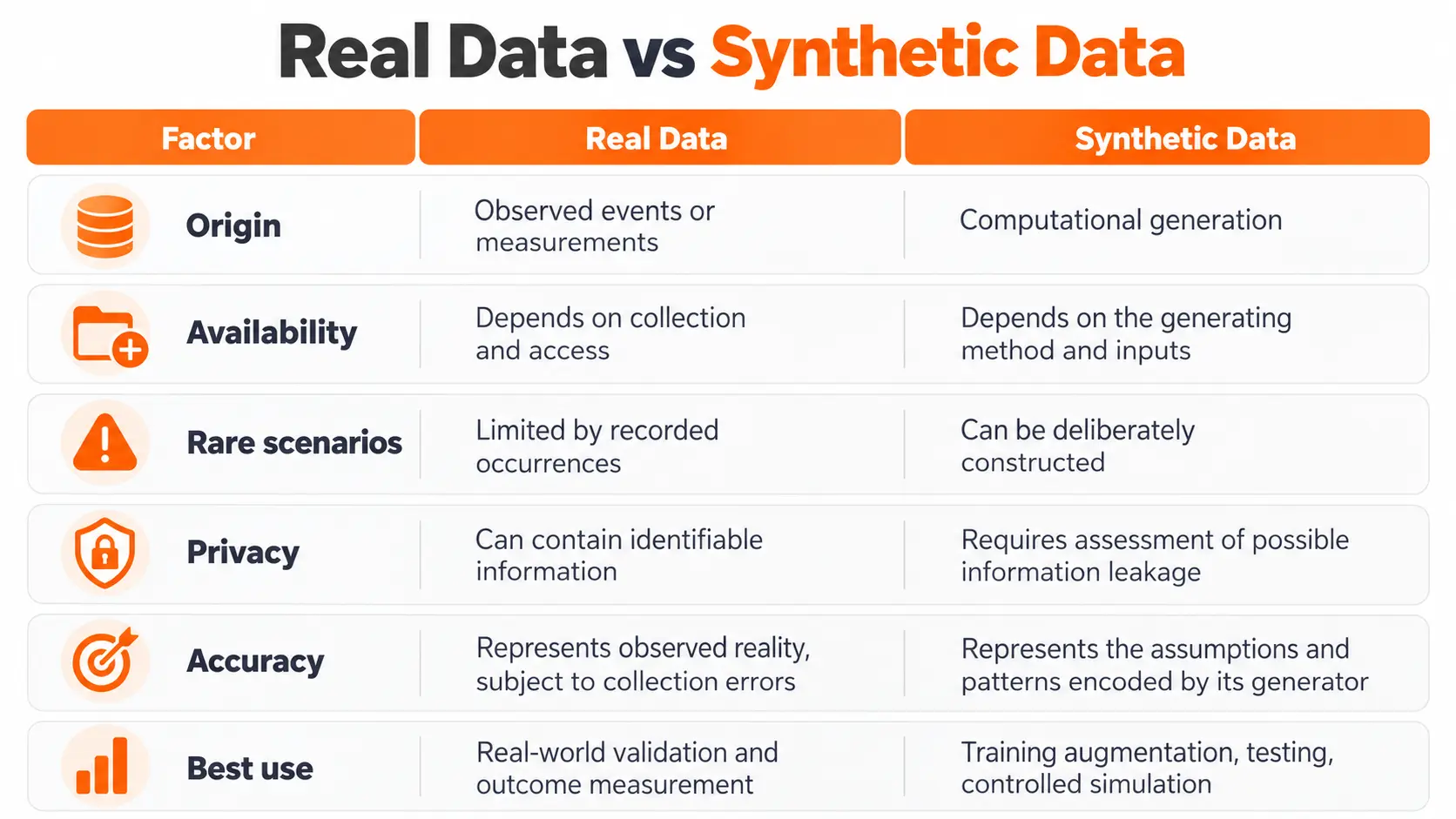
One distinction matters particularly for product teams: synthetic data is not the same as anonymized data.
Anonymization modifies or processes existing information to reduce the ability to identify individuals. Synthetic generation creates artificial observations, although some techniques retain parts of real records.
Neither label provides an automatic privacy guarantee.
I would treat real data as the reference for demonstrating real-world performance and synthetic data as a controlled resource for improving coverage, development, and testing. A model that performs well on generated examples still needs independent evaluation against representative real observations.
Synthetic Data Applications in AI and Software Development
Synthetic data becomes valuable when it solves a specific limitation in collecting or using real-world information.
AI Model Training
Machine learning systems need examples that reflect the patterns they are expected to recognize.
An AI developer working with an imbalanced dataset can generate additional examples of an underrepresented class. For instance, a fraud detection model can receive more examples of suspicious transaction patterns.
The objective is not simply to increase the number of training records. It is to expose the model to useful variation while preserving meaningful relationships.
Generated samples must be evaluated against real outcomes to determine whether they improve performance.
Computer Vision and Autonomous Systems
Synthetic Data for Computer Vision supports applications such as object detection, image segmentation, industrial inspection, and autonomous navigation.
A manufacturer developing an AI inspection system can generate images showing different lighting conditions, object positions, and product defects.
In simulation-based pipelines, corresponding labels can be produced automatically because the system controls the location and identity of simulated objects.
This reduces dependence on manually collecting and labeling every visual scenario.
The difference between generated imagery and actual camera output remains a technical challenge. Lighting, textures, sensor noise, and environmental behavior must be represented sufficiently for the target application.
Software Testing and Development
Software teams need realistic test environments without exposing customer information or depending on production databases.
Synthetic Test Data provides generated records for checking application behavior, database operations, API responses, and system performance.
For example, a payment application can be tested against thousands of fictional transactions with different currencies, payment statuses, refund conditions, and account relationships.
The generated dataset can deliberately include invalid records, missing values, and boundary conditions to verify how the software responds.
This creates reproducible testing scenarios without requiring actual customer transactions.
Research and Data Analysis
Research teams use synthetic datasets to experiment with analytical methods and test processing workflows when access to original records is restricted.
A healthcare research team, for example, can use generated patient-like records to develop analytical software without putting actual patient identities into the development environment.
However, synthetic results do not establish clinical findings. Conclusions requiring real patient outcomes must be validated using appropriately governed real-world data.
The same principle applies to financial analysis, market research, and scientific modeling.
Business Benefits and Practical Limitations
For startups, the strongest argument for synthetic data is control over the information used during development.
A team can define specific scenarios, generate additional records, and test product behavior without waiting for every possible real-world event to occur.
That control provides three practical advantages.
Faster development: Engineers can build and test applications before obtaining full access to production information.
Broader scenario coverage: Teams can construct rare, extreme, or previously unobserved conditions to examine system behavior.
Reduced exposure of production records: Artificial datasets can reduce the need to copy customer information into development systems when the generation process meets the required privacy controls.
These advantages do not eliminate the cost of creating, maintaining, and validating the data.
A synthetic dataset can also fail to represent reality in ways that are difficult to detect. A generator trained on incomplete records can omit important variations. A simulated environment can introduce unrealistic patterns. Repeated training on poorly validated generated content can reinforce errors.
The practical measure of value is therefore not the number of artificial records produced. It is whether those records help the product perform better or allow a necessary test to be completed reliably.
Synthetic Data Quality and Validation
A visually realistic dataset is not necessarily useful.
A collection of generated customer transactions can appear convincing while containing unrealistic relationships between income, spending, and account activity.
Synthetic Data Quality focuses on determining whether generated information meets the requirements of its intended application.
Three evaluation dimensions are especially important.
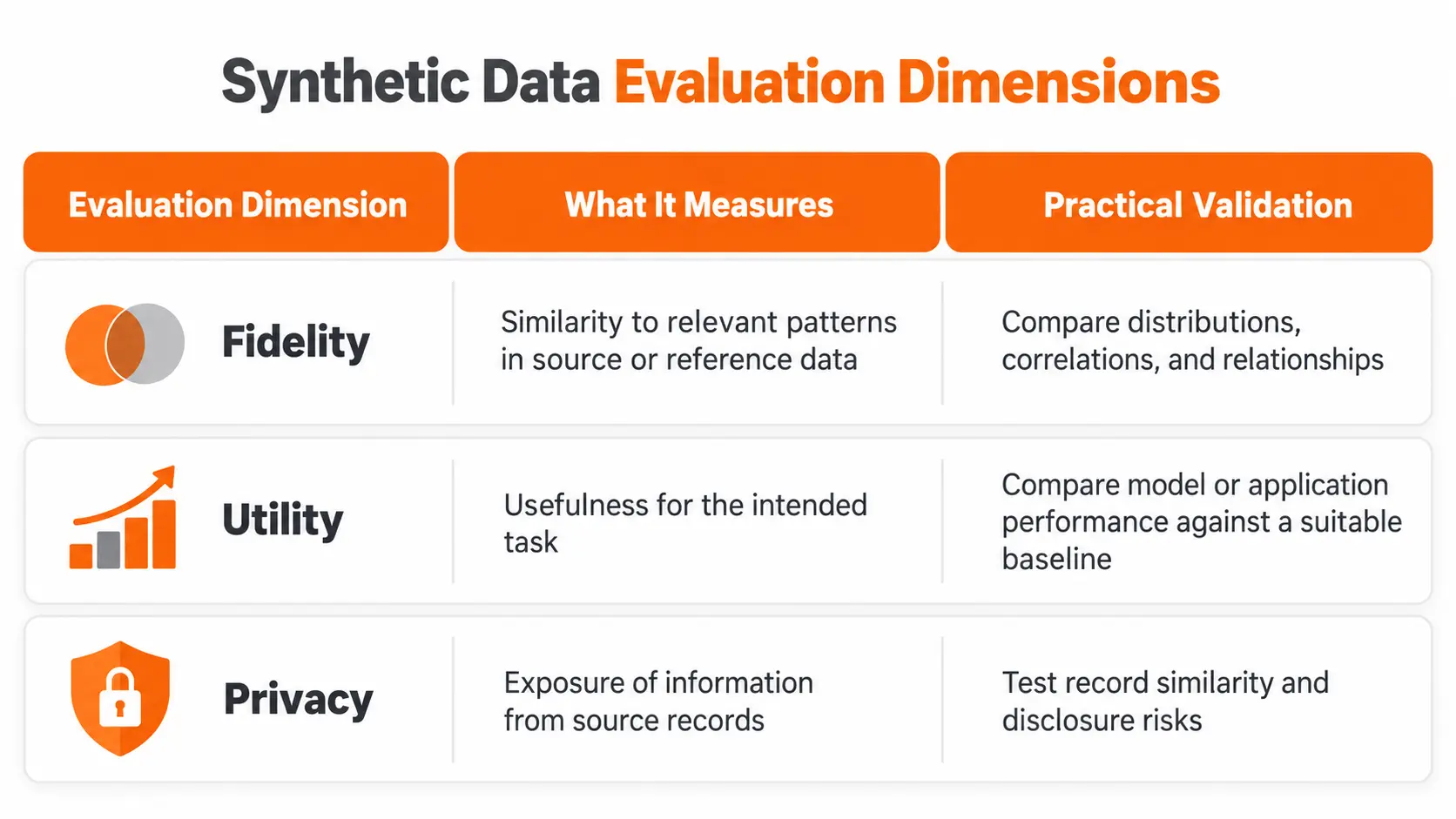
The evaluation process must match the use case.
For machine learning, a useful experiment compares model performance under different training conditions. A team can train one model on permitted real training data and another using synthetic or augmented training data, then evaluate both against the same independent real test set.
For software testing, statistical similarity alone is insufficient. The generated records must satisfy schema requirements, relational constraints, and the specific conditions under test.
Quality thresholds should be defined before generating the dataset. Otherwise, teams risk accepting output simply because it looks realistic or produces an attractive benchmark.
There is also a trade-off between preserving detailed relationships and protecting the source information. Optimizing for maximum similarity without evaluating privacy can produce a dataset that is unsuitable for sharing.
Privacy, Security, and Data Ownership
Synthetic data is widely discussed as a way to reduce dependence on sensitive information, but artificial generation does not automatically remove privacy or legal obligations.
A model trained on personal information can reproduce individual characteristics or records closely enough to create disclosure risks.
NIST distinguishes ordinary synthetic generation from methods that provide formal privacy protections, such as differential privacy.
For organizations handling sensitive data, the generation process needs documented access permissions, appropriate security controls, privacy testing, and rules governing downstream use.
Data ownership also matters. A company must have the necessary rights to use source information for the proposed generation process.
Producing artificial records does not cancel contractual restrictions attached to the underlying data.
These requirements should be addressed before a dataset is distributed to external teams, partners, or customers.
Choosing Synthetic Data Generation Tools
The right generation software depends on the dataset format, the required relationships, and the intended use.
Synthetic Data Generation Tools range from simple record generators to statistical modeling libraries and specialized simulation platforms.
For example, Faker supports rule-based generation of fictional values such as names, addresses, and dates. SDV provides methods for generating synthetic structured datasets, while simulation environments such as NVIDIA Omniverse support creating virtual environments for visual and physical scenarios.
These tools do not solve the same problem.
A developer creating fictional user accounts for a checkout test does not need the same infrastructure as a team producing statistically representative financial transactions or synthetic camera images.
The selection criteria should include:
Data compatibility: Support for the required format, schema, and relationships.
Generation control: Ability to specify rules, distributions, and target scenarios.
Evaluation capabilities: Availability of statistical, task-specific, and privacy assessments.
Deployment requirements: Infrastructure needs, access controls, and integration with existing systems.
Total cost: Software, compute resources, engineering work, and validation effort.
For a startup, choosing a technically sophisticated generator without a clear application creates unnecessary complexity. The simplest approach that satisfies the defined quality requirements is the more useful starting point.
Implementing Synthetic Data in an AI Product
Consider a startup building software to predict equipment failures from industrial sensor readings.
The company has real operating data, but it contains too few examples of critical failures to provide broad coverage during model development.
The first step is to define the failure patterns the model must recognize and identify which relationships between sensor readings need to remain physically plausible.
The team then selects a generation approach capable of representing those relationships. If the product requires temporal dependencies, the generated readings must preserve the timing and progression of events rather than simply reproduce isolated sensor values.
After generating the additional examples, the team examines their physical plausibility and uses them in controlled model-training experiments.
Performance is measured on real sensor observations that were not used to build the generator or train the predictive model.
If the augmented model performs better on relevant real-world cases without unacceptable regressions, the generated data has demonstrated practical value.
If it only improves results on synthetic benchmarks, the evidence is insufficient for deployment.
This distinction is especially important in systems connected to physical safety, financial decisions, or other high-impact outcomes.
Limitations of Synthetic Data in Production
Synthetic data cannot replace every category of real-world evidence.
It does not establish that a customer completed a purchase, that a patient experienced a medical outcome, or that an industrial machine actually failed.
It also cannot compensate for incorrect assumptions about the environment a system operates in.
A generator that excludes an important class of real behavior cannot teach a model to recognize that behavior simply by producing more records from the same incomplete representation.
The same limitation applies when underlying conditions change. Customer behavior, fraud tactics, equipment performance, and market conditions can evolve beyond the patterns represented in an existing generator.
This is why production monitoring and independent real-world evaluation remain necessary after synthetic data enters a development workflow.
Synthetic data is strongest when the required scenario can be specified, generated, and assessed against reliable evidence. Where the objective is to establish what actually happened, real observations remain essential.
The Real Value of Synthetic Data
Synthetic data gives developers greater control over the information used to build and test digital products. It supports experiments that real-world data collection cannot deliver quickly or economically and makes it possible to examine conditions that are difficult to reproduce.
For AI startups, its value is tied to one measurable outcome: whether the generated information helps create a more reliable product.
A well-designed synthetic dataset has a defined purpose, a generation method suited to that purpose, and evidence showing that it meets its quality requirements. Without those elements, more generated data is simply more data.
FAQ
Can I use synthetic data in a public product demo?
Yes, provided the dataset has been reviewed for privacy, licensing, and content risks. Use a controlled demo environment containing fictional identities and transactions. If the demonstration depends on stable results, use a fixed dataset rather than regenerating records during every session.
What if I only have 100 real records to work with?
There is no universal minimum sample size for synthetic data generation. One hundred records can support a simple rule-based test dataset, but they do not establish reliable estimates of complex real-world relationships. For model training, assess the diversity of the source records and validate the generated output against additional independent evidence.
Do I need a GPU to generate synthetic data?
No. Rule-based generators and statistical approaches can run on a standard computer. Training large neural generators or producing high-resolution simulated environments introduces greater computational requirements, where GPU acceleration becomes valuable.
Can I sell synthetic data generated from customer information?
Commercial use depends on the rights attached to the source information, contractual obligations, applicable privacy laws, and the generation method. Creating artificial records does not automatically grant redistribution rights. Legal and privacy review is necessary before selling datasets derived from customer information.
How do I keep synthetic datasets consistent across software releases?
Version the generator, input schema, generation rules, dependencies, and source dataset where applicable. Record random seeds for deterministic processes and preserve an approved reference dataset for regression testing. Compare new outputs against established constraints before replacing the previous dataset.

Fatemeh Jahangard
Technology & AI Writer at PinerookFatemeh Jahangard covers AI, emerging technologies, and digital innovation for Pinerook, focusing on how technology shapes startups and industries.
 Seen first.


