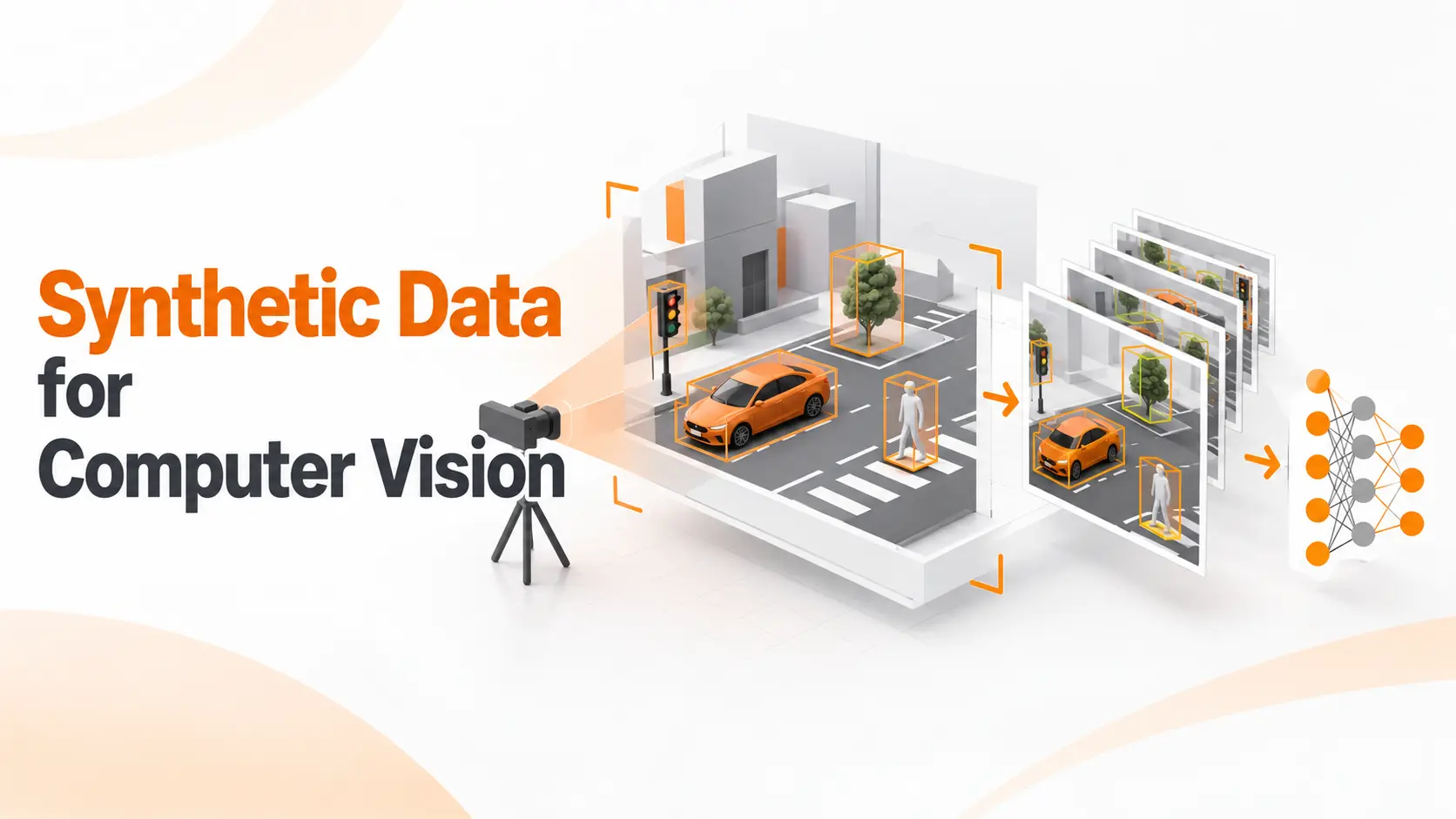
Synthetic data for computer vision refers to artificially generated images, videos, and visual annotations used to train machine learning models. Instead of collecting and labeling every image in the real world, developers create controlled visual scenarios through 3D simulations, computer graphics, or generative AI. These datasets support tasks such as object detection, image segmentation, and image classification.
The advantage of Synthetic Data is not simply the ability to produce more images. It is the control over what those images contain. When building a computer vision dataset, I focus on creating examples that address specific weaknesses in the training data, whether that means different lighting conditions, unusual object positions, or events that are difficult to capture with a camera.
Synthetic Data Generation for Computer Vision
Creating a synthetic image dataset starts with the task the model needs to perform. The generation process for an object detection model differs from the process used to train a semantic segmentation system.
Consider a warehouse camera designed to detect damaged packages.
A real world dataset would require photographing packages under different conditions and manually labeling their locations. With a synthetic pipeline, developers can construct a virtual warehouse, place 3D package models in the scene, introduce visible damage, and render images from different camera positions.
The same scene can produce multiple examples by changing the lighting, package arrangement, camera angle, and background.
A simulation based generator can also export object locations and other annotations directly from the scene.
The practical workflow consists of five stages.
Define the visual task: Identify the objects, conditions, and behaviors the model must recognize.
Prepare the scene or source images: Use 3D assets, simulation environments, or verified visual references that represent the target application.
Generate visual variations: Change scene parameters to cover different appearances, positions, and environmental conditions.
Export images and labels: Produce annotations compatible with the selected computer vision training framework.
Evaluate on real images: Measure whether the model trained with synthetic examples performs reliably under actual deployment conditions.
I establish the real world evaluation dataset before starting generation. Without that reference, generating thousands of images provides no reliable evidence that the resulting model will work outside the artificial environment.
Methods for Generating Synthetic Images
Three approaches are particularly relevant for synthetic image data generation: simulation based rendering, generative AI, and image compositing.
Each provides a different level of control over the visual content and its annotations.
3D Simulation and Rendering
A 3D simulation creates artificial scenes using digital objects, lighting, materials, cameras, and environmental settings.
The simulation engine renders the scene into an image while retaining information about the objects it contains.
For example, a simulated road can contain vehicles, pedestrians, traffic signs, and buildings. The scene can be rendered under different weather conditions, camera positions, and lighting setups.
Because the simulator knows the objects' geometry and location, it can generate bounding boxes, segmentation masks, depth maps, and other ground truth annotations.
NVIDIA Omniverse Replicator provides this type of workflow through scene randomization, annotators, and output writers.
The main advantage is control. Developers decide which objects appear, where they are positioned, and how environmental conditions change.
The limitation is the effort required to build suitable assets and environments. A poorly constructed simulation can reproduce unrealistic visual patterns that do not exist in the intended deployment setting.
Generative AI and Diffusion Models
Generative AI creates artificial images by learning visual patterns from existing data.
Diffusion models can generate new scenes from text descriptions or other conditioning inputs. This supports the creation of visual examples that are difficult to photograph or render through a complete 3D simulation.
For instance, a generative model can produce variations of industrial equipment under different lighting conditions or create additional visual examples of rare surface defects.
However, a realistic synthetic image is not automatically a correctly labeled training example.
A generated image can contain distorted object shapes, inconsistent geometry, or details that differ from its prompt. For object detection and segmentation, the output still requires reliable annotations.
Controlled generation methods can use existing segmentation masks or other spatial guidance to preserve the relationship between the generated image and its label.
This distinction matters when choosing between rendering and generative AI. Simulation offers direct access to scene geometry, while diffusion based generation provides flexibility in visual appearance but requires additional attention to label consistency.
Image Compositing
Image compositing combines visual elements from separate sources.
A developer can place a rendered object onto a real background, adjust its scale and orientation, and generate a new training image.
This approach is useful when suitable object images or 3D assets already exist but the project needs greater background diversity.
For example, a factory inspection dataset can combine images of a component with different production line backgrounds.
The generated image must preserve realistic object placement, perspective, occlusion, and lighting relationships.
Poor compositing introduces visual artifacts that a model can learn instead of the actual features of the object.
Synthetic Data for Object Detection and Segmentation
The type of computer vision task determines which annotations the generated dataset must contain.
The following comparison shows the main requirements.
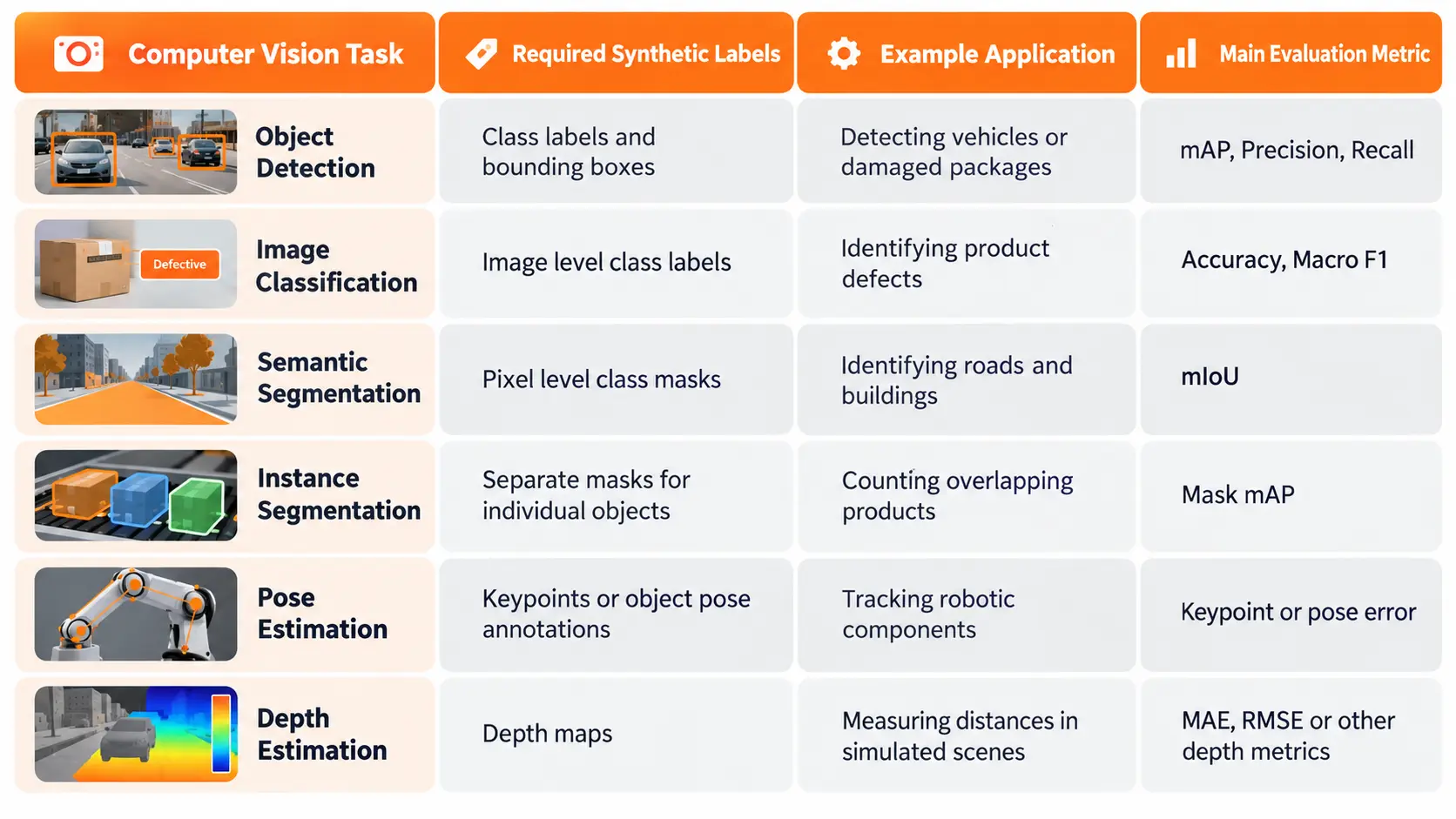
Object Detection
Synthetic object detection datasets contain images with labeled objects and their bounding box coordinates.
In a 3D environment, the positions of rendered objects can be projected into the image to generate these labels.
I would validate that bounding boxes match visible objects, especially when objects overlap, are partly hidden, or extend beyond image boundaries.
The annotation export must also match the model's expected format, such as COCO or YOLO.
A correctly rendered image paired with incorrectly converted bounding boxes is not suitable training data.
Image Segmentation
Segmentation requires more detailed spatial information.
Semantic segmentation assigns class labels to pixels. Instance segmentation additionally distinguishes separate objects belonging to the same class.
A simulator can generate the corresponding masks using its knowledge of the scene.
For example, an autonomous driving dataset can include an RGB road image alongside a semantic mask identifying roads, sidewalks, vehicles, and pedestrians.
I treat mask alignment as a mandatory validation step. Resizing, cropping, or modifying an image without applying the corresponding transformation to its mask creates incorrect supervision.
Image Classification
For image classification, the training target describes the category of the complete image.
A synthetic dataset for defect detection could include rendered images of acceptable products and different defect categories.
The label must correspond to a visually meaningful difference. If generated defective products always have a particular background color, the model can associate the background with the defect instead of recognizing the damaged component.
This is a dataset design problem, not simply a model training problem.
Domain Randomization and Visual Diversity
Domain randomization is a method for improving the variety of synthetic training images by changing parameters within a simulation.
Instead of keeping objects, materials, and environments identical, the generator varies selected scene properties.
These can include lighting intensity, textures, camera positions, object orientation, background objects, and environmental conditions.
For an object detection dataset, I would also vary the apparent object size, visibility, and degree of occlusion.
The objective is to prevent the model from depending on visual details that are specific to one artificial scene.
Research on domain randomization has shown that models trained on deliberately varied synthetic images can transfer successfully to real world detection tasks.
The critical factor is the choice of variations.
Randomizing every parameter without considering the application can produce unrealistic combinations and remove useful contextual information.
For a warehouse camera, the relevant variations should reflect plausible camera positions, package arrangements, lighting changes, and background conditions.
A model does not benefit from arbitrary visual diversity if the generated examples stop representing the task it is supposed to perform.
Synthetic to Real Gap in Computer Vision
The synthetic to real gap, also called the sim to real gap, describes the difference between synthetic training conditions and real world data.
A model can achieve strong performance on rendered images and still perform poorly on real camera footage.
This happens because the generated images and real observations do not share exactly the same visual distribution.
The differences can involve textures, reflections, noise, motion blur, lighting, object geometry, scene composition, and camera behavior.
For example, a vehicle detector trained on clean simulation images can struggle when real vehicles appear through rain, glare, or a low quality camera.
The problem is not solved simply by increasing the number of rendered images.
Reducing the Synthetic to Real Gap
I focus on three areas when designing a dataset intended for real world deployment.
Visual variation: Expand coverage of environmental and camera conditions that influence the target task.
Realistic scene relationships: Preserve meaningful object placement, scale, occlusion, and interactions within the environment.
Real data adaptation: Use representative real images for evaluation and, when available and appropriate, fine tuning.
Domain adaptation provides another approach by attempting to reduce differences between source and target distributions.
The effectiveness of each technique must be measured on real world test data.
A more photorealistic image generator does not automatically produce better model performance. Research has shown that controlled randomization and task specific scene design can outperform more visually realistic alternatives under certain evaluation conditions.
Training Computer Vision Models with Synthetic Data
Synthetic datasets can be used in three training configurations: training exclusively on synthetic data, training exclusively on real data, and combined training.
Each configuration answers a different question.
Synthetic data training measures how much useful information the generated dataset provides without additional real training examples.
Real data training establishes the performance of a model trained on collected and labeled observations.
Combined training evaluates whether synthetic examples improve performance when added to a real training dataset.
For projects with limited real world training data, I would begin with a real data baseline and then introduce synthetic examples addressing specific weaknesses.
A practical object detection experiment could compare three models trained under comparable conditions. The first uses real images, the second uses synthetic images, and the third uses a controlled mixture of both datasets.
All three models should then be evaluated against the same independent real test set.
The comparisons should use the same model architecture, input resolution, evaluation procedure, and comparable training budgets.
For object detection, mean Average Precision (mAP) provides a measure of detection performance across defined conditions. I would also inspect precision and recall for important object classes.
An improvement in aggregate mAP does not establish that the model performs better under every operational condition.
For example, a warehouse detector can improve its overall accuracy while still missing small packages or objects hidden behind others.
Results should be examined by object size, class, lighting condition, and occlusion level when those factors matter to the application.
Combining Synthetic Pretraining and Real Fine Tuning
Another approach is to train a model with synthetic examples and then fine tune it using a smaller collection of real images.
This allows the model to learn from a broad set of artificially generated scenarios before adapting to the visual characteristics of the deployment environment.
The method has produced useful results in object detection and other visual recognition tasks.
The real data fine tuning stage still requires careful evaluation. Additional training does not guarantee that the model will retain every useful pattern learned from synthetic examples.
Automatic Annotation of Synthetic Images
One of the strongest reasons to use simulation based synthetic data is its ability to generate annotations alongside images.
Manual annotation becomes expensive when a dataset requires thousands of bounding boxes or pixel level segmentation masks.
A simulation system can generate these labels using the objects and geometry already present in its virtual scene.
For example, a rendered scene can provide an RGB image together with object identifiers, semantic masks, depth values, and bounding boxes.
However, automatic annotation is only reliable when the scene definitions and export configuration are correct.
I would verify the label pipeline before producing a large dataset.
This includes checking class identifiers, coordinate systems, image dimensions, visibility rules, and the treatment of occluded objects.
A small set of images should be inspected with their annotations overlaid on the rendered content.
Generative AI requires a separate distinction. A model generating images from text does not inherently provide geometrically accurate labels for every generated object. Such labels require a controlled generation process, an additional annotation method, or verification.
Evaluating Synthetic Image Dataset Quality
Image quality and training usefulness are different properties.
A synthetic dataset can contain convincing images while failing to represent the conditions required for model deployment.
I evaluate the dataset on three levels.
Visual and Annotation Quality
First, I inspect whether the images contain the intended objects and conditions.
The review should identify unrealistic geometry, visible generation artifacts, missing objects, incorrect class assignments, and misaligned labels.
For simulation generated images, I also verify that the configured environmental variations appear in the exported dataset.
These checks establish whether the data generation pipeline is functioning as intended.
Dataset Coverage
Next, I examine whether the dataset represents the relevant combinations of objects, backgrounds, camera angles, and operating conditions.
A dataset containing 100,000 nearly identical images provides less useful variation than its size suggests.
I review the distribution of object sizes, class frequencies, lighting conditions, and scene arrangements.
Rare but important events deserve separate coverage.
For example, an autonomous vehicle perception dataset needs to represent conditions such as partial visibility and challenging environmental situations when these are part of the intended operating domain.
Real World Model Performance
The final assessment is performance on real images.
Metrics such as mAP, mIoU, and classification accuracy measure different tasks and should be selected accordingly.
I would retain a dedicated real world test set that does not influence dataset generation, training decisions, or hyperparameter selection.
This separation matters because tailoring the synthetic generator to the final test images can create an overly optimistic evaluation.
The dataset should be accepted based on its contribution to the intended model performance, not on image count or visual realism alone.
Applications of Synthetic Data in Computer Vision
Synthetic image data has practical applications wherever collecting enough labeled visual examples is difficult, expensive, or restricted.
Autonomous Vehicles
Driving simulations can generate road scenes containing vehicles, pedestrians, lane markings, and traffic signs.
They support controlled variation in weather, visibility, traffic density, and camera placement.
These datasets can help develop perception models, but real world testing remains essential before deployment in safety critical environments.
Robotics and Industrial Inspection
Robotic systems use visual recognition to locate objects, estimate poses, and support manipulation tasks.
Synthetic scenes allow developers to vary object orientation, surface appearance, background clutter, and visibility.
For industrial inspection, generated images can also represent selected defect patterns that are scarce in real production records.
Medical Imaging
Synthetic medical images can support research into imaging workflows, model robustness, and training under limited data availability.
However, visual realism does not establish clinical validity.
Medical applications require appropriate expert review, privacy assessments, and validation against representative real clinical data.
Retail and Inventory Management
Computer vision systems in warehouses and retail environments can use synthetic scenes to recognize products, count objects, and identify items in different arrangements.
A generated dataset can represent different shelf layouts, packaging variations, and degrees of object overlap.
The benefit must be verified against the actual cameras and operating conditions used by the business.
Cost and Scalability of Synthetic Image Generation
The cost of synthetic data generation depends on the selected method and the complexity of the visual environment.
3D simulation requires suitable assets, scene development, rendering resources, and annotation configuration.
Generative AI introduces model inference and output validation costs.
Compositing requires usable source images and methods for preserving visual consistency.
I compare the cost of obtaining usable training examples rather than the cost of generating individual images.
For a small object detection project, manually annotating additional real images can be more economical than constructing a complex simulation environment.
For a project requiring repeated generation of thousands of controlled scenes, a reusable simulation pipeline can provide greater value.
The decision depends on the number of required examples, annotation complexity, available resources, and evidence of downstream performance improvement.
Conclusion
Synthetic data for computer vision gives developers direct control over the visual scenarios used to train perception models. Through simulation, generative AI, and image compositing, teams can create datasets for object detection, segmentation, classification, and other visual tasks.
The value of these datasets depends on correct annotations, meaningful variation, and performance on real images.
I consider synthetic generation successful when the additional data improves the model's ability to handle its intended operating conditions. Generating more images is straightforward once a pipeline exists; demonstrating that those images improve real world performance is what makes the dataset useful.
FAQ
Can I use synthetic images to train a pretrained YOLO model?
Yes. A pretrained YOLO model can be trained or fine tuned using synthetic images when the dataset follows the supported image and annotation formats. Class definitions and label coordinates must match the selected task. The resulting model should be evaluated against independent real images before deployment.
Can I create synthetic computer vision data without any 3D models?
Yes. Image compositing, procedural image generation, and generative AI can produce visual training examples without a complete 3D scene. These methods require appropriate labeling and validation. The absence of 3D models does not eliminate the need for reliable annotations.
Can I generate synthetic videos for object tracking?
Yes. Simulation pipelines can generate sequences of frames with controlled object movement and camera motion. Tracking datasets require consistent object identities across frames, along with the relevant location or segmentation labels. Independent frame generation does not automatically preserve temporal continuity.
Can I sell a synthetic image dataset generated with AI?
Commercial distribution depends on the rights associated with source assets, the generation model's terms, software licenses, and applicable intellectual property law. Artificial generation does not automatically remove restrictions attached to copyrighted assets or training materials. These requirements must be reviewed before commercial release.
Do I need to regenerate my dataset after changing the camera?
A camera change requires renewed evaluation because resolution, optics, sensor noise, and image processing can alter the input distribution. If the existing dataset does not represent the new camera characteristics, additional synthetic generation or real data adaptation is needed. The decision should follow performance testing with images from the updated camera.

Fatemeh Jahangard
Technology & AI Writer at PinerookFatemeh Jahangard covers AI, emerging technologies, and digital innovation for Pinerook, focusing on how technology shapes startups and industries.
 Seen first.


