Synthetic test data is artificially generated information used to test software without relying on actual customer records. It can include fake user accounts, transactions, product inventories, payment records, and deliberately invalid inputs. Developers and QA engineers use it to test application behavior, reproduce specific scenarios, and prepare data for automated testing.
The value of Synthetic Data in software testing comes from controlling both the input and the expected result. I prefer starting with the behavior a test needs to verify, then creating the exact data required to exercise it. A thousand random customer records are less useful than one carefully constructed record that exposes a problem in the checkout process.
Synthetic Test Data Examples in Software Testing
An online store offers a straightforward example of how synthetic test data works.
Imagine an application that allows customers to register, place orders, apply discount codes, and complete payments. Each feature requires different data to confirm that it behaves correctly.
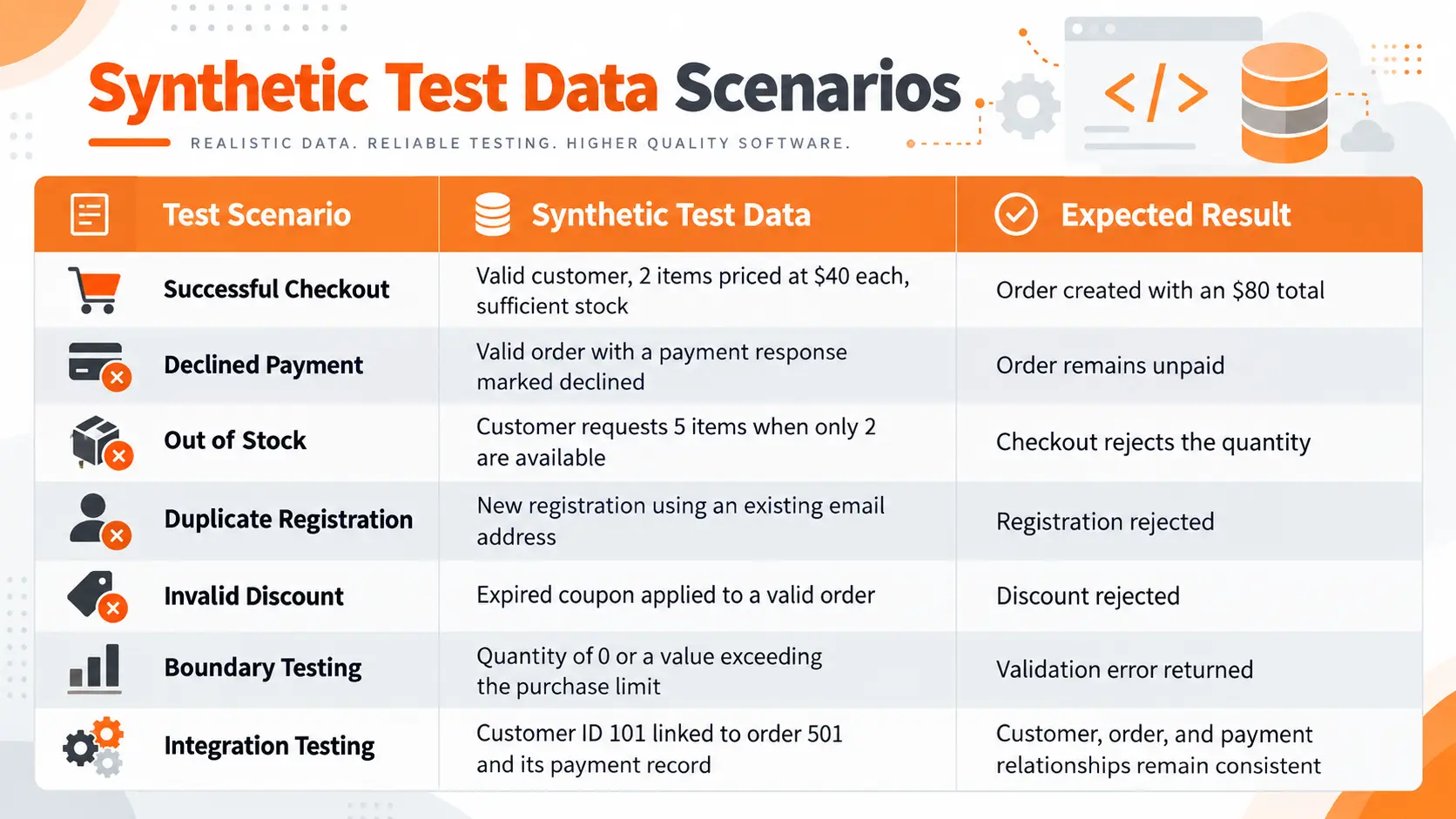
These results assume the store follows the business rules described. Another application can implement different rules, which means its test data and expected results must reflect those requirements.
The important distinction is that synthetic test data should verify a specific behavior.
For example, generating a random discount code tests very little unless the application has a defined rule for accepting or rejecting that code.
Creating Synthetic Test Data for an Online Store
I would begin with a small dataset covering the customer, order, and payment records required for one checkout test.
The objective is to create a realistic transaction without copying anything from the production database.
1. Define the Test Scenario
Suppose the checkout process must prevent a customer from ordering more products than are available.
The test requires a registered customer, a product with a known stock level, and an order request that exceeds that stock.
For this example, the product has three units available and the customer requests five.
The expected outcome is clear: the application must reject the order without reducing inventory or recording a successful payment.
2. Create the Customer Record
The customer needs an identifier, name, and valid email address.
A generated record could contain:
Customer ID: 101
Name: Emma Parker
Email: emma.parker@example.com
The name and email are fictional. The customer ID must be unique within the test environment.
For tests involving registration, I would create the customer through the application's registration interface or API when the registration process itself is being tested.
For checkout tests, inserting an already valid customer through a supported test fixture is more efficient.
3. Generate Related Product and Order Data
Next, create a product with a stock quantity of three and a unit price of $40.
The order references Customer ID 101 and requests five units of that product.
The relationship between the customer and order must be valid. The quantity is deliberately outside the permitted stock limit.
This is an important distinction: the dataset can contain a valid database relationship while the submitted order request violates a business rule.
I would send the invalid quantity through the application's checkout interface or API rather than bypassing the application and inserting an invalid completed order directly into the database.
4. Execute the Test
Run the checkout request using the generated records.
The assertion should verify that the application rejects the requested quantity and preserves the existing inventory.
I would also check that no completed order or successful payment was created.
A test is not complete simply because an error message appears. The resulting system state matters just as much as the response returned to the user.
5. Restore the Test Environment
After execution, the test records should be removed or the environment restored to its original state.
That allows the same scenario to run again without being affected by records from earlier executions.
The generator configuration, expected outcome, and cleanup procedure can then become part of a reusable automated test.
Methods for Generating Synthetic Test Data
The right generation method depends on whether the test needs controlled values, large numbers of varied records, or realistic relationships from an existing dataset.
Rule Based Data Generation
Rule based generation creates records according to predefined formats, constraints, and business rules.
For example, a customer identifier must be unique, an order quantity must be a positive integer for a valid purchase, and a delivery date cannot precede the order date.
Developers can also deliberately generate values that violate those rules to test validation behavior.
I would use this method for boundary testing, negative testing, and scenarios with specific expected outcomes.
The advantage is precision. Every generated value serves a defined purpose.
Random Data Generation
Random generators produce artificial values such as names, addresses, phone numbers, and dates.
Python's Faker library is a familiar example. It can generate realistic looking customer information and supports repeatable generation through random seeds.
This method is useful when an application requires many distinct records for testing forms, search results, or account management features.
However, independently generated values do not automatically satisfy relationships between tables.
A valid looking postal code and a valid looking address can still form an inconsistent combination.
I use random generation for fields that need variation, then apply explicit rules where consistency matters.
Model Based Data Generation
Model based generation learns patterns from an existing dataset and creates new records reflecting those patterns.
This approach can preserve statistical relationships that would take considerable effort to reproduce through manually defined rules.
For example, transaction values, product categories, and ordering frequencies can be modeled to produce a dataset resembling the characteristics of an operational system.
It is particularly relevant for analytics, reporting, and realistic database testing.
The main requirement is access to an appropriate source dataset. If that dataset contains personal information, the generation process and output require privacy assessment.
Model based generation also does not remove the need for deliberately designed test cases. A model trained on common transactions will not guarantee coverage of every unusual payment or account state.
Synthetic Test Data vs Production and Masked Data
Production data, masked production data, and synthetic test data serve different testing requirements.
Production data contains actual operational records. Copying it into a development environment can expose sensitive information and create access and compliance risks.
Masked production data is derived from existing records, with selected values transformed or concealed. It can preserve valuable transaction histories and complex relationships, but masking does not automatically make the dataset anonymous.
Synthetic test data is generated rather than copied record by record. It provides control over the scenarios, formats, and volumes required for testing.
For a new feature with no historical data, I would generate records directly from the application's requirements.
For a complex migration or regression test that depends on historical relationships, a properly protected and authorized production derived dataset can provide useful coverage that is difficult to recreate.
A combined approach is also possible, using protected source data where historical complexity is necessary and generated records to cover missing scenarios.
The decision should follow the test objective and privacy requirements rather than an assumption that one type of data is suitable for every test.
Data Validation and Referential Integrity
Generating records is only the beginning. A test dataset must satisfy the constraints required by the scenario.
I separate validation into two categories: the structural validity of the dataset and the expected validity of the test input.
Database Relationships
Consider three tables: Customers, Orders, and Payments.
Every order must reference an existing customer, and every payment must reference the appropriate order.
If Customer ID 101 does not exist, Order 501 should not reference it as a valid customer.
For generated databases, I would create parent records before dependent records and assign foreign keys from identifiers that have already been generated.
Relationships enforced only in application logic also need to be included in the generation rules.
Field and Business Constraints
The dataset should respect field types, required values, uniqueness rules, and relationships between columns.
An order total must agree with the application's pricing calculation. A completed payment must match the order and currency associated with it.
Dates must also follow the application's business logic.
A field that accepts an integer cannot be populated with arbitrary text in a valid database fixture.
Invalid inputs require a different approach.
If the objective is to verify how an API handles an invalid email address, the invalid value should be submitted through the API so the application can reject it.
I would not force that value into a database table whose constraints explicitly prohibit it.
That separation makes failures easier to interpret. A rejected API request tests application validation, while a failed database insertion tests data integrity constraints.
Synthetic Test Data for Automated Testing
Synthetic data becomes particularly valuable when automated tests can create the records they need without depending on a shared database state.
For a login test, the automation can create a fictional account with known credentials, execute the login request, verify the outcome, and remove the account afterward.
For a checkout test, the setup can create a customer and available inventory before the first request is sent.
Frameworks such as pytest and Playwright support fixtures for preparing test conditions and performing cleanup.
I would keep the generation logic close to those fixtures so the setup remains visible, reusable, and connected to the test that needs it.
Reproducible Test Data
Random generation introduces a challenge when a test fails only with a particular combination of values.
Using a fixed random seed makes generated sequences repeatable under the same generator configuration and software version.
Faker supports instance level seeding through seed_instance().
I would also preserve the generator version, relevant configuration, and scenario identifier when diagnosing a failed test.
The seed alone is not enough to guarantee identical results after generator data or software versions change.
Synthetic Test Data in CI/CD
In a continuous integration pipeline, test data should be available whenever the test suite runs.
The process can create an isolated environment, generate the required records, execute the tests, and then remove the temporary data.
Isolation becomes especially important when multiple test jobs run in parallel.
Two jobs using identical customer IDs or email addresses against the same database can interfere with each other.
Separate databases, schemas, or unique namespaces prevent that collision.
I also keep external side effects under control. Payment requests should use a sandbox, emails should be intercepted by a test service, and generated records should never trigger real customer notifications.
Choosing Synthetic Test Data Generation Tools
The tool should match the complexity of the application and the generation method.
Faker is a strong starting point for developers who need fictional names, addresses, dates, and other values directly inside Python tests.
Mockaroo offers a browser based interface for defining fields and exporting generated records without developing a complete generation script.
Tonic.ai provides products for preparing realistic development data and generating test records within broader engineering workflows.
Synthesized offers generation, masking, and data management capabilities for structured datasets and connected databases.
For a small API test, I would choose a lightweight library and a set of explicit business rules.
For a complex database containing many connected entities, I would evaluate whether a dedicated test data platform can maintain relationships and generate the required volume more efficiently.
The most useful tool is the one that integrates with the existing testing workflow and produces records that the application can actually process.
Synthetic Test Data for Performance and Regression Testing
Performance testing requires more than increasing the number of records in a database.
A system containing one million customers with no orders behaves differently from one containing customers with varied purchasing histories, active subscriptions, and large transaction tables.
I would define the data volumes and relationships that influence the operations being measured.
For example, testing an order history page requires realistic variation in the number of orders per customer, not simply a large number of customer accounts.
Database size also does not replace workload generation. To measure behavior under concurrent traffic, the test must create the required request patterns and user activity.
For regression testing, the priority changes.
I would retain a stable set of scenarios associated with previously verified behavior. These fixtures should be reproducible so a code change can be evaluated against consistent inputs and expected results.
Additional generated records can expand coverage, but they should not replace the smaller set of deterministic regression cases.
Conclusion
Synthetic test data allows development teams to create controlled, repeatable inputs without depending on real customer information.
Its practical value comes from the relationship between the generated records, the behavior being tested, and the expected result.
I would begin with a small collection of clearly defined scenarios, validate their structure and business rules, and integrate generation into the automated testing workflow. Larger datasets and more sophisticated generators become useful when the application's complexity requires them.
Good test data is not measured by how many records it contains. It is measured by how effectively those records help verify the software.
FAQ
Can I create synthetic test data before the software is finished?
Yes. Test data can be generated from API contracts, database schemas, and documented business requirements before the complete application is available. The dataset should be updated as the implementation and validation rules are finalized.
What if my application works with different time zones?
Generate timezone aware timestamps and include scenarios around daylight saving transitions, midnight boundaries, and date conversions. The expected results must follow the application's defined timezone rules. Controlling the system clock during tests also helps prevent date dependent failures.
Can I share synthetic test data with an external development team?
Yes, provided the dataset is cleared for sharing and applicable licenses, confidentiality obligations, and privacy requirements are satisfied. Data generated from sensitive source records requires an appropriate disclosure risk assessment. The term synthetic does not establish that a dataset is safe to disclose.
Can synthetic test data help reproduce a bug that happened only once?
Yes. The relevant application state, input values, and sequence of operations can be reconstructed using generated records. Successful reproduction depends on identifying the conditions responsible for the original failure. Where those conditions remain unknown, additional diagnostic evidence may be required.
How do I stop fake customer records from sending real emails or payments?
Configure the test environment to use isolated email services, payment sandboxes, and controlled external integrations. Test records should also use reserved example domains and nonproduction credentials. Artificial customer information alone does not prevent an application from making real external requests.

Fatemeh Jahangard
Technology & AI Writer at PinerookFatemeh Jahangard covers AI, emerging technologies, and digital innovation for Pinerook, focusing on how technology shapes startups and industries.
 Seen first.


