The best synthetic data generation tools depend on what you need to create. SDV and MOSTLY AI are strong options for structured datasets, Faker and Mockaroo simplify test data generation, NVIDIA NeMo Data Designer supports AI training data, and Omniverse Replicator serves computer vision projects. The key is choosing a tool that supports your data type, preserves the required relationships, and fits your technical budget.
I approach Synthetic Data tools by separating realistic data generation from basic mock data creation. A generator that produces thousands of fake customer names is useful for software testing, but that does not mean its output preserves the statistical patterns needed to train a machine learning model.
Best Synthetic Data Generation Tools at a Glance
The following comparison covers nine tools across structured data, AI training, software testing, healthcare, and computer vision.
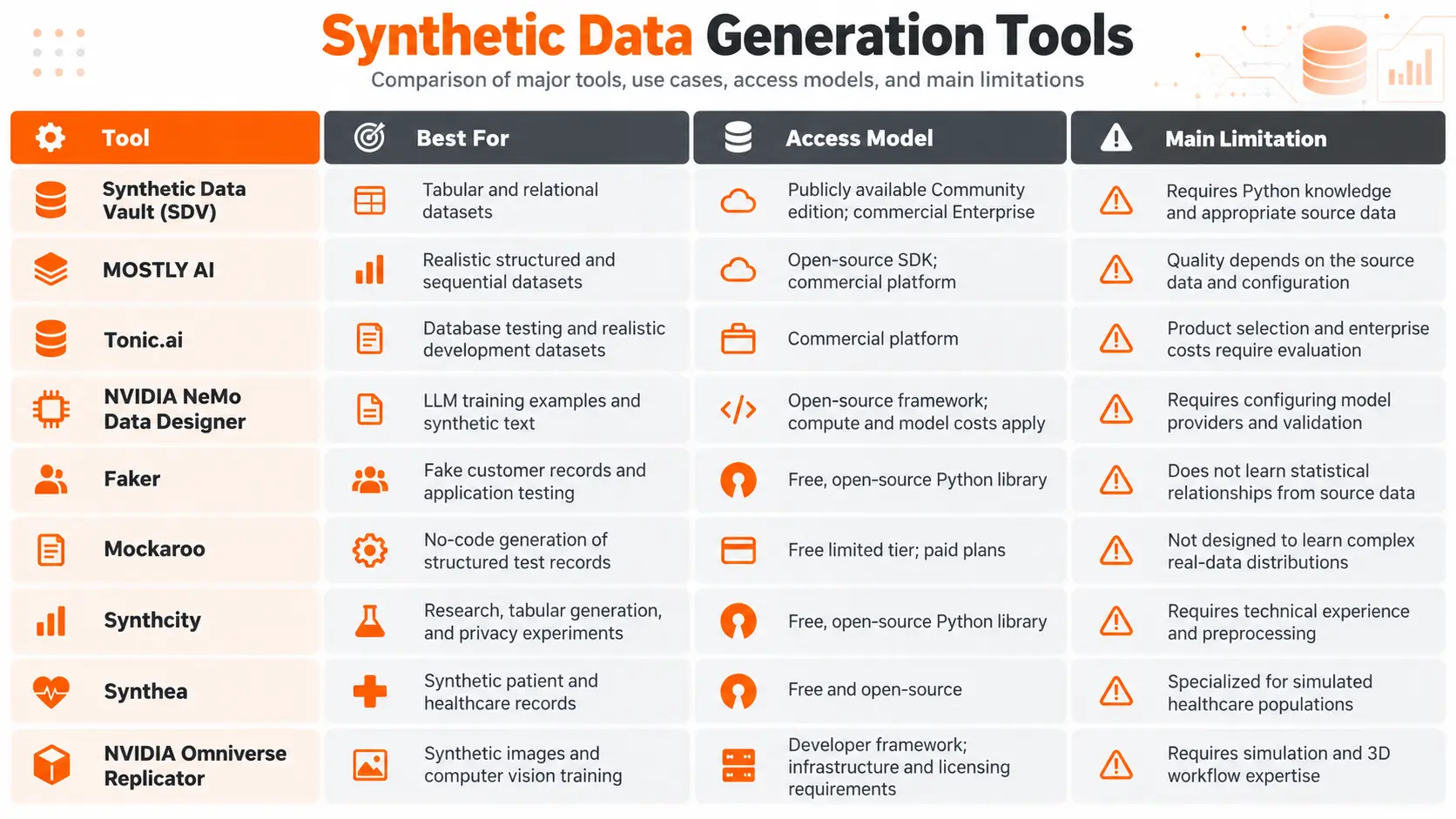
There is no meaningful universal ranking across these tools. A software developer generating test accounts and an ML engineer building a training dataset have different requirements.
For each tool, I examine what it generates, where it fits, and what should be checked before adoption.
Best Synthetic Data Generation Tools
1. Synthetic Data Vault (SDV)
Best for: Structured synthetic datasets and Python based data science workflows
SDV is one of the first tools I would consider for generating synthetic tabular data from an existing dataset.
It supports single table, multi table, and sequential data generation through a collection of synthesizers. These include statistical and neural approaches designed to learn distributions and relationships within structured datasets.
For example, a business could use SDV to generate customer records that reflect important patterns in an existing customer database.
Its main advantage is the combination of data generation and evaluation. SDV works with the SDMetrics ecosystem to help assess statistical similarity and diagnose issues in generated records.
Strengths: Structured data support, multiple generation methods, Python integration, and quality evaluation.
Limitation: Configuring metadata, relationships, and generation settings requires technical knowledge. The Community edition also uses a Business Source License, so teams should review its terms rather than assume it has an unrestricted open source license.
I would select SDV for a data science project where controlling the generation method and inspecting the results are essential.
2. MOSTLY AI
Best for: Structured synthetic datasets with privacy and quality assessment requirements
MOSTLY AI provides a synthetic data platform and a Python SDK for generating artificial datasets based on source data.
The SDK supports local generation, while the broader platform provides additional workflows for managing data sources, generated datasets, and collaboration.
Its capabilities include modeling relationships within structured data, controlled sampling, and quality reporting.
One important advantage is the availability of an open source Synthetic Data SDK under the Apache 2.0 license.
For organizations working with customer, transaction, or operational datasets, this provides a route to developing synthetic data workflows without relying exclusively on a hosted interface.
Strengths: Local SDK, structured data generation, quality reports, and enterprise workflow options.
Limitation: Complex datasets still require validation, privacy review, and technical configuration. The open source SDK and commercial platform do not provide identical operational capabilities.
I would place MOSTLY AI on the shortlist when an organization needs synthetic data generation integrated into a repeatable data workflow.
3. Tonic.ai
Best for: Realistic test databases and software development environments
Tonic.ai offers several products addressing different synthetic data requirements.
Tonic Structural focuses on transforming existing structured data for development and testing while preserving important database relationships. Tonic Fabricate addresses generation of synthetic data from scratch, including scenarios where production examples are unavailable.
This distinction matters.
When a development team needs a realistic copy of a complicated database without exposing sensitive production records, Structural is the more relevant product to evaluate.
When a team needs to create an entirely new dataset, Fabricate serves a different requirement.
Tonic's commercial offerings also include integrations and workflows designed for engineering teams.
Strengths: Database integration, relational consistency, test data management, and enterprise workflows.
Limitation: Product capabilities and pricing vary by solution. Teams must distinguish transformed production data from independently generated records.
4. NVIDIA NeMo Data Designer
Best for: LLM training data and custom synthetic text generation
NVIDIA NeMo Data Designer is designed for building configurable synthetic data generation pipelines.
It can generate domain specific examples from scratch or use seed data to guide generation. Developers define the structure and conditions of the output, select model providers, and incorporate validation into the workflow.
This makes it relevant to projects that need instruction response pairs, classification examples, or specialized training records for language models.
For example, a financial AI project could generate categorized financial headlines and then evaluate whether the generated examples cover its intended topics.
The framework supports reproducible, configuration driven workflows and is available through NVIDIA's public source repository.
Strengths: Configurable generation, LLM integration, validation support, and automation.
Limitation: Generating high quality examples still requires appropriate models, computing resources, and reliable checking procedures. Third party model APIs can introduce additional costs and data-handling considerations.
I would select NeMo Data Designer when the objective is to construct an AI training dataset rather than populate a test database.
5. Faker
Best for: Fast mock data generation in Python applications
Faker is a Python library that generates artificial values such as names, addresses, phone numbers, and dates.
It integrates directly into Python code and supports localization, making it useful for testing applications that require records with realistic looking field formats.
A developer building a customer registration system can use Faker to create hundreds of test accounts without manually entering information.
Its simplicity is the main benefit. Developers can generate values within automated tests and control reproducibility through random seeds.
Strengths: Free, lightweight, local execution, localization, and simple Python integration.
Limitation: Faker does not automatically learn the statistical relationships of an existing dataset. Independently generated fields should not be treated as representative machine learning training data.
I would choose Faker for unit tests, application prototypes, and basic database population, not for preserving complex relationships in real world source data.
6. Mockaroo
Best for: Generating test datasets without writing code
Mockaroo offers a browser based interface for creating structured records.
Users define fields, select the required data types, and generate datasets in formats such as CSV, JSON, SQL, and Excel.
This makes it useful for developers, QA teams, and analysts who need a sample dataset without installing a Python framework.
For example, a product team preparing a dashboard demonstration could create sample orders, product records, and customer information through the browser.
Mockaroo's free plan allows up to 1,000 rows per file, with larger generation limits available through paid plans.
Strengths: Browser based workflow, customizable schemas, multiple export formats, and quick setup.
Limitation: The tool is designed around configurable generation rules rather than automatically learning all relationships from an existing real world dataset.
I would use Mockaroo when speed and simplicity are more important than statistical fidelity.
7. Synthcity
Best for: Research and experimentation with synthetic data algorithms
Synthcity is an open source Python library developed by researchers at the van der Schaar Lab.
It provides access to several families of synthetic data generators, including GAN-based, VAE-based, privacy focused, and time series methods.
Its plugin architecture is valuable for researchers comparing different generation techniques under consistent experimental conditions.
For example, a research team could use Synthcity to investigate how different generators preserve predictive patterns or handle specific privacy requirements.
The library also includes evaluation capabilities related to synthetic data quality and privacy.
Strengths: Multiple algorithms, experimental flexibility, time series support, and research oriented evaluation.
Limitation: The framework requires Python and machine learning experience. Missing values must also be handled appropriately before using generators that do not support them directly.
I would select Synthcity when the research question concerns the generation method itself, rather than choosing the simplest tool for creating records.
8. Synthea
Best for: Synthetic healthcare records and patient simulations
Synthea is an open source synthetic patient population simulator.
It generates artificial patient histories covering medical encounters, conditions, medications, and other healthcare related information.
Unlike tools that learn patterns from an uploaded customer dataset, Synthea creates simulated patient records using its healthcare simulation framework.
This makes it useful for testing healthcare applications, demonstrating health information systems, and developing workflows that require patient like records.
It supports healthcare oriented data exports, including FHIR.
Strengths: Healthcare specialization, open source access, longitudinal patient histories, and standardized healthcare outputs.
Limitation: Simulated patients are not substitutes for verified clinical observations. The output must be evaluated for the particular healthcare application or research question.
I would choose Synthea for healthcare system development rather than using a general purpose fake data generator to imitate complex patient histories.
9. NVIDIA Omniverse Replicator
Best for: Computer vision datasets and simulated environments
NVIDIA Omniverse Replicator generates synthetic visual data from simulated 3D environments.
Developers can configure scenes, cameras, lighting, objects, and environmental conditions to produce training images.
The framework also supports generating annotations used in computer vision training.
For example, an object detection project could create scenes containing different object arrangements, lighting conditions, and camera angles.
This provides control over scenarios that would require expensive or time consuming physical data collection.
Strengths: Scene control, visual variation, automated annotations, and integration with simulation workflows.
Limitation: Effective use requires suitable 3D assets, simulation infrastructure, and domain knowledge. Performance on synthetic images must still be measured against real world images.
I would consider Omniverse Replicator when the objective involves visual perception rather than text or tabular data.
Free and Open Source Synthetic Data Generators
A free tool and an open source tool are not necessarily the same thing.
Faker, Synthcity, Synthea, and NVIDIA NeMo Data Designer provide publicly available source code under permissive open source licenses. MOSTLY AI also offers an Apache 2.0 licensed SDK.
These options appeal to development teams that need local execution, source code access, or customization.
SDV Community is publicly available, but its Business Source License requires separate attention. Mockaroo offers a free hosted tier with usage limits rather than unrestricted source code access.
Commercial platforms such as Tonic.ai provide managed workflows and integrations that go beyond installing a library.
For a small Python project, I would start with the open source options before evaluating a commercial platform. For an organization managing several databases, teams, and access policies, deployment and governance requirements can justify the additional investment.
The relevant distinction is not simply free versus paid. It is whether the tool provides the capabilities needed without introducing unnecessary operational complexity.
Choosing Synthetic Data Tools by Data Type
The first filter in tool selection should be the type of data required.
Tabular and relational data: SDV and MOSTLY AI are relevant when generated records need to preserve statistical properties. Tonic Structural is relevant when the requirement is creating safe, representative development datasets from existing database systems.
LLM training data: NVIDIA NeMo Data Designer provides a framework for generating structured text and task specific examples. The selected models and validation process determine whether the examples are suitable for fine tuning.
Software testing: Faker and Mockaroo provide faster paths to generating sample fields and records without requiring a statistical model of production data.
Time series and research datasets: Synthcity provides specialized generators and an experimental framework for comparing approaches.
Healthcare records: Synthea addresses simulated medical histories and healthcare data formats.
Computer vision: NVIDIA Omniverse Replicator provides the simulation and annotation capabilities needed for visual training datasets.
This categorization avoids a common selection problem: comparing products that generate fundamentally different outputs.
Synthetic Data Generator Pricing and Deployment
Software licensing is only one component of synthetic data generation costs.
Open source tools eliminate software license fees under their applicable terms, but computation, infrastructure, configuration, and validation still require resources.
Commercial services introduce additional considerations, including subscription models, usage limits, data volume, and deployment options.
I examine three cost categories before selecting a platform.
Generation cost: The infrastructure, model inference, computing resources, and software required to produce records.
Integration cost: The engineering effort required to connect data sources, automate generation, and deliver the output to downstream systems.
Validation cost: The resources needed to evaluate data quality, inspect privacy risks, and verify application performance.
A low cost generator can become expensive if its output requires substantial correction.
Equally, a managed platform is not automatically better value if the project requires only a small dataset for a temporary test environment.
For enterprise products, I would request current pricing against the expected data volume and deployment requirements rather than compare subscription prices without considering what they include.
Evaluating a Synthetic Data Generator Before Adoption
I would run a controlled pilot before committing to a generator or platform.
The pilot should use a dataset representative of the actual project, including the column types, relationships, and constraints that matter.
For a structured customer database, I would compare the generated records against a separate real evaluation set using appropriate statistical quality measures.
For an AI training dataset, I would also train a comparable downstream model and test it on independent real world examples.
The evaluation should establish four things:
Data validity: The generated records satisfy schema rules, business constraints, and required relationships.
Statistical fidelity: Important distributions and dependencies resemble the reference data.
Downstream utility: The generated data supports acceptable performance on the intended task.
Privacy and security: The generation process and output meet the project's applicable data handling and disclosure requirements.
I would record generation time, resource consumption, and manual review effort alongside the quality results.
Privacy requires particular caution. A product described as privacy-safe does not automatically provide a formal privacy guarantee. Before supplying sensitive source records to a hosted generator, its data processing terms, deployment architecture, and privacy controls need to be reviewed.
The strongest pilot result is not the largest dataset produced. It is a dataset that satisfies measurable requirements at an acceptable total cost.
Selecting the Right Synthetic Data Generation Tool
For a Python based machine learning project built around structured data, SDV is my starting recommendation because it combines established synthesis methods with evaluation tools.
For structured generation with a local SDK and broader platform capabilities, MOSTLY AI deserves consideration.
For software testing, I would choose Faker when generation belongs inside Python code and Mockaroo when a browser based workflow is more useful.
For enterprise development databases, Tonic.ai provides products specifically designed around representative data and engineering workflows.
For LLM training, NVIDIA NeMo Data Designer is a stronger fit than a general purpose fake record generator. For research experiments, Synthcity provides greater flexibility across generation methods.
Synthea and Omniverse Replicator serve specialized healthcare and computer vision requirements that should not be evaluated against ordinary customer record generators.
These recommendations reflect product capabilities and use cases, not a universal performance ranking. The final choice should follow a pilot against the project's actual requirements.
Conclusion
Synthetic data generation tools solve different problems, from creating simple test accounts to building training datasets that preserve complex relationships.
The most effective selection process starts with the data type, intended use, privacy requirements, and available engineering resources. Features and licensing matter, but they do not establish whether the generated output is suitable.
I would make the final decision based on a small, measurable pilot. A tool that generates reliable data for the intended application is more valuable than one offering a longer feature list without demonstrating the required quality.
FAQ
Can I combine synthetic datasets from two different tools?
Yes. Datasets generated by separate tools can be combined when their schemas, column definitions, labels, and intended meanings are compatible. The combined output must be checked for duplicates, contradictory labels, distribution changes, and differences in generation assumptions before use.
Can I create millions of synthetic records on my laptop?
The feasibility depends on the generator, model complexity, available memory, processor capabilities, and output format. Rule based record generation has different resource requirements from training a neural synthesizer. A small benchmark can establish realistic memory consumption and generation throughput before attempting the full dataset.
Will I get the same records if I run the generator again?
Exact reproducibility depends on random seeds, model checkpoints, library versions, generation configuration, and execution environment. Fixing a random seed improves repeatability but does not guarantee identical results after software or infrastructure changes. The complete generation configuration must be preserved for reproducible experiments.
Can I use synthetic data generated by these tools commercially?
Commercial use depends on the software license, applicable service terms, rights associated with source data, and restrictions on the underlying models. An open source generator does not automatically grant unrestricted rights to every dataset derived from protected material. The relevant terms and source data permissions must be reviewed.
Can I switch generators halfway through a project?
Yes. A project can adopt a different generator, but the new output must be validated against the existing schema, quality criteria, and downstream requirements. Changes in statistical distributions or labeling behavior can affect model performance and application tests. A controlled comparison is necessary before replacing the original generator.

Fatemeh Jahangard
Technology & AI Writer at PinerookFatemeh Jahangard covers AI, emerging technologies, and digital innovation for Pinerook, focusing on how technology shapes startups and industries.
 Seen first.


