Synthetic data is artificially generated through simulations, statistical models, or AI systems, while real data comes from actual users, transactions, sensors, and events. Real data captures observed behavior; synthetic data expands the examples available for training. Neither guarantees better AI performance. The right choice depends on data quality, task requirements, and results measured against real-world conditions.
The value of Synthetic Data becomes clearer when a training dataset lacks examples of important situations. I would rather generate targeted examples that address a measurable gap than add thousands of artificial records without knowing what the model needs to learn.
Synthetic Data vs Real Data: Key Differences
The most useful comparison is not how each dataset is created, but what each one contributes to model training.
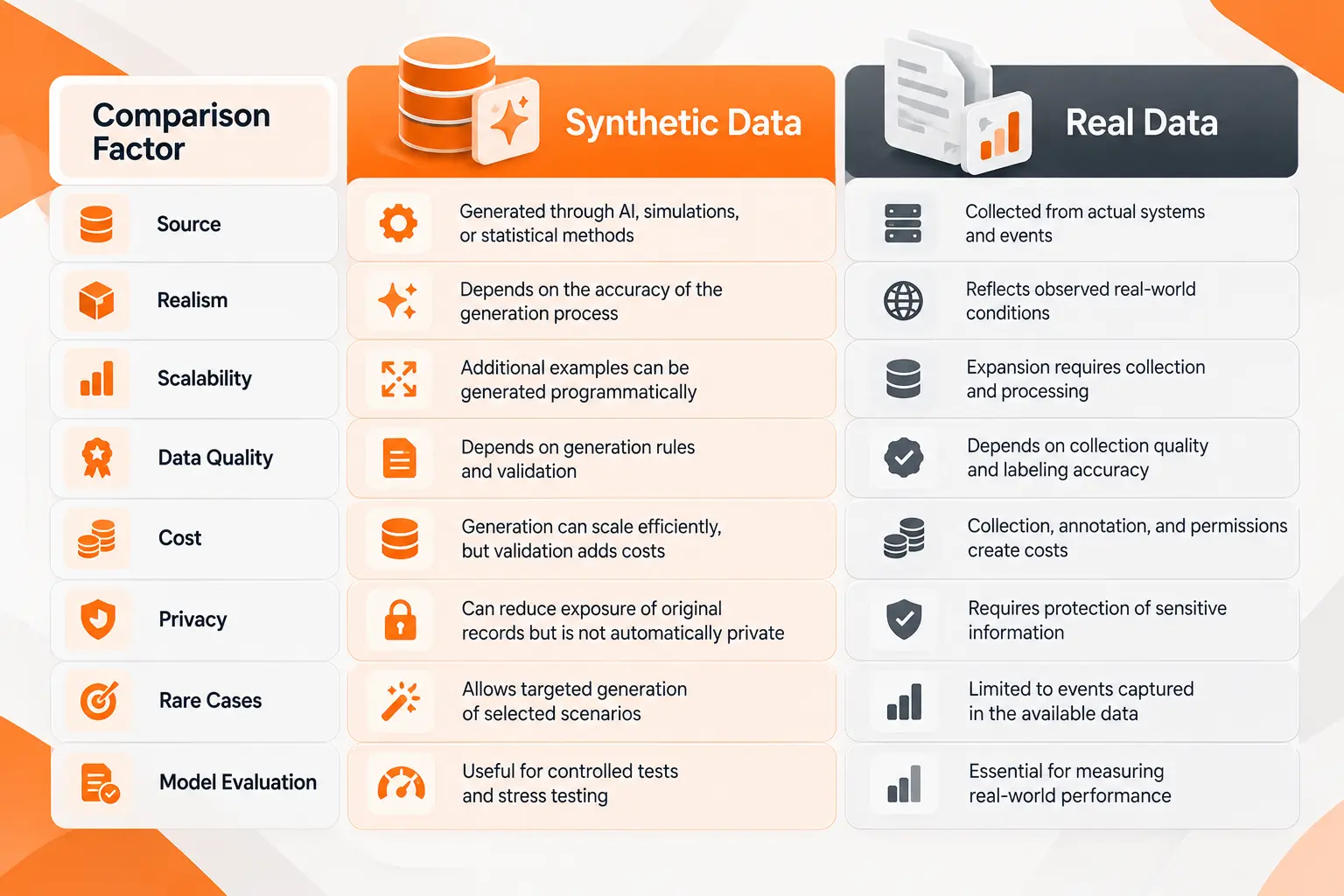
The key distinction is that synthetic data gives developers control over which examples exist, while real data provides evidence of what actually occurs.
That difference becomes especially important when a model performs well on controlled training examples but struggles with unexpected inputs after deployment.
Training Quality and Model Performance
A model learns patterns from the examples it receives. If those examples fail to represent its operating environment, strong training results do not establish reliable performance.
Real-world training data captures variation introduced by actual users, equipment, environments, and business processes. These details are difficult to reproduce completely through artificial generation.
Consider a customer support model.
Real customer messages contain incomplete descriptions, contradictory information, unusual wording, and requests that do not fit predefined categories. A synthetic dataset can reproduce these patterns, but its coverage depends on the scenarios selected during generation.
If the generated examples contain only clearly written complaints, the model receives less evidence of how to interpret ambiguous messages.
This difference is called the synthetic-to-real gap, or domain gap. It occurs when the distribution of generated training examples differs from the data the model encounters in production.
Data Accuracy and Label Quality
Real data is not automatically accurate training data. A genuine customer message can still have the wrong classification label, and an authentic business record can contain errors.
Synthetic examples have the opposite challenge: their labels can be intentionally generated, but that does not establish that the underlying scenarios are realistic or factually correct.
I separate two quality checks when evaluating training data.
Label accuracy measures whether the expected answer is correct for the example.
Data fidelity measures how closely the examples preserve relevant characteristics and relationships found in the target environment.
A dataset needs both. Perfect labels attached to unrealistic examples can still produce a model that performs poorly on real requests.
Bias and Missing Patterns
Synthetic data generation also inherits limitations from its source material, generation rules, and underlying models.
If a generator has learned a narrow representation of customer behavior, producing more examples can reinforce that narrow representation instead of introducing genuine diversity.
Real datasets have their own sampling biases. Collecting data from one customer segment or geographic market does not guarantee coverage of an entire population.
The useful approach is to identify which important groups, behaviors, and situations are missing, then verify whether additional data improves performance on those cases.
Cost, Scalability, and Privacy
Synthetic data offers a clear operational advantage when additional real-world records are expensive or difficult to obtain.
A simulator can generate controlled equipment failures without requiring physical equipment to break. A language model can produce variations of customer questions without waiting for those requests to appear in a support queue.
However, generating data is only one part of its cost.
A reliable synthetic data pipeline also requires quality checks, duplicate detection, source documentation, expert review, and downstream evaluation.
I would compare the total cost of producing usable examples rather than the cost of generating individual records.
Privacy Protection
Synthetic data can help organizations develop and test systems without exposing original customer records to every stage of the workflow.
However, artificially generated data is not automatically anonymous or privacy-safe.
A model trained on sensitive records can reproduce identifying information or reveal patterns that compromise privacy. Simply replacing names and account numbers does not establish effective anonymization.
Differentially private data-generation methods provide formal privacy guarantees under defined conditions, but they introduce their own accuracy and utility trade-offs.
For projects involving sensitive information, the generation method, source permissions, disclosure risks, and applicable privacy requirements must all be evaluated.
Synthetic vs Real Data for LLM Fine-Tuning
The comparison becomes more specific when training large language models.
LLM fine-tuning uses examples that connect inputs with desired outputs. These examples influence how the model follows instructions, responds to specialized requests, and produces information in the required format.
Human-reviewed real examples provide evidence of the tasks users actually perform. Synthetic training data can expand those examples, introduce alternative wording, and provide additional demonstrations.
Consider an AI assistant designed to classify business emails.
A real dataset might contain hundreds of messages about invoices, appointments, contracts, and support requests. A generator can create additional emails with different writing styles, message lengths, and combinations of topics.
The synthetic records must still be checked against the intended classification rules. If the generator assigns an incorrect category, the model can learn that error during fine-tuning.
Synthetic Instruction Data
For instruction tuning, synthetic datasets can contain generated prompts paired with reference responses.
This approach is useful for expanding instruction diversity, particularly when human-written examples are limited.
The most important factor is whether the responses demonstrate the intended behavior correctly.
A powerful teacher model does not guarantee perfect training targets. Generated responses can contain factual errors, unsupported claims, or formatting inconsistencies.
I would preserve a smaller collection of verified responses as a quality reference rather than accepting every generated example.
Model Collapse and Repeated Synthetic Training
Research on model collapse has demonstrated risks when generative models are repeatedly trained on outputs produced by earlier models.
Under the studied conditions, information about less common patterns can progressively disappear from the learned distribution.
This does not mean every use of synthetic data causes model collapse.
The generation method, training mixture, data diversity, and number of recursive training stages influence the outcome. Research has also documented useful results from carefully constructed synthetic and real-data mixtures.
The practical implication is to preserve access to original data, maintain source information, and evaluate whether each new generation of training data retains important variation.
Combining Synthetic and Real Training Data
A hybrid dataset uses real observations and artificial examples to support the same training objective.
The objective is not to reach a predetermined percentage of synthetic records. It is to use generated examples where they provide additional information that the existing dataset lacks.
I would build the combined dataset around four decisions.
Establish a Real-Data Reference
Start with a representative collection of real examples that reflect the application's intended users and operating conditions.
Separate the training records from an independent evaluation set before creating synthetic variations.
The evaluation set must remain outside the data-generation process. Otherwise, generated records can reproduce test examples and make the trained model appear more accurate than it is.
Generate Examples for Specific Gaps
Use the initial evaluation results to identify missing coverage.
For example, if a classification model performs poorly on messages containing several customer intentions, create training examples that represent those combinations.
This is more useful than generating additional straightforward examples from categories the model already handles successfully.
Synthetic generation should address a defined weakness, not merely increase dataset size.
Validate and Combine the Records
Review generated examples for factual correctness, labeling accuracy, duplicates, and similarity to evaluation records.
Keep information about the source of each record, including whether it is real or synthetic.
I would also record the generation method and the synthetic-to-real ratio used in each training experiment. These details make it possible to identify which changes actually contributed to improved performance.
Evaluate Different Training Mixtures
Compare a real-only dataset, a synthetic-only dataset, and a combined dataset using controlled training conditions.
The best ratio is the one supported by independent evaluation, not a fixed percentage copied from another project.
A hybrid approach is worth keeping when it produces a meaningful improvement in the application's target metrics without introducing unacceptable performance or privacy risks.
Evaluating Synthetic and Real Datasets
The strongest evidence comes from training comparable models and testing them against the same untouched real-world dataset.
I would structure the comparison around three experiments:
Model A: Fine-tuned using real training examples.
Model B: Fine-tuned using synthetic training examples.
Model C: Fine-tuned using a mixture of real and synthetic examples.
All three experiments should use the same base model, evaluation procedure, and comparable training budgets. Holding the number of training tokens or optimizer updates consistent helps avoid mistaking additional training exposure for a data-source advantage.
The test set should represent actual deployment conditions and remain independent of every training and generation pipeline.
Model Performance Metrics
For classification, I would compare precision, recall, and F1 score, including results for individual categories.
For information extraction, exact-match accuracy and field-level correctness provide direct evidence of whether the model extracts the required information.
For generative LLM applications, evaluation should cover factual correctness, instruction adherence, response relevance, and compliance with output requirements.
Aggregate performance is not enough. A model can improve its overall score while performing worse on rare but important cases.
That is why I also compare results across meaningful groups of requests, document types, or operating conditions.
Dataset Quality and Reliability
Statistical similarity between real and synthetic data provides useful evidence, but it does not prove that the datasets are interchangeable.
For structured data, examine important distributions and relationships between variables. For text datasets, examine topic coverage, language variation, semantic duplication, and the accuracy of target responses.
I also separate performance improvements from dataset-size effects. If the hybrid dataset contains twice as much training material, the comparison should account for the additional training exposure.
The result needs to answer a specific question: Did the synthetic examples improve performance on real data enough to justify their generation and validation costs?
Choosing the Right Data for AI Training
The right data source depends on which limitation matters most to the application.
Use real data as the primary source when the model must learn subtle patterns from actual behavior, when reliable ground truth is available, or when the objective is to evaluate production performance.
Use synthetic data to extend coverage when important cases are scarce, simulations can reproduce the relevant conditions, or controlled examples are needed for development and testing.
Use a hybrid dataset when real examples provide a reliable foundation but additional cases are needed to improve coverage or task performance.
For example, a business document classifier benefits from authentic invoices and contracts because these contain the formatting and language encountered in production. Synthetic variations can then introduce new document layouts, wording patterns, and controlled edge cases.
The same reasoning applies to LLM applications, fraud detection, computer vision, and predictive models, although the methods used to generate and validate data differ across those fields.
The selection should be based on the target task and validated model performance rather than treating either data source as inherently superior.
Conclusion
Synthetic data and real data solve different problems in AI training. Real observations establish the conditions a model must handle, while synthetic examples provide a controlled way to expand training coverage.
The strongest decision comes from comparing both sources against the same real-world requirements. A dataset should earn its place in the training pipeline through measurable improvements in accuracy, reliability, or coverage, not simply because it is larger or easier to produce.
FAQ
Can I add AI-generated labels to real data instead of generating new records?
Yes. This approach is known as automated labeling or pseudo-labeling, depending on the method used. The original inputs remain real, while their labels are generated by a model. Label accuracy must be checked against verified examples because incorrect generated labels can introduce systematic training errors.
How can I tell if a dataset I received contains synthetic records?
The most reliable evidence comes from dataset provenance, generation logs, and documentation provided by the data owner. Statistical analysis can reveal unusual patterns, repetition, or distribution differences, but these signals do not establish the origin of every record. AI-content detectors alone are insufficient for definitive classification.
Can I legally sell a dataset generated by an AI model?
The answer depends on the generation service's terms, the rights associated with the underlying data, applicable intellectual property laws, and any contractual restrictions. AI-generated content is not automatically free of third-party rights or licensing obligations. Commercial distribution requires reviewing these conditions before release.
Will a synthetic dataset work with a different AI model?
A synthetic dataset can be reused across compatible models when its examples match their training objectives. Format conversion, tokenization, label compatibility, and model-specific training requirements must be addressed. Performance must be evaluated independently for each target model.
How do I check whether synthetic tabular data preserves relationships between columns?
Compare important marginal and conditional distributions, correlations, category dependencies, and constraint violations against an authorized real reference dataset. Then evaluate a downstream model trained on the synthetic records against a held-out real test set. Similar-looking column statistics alone do not establish equivalent predictive usefulness.

Fatemeh Jahangard
Technology & AI Writer at PinerookFatemeh Jahangard covers AI, emerging technologies, and digital innovation for Pinerook, focusing on how technology shapes startups and industries.
 Seen first.


