Economic shifts do not stay inside central bank meetings, inflation reports, or financial markets. They eventually reach a startup through customers, hiring, financing, pricing, and the amount of risk a company can afford to take.
For founders, the useful question is not whether the economy is “good” or “bad.” It is which economic changes can alter the assumptions behind the business.
A startup selling discretionary software to small businesses may feel weaker demand before a company selling compliance infrastructure. A capital intensive startup may react quickly to higher borrowing costs, while a bootstrapped software company with strong cash flow may barely notice them. A stronger currency may reduce imported infrastructure costs for one company while making another startup’s exports less competitive.
That is why macroeconomics for startups should not be treated as an exercise in forecasting GDP or predicting the next central bank decision. It is a framework for understanding how external conditions reach the company and which operating decisions may need to change.
Why Macroeconomics Matters Even to Small Startups
Founders often assume macroeconomic analysis matters mainly to public companies, banks, or large corporations. Early stage startups seem too small to be affected by forces such as interest rates, inflation, oil prices, or labor market conditions.
In practice, smaller companies can be more exposed because they have fewer ways to absorb a shock.
A large company may have multiple revenue lines, access to debt markets, stronger purchasing power, and enough cash to wait through a weak period. An early stage startup may depend on a handful of customers, one fundraising window, a small hiring plan, and a runway measured in months.
That makes macro conditions relevant even when the company itself has not changed.
A customer budget can disappear. A financing round can take longer. Salaries can move faster than revenue. Cloud, logistics, energy, or supplier costs can change. Investors can demand stronger evidence before accepting the same valuation they might have accepted in a different market.
The objective is not to react to every economic headline. It is to know which macro signals can materially change your business.
The 2026 Economic Backdrop Shows Why Context Matters
The United States offers a useful example of why founders need to look at several signals together rather than relying on one headline. In September 2026, the Federal Reserve raised its target range for the federal funds rate to 3.75% to 4.00%, while noting that economic activity remained solid, capital investment was robust, and inflation was still elevated.
August CPI was 3.4% higher than a year earlier, while September unemployment remained at 4.2% and payroll employment changed little. At the same time, the Conference Board reported that U.S. consumer confidence fell to 81.9 in September, marking a third consecutive monthly decline.
Those signals do not describe a single simple condition such as “strong economy” or “weak economy.” They describe different pressures occurring at the same time.
For a founder, that distinction matters. Stable employment may support demand, while weaker confidence can make consumers more cautious. Strong capital investment can benefit infrastructure businesses, while high financing costs can still constrain smaller firms.
The Richmond Fed's September 2026 CFO Survey illustrates that unevenness: overall business optimism remained relatively steady, but financial constraints were more common among smaller firms than larger ones.
The operating lesson is simple: macroeconomic conditions rarely affect every startup in the same way.
Think in Transmission Channels, Not Headlines
A useful founder framework is to ask how an economic change reaches the company. Most macroeconomic changes move through five broad channels:
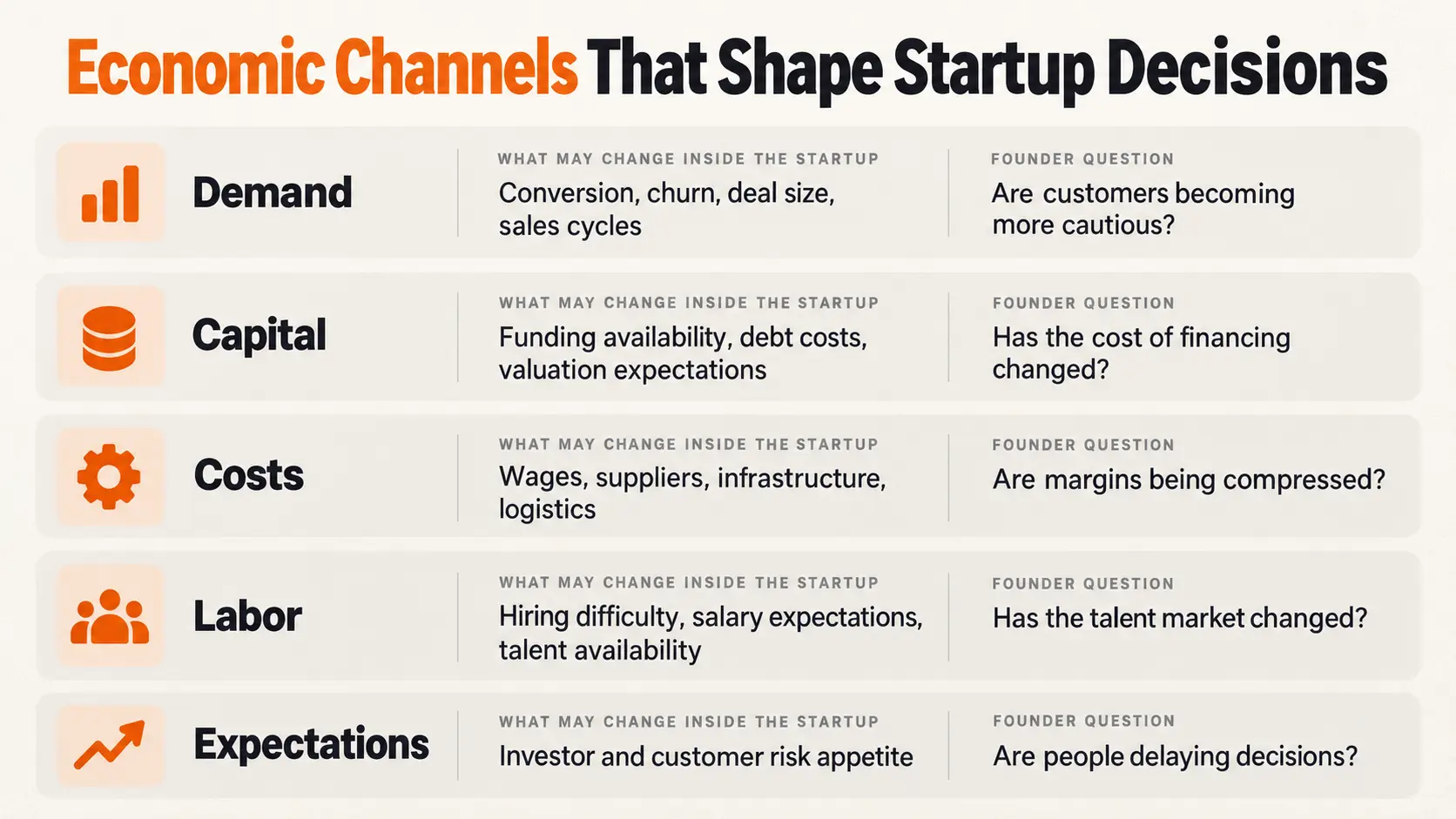
This approach prevents founders from treating macroeconomic news as abstract information.
An interest rate change matters only if it changes something relevant to your company: customer borrowing, venture conditions, your own financing costs, or investor return expectations.
Inflation matters when it reaches pricing, wages, infrastructure, suppliers, or customer purchasing power.
A labor market shift matters when it changes hiring costs, retention, customer income, or overall demand.
The macro event is the starting point. The business impact is what matters.
Interest Rates Change More Than the Price of Loans
Interest rates influence startups through several paths at once.
The direct effect is the cost of borrowing. When rates are higher, debt becomes more expensive and businesses may become more selective about projects that require external financing.
But startups often feel the indirect effects first.
Investors compare risky startup investments against safer alternatives. Customers that rely on financing may delay purchases. Companies may become more cautious about discretionary software or consulting budgets. Founders may choose to extend runway rather than accelerate hiring.
For founders trying to understand how interest rates affect startups, the mistake is focusing only on whether the company currently has a loan.
Consider a B2B startup selling software to property developers. Even if the startup carries no debt, higher financing costs for its customers can reduce construction activity, which can eventually weaken demand for the startup's product.
The exposure sits with the customer.
Interest rates also feed directly into the cost of capital for startups. Capital has a required return whether it arrives as debt or equity. When financing conditions tighten, investors may place greater weight on profitability, capital efficiency, runway, and evidence of durable demand.
That does not mean every rate increase automatically causes startup funding to collapse. It means the threshold for taking risk can change.
Inflation Is a Margin Problem Before It Becomes an Economics Lesson
Inflation is usually presented as a consumer price statistic. Founders experience it more concretely.
Higher salaries
More expensive suppliers
Rising hosting or infrastructure costs
Higher logistics expenses
Changes in customer purchasing power
Pressure to increase prices
Understanding how inflation affects startups requires separating input inflation from pricing power.
If costs rise 8% but the startup can increase prices by the same amount without materially affecting demand, margins may remain intact. If costs rise while customers resist higher prices, the company absorbs the difference.
That is why inflation exposure depends heavily on the business model.
A software startup with high gross margins may have more flexibility than a marketplace subsidizing transactions or a hardware company with thin margins and physical supply chains.
Founders should therefore monitor the cost categories that actually matter to their business instead of reacting to a single national inflation number.
This becomes particularly important when thinking about energy prices and business costs. Energy shocks can reach a company indirectly through shipping, manufacturing, travel, data infrastructure, suppliers, and household purchasing power even when the startup does not buy large quantities of energy itself.
Customer Demand Often Changes Before Revenue Makes the Problem Obvious
Revenue is a lagging signal.
Before revenue falls, customers may start behaving differently.
Sales cycles become longer. Procurement requests more approvals. Consumers compare prices more aggressively. Expansion deals become smaller. Free to paid conversion slows. Customers downgrade rather than cancel.
Those behavioral changes can be more useful than waiting for a quarterly economic number.
The connection between consumer confidence and startup demand is especially important for businesses exposed to discretionary spending. Lower confidence does not guarantee lower revenue, but it can indicate that households are becoming more careful about future purchases.
The same logic applies to B2B companies. Business confidence, financing conditions, expected demand, and profitability pressure can all change the willingness of companies to approve new spending.
A founder should therefore monitor demand inside the product as closely as demand in the broader economy.
Sales cycle length
Win rate
Average contract value
Expansion revenue
Churn reasons
Discount requests
Payment delays
Usage frequency
Macroeconomic data tells you what may be changing outside the company. Customer behavior tells you whether that change has reached your business.
Labor Markets Affect Both Your Costs and Your Capacity to Grow
The labor market creates a two sided problem for startups.
A strong labor market can support consumer incomes and demand, but it can also make hiring expensive and competitive. A softer market can improve talent availability while simultaneously signaling weaker demand elsewhere in the economy.
That makes labor market trends and startup hiring more useful than simply tracking the unemployment rate.
Founders should think about the specific talent market they hire from.
Demand for machine learning engineers can remain intense even when hiring slows across other industries. Sales talent may behave differently from product or finance roles. A local labor market may also differ substantially from the national picture.
The relevant questions are:
Is time to hire changing?
Are compensation expectations moving?
Is voluntary turnover falling?
Are stronger candidates becoming available?
Can the company delay a hire without creating a bottleneck?
Macroeconomic labor data provides context, but the startup's own hiring funnel should determine the decision.
Economic Cycles Do Not Affect Every Startup at the Same Time
Business cycles move through periods of expansion, slowing growth, contraction, and recovery, but the transmission to startups is uneven.
Some businesses are cyclical. Others are defensive. Some can even benefit when companies are under pressure to reduce costs.
A startup selling premium consumer travel may be highly sensitive to household confidence. A cybersecurity provider may experience more stable demand. A software company promising measurable cost reductions could become more attractive during a slowdown.
Understanding how economic cycles affect startup growth therefore begins with identifying the sensitivity of the company's customers.
Ask:
What causes customers to increase spending?
What causes them to delay purchases?
Is the product a necessity, efficiency tool, revenue driver, or discretionary improvement?
How long does it take changes in the customer's economy to reach your revenue?
This also changes the way founders should think about how recessions affect startups.
A recession is not automatically a command to stop hiring, cut marketing, or abandon expansion. Some companies should preserve cash aggressively. Others may find cheaper acquisition, better talent availability, or market share opportunities.
The correct response depends on exposure, not the label attached to the economy.
Global Startups Need to Think About Currency Exposure
Startups operating across borders face an additional macro variable: currencies.
Exchange rate movements can affect revenue, payroll, supplier costs, infrastructure, and reported financial performance.
A startup might earn dollars while paying employees in euros. Another may sell subscriptions in pounds while paying cloud infrastructure in dollars. A marketplace may collect revenue in several currencies but report financial results in only one.
This is why exchange rate risk for startups becomes relevant well before a company becomes a multinational corporation.
The first step is not sophisticated currency trading. It is simply mapping exposure.
Which currencies generate revenue
Which currencies drive costs
Where cash is held
Whether customer contracts adjust for currency movements
How much margin could change after a meaningful exchange rate move
A company with naturally matched revenue and costs may have limited exposure. A company earning in one currency and spending heavily in another may have much more.
Public Markets Can Change Private Startup Conditions
Private startups do not trade every day on a stock exchange, but public markets still influence the environment around them.
Public company valuations provide reference points for investors. IPO markets affect potential exit paths. Technology multiples can influence how investors price future growth. Public market volatility can also change risk appetite across venture portfolios.
Understanding how public markets affect private startups does not mean founders should watch the Nasdaq every hour.
The connection matters because private valuations do not exist in isolation.
Suppose publicly traded software companies move from being valued primarily on growth to being valued on cash flow and profitability. Private investors can gradually apply similar standards to later stage startups.
That is also why how macroeconomic conditions affect startup valuations is more complicated than saying higher rates produce lower valuations.
Valuation reflects a combination of:
Expected future cash flows
Growth
Risk
Comparable companies
Capital availability
Competitive investor demand
Company specific quality
Macro conditions influence several of those variables, but they do not replace company fundamentals.
A strong company can still raise capital in a difficult market. The terms and evidence required may simply change.
Which Economic Indicators Should Founders Actually Track?
The answer is not every economic indicator.
A startup does not need an internal economics department to make use of macro data.
The objective is to build a small dashboard that matches the company's economic exposure.
A practical starting point for economic indicators every founder should track might include:
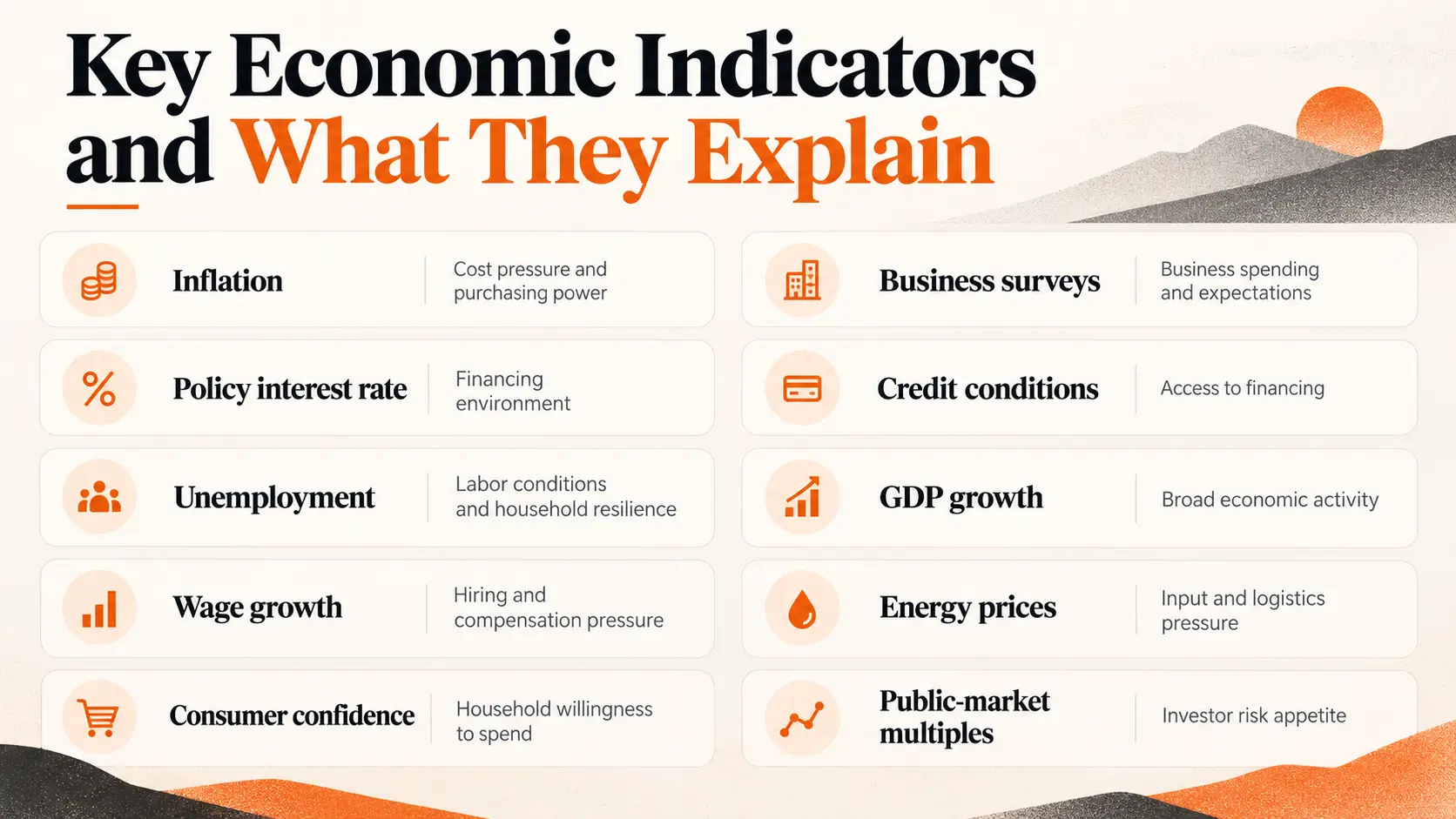
Not every startup needs all ten.
A consumer company may care more about employment, confidence, inflation, and disposable income.
An enterprise SaaS company may care more about business investment, CIO budgets, credit conditions, and employment.
A manufacturing startup may care heavily about energy, commodities, trade, rates, and currencies.
The dashboard should reflect the business, not the economics textbook.
Build an Economic Exposure Map
Before founders build a macro dashboard, they should understand what they are trying to monitor.
A simple exposure map can connect economic variables to company outcomes.
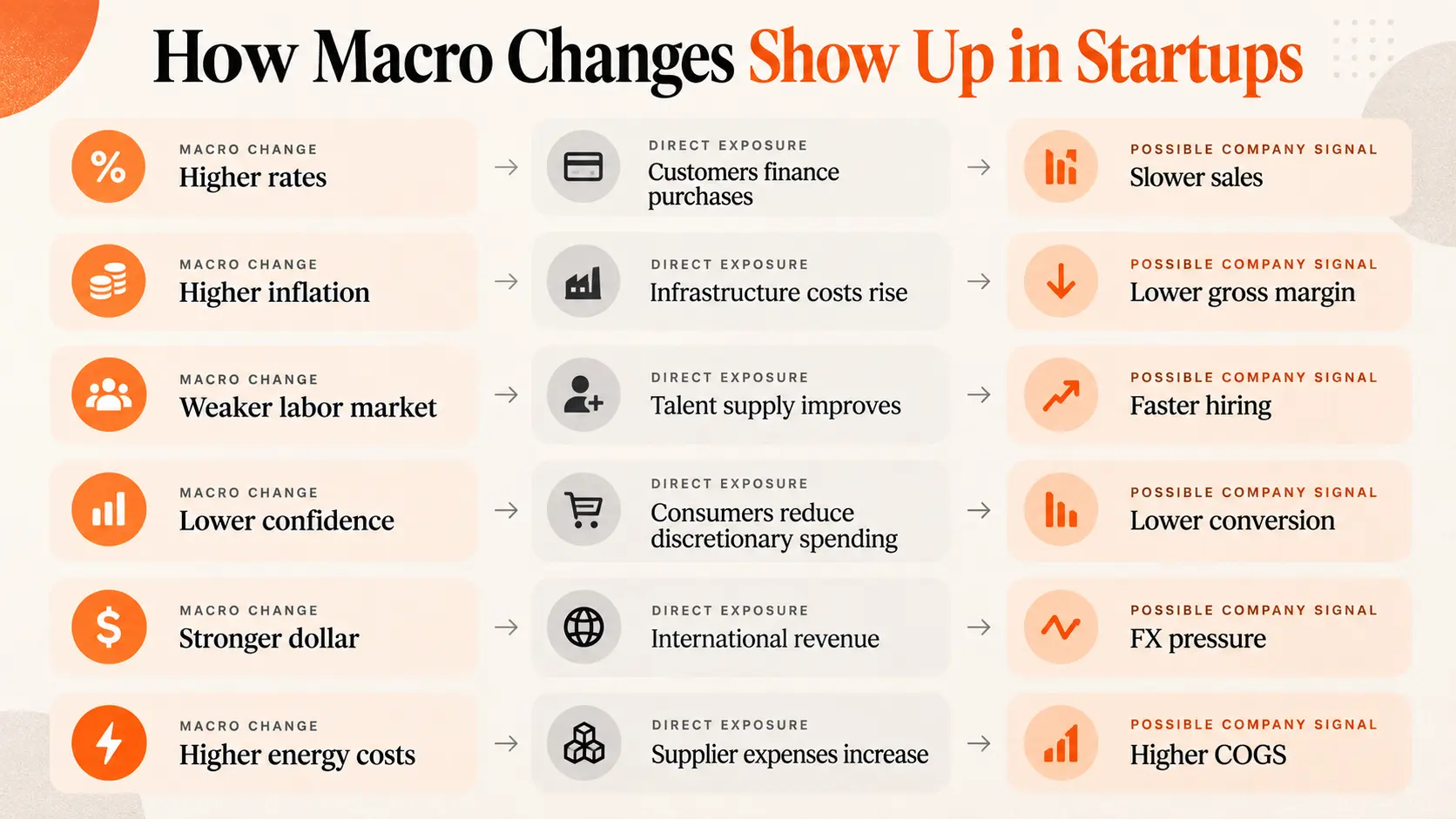
This exercise does something important: it separates exposure from speculation.
A founder does not need to know whether oil will rise next quarter.
They need to know what they would do if it rises enough to materially affect margins.
That is a much more useful operating question.
Use Scenarios Instead of Macroeconomic Predictions
Founders have limited control over the economy and very little advantage in trying to out forecast economists.
A better approach is scenario planning.
Imagine three conditions:
Base case: demand continues roughly as expected.
Pressure case: customer demand weakens and financing takes longer.
Upside case: demand strengthens and growth opportunities accelerate.
For each scenario, founders can define what happens to:
Hiring
Marketing
Cash runway
Pricing
Capital spending
Fundraising
Expansion
The important part is identifying triggers.
For example: If sales cycles increase by 30% and net new revenue falls below a defined threshold for two consecutive months, hiring plans are reviewed.
That is far more actionable than saying, “We will cut spending if the economy gets worse.”
Macro data informs the scenario. Company data activates the decision.
Separate Leading Signals From Lagging Results
One reason macro analysis can become confusing is that not all indicators move at the same time.
Some signals change before business conditions become obvious. Others confirm changes after they are already underway.
For founders, an internal equivalent exists.
Pipeline quality can deteriorate before revenue does.
Interview acceptance rates can improve before salary costs fall.
Supplier quotes can increase before gross margin declines.
Expansion behavior can weaken before churn appears.
That means founders should combine external leading indicators with internal operating data.
A startup that sees weaker consumer confidence but no change in conversion, retention, or average spending should not automatically assume demand is collapsing.
Likewise, a company seeing clear deterioration in customer behavior should not ignore it simply because GDP remains positive.
The company is the final unit of analysis.
Do Not Let Macro Become an Excuse for Weak Execution
Macroeconomics is useful because it provides context. It becomes dangerous when it becomes an explanation for everything.
Founders can easily attribute weak growth to interest rates, inflation, or uncertain markets when the real problem is product positioning, execution, retention, or distribution.
The reverse is also true. Strong macro conditions can hide weak fundamentals for a period of time.
A useful discipline is to separate three categories:
What the company controls: product, pricing, execution, hiring quality, customer experience.
What the company can influence: acquisition efficiency, sales process, supplier terms, capital structure.
What the company cannot control: central bank policy, commodity shocks, national unemployment, currency markets.
Spend most management attention on the first two.
Use the third to adjust assumptions.
How Often Should a Startup Review Macroeconomic Conditions?
Most startups do not need daily macroeconomic monitoring.
For many teams, a monthly review is enough.
A simple operating rhythm could be:
Monthly: update key indicators and compare them with internal business data.
Quarterly: review assumptions about demand, hiring, pricing, runway, and financing.
Event driven: reassess when a major economic change directly affects an important exposure.
The key is consistency.
If founders only pay attention to economics when headlines become frightening, they are more likely to react emotionally.
A small, repeatable process makes macro information more useful and less distracting.
What Macroeconomics Cannot Tell a Founder
Economic data is contextual, not deterministic.
It cannot tell you:
Whether your product has product market fit
Which feature to build
Whether a particular customer will churn
Whether your next hire will perform
Whether your startup should raise money next month
Whether your pricing is correct
Those are company specific questions.
Macroeconomics can tell you whether some assumptions deserve another look.
That is its proper role.
Use Macro as an Operating Input, Not a Forecast
The most useful founder does not need to become an economist.
They need to understand the path between an economic change and the business.
Interest rates can alter capital costs and customer behavior. Inflation can pressure margins. Labor markets can reshape hiring. Confidence can affect demand. Currency movements can change international economics. Public markets can influence investor expectations.
But none of these forces should automatically dictate a startup's strategy.
The job is to identify exposure, monitor the right signals, create scenarios, and change decisions when evidence reaches the business.
Macroeconomics becomes useful when it stops being a collection of headlines and becomes part of the company's operating context.
FAQ
What is macroeconomics for startups?
Macroeconomics for startups is the use of broader economic indicators and conditions to understand how changes in demand, financing, costs, hiring, and investor behavior may affect an early stage company.
Which macroeconomic indicators matter most to startups?
The most relevant indicators depend on the business model. Common ones include inflation, interest rates, unemployment, wage growth, consumer confidence, credit conditions, GDP growth, energy prices, and public market conditions.
Do interest rates affect startups without debt?
Yes. Interest rates can affect customer spending, venture valuations, investor risk appetite, fundraising conditions, and the financing costs of customers even when the startup itself has no debt.
How does inflation affect startup growth?
Inflation can increase wages and operating costs while reducing customer purchasing power. The impact depends on the startup's margins, pricing power, customer base, and cost structure.
Should startups change strategy during a recession?
Not automatically. The right response depends on how a downturn affects the startup's customers, runway, margins, hiring market, and competitive position.
How often should founders track economic indicators?
For most early stage companies, a monthly review combined with a deeper quarterly assessment is sufficient. More frequent monitoring is useful when a particular economic variable directly affects the business.
Can macroeconomic data predict startup performance?
No. Macro data provides context and can reveal changing external conditions, but startup performance still depends heavily on company specific factors such as product, execution, distribution, retention, and capital discipline.

Masoumeh Jahangard
Markets & Economy Writer at PinerookMasoumeh Jahangard covers markets, economic trends, and business conditions for Pinerook, focusing on how they affect startups and growing companies.
 Seen first.