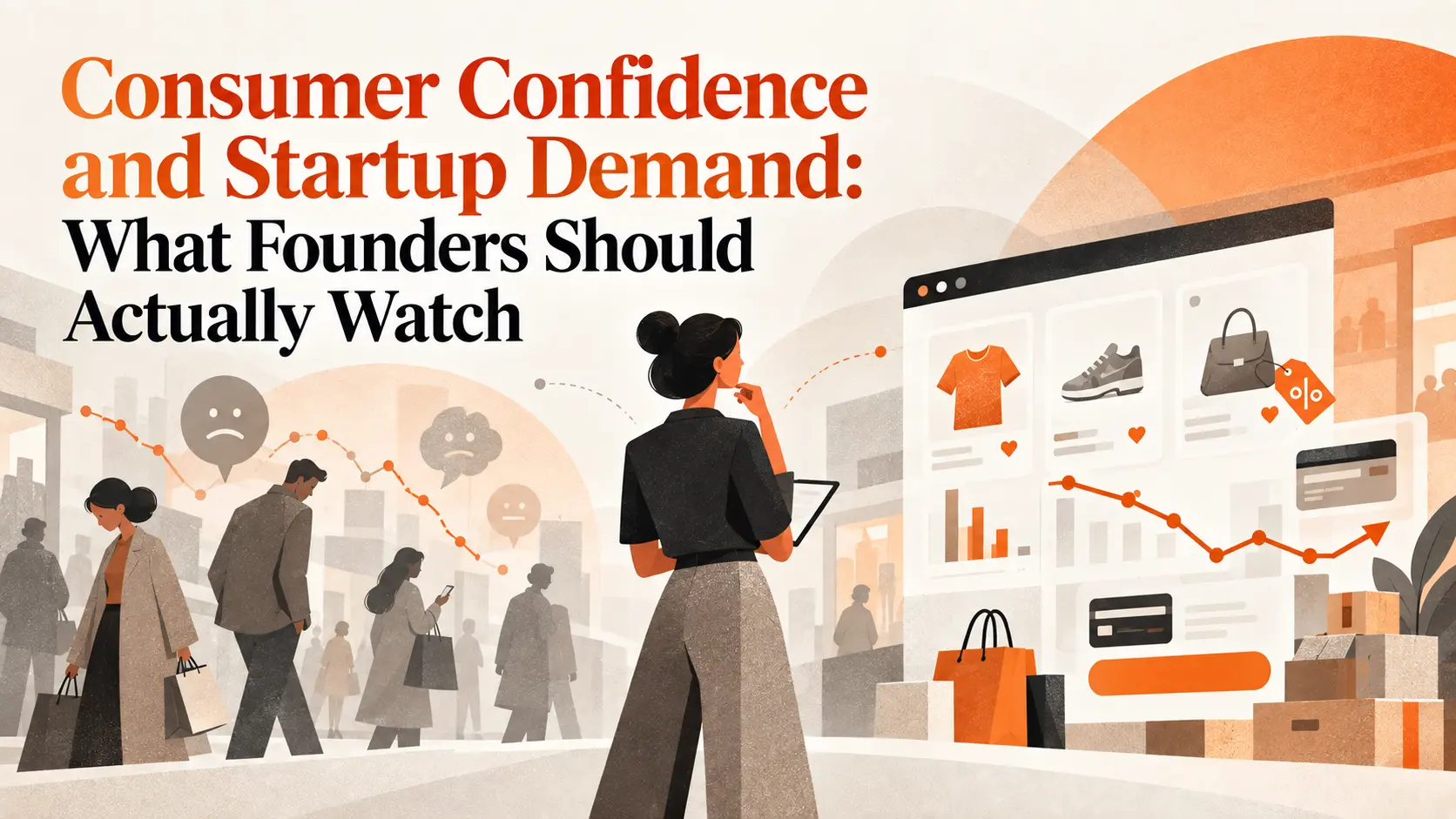
Consumer confidence can fall sharply while people keep spending. That is exactly why founders should not treat a confidence index as a direct forecast of startup demand.
The practical value of macroeconomics for startups is learning how an external signal reaches the business. Consumer confidence matters when it changes customer behavior, purchase timing, price sensitivity, retention, or the willingness to make a larger commitment. Until that change appears in customer behavior, confidence is a signal to investigate, not a command to react.
This distinction matters because founders can make two opposite mistakes. They can ignore weakening confidence until demand is already deteriorating, or they can overreact to a bad index reading even when their own customers are still buying normally. The better approach is to connect confidence data to the metrics that show whether caution has actually reached your market.
What Consumer Confidence Actually Measures
Consumer confidence measures how households feel about current economic conditions and what they expect in the near future. It is not a direct measure of spending. It captures perceptions about issues such as jobs, income, business conditions, personal finances, and the outlook for the economy.
Two widely followed United States measures are produced by The Conference Board and the University of Michigan. They use different survey designs, so their index levels should not be compared directly. The Conference Board separates views of the present situation from expectations about income, business, and labor conditions. The Michigan survey also separates current conditions from expectations and places substantial emphasis on household finances and buying conditions.
In September 2026, The Conference Board Consumer Confidence Index fell to 81.9, its third consecutive monthly decline. Its Expectations Index fell to 63.6. The Conference Board reported deterioration in both current views and expectations.
The University of Michigan reported a September Consumer Sentiment reading of 48.1, down 7.0 percent from August and 12.7 percent from a year earlier. University of Michigan Surveys of Consumers also showed a particularly weak expectations reading.
Those numbers tell a founder that households are cautious. They do not, by themselves, tell the founder how much demand will fall, which products will be affected, or whether the startup should change its plan.
Consumer Confidence Is Not the Same as Consumer Spending
The most important distinction in this topic is simple: sentiment describes what consumers say about the economy, while spending data describes what they actually do.
The two often influence each other, but they can move apart for meaningful periods. Households can feel pessimistic and still spend because employment is stable, income is growing, savings remain available, or purchases cannot be postponed. They can also feel reasonably confident while cutting spending because debt costs, housing expenses, or another financial pressure have changed.
The contrast was visible in the latest 2026 data. Consumer confidence weakened in September, but August personal consumption expenditures rose 0.9 percent in current dollars and 0.6 percent after adjusting for prices. Bureau of Economic Analysis reported continued spending growth even as survey based confidence measures were weak.
Retail and food service sales also rose 1.2 percent in August from July and 6.0 percent from a year earlier, according to the United States Census Bureau. Those retail figures are not adjusted for price changes, which is another reason founders should avoid reading a single headline number as pure demand growth.
The operating conclusion is not that confidence is useless. It is that confidence works best as an early warning signal that should be confirmed by real customer behavior.
How Lower Confidence Can Reach Startup Demand
When households become more uncertain about jobs, income, inflation, or the broader economy, they rarely stop spending in one uniform way. They become more selective.
That selectivity can reach a startup through several channels:
Customers delay larger purchases because waiting feels safer than committing now.
Price comparison increases, making weak differentiation more visible.
Discounts become more attractive, especially for products that are easy to postpone.
Consumers protect essential spending while reducing discretionary upgrades and experiments.
Subscription customers become more willing to downgrade before they cancel entirely.
Households with uncertain income become more sensitive to payment timing and financing costs.
Small business owners can carry the same caution into their company budgets, creating a delayed effect for some business to business startups.
The key is that weaker confidence often changes the quality of demand before it changes total revenue. A customer who still buys may take longer, choose a cheaper plan, request a discount, delay an upgrade, or require clearer proof of value.
Which Startups Are Most Sensitive to Consumer Confidence?
Consumer confidence matters most when the customer can easily postpone the purchase, substitute a cheaper option, or decide that the product is not essential right now.
Higher sensitivity. Consumer discretionary products, premium subscriptions, travel, furniture, lifestyle services, marketplaces built around discretionary purchases, and products that require customer financing can react quickly to caution.
Moderate sensitivity. Education products, consumer services, small business software, and tools with a clear benefit but flexible purchase timing can feel pressure through longer consideration periods or smaller budgets.
Lower sensitivity. Mission critical infrastructure, cybersecurity, compliance, essential health or safety products, and products tied directly to revenue protection can be more resilient because customers have less freedom to delay the purchase.
Lower sensitivity does not mean immunity. A product can be essential and still face tougher procurement, slower payment, or pressure on pricing when customers become cautious.
The Signals That Usually Appear Before Revenue Falls
Revenue is often too late to be the first warning. Founders should watch for changes in customer behavior that can reveal caution earlier.
Sales cycle length increases even when lead volume remains stable.
Conversion falls most sharply on higher priced plans or larger purchases.
Average order value weakens as customers choose smaller baskets or cheaper tiers.
Discount code use and requests for promotional pricing increase.
Repeat purchase frequency slows before customers disappear completely.
Upgrade rates fall while downgrade requests rise.
Cart abandonment increases near the payment step.
Customers ask more questions about price, cancellation, financing, or contract length.
Payment delays increase among small business customers.
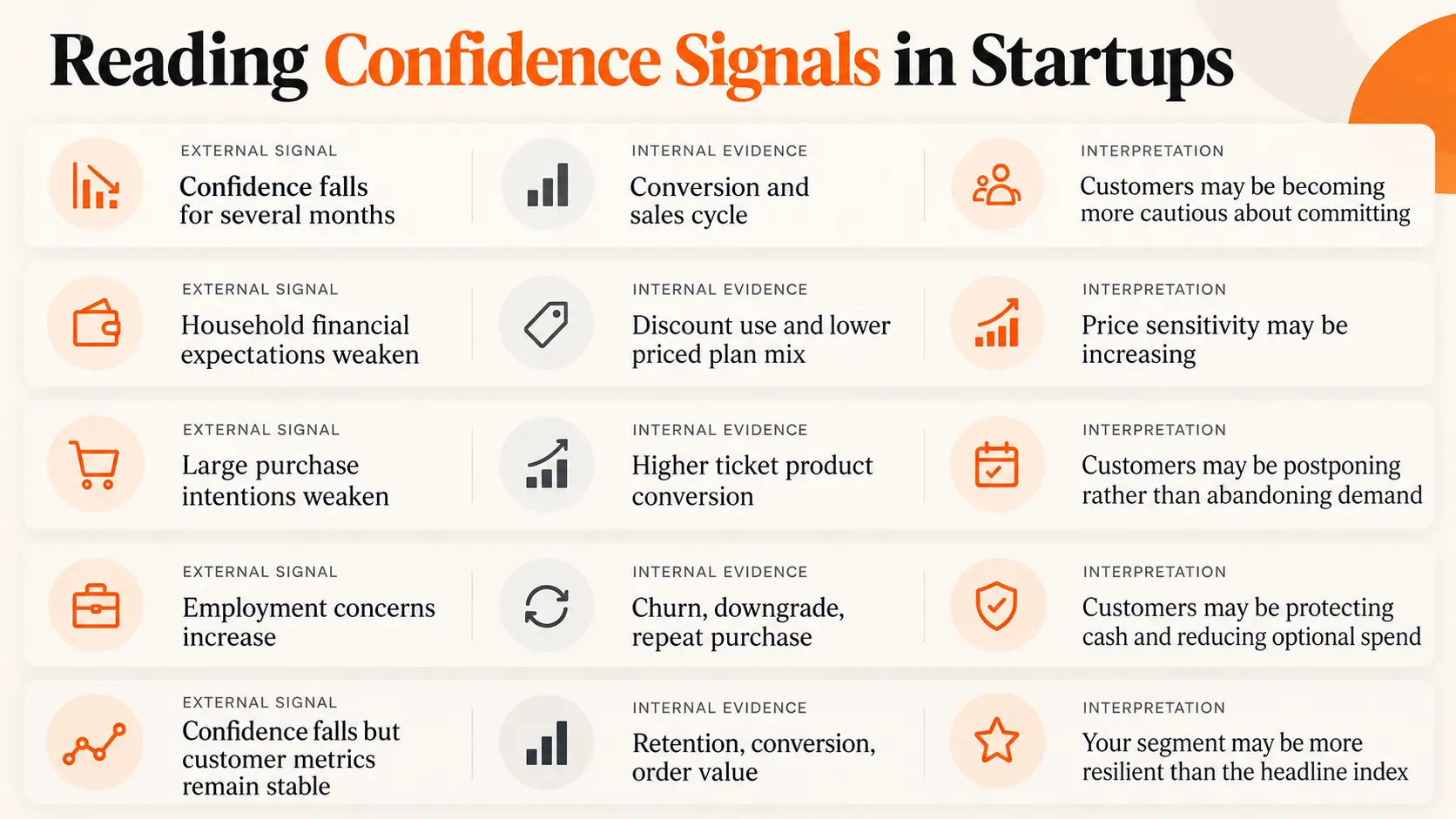
One change does not prove that the economy is responsible. The signal becomes more useful when several customer metrics deteriorate at the same time that confidence, employment expectations, or household financial expectations are weakening.
Pair Confidence Data With Internal Customer Evidence
A founder should never make a demand decision from an external index alone. Use the macro signal to form a question, then use internal data to answer it.
Business to Consumer and Business to Business Startups Should Read Confidence Differently
For a consumer startup, the path from sentiment to demand can be relatively direct. Household caution can change conversion, basket size, purchase frequency, and willingness to commit to a subscription.
For a business to business startup, the effect is often indirect and slower. Consumer caution can reduce revenue for small business customers, which then leads those customers to delay hiring, protect cash, cut software budgets, or postpone expansion. The startup may feel weaker confidence through a longer sales cycle rather than through an immediate collapse in inbound demand.
This is why a national consumer index can be relevant to a business software company without being its primary demand metric. The founder still needs to understand the economics of the customer base.
When Should a Founder Actually React?
A confidence decline should change attention before it changes strategy.
Watch when confidence falls but internal demand remains healthy. Update the dashboard, review customer segments, and listen for new objections, but do not force a strategic change simply because one index moved.
Investigate when confidence weakens for several months and customer behavior begins to change. Look for longer sales cycles, weaker conversion, smaller purchases, more discount pressure, and changes concentrated in specific customer groups.
Act when internal demand deterioration becomes large enough to change the economics of the plan. If slower demand changes revenue forecasts, customer acquisition payback, inventory needs, hiring plans, or runway, the company should adjust based on its own data.
The trigger is not a confidence number. The trigger is the combination of external pressure and internal evidence.
What Founders Can Change When Customers Become More Cautious
A weaker demand environment does not automatically mean cutting price or reducing growth investment. The right response depends on whether customers still value the product and what part of the buying decision has changed.
Make the value easier to justify. When customers are cautious, vague benefits become harder to sell. Positioning should make the economic or practical outcome clearer, especially for higher priced products.
Protect high intent acquisition. Do not cut every marketing channel equally. Separate channels that produce weak curiosity from channels that continue to bring customers with strong purchase intent.
Test pricing architecture before defaulting to discounts. Smaller plans, different billing periods, bundles, or clearer value tiers may protect conversion without teaching the market to wait for a lower price.
Revisit forecast timing. If customers are still buying but taking longer, the problem may be timing rather than destroyed demand. Revenue forecasts and runway assumptions should reflect that delay.
Separate customer segments. Confidence shocks are not distributed evenly. Higher income customers, essential use cases, and customers with stronger balance sheets can behave differently from the broader market.
The 2026 Confidence Paradox
The current United States environment is a useful reminder of why founders need more than one macro signal.
In September 2026, both The Conference Board and the University of Michigan reported weak consumer attitudes. The Conference Board index fell to 81.9, while the Michigan Sentiment Index fell to 48.1. Both pointed to substantial caution about the economy and the future.
At the same time, the latest available August data showed real consumer spending increasing 0.6 percent from the previous month, while nominal retail and food service sales rose 1.2 percent.
That is not a contradiction that needs to be resolved before a founder can act. It is a normal feature of economic data. People can feel worse while continuing to spend, and different customer groups can react at different speeds.
The useful founder question is therefore not, “Which indicator is correct?” Both can be correct. The question is, “Which pattern is reaching our customers?”
Segment the Signal Before You Change the Plan
National confidence data averages households with very different incomes, jobs, debt burdens, ages, regions, and spending obligations. A startup rarely serves the average household.
Before making a broad demand assumption, break internal performance into the customer groups that matter most. A premium product may remain resilient among higher income customers while weakening sharply among more price sensitive groups. A marketplace may see one side remain healthy while the other becomes cautious. A subscription company may retain core users while losing casual customers.
Cohort analysis is often more useful than the headline index because it reveals whether economic caution is changing behavior among the customers who actually determine revenue quality.
Do Not Use Consumer Confidence to Explain Every Demand Problem
Macroeconomic context can help explain pressure, but it can also become a convenient excuse for company specific problems.
If conversion is falling while competitors are gaining share, the problem may be positioning or product quality. If churn is rising only among customers who never activated properly, the issue may be onboarding. If acquisition costs rise because the company exhausted an efficient channel, consumer sentiment may have little to do with it.
A useful discipline is to ask what evidence would prove the macro explanation wrong. If the company cannot answer that question, it may be using the economy as a story rather than as an analytical input.
Build Confidence Into a Monthly Demand Review
Most startups do not need to monitor confidence data every day. A monthly review is enough for most operating teams.
A simple review can follow four steps:
1. Record the latest confidence and sentiment direction, focusing on the trend rather than one monthly move.
2. Compare the external signal with conversion, purchase size, sales cycle, retention, discount use, and payment behavior.
3. Identify whether weakness is broad or concentrated in a specific segment, channel, product, or price point.
4. Change forecasts or operating plans only when internal evidence is strong enough to alter expected demand or cash needs.
This turns confidence from a news headline into a controlled input to demand planning.
Common Mistakes When Founders Read Consumer Confidence
Treating confidence as a sales forecast. Confidence can warn of pressure, but spending, purchase timing, and customer behavior can remain resilient for longer than the index suggests.
Reacting to one month of data. Survey measures are noisy. A multi month trend combined with internal evidence is more useful than a single release.
Watching national data instead of the customer segment. Your users may have different income, geography, employment exposure, or reasons to buy than the average household.
Cutting prices too quickly. A slower purchase decision is not always a price problem. Automatic discounts can damage positioning and margins without fixing the real objection.
Confusing delayed demand with destroyed demand. A customer who waits three months is different from a customer who no longer needs the product. The distinction matters for forecasting and runway.
Blaming macro sentiment for weak execution. Poor retention, unclear value, weak distribution, and product problems still require company specific fixes.
Read Confidence Through Your Customers
Consumer confidence is useful because it can reveal pressure before every consequence appears in revenue. It can tell founders that households are more worried about jobs, income, prices, or the future and that purchase behavior may become more selective.
What it cannot do is tell a startup exactly how its customers will react.
The index tells you where pressure may appear. Conversion, sales cycles, order value, retention, payment behavior, and customer conversations tell you whether it has arrived.
Founders should use confidence as an early signal, spending data as broader confirmation, and their own customer evidence as the basis for the decision.
FAQ
What is consumer confidence?
Consumer confidence is a survey based measure of how households view current economic conditions and what they expect for areas such as jobs, income, business conditions, and their financial future.
Does lower consumer confidence mean spending will fall?
Not necessarily. Confidence and spending can move apart for meaningful periods. Founders should use confidence as an early signal and confirm it with actual customer behavior and spending data.
Which startups are most sensitive to consumer confidence?
Consumer discretionary businesses, travel, premium subscriptions, marketplaces, larger ticket purchases, and products that customers can easily postpone are generally more sensitive.
Does consumer confidence matter for business to business startups?
Yes, but the effect can be indirect. Weaker consumer demand can pressure small business revenue, which can later reduce hiring, software budgets, expansion, and other business spending.
What metrics should founders watch when confidence falls?
Useful internal signals include conversion, sales cycle length, average order value, discount use, repeat purchase, upgrades, downgrades, churn, payment delays, and customer acquisition efficiency.
How often should startups review consumer confidence?
For most early stage companies, a monthly review is enough. The goal is to identify a sustained trend and compare it with internal demand data, not react to every release.

Masoumeh Jahangard
Markets & Economy Writer at PinerookMasoumeh Jahangard covers markets, economic trends, and business conditions for Pinerook, focusing on how they affect startups and growing companies.
 Seen first.