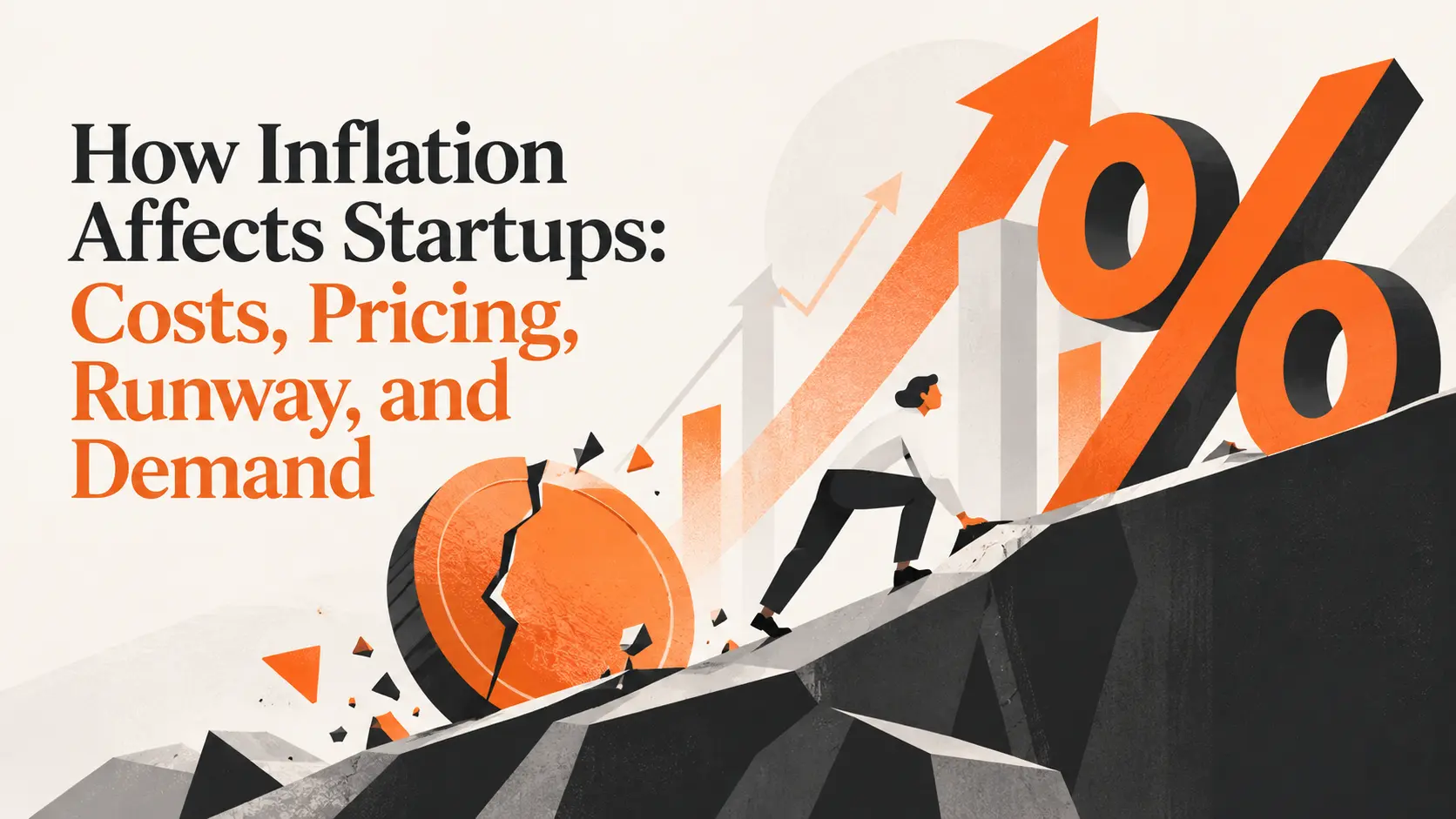
Inflation rarely hits a startup as one dramatic expense. It usually arrives as a series of smaller changes: a vendor renews at a higher price, cloud usage costs more, salary expectations rise, customers push harder on discounts, and the same cash balance covers fewer months of operating activity.
This is where macroeconomics for startups becomes operational rather than theoretical. Inflation matters when it changes the economics of serving a customer, the amount of runway a startup actually has, or the willingness of buyers to keep spending.
The founder's job is not to respond to the headline inflation rate. It is to identify which costs are moving, whether the company has pricing power, how customers are reacting, and which assumptions in the financial plan are no longer true.
Inflation becomes dangerous when a startup keeps operating on yesterday's economics.
How Does Inflation Affect Startups?
Inflation affects startups through two sides of the business at the same time: it can raise the cost of operating while also making customers more price sensitive. That combination can compress margins, increase burn, shorten runway, and force harder decisions about pricing, hiring, suppliers, and growth.
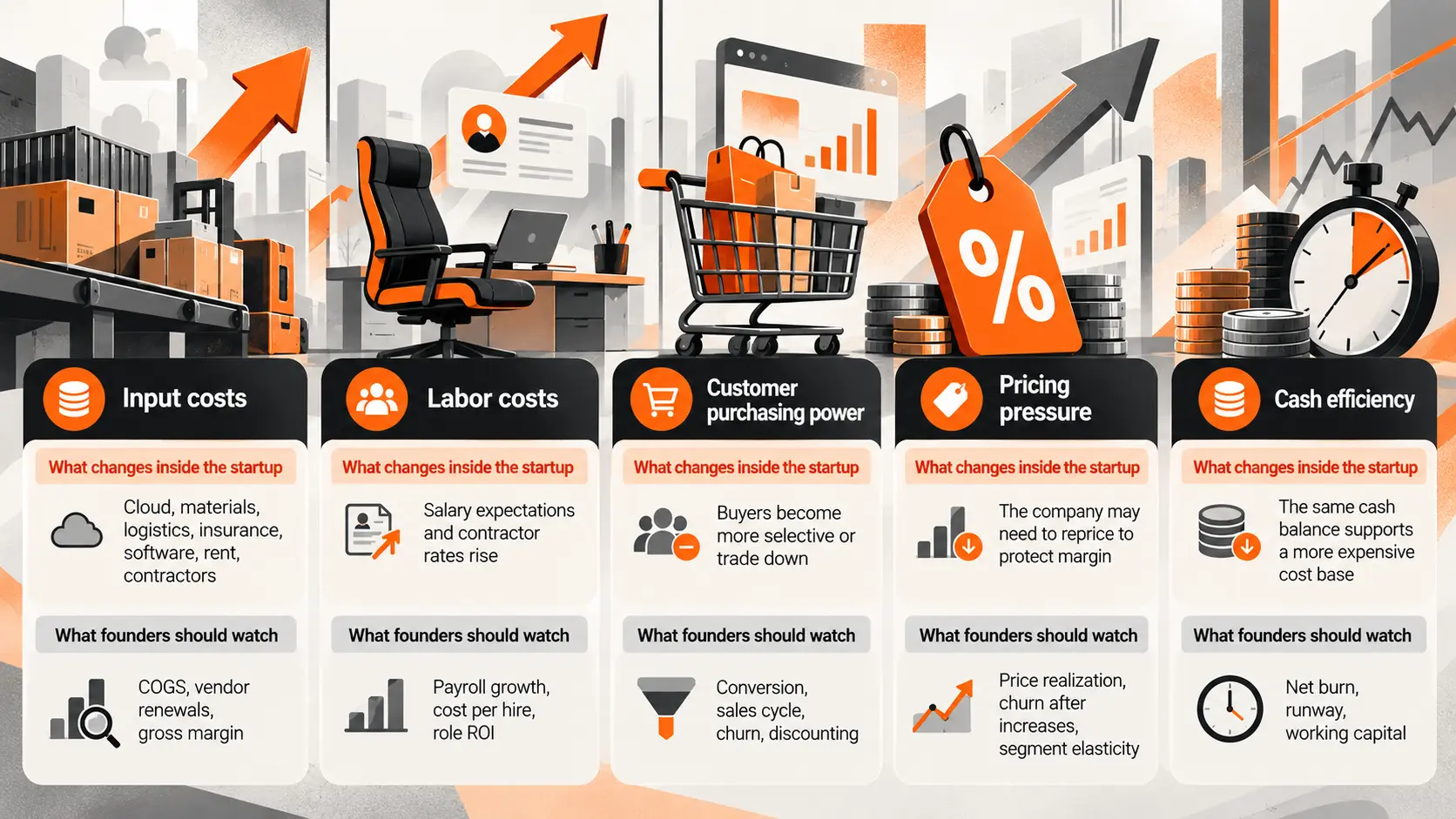
The magnitude depends on the business model. A software company with high gross margins can absorb cost increases differently from a hardware startup, marketplace, restaurant tech company, or logistics business with substantial variable costs.
The 2026 Inflation Environment Makes Cost Discipline More Important
Inflation remains high enough in 2026 that founders cannot treat cost pressure as a resolved post pandemic issue. The latest U.S. Consumer Price Index available at the time of writing showed prices up 3.4% year over year in August 2026, with energy costs contributing materially to the monthly increase.
That national number is useful context, but it is not a startup cost index. A founder may face much higher inflation in a specific input such as energy, insurance, specialized labor, imported hardware, or compute while other expenses remain stable.
Federal Reserve regional reports in 2026 have repeatedly described the same operating tension: firms facing higher input costs, pressure on profit margins, and customers becoming more resistant to price increases. The lesson for startups is to monitor their own cost structure and customer behavior rather than assume the headline CPI describes their exact exposure.
Do Not Treat Inflation as One Number
A startup can be exposed to several different forms of inflation at once. The source matters because the response should be different.
Cost inflation. Suppliers, infrastructure, freight, rent, software, insurance, or raw materials become more expensive.
Wage inflation. Compensation rises faster than planned because the company competes for scarce skills or existing employees need larger adjustments.
Customer price inflation. The customer is already paying more for essentials or business inputs, making them less willing to absorb another increase from your company.
Asset and financing inflation. The cost of equipment, property, inventory, or capital can rise, changing expansion economics.
Founders should therefore ask which line items are inflating, how quickly, and whether those costs are fixed, variable, or avoidable. A broad cost cutting program is usually less useful than identifying the two or three cost categories that are actually changing the company's unit economics.
Margin Compression Is Usually the First Financial Warning
Inflation can exist for months before it becomes obvious in revenue. Gross margin often reveals the problem earlier.
Suppose a SaaS startup keeps its price at $100 per month. If the cost of infrastructure, support, and third party services required to serve that account rises from $20 to $27, revenue has not changed but the economics of every customer have.
The same problem appears in physical products when materials, freight, packaging, and fulfillment rise faster than selling prices. In services, salaries and contractor rates can increase faster than client fees.
Founders should distinguish inflation driven margin pressure from internal inefficiency. If nearly every vendor in a category is repricing and competitors face similar inputs, the pressure may be external. If costs are rising because usage is poorly controlled, processes are inefficient, or discounts are expanding, inflation may only be hiding an execution problem.
Gross margin by product or customer segment
Contribution margin after variable service and acquisition costs
COGS growth compared with revenue growth
Infrastructure or supplier cost per customer
Payroll growth relative to output and revenue
Discount rate and realized selling price
Pricing Power Determines How Much Inflation You Can Pass Through
When costs rise, the obvious response is to raise prices. The difficult part is knowing whether customers will accept the increase.
Pricing power is the ability to increase price without losing enough volume, customers, or usage to make the change counterproductive. It depends on the value of the product, available alternatives, switching costs, customer urgency, contract structure, and the share of the customer's budget your product represents.
A mission critical B2B product that saves a customer ten times its subscription cost may have substantial pricing flexibility. A discretionary consumer product in a crowded category may have much less.
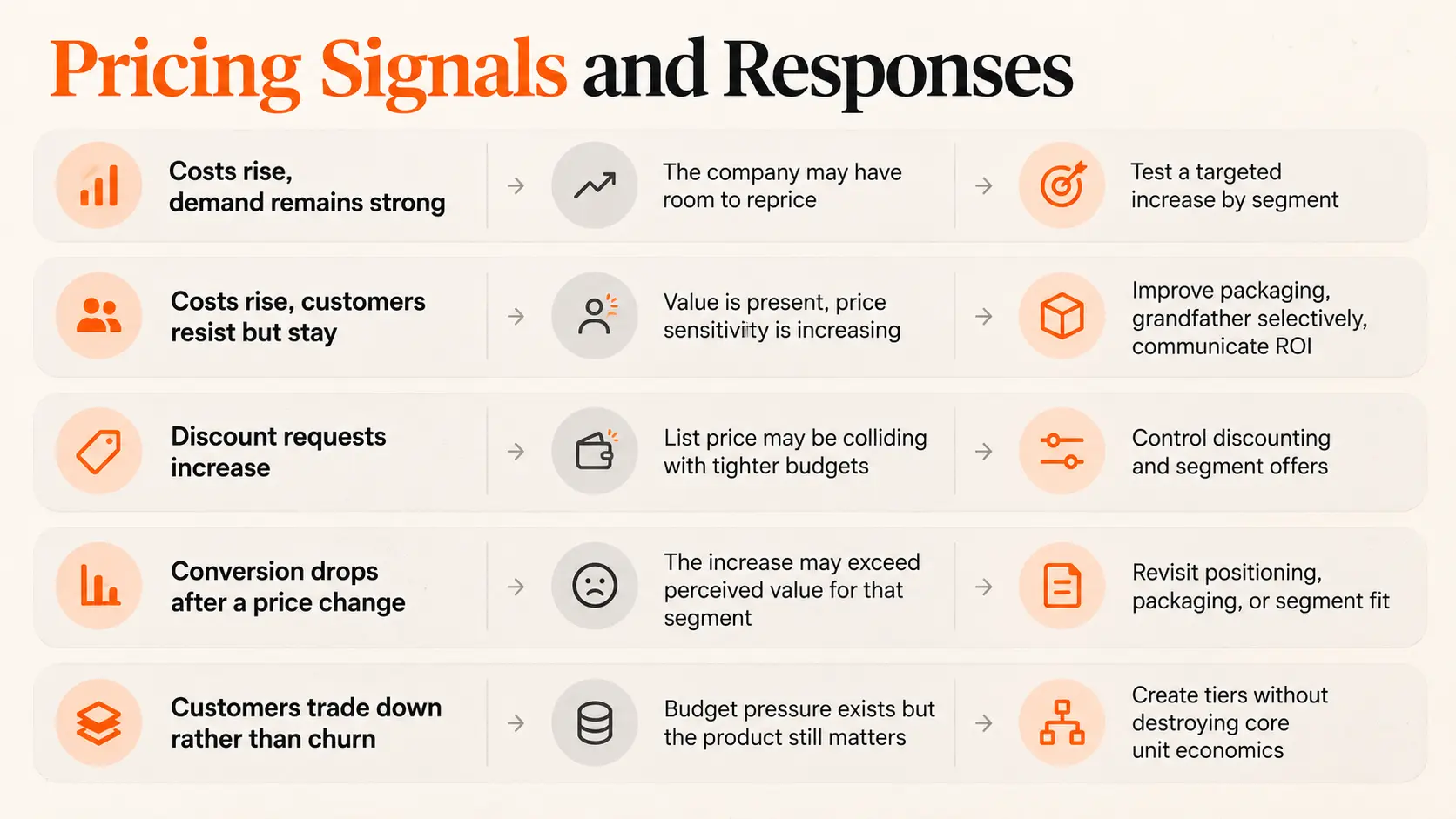
Founders should avoid mechanically applying the national inflation rate to every customer. A 3% CPI print does not automatically justify a 3% price increase, and a 10% supplier increase does not automatically mean every customer can absorb 10%. Pricing should be based on customer value and elasticity, not just reimbursement for higher costs.
When Should a Startup Raise Prices During Inflation?
A price increase is easier to defend when three conditions are present: the cost pressure is durable, the company can explain the value delivered, and the current price no longer supports healthy unit economics.
1. Rebuild the unit economics first. Quantify how much the relevant cost base has changed and which customers or products are affected.
2. Segment the exposure. Do not assume enterprise customers, SMBs, and consumers have the same sensitivity.
3. Test before rolling out broadly. New customers, renewals, geographic markets, or product tiers can provide useful pricing evidence.
4. Watch behavior, not complaints alone. Customers may object to a price increase but still renew because the product creates enough value.
5. Protect the price architecture. Avoid solving every objection with permanent discounts that make the new price meaningless.
Sometimes the right answer is not a higher headline price. Startups can change packaging, minimum commitments, usage thresholds, contract length, or included service levels to protect economics without treating every customer identically.
Inflation Can Weaken Demand Even When the Startup Does Not Raise Prices
Founders often focus on what inflation does to their own costs. The second order effect on customers can be just as important.
Consumers whose food, housing, transport, and energy costs rise have less discretionary income. Businesses facing higher wages, insurance, materials, or financing costs may freeze budgets and delay purchases. A startup can therefore experience weaker demand without changing its own price at all.
The signals usually appear before a major drop in revenue:
Longer sales cycles
More approvals in procurement
Smaller initial contracts
Higher discount requests
Downgrades to cheaper plans
Lower purchase frequency
Longer payment times
Greater emphasis on measurable ROI
This is why a startup should not interpret every slowdown as a product problem but it should not use inflation as an excuse either. Compare market signals with customer level evidence. If retention, usage, and win rates are deteriorating far more than competitors or adjacent categories, execution may be part of the problem.
Inflation Can Shorten Runway Before the Cash Balance Looks Dangerous
Runway is based on the future cost of operating, not the historical cost base.
If a startup has $1.2 million in cash and burns $100,000 per month, the simple model shows 12 months of runway. If payroll, software, hosting, insurance, and vendors push burn to $115,000, the same cash balance supports only a little more than 10 months before considering any slowdown in revenue collection.
The more useful question is not “How many months of runway do we have?” It is “How many months of runway do we have under the cost environment we are likely to face?”
A practical inflation stress test should model at least three cases:
Base case: current cost assumptions and expected revenue.
Cost pressure case: key expenses rise faster than plan while revenue remains on target.
Margin pressure case: costs rise while sales cycles lengthen or discounting increases.
The third scenario is often the most important because inflation can attack both sides of the model simultaneously.
Watch Working Capital, Not Only Burn Rate
Inflation can tighten cash even when the income statement looks manageable. Customers may take longer to pay, suppliers may shorten payment terms, and inventory may require more cash to replace.
A growing physical product startup can report higher revenue and still feel a severe cash squeeze if replacing inventory costs more than the inventory sold. A B2B startup can face a similar problem when customers negotiate longer payment terms while vendors reprice quickly.
Founders should monitor days sales outstanding, days payable outstanding, inventory requirements, and cash conversion alongside burn. Inflation makes working capital mistakes more expensive because every delay ties up more money.
Wage Inflation Changes Hiring Economics
Payroll is the largest expense for many startups, so even modest wage inflation can materially change burn.
The mistake is to respond with either extreme: matching every market increase automatically or freezing compensation across the company. Founders should separate critical roles from replaceable capacity, understand actual market rates, and evaluate whether each hire still clears the company's return threshold.
Inflation can also create a retention problem when employee pay rises more slowly than living costs. Even if the external hiring market softens, workers may still expect compensation changes because their real purchasing power has declined.
The right question is not simply whether salaries are rising. It is whether the company can maintain the talent required for its next stage without allowing payroll growth to outrun the economics of the business.
Inflation Exposure Depends on the Business Model
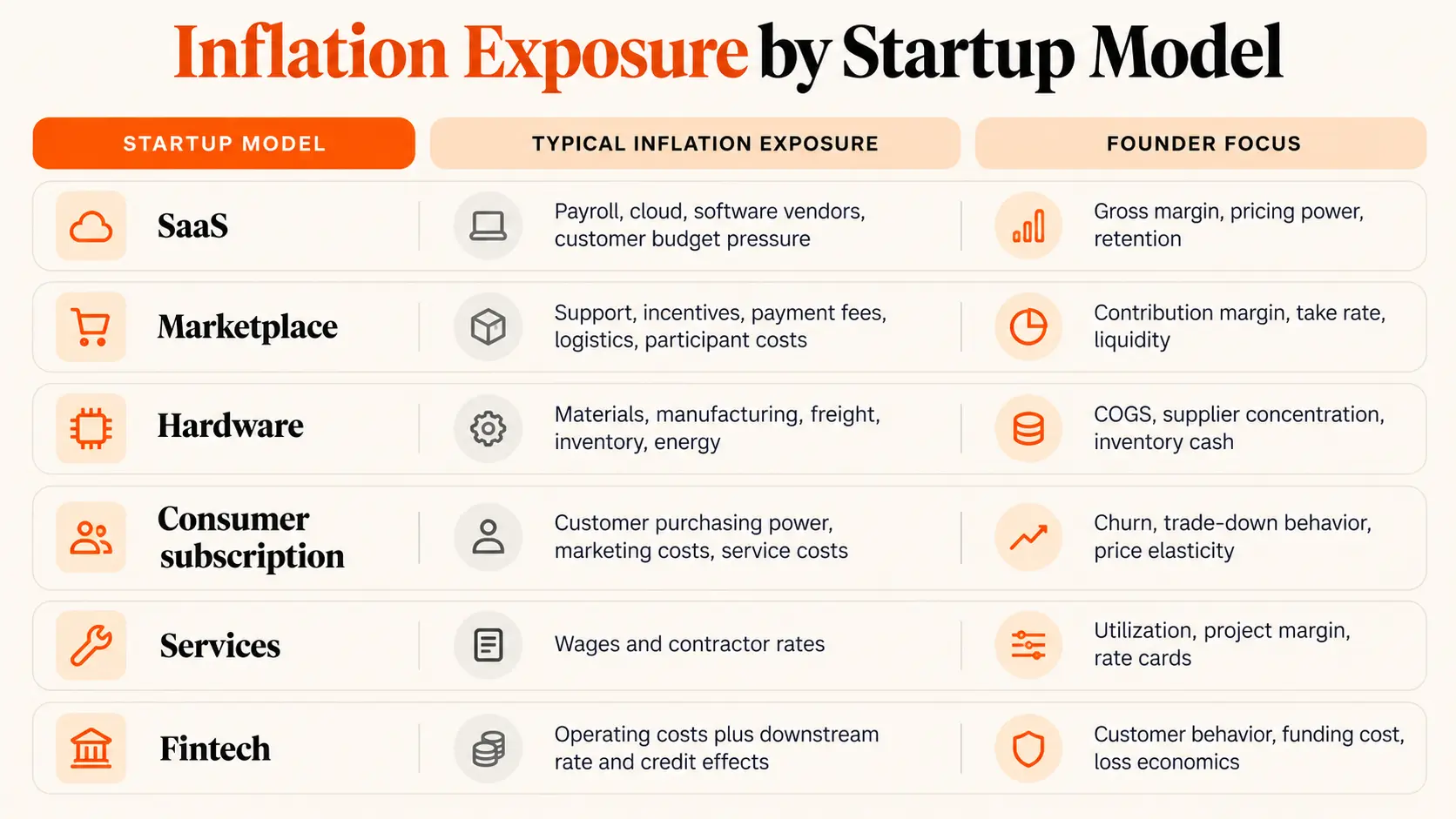
This is why broad advice such as “cut costs during inflation” is not enough. The highest risk line item for one startup may barely matter to another.
Vendor Renegotiation Is Often More Valuable Than Blanket Cost Cutting
Inflation creates an opportunity to review the cost base with more precision. Startups often accumulate software, cloud commitments, agencies, suppliers, and service contracts during periods of fast growth. When vendors reprice, the company should revisit usage and value rather than automatically renew.
Useful questions include:
Are we paying for capacity we no longer use?
Can volume commitments secure better pricing?
Can a multi year contract lock in an important input without creating excessive rigidity?
Do we have supplier concentration that gives one vendor too much pricing power?
Can product or engineering changes reduce consumption of the expensive input?
Would changing payment terms improve cash without damaging the relationship?
The objective is not to cut every expense. It is to preserve spending that creates growth or product advantage while removing inflation amplified waste.
A Founder Framework for Managing Inflation
Inflation becomes manageable when founders convert it into a small number of operating decisions.
1. Map inflation exposure. Identify the cost categories and customer segments most sensitive to rising prices.
2. Measure margin movement. Track whether revenue growth is keeping pace with COGS and operating costs.
3. Test pricing power. Learn where the company can reprice, repackage, or change terms without destroying demand.
4. Stress test runway. Model higher costs and weaker demand together, not as separate risks.
5. Review vendor and hiring commitments. Reassess large recurring costs before they become fixed assumptions.
6. Define triggers. Decide which changes in gross margin, burn, conversion, or cash collections require action.
This framework keeps the company from reacting to every CPI release while still preventing slow cost drift from becoming a crisis.
The Inflation Dashboard a Startup Actually Needs
Most founders do not need a complicated macro dashboard. A small operating view is more useful.
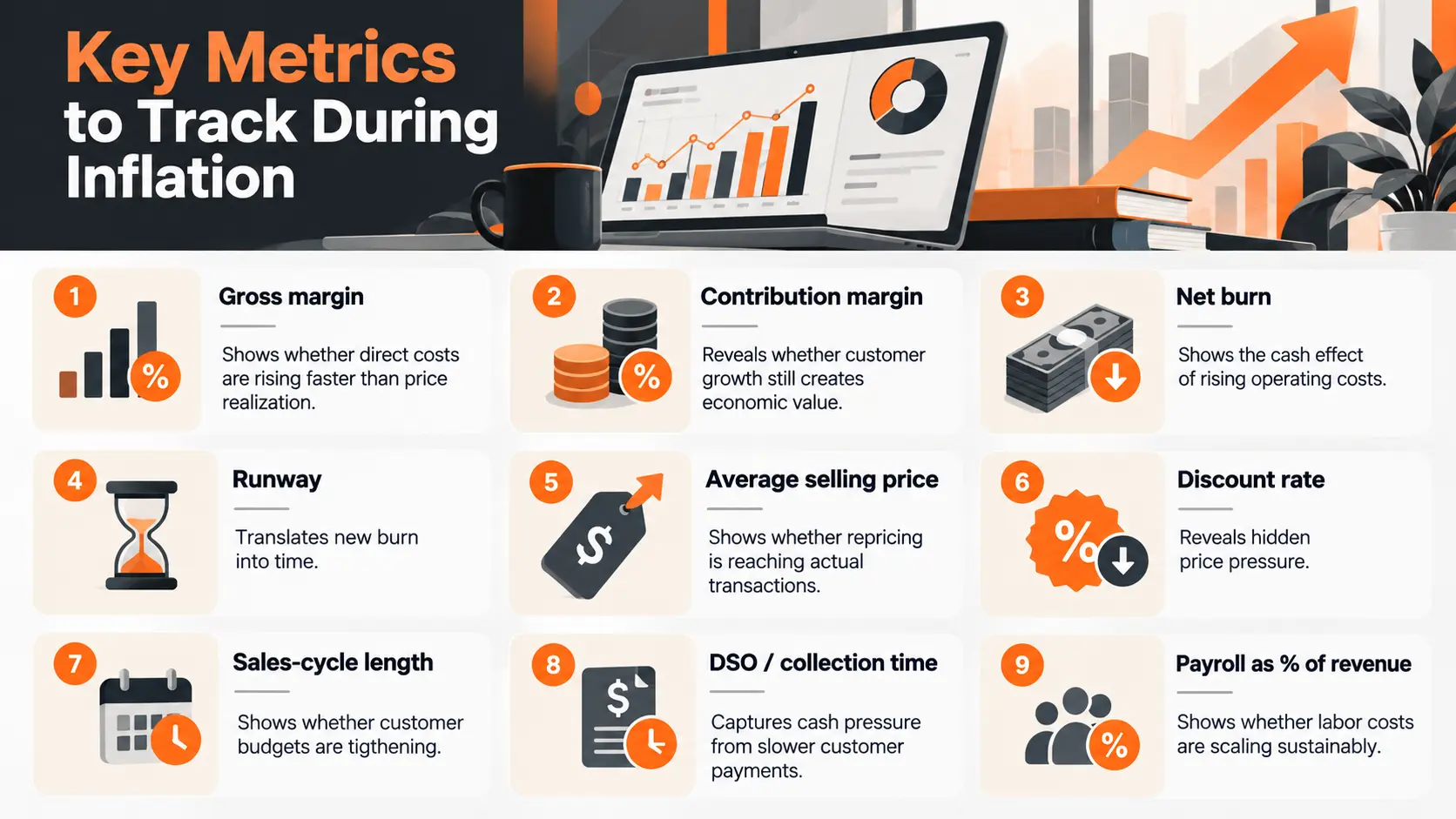
The dashboard should be reviewed against the company's own historical trend. A national inflation number can explain context, but the business metrics reveal whether inflation is actually changing the company.
Common Mistakes Startups Make During Inflation
Using CPI as the company's cost index
Headline inflation measures a broad consumer basket. A startup's true cost exposure may be concentrated in labor, cloud, fuel, imported components, insurance, or another category moving at a very different rate.
Raising every price by the same percentage
Different customer segments have different willingness to pay and different economics. Uniform increases can leave money on the table in one segment and cause unnecessary churn in another.
Cutting growth investments before fixing waste
Reducing high return product, sales, or acquisition spending can weaken the company while low value recurring costs remain untouched.
Mistaking nominal revenue growth for stronger economics
Revenue can rise because prices are higher while volume, margin, or real purchasing power deteriorates. Founders should look at units, customers, usage, and margins alongside top line growth.
Waiting until runway has already compressed
Inflation is often gradual. By the time cash becomes visibly tight, vendor, pricing, and hiring decisions made months earlier may already be difficult to reverse.
Protect the Economics, Not Just the Budget
Inflation is not simply a higher expense problem. It changes the relationship between costs, prices, customer demand, and cash.
The startups that handle it well do not respond by cutting everything or passing every cost increase directly to customers. They identify where inflation is actually entering the business, measure the effect on margins and runway, test pricing power, and protect the spending that still produces strong returns.
Founders cannot control inflation. They can control how quickly the company notices that its economics have changed.
FAQ
How does inflation affect startups?
Inflation can raise operating and labor costs, reduce customer purchasing power, compress margins, increase burn, shorten runway, and force startups to reconsider pricing, hiring, suppliers, and growth plans.
Why are startups vulnerable to inflation?
Startups often have limited cash, less pricing history, smaller supplier leverage, and business models that are still changing. That gives them less room to absorb sustained cost increases.
Should startups raise prices during inflation?
Sometimes. A price increase makes sense when cost pressure is durable and the product has enough pricing power, but founders should test elasticity and segment customers instead of applying a blanket increase.
How does inflation affect startup runway?
If operating costs rise faster than revenue, monthly burn increases and the same cash balance supports fewer months of operation. Inflation can also tighten working capital through slower collections or more expensive inventory.
Can inflation reduce customer demand?
Yes. Consumers may have less discretionary income, while businesses may delay spending because their own costs are rising. The effect usually appears in sales cycles, conversion, discounting, trade down behavior, or purchase frequency.
What metrics should founders track during inflation?
Gross margin, contribution margin, net burn, runway, realized selling price, discount rate, sales cycle length, collection time, and payroll relative to revenue are useful starting points.

Masoumeh Jahangard
Markets & Economy Writer at PinerookMasoumeh Jahangard covers markets, economic trends, and business conditions for Pinerook, focusing on how they affect startups and growing companies.
 Seen first.