Startup capital rarely arrives with a price tag that tells the whole story. Debt has an interest rate, but may also carry fees, warrants, covenants, and repayment pressure. Equity has no monthly payment, but it permanently gives investors a share of the company and part of the upside created later. A SAFE can feel simple at signing and become much more expensive when several instruments convert together.
That makes cost of capital a founder decision, not just a finance formula. The useful question is not which funding source looks cheapest today. It is which source gives the company enough time and flexibility to reach the next valuable milestone at an acceptable economic cost.
Within the broader context of macroeconomics for startups, the cost of capital is where market conditions become personal. Interest rates set part of the external price of money, but a startup's stage, risk, traction, cash flow, and negotiating position determine what founders actually pay.
For early stage companies, the answer is rarely a single percentage. Cost includes cash, ownership, control, constraints, timing, and the opportunity cost of choosing one capital structure over another.
What Cost of Capital Means for a Startup
In corporate finance, cost of capital is the return required by the people providing money to a business. Lenders expect interest and repayment. Equity investors expect enough upside to compensate for the risk that the company may fail or take years to create liquidity.
That definition is useful, but founders need a broader operating version. The real cost of capital is everything the company gives up, commits to, or risks in order to obtain money.
Cash cost, including interest, fees, and repayment.
Ownership cost through dilution.
Control cost through voting rights, board influence, or protective provisions.
Constraint cost through covenants, liens, milestones, or restricted spending.
Timing cost if fundraising distracts the team or arrives too late.
Opportunity cost if the company chooses capital that limits better options later.
Two financing offers can provide the same amount of cash and still have very different economic costs. That is why comparing only valuation or interest rate can produce the wrong decision.
Equity Is Expensive Even When It Has No Monthly Payment
Equity often feels easier on cash flow because there is no scheduled principal repayment. That flexibility is exactly why equity is well suited to highly uncertain work such as product development, market creation, research, and other investments that may take years to pay back.
The cost is dilution. Investors receive a permanent claim on future value, and that cost compounds across rounds.
Carta's 2026 Founder Ownership Report shows the scale of that trade. Across the companies in its dataset, the median founding team retained about 56% of fully diluted equity after seed and about 36% after Series A. Carta also reported median Series A dilution of 18.7% in Q2 2026.
Those figures do not mean founders should avoid equity. Capital that materially increases the value of the company can make a smaller ownership percentage worth far more. The mistake is treating dilution as free simply because it does not appear as an expense on the income statement.
Imagine a startup raises $2.5 million at a $10 million pre money valuation. The post money value is $12.5 million, so the new investor owns 20% before considering other cap table effects. If the company later becomes worth $100 million, that stake is worth $20 million. But calling the $20 million a pure financing cost would also be misleading, because the capital may have helped create the outcome. The correct question is whether the value created with the money is worth the ownership sold to obtain it.
Debt Can Look Cheaper Until You Calculate the All In Cost
Debt has a visible price, which makes it easier to compare. But the headline interest rate is only the beginning.
For venture debt, the all in cost can include interest, origination fees, end of term charges, warrants, legal costs, prepayment terms, liens, and covenants. The company also has to repay principal on a schedule, which means the financing consumes future cash rather than sharing future upside.
That cash obligation is the central trade. Debt can reduce dilution when a startup already has credible financing access and a clear path to the milestone the loan is meant to bridge. It can become dangerous when the company is still searching for product market fit, has uncertain revenue, or would need another equity round simply to repay the debt.
Silicon Valley Bank describes venture debt as a supplement to equity rather than a replacement for it, and notes that pricing commonly includes the interest rate, an origination fee, and warrants. That framing is important: founders should compare the whole structure, not one quoted rate.
SAFEs Defer the Price of Equity, They Do Not Remove It
SAFEs are popular because they can make an early financing faster and simpler. The investor provides money now and receives shares later when the SAFE converts under the agreed terms.
That simplicity can hide the cost if founders think of a SAFE as money without dilution. The dilution is deferred, not eliminated.
The economic outcome depends on the valuation cap, any discount, the amount raised, whether the SAFE is pre money or post money, and how multiple SAFEs interact before the next priced round. Several small instruments signed at different caps can produce more dilution than a founder expects if the cap table is not modeled before the next raise.
Carta has specifically highlighted overreliance on multiple post money SAFEs as one reason founders can arrive at their first priced rounds more diluted than expected. The lesson is not that SAFEs are bad. It is that speed at signing should not replace ownership modeling.
Bootstrapping Also Has a Cost of Capital
A company that raises no external capital can still pay a financing cost. It simply pays in different forms.
Founders may fund the company with personal savings, unpaid time, foregone salary, slower hiring, delayed product development, or revenue that could otherwise be reinvested elsewhere. Staying bootstrapped can preserve ownership and control, but it can also create a speed cost if the market rewards the company that reaches scale first.
The decision therefore should not be framed as expensive venture capital versus free bootstrapping. It is a comparison between dilution and external expectations on one side, and time, founder concentration, slower experimentation, and potentially missed opportunities on the other.
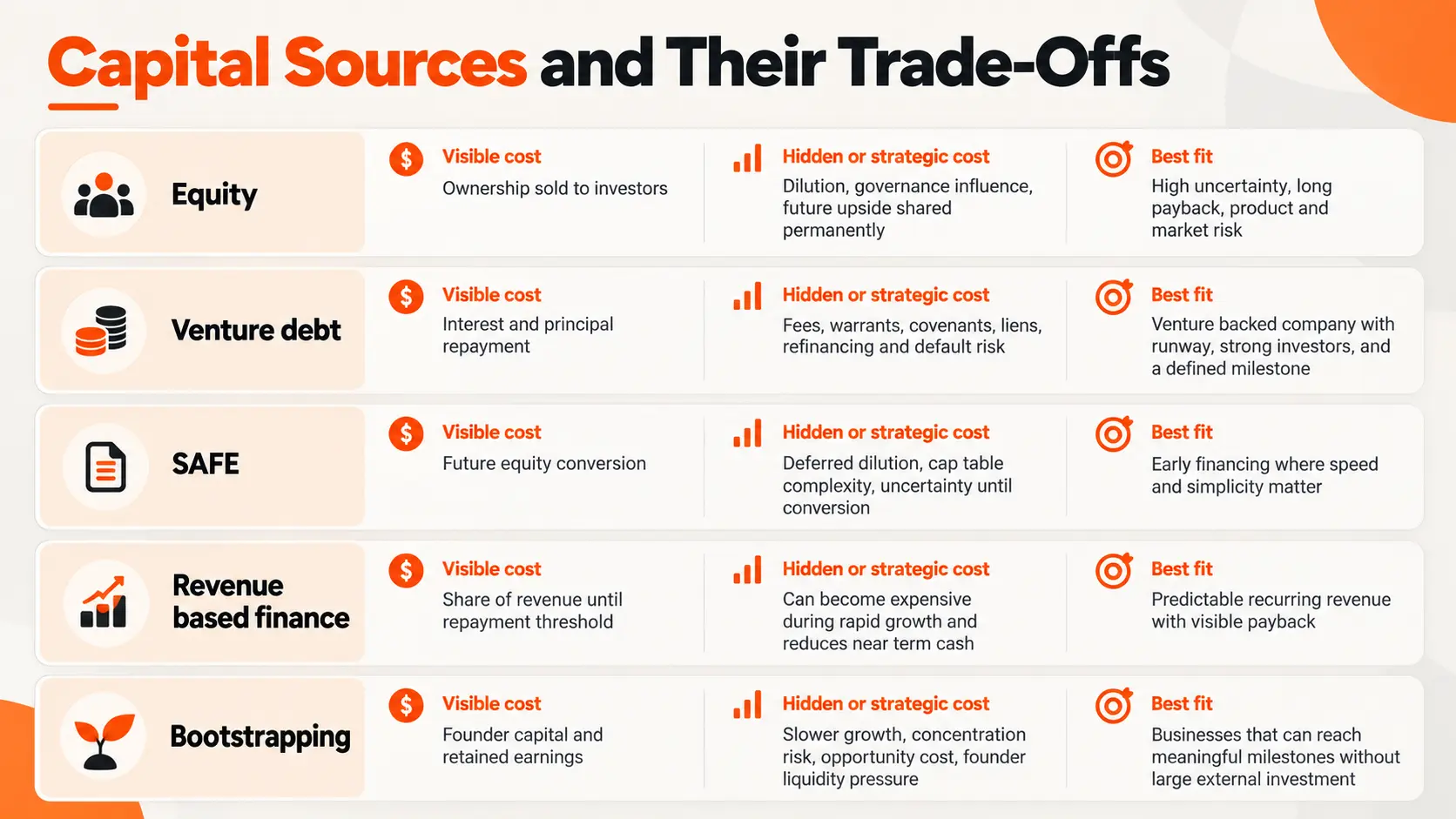
Compare Capital by More Than the Headline Price
A useful founder comparison starts with the visible price, then adds the less obvious cost created by the structure.
Stage Changes the Cost of Capital
A startup does not have one permanent cost of capital. It changes as uncertainty falls and negotiating power improves.
At pre seed, the company may have a team, thesis, prototype, or early customer evidence, but much of the risk remains unresolved. Equity investors therefore require the possibility of very large returns, while conventional lenders may not lend at all because there is little cash flow or collateral to underwrite.
At seed and Series A, evidence around product, retention, distribution, and revenue can reduce some risk, but growth still depends heavily on execution. By later stages, a company with recurring revenue, stronger margins, and a more predictable fundraising path may gain access to cheaper or more structured capital.
This creates an important founder principle: capital can become cheaper after a milestone. Raising only enough to reach a genuine de risking event can be more valuable than maximizing the size of the current round.
Interest Rates Set the Baseline, Startup Risk Sets the Premium
Market interest rates matter because they change the return available on safer assets and the base price of borrowing. But a startup usually pays far more than the policy rate because lenders and investors need compensation for startup specific risk.
As of September 2026, the Federal Reserve target range for the federal funds rate is 3.75% to 4.00%. That does not mean a startup can borrow at roughly 4%. A lender may add a significant risk premium, fees, warrants, and structural protections. Equity investors require an even less observable return because they sit behind creditors and may wait years for liquidity.
This is why a change in policy rates can influence startup capital without determining it. A stronger business can still reduce its effective cost of capital by improving retention, margins, revenue quality, cash discipline, governance, and the credibility of the next milestone.
WACC Is Useful Conceptually, but Early Stage Precision Is Often False
In established companies, finance teams often use weighted average cost of capital, or WACC, to blend the required return on equity with the after tax cost of debt. It can be useful for valuation and capital allocation.
For early stage startups, the concept matters more than a precise calculation. Young private companies rarely have a stable market value, a reliable public beta, predictable cash flows, or a mature debt structure. A spreadsheet can produce a clean percentage without making the assumptions behind it any more certain.
Founders should still use the core idea: every dollar has a required return, and an investment should create enough value to justify the risk and financing used to fund it. But a pre revenue founder does not need a fake precision WACC to decide whether to sell equity, take debt, or stay lean.
The Better Founder Question Is What Milestone the Capital Buys
The cheapest capital on paper is not always the cheapest capital in practice.
Suppose debt appears cheaper than equity, but the repayments force a startup to reduce product investment before reaching a major technical milestone. The loan can destroy optionality even though its stated annual cost is lower. Conversely, equity can look expensive because of dilution, but be rational if the business needs several years of uncertainty before cash flows become dependable.
A useful way to compare financing is to ask what the capital buys and how the company should look when the money is mostly spent.
Will this capital reach a product, regulatory, revenue, or margin milestone that meaningfully reduces risk?
Will that milestone make the next round cheaper or make future funding unnecessary?
Does the financing structure survive a delay in reaching the milestone?
Will repayment, covenants, or investor rights reduce the company's ability to adapt?
How much ownership or future cash flow is being exchanged for the additional time?
Capital should not merely extend the calendar. It should improve the company's next financing position or move the business closer to self funding.
Match the Capital to the Risk You Are Funding
Different types of work deserve different types of capital.
Equity is usually better suited to uncertain initiatives where the payoff is large but the timing is hard to predict. Core R&D, category creation, an unproven go to market motion, and first of a kind infrastructure all contain risk that fixed repayments handle poorly.
Debt is better suited to uses with clearer payback, such as equipment with identifiable economic life, working capital against predictable receivables, or a milestone bridge for a company with strong equity support and a credible next financing path.
A mismatch creates fragility. Funding uncertain discovery with rigid debt can force the company to optimize for repayment before the learning is complete. Funding predictable short term working capital entirely with expensive equity can create unnecessary dilution.
Sometimes Higher Cost Capital Is the Rational Choice
Founders naturally want to minimize dilution and interest. But minimizing the price of capital is not the same as maximizing company value.
A more expensive source can be rational when it provides strategic help, a longer risk horizon, access to customers, credibility with future investors, or enough flexibility to protect the company through uncertainty. A lower priced instrument can be destructive when it creates a repayment wall, personal guarantee, restrictive covenant, or fundraising dependency at the wrong time.
The relevant question is the return on the total package, not the apparent price of one term.
A Founder Framework for Choosing Capital
Before comparing term sheets or financing products, define the operating problem the capital is meant to solve.
1. Define the milestone. State exactly what should be true when this capital is mostly spent.
2. Calculate the runway required. Include a buffer for delays rather than assuming the optimistic plan.
3. Map the downside. Ask what happens if revenue is late, the next round is delayed, or the market becomes less favorable.
4. Model dilution and all in debt cost. Include SAFEs, option pool changes, warrants, fees, and repayment schedules.
5. Protect optionality. Understand which terms could constrain future fundraising, spending, acquisitions, or strategic changes.
6. Compare the value created with the value surrendered. The best capital is the one that improves the probability and value of the next state of the company.
The 2026 Capital Environment Rewards a More Explicit Trade Off
The current environment makes cost of capital harder to ignore. The Federal Reserve raised its target range to 3.75% to 4.00% in September 2026, keeping the baseline cost of money well above the near zero conditions founders experienced earlier in the decade.
At the same time, equity remains expensive in a different way. Carta's 2026 ownership data shows how quickly founder stakes can decline across early rounds. These two facts create a more balanced capital question: debt is no longer obviously cheap, but equity has never been free.
That environment increases the value of milestone planning. Founders with more evidence, more runway, cleaner unit economics, and fewer financing dependencies generally have more negotiating leverage regardless of which instrument they ultimately choose.
Common Cost of Capital Mistakes Founders Make
Comparing interest rate with dilution as if they were the same metric. Debt and equity transfer different risks. One consumes future cash; the other shares future ownership. The comparison needs a scenario, not a single number.
Assuming equity is free because there is no repayment. Equity can be the most flexible capital and still be economically expensive because the ownership transfer is permanent.
Treating debt as non dilutive and therefore cheap. Warrants, fees, covenants, liens, principal payments, and downside risk all belong in the calculation.
Raising more simply because it is available. Extra capital can extend runway, but early overfunding can also create unnecessary dilution, higher burn, and weaker capital discipline.
Failing to model stacked SAFEs. Several simple agreements can produce a complicated ownership outcome when they convert. Model the fully diluted cap table before adding another instrument.
Optimizing the current round instead of the next milestone. A higher valuation or lower rate is not automatically better if the terms reduce the company's ability to reach the proof point that matters next.
Buy the Milestone, Not Just the Money
Cost of capital for startups is not a contest to find the lowest rate or the highest valuation. It is the economic price of creating more time, capability, and optionality.
Equity trades ownership for flexibility. Debt preserves ownership but creates cash obligations and constraints. SAFEs postpone the ownership calculation. Bootstrapping protects the cap table while asking founders to absorb more of the time and concentration risk themselves.
The strongest financing decision starts with the milestone the company needs to reach, the risks between here and there, and the amount of flexibility required if the plan takes longer than expected. Capital is cheapest when it helps the company become materially less risky before it has to ask for money again.
FAQ
What is the cost of capital for a startup?
It is the economic cost of obtaining money from founders, investors, or lenders. For startups, that includes interest and fees as well as dilution, control, covenants, repayment pressure, and lost flexibility.
Is equity more expensive than debt for startups?
Equity often has a higher economic cost because investors receive a permanent share of future upside, but it is also more flexible because it has no scheduled repayment. Debt may be cheaper when the company can reliably service it and the use of funds has a clear payback.
How does dilution affect the cost of capital?
Dilution reduces the percentage of the company owned by existing shareholders. Its economic cost depends on how much ownership is sold and how much additional company value the new capital helps create.
Are SAFEs free capital until they convert?
No. SAFEs defer equity issuance, but they still create future dilution. Multiple SAFEs with different caps or terms can produce a larger ownership impact than founders expect.
Should an early stage startup calculate WACC?
Understanding the WACC concept is useful, but a precise figure can be misleading for very young companies because equity value, risk, and capital structure are unstable. A scenario based financing comparison is often more useful.
When does venture debt make sense?
It is generally more suitable for venture backed companies with strong investor support, sufficient runway, and a specific milestone that can be reached before repayment pressure becomes a problem.
How can a startup lower its cost of capital?
Reduce business risk before raising. Stronger retention, better margins, clearer revenue quality, more runway, clean governance, and credible milestones can improve negotiating leverage and expand the range of financing options.

Masoumeh Jahangard
Markets & Economy Writer at PinerookMasoumeh Jahangard covers markets, economic trends, and business conditions for Pinerook, focusing on how they affect startups and growing companies.
 Seen first.