
A cooling labor market can make hiring easier without making a new hire necessary. A strong labor market can make talent expensive without making hiring a mistake. The challenge for founders is separating the state of the labor market from the state of the company.
This is where macroeconomics for startups becomes operational. Labor data is useful when it helps a founder understand whether the company is competing for scarce talent, whether compensation pressure is changing, whether candidates are more willing to move, and whether a planned role can be filled on terms that still make sense for the business.
The wrong response is to turn every jobs report into a hiring signal. National employment data describes millions of workers across very different industries. A startup needs a narrower question: what is changing in the labor market that actually supplies the people we need?
That distinction matters in 2026. The U.S. labor market has cooled, but it has not collapsed. Payroll employment rose only 29,000 in September and unemployment was 4.2 percent. In August, job openings stood at 7.1 million, hires at 5.2 million, quits at 3.1 million, and layoffs at 1.6 million. The picture is not a hiring boom or a mass layoff cycle. It is a slower market where employers and workers are both moving more carefully.
Labor Market Data Should Change Assumptions, Not Make the Decision
A founder does not hire because unemployment moved from one number to another. The company hires because a bottleneck is important enough to justify adding permanent capacity. Labor market conditions affect the cost, speed, and probability of making that hire well.
Think of the labor market as a constraint around the hiring decision. It can change how long the search takes, what candidates expect, how much negotiating leverage the company has, and whether a local or remote search is realistic. It cannot tell you whether the role itself is necessary.
That keeps this question separate from general hiring strategy. First decide whether the business needs the role. Then use labor market evidence to decide how to recruit, budget, and time the search.
The Labor Signals That Matter Most to Startups
Most founders do not need a large labor economics dashboard. A small set of signals can explain most changes in hiring conditions.
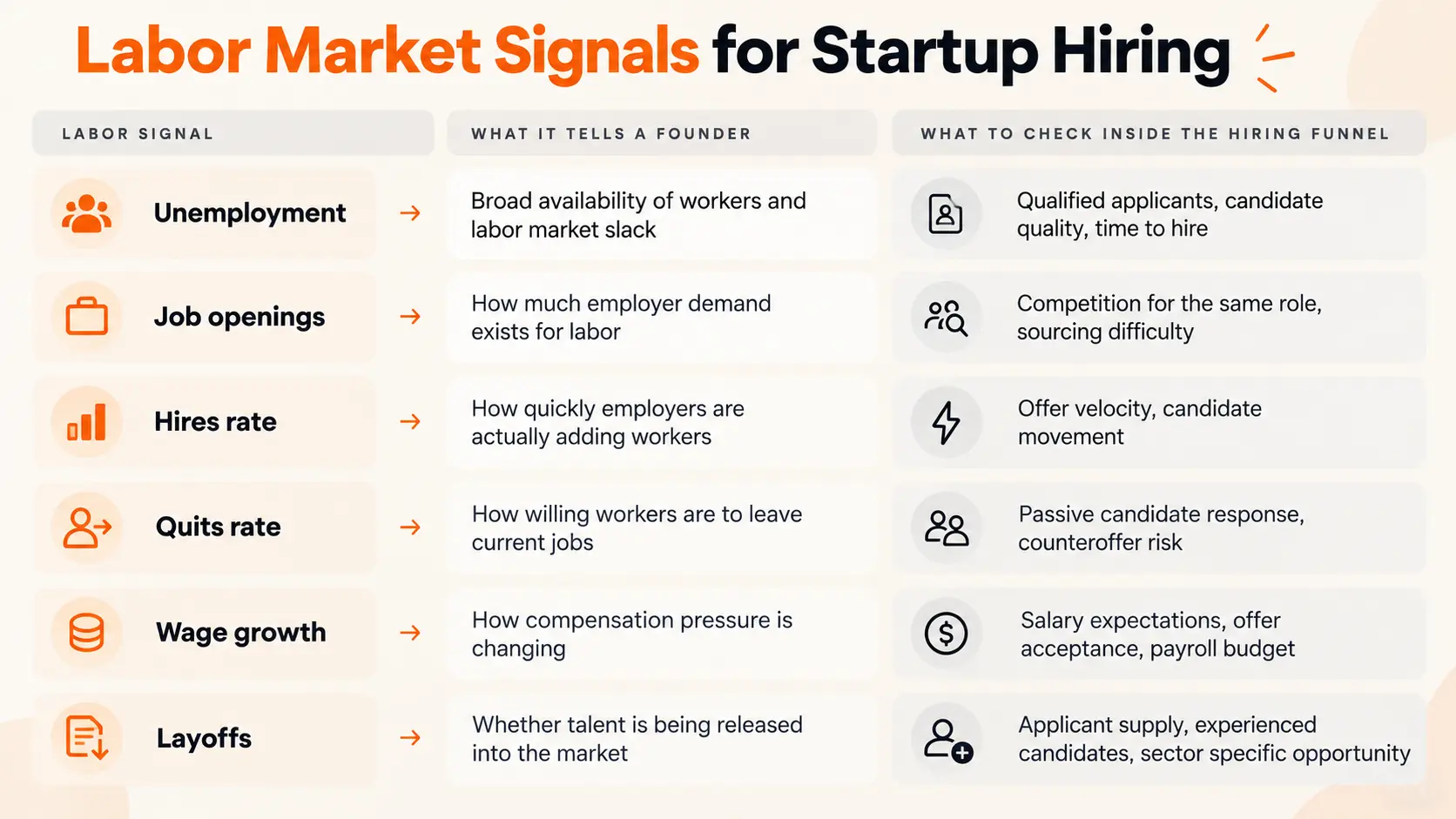
The important step is to pair these external signals with company data. If job openings fall nationally but your time to hire is still rising, your specific talent market may remain tight. If wage growth moderates but every strong candidate rejects your compensation range, the national average is not solving your local problem.
The 2026 Labor Market Looks Cooler, Not Loose
The latest U.S. data shows why founders need more than one headline. September payroll growth was modest at 29,000, and the unemployment rate held at 4.2 percent. Average hourly earnings were 3.0 percent higher than a year earlier. These figures point to slower momentum, but not to widespread labor market distress.
JOLTS data for August tells a similar story. Job openings were 7.1 million and hires were 5.2 million. Quits remained at 3.1 million with a quits rate of 1.9 percent, while layoffs were only 1.6 million. Workers are not leaving jobs aggressively, but employers are not cutting at crisis levels either.
For startups, that combination creates a specific environment: more candidates may be willing to listen than during a hot market, but the best people are not automatically easy to hire. Strong specialists can remain scarce even when overall hiring activity slows.
A Lower Unemployment Rate Does Not Automatically Mean Hiring Is Hard
Unemployment is useful as broad context, but it is one of the easiest indicators to overgeneralize. A startup does not hire from the entire labor force. It hires from a specific pool of people with a particular skill set, location, compensation expectation, risk tolerance, and interest in early stage companies.
The market for a senior machine learning engineer can remain tight while the national unemployment rate rises. The market for generalist operations talent can become easier at the same time. Geography can create another split. A company hiring only in one expensive technology hub faces a different market from a company willing to hire across several regions.
Founders should therefore treat unemployment as a backdrop and measure the real market through the hiring funnel: qualified applicants per opening, response rate from target candidates, time to first strong candidate, interview pass rate, and offer acceptance.
Job Openings, Hires, and Quits Tell You More About Movement
The JOLTS data is particularly useful because it shows whether employers are trying to hire and whether workers are willing to move.
Job openings: A decline can indicate weaker employer demand and less competition for talent. But openings should be read by industry and company size when possible. In August 2026, the job openings rate declined for establishments with one to nine employees even though the overall national level changed little. That is more relevant to a small startup than a national average by itself.
Hires: Open roles are intentions. Hires show actual movement. If openings stay high while hiring remains weak, companies may be cautious, slow, or unable to find the right people. A founder should not assume a large pool of listings means candidates are changing jobs rapidly.
Quits: Workers usually quit when they believe another opportunity is available or worth the risk. A low quits rate can mean candidates are less willing to leave stable jobs, even if more people are technically available. This can make recruiting passive candidates harder than unemployment data suggests.
Layoffs: Higher layoffs can increase candidate supply, but the source matters. A wave of layoffs in one function or sector may create a rare opportunity to hire experienced people. Layoffs elsewhere may have almost no effect on the role your startup needs.
Wage Growth Changes the Economics of the Role
A labor market can cool while compensation remains sticky. Salaries do not automatically reset when job openings fall.
Private industry wages and salaries were 3.1 percent higher over the year ending June 2026, according to the Employment Cost Index. Average hourly earnings were up 3.0 percent over the year in September. That is slower than the wage pressure seen in hotter periods, but it still means a startup should not build a hiring plan around the assumption that talent is becoming cheaper.
For founders, the useful comparison is not salary growth versus last year. It is total compensation versus the expected value of the role. A hire can be expensive and still be rational if the person removes a meaningful bottleneck. A cheaper hire can be costly if the role was unnecessary or the candidate needs heavy management to create value.
Compensation planning should also include equity, benefits, location, flexibility, and the risk candidates associate with joining a young company. A startup competes with established employers on more than cash.
A Cautious Labor Market Changes Candidate Behavior
When workers feel less confident about finding another job, recruiting changes even before salary expectations do.
Candidates may take longer to leave secure employers. They may ask more questions about runway, funding, revenue, leadership, and the durability of the role. Counteroffers can carry more weight. People who would have accepted startup risk in a stronger market may prefer stability.
This means a cooler labor market does not eliminate the need for a credible employer story. It changes the story. Founders should be prepared to explain why the company exists, what the role will own, how success is measured, what the company has proven, and what risk the candidate is actually taking.
The strongest candidates are evaluating the startup as carefully as the startup evaluates them.
Local and Sector Labor Markets Matter More Than the National Average
Recent research on startup hiring emphasizes that local labor market conditions and competition from incumbent employers can shape a startup's ability to attract talent. That matches what founders see in practice: hiring difficulty is usually concentrated, not universal.
A national technology slowdown can coexist with intense competition for AI infrastructure, security, robotics, or specialized sales talent. A weak hiring market in one city can coexist with a strong market elsewhere. A role that is difficult to fill on site may become much easier when the company expands the geographic search.
That is why founders should build compensation and sourcing plans around the actual talent pool for the role rather than a national headline. Industry, seniority, location, and company stage can matter more than the top line unemployment rate.
AI Is Changing Role Design Before It Changes Headcount
One of the most important hiring changes in 2026 is not simply whether AI removes jobs. It is how AI changes the amount and type of work a new employee is expected to own.
Startups increasingly expect each hire to operate with more leverage. Routine research, documentation, drafting, scheduling, and analysis can often be accelerated by software. That raises the value of people who can make decisions, build systems, communicate across functions, and use AI without losing judgment.
This does not mean every role should be combined into a broad generalist position. Some specialist work remains scarce precisely because AI increases the amount of infrastructure, security, data, and technical judgment companies need. The labor market should influence role design, but the business bottleneck still determines whether a specialist or a broader operator is the right answer.
Remote Work Expands Supply but Changes the Competition
Opening a role to remote candidates can increase the size of the talent pool dramatically. It can also expose the startup to a much larger set of competing employers.
Startup recruiting data in 2026 continues to show that remote roles attract substantially more applications and can improve offer acceptance. That is useful when the local market is shallow, but application volume should not be confused with qualified supply.
A remote search also changes compensation, onboarding, time zones, collaboration, and legal considerations. Founders should use remote hiring as a deliberate talent strategy rather than as a default response to a difficult local search.
How Founders Should Translate Labor Data Into a Hiring Plan
A labor report should not trigger a hiring decision. It should update the assumptions around an existing plan.
If talent availability improves: Use the opportunity to raise the quality bar, shorten the sourcing cycle, or reach candidates who were previously inaccessible. Do not add roles simply because hiring looks easier.
If wage pressure remains high: Recheck whether the role creates enough leverage to justify the full compensation cost. Redesign scope before lowering the bar on candidate quality.
If quits are low: Expect passive candidates to need stronger reasons to move. Give them clarity on ownership, company risk, and the upside of joining early.
If hiring demand weakens in your sector: Look for unusually strong candidates and reduce unnecessary urgency. A slower market can give a startup more time to assess fit.
If your specific talent market stays tight: Broaden geography, revisit level, split the role, use a contractor where appropriate, or change the operating system around the bottleneck before assuming compensation alone is the problem.
Track Your Hiring Funnel as the Real Time Labor Market
National data arrives with a lag. Your recruiting funnel tells you what is happening to your startup now.
A simple monthly founder view can include:
Qualified candidates per open role
Response rate from targeted candidates
Time to first qualified interview
Time to hire
Offer acceptance rate
Compensation requests versus approved range
Candidate drop off by stage
Reasons strong candidates decline
If those metrics improve while the role remains strategically necessary, the labor market may be creating a hiring window. If they deteriorate despite softer national data, trust the specific market you are actually hiring in.
When Labor Market Conditions Should Change the Plan
There are three useful levels of response.
Observe: The national labor market changes but your hiring funnel and business needs remain stable. Update assumptions, but do not change the plan.
Adjust: Compensation, candidate availability, or time to hire changes enough to affect the economics or timing of a planned role. Change the search strategy, scope, location, or budget.
Replan: Labor conditions and business conditions move together. Customer demand weakens, runway becomes more valuable, and hiring remains expensive. Revisit whether the role is still the best use of capital.
The company should react to the interaction between labor conditions and business conditions, not to a macro number in isolation.
Common Mistakes Founders Make When Reading the Labor Market
Assuming more applicants means better talent availability: A weak market can increase application volume without increasing the supply of people who fit a specialized role.
Using unemployment as a compensation benchmark: Pay is shaped by role scarcity, location, industry, seniority, and competing offers. National unemployment is context, not a salary table.
Waiting for the perfect market to hire: If a bottleneck is materially limiting growth or product quality, the cost of waiting can exceed the benefit of slightly better labor conditions.
Hiring because talent suddenly looks cheap: A role that does not create enough value remains unnecessary even if the candidate market improves.
Ignoring candidate risk perception: In uncertain markets, strong candidates may care more about runway, revenue, leadership, and job durability than about a slightly higher offer.
Treating the technology labor market as one market: Software, AI, hardware, security, product, sales, and operations can move in different directions at the same time.
Read the Labor Market Through the Role You Need to Fill
Labor market trends matter to startups because they change the price and availability of talent, the willingness of candidates to move, and the amount of competition around a role. They do not determine whether a startup should hire.
In 2026, the broad U.S. labor market looks slower and more cautious than a classic hiring boom. Payroll growth is modest, quits are low, and job openings have eased, while layoffs remain contained. That can create better recruiting conditions in some areas without turning every specialist market into an employer market.
Founders should use macro labor data to update assumptions, then let the company's bottleneck and recruiting funnel make the decision. The most useful signal is not whether the labor market is strong or weak. It is whether the market for the exact person you need has changed enough to alter the economics of hiring them.
FAQ
Which labor market indicators should startup founders track?
The most useful indicators are unemployment, job openings, hires, quits, layoffs, and wage growth. Founders should compare them with their own time to hire, candidate quality, compensation requests, and offer acceptance.
Does a higher unemployment rate make startup hiring easier?
Sometimes, but not automatically. National unemployment can rise while specialist talent remains scarce. Industry, role, seniority, location, and startup risk all affect candidate availability.
Why is the quits rate useful for startup hiring?
The quits rate helps show how willing workers are to leave existing jobs. A low quits rate can make passive candidates more cautious even when there are more applicants in the market.
Should startups reduce salaries when the labor market cools?
Not simply because national hiring slows. Compensation should reflect the role, local and sector supply, competing offers, candidate quality, and the value the hire is expected to create.
How does AI affect startup hiring in 2026?
AI is increasing the leverage expected from many roles and reducing some repetitive work, while raising demand for people who can combine domain judgment with AI enabled execution. Some technical specialties remain highly competitive.
How often should founders review labor market data?
A monthly review is usually enough for most early stage startups. Hiring funnel data should be reviewed more frequently when an important role is actively open.

Masoumeh Jahangard
Markets & Economy Writer at PinerookMasoumeh Jahangard covers markets, economic trends, and business conditions for Pinerook, focusing on how they affect startups and growing companies.
 Seen first.