Interest rates can look distant from the day to day work of building a startup. A founder may not have a bank loan, may not follow bond markets, and may be years away from an IPO. Yet rate changes can still reach the company through investors, customers, hiring plans, pricing, and the amount of time the business has to prove itself.
That is why understanding macroeconomics for startups starts with transmission rather than prediction. The useful question is not whether the Federal Reserve will move rates next. It is what a change in the price of money would actually change inside your business.
For some startups, the first effect is obvious: debt becomes more expensive. For others, the more important effects are indirect. Investors may demand stronger evidence before taking risk. Customers may delay financed purchases. Public market valuations can reset the benchmarks used for private companies. A startup that looked comfortably funded under one capital environment can suddenly need a longer runway under another.
Interest rates matter because they change the trade offs around capital. They do not dictate every startup decision, but they can change the cost, timing, and risk of those decisions.
How Do Interest Rates Affect Startups?
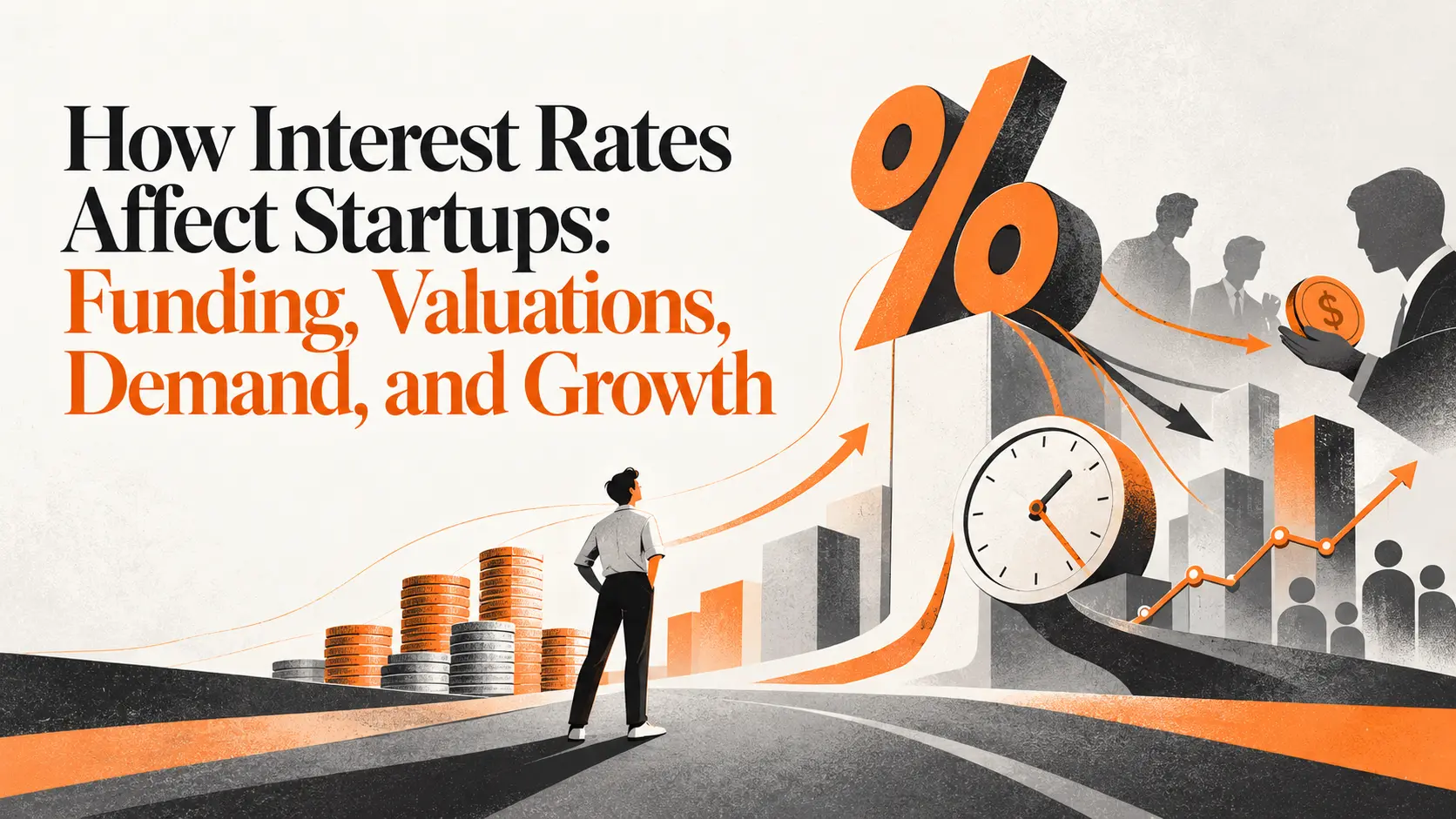
Interest rates affect startups through five main channels: borrowing costs, investor risk appetite, startup valuations, customer demand, and operating decisions such as hiring or cash preservation.
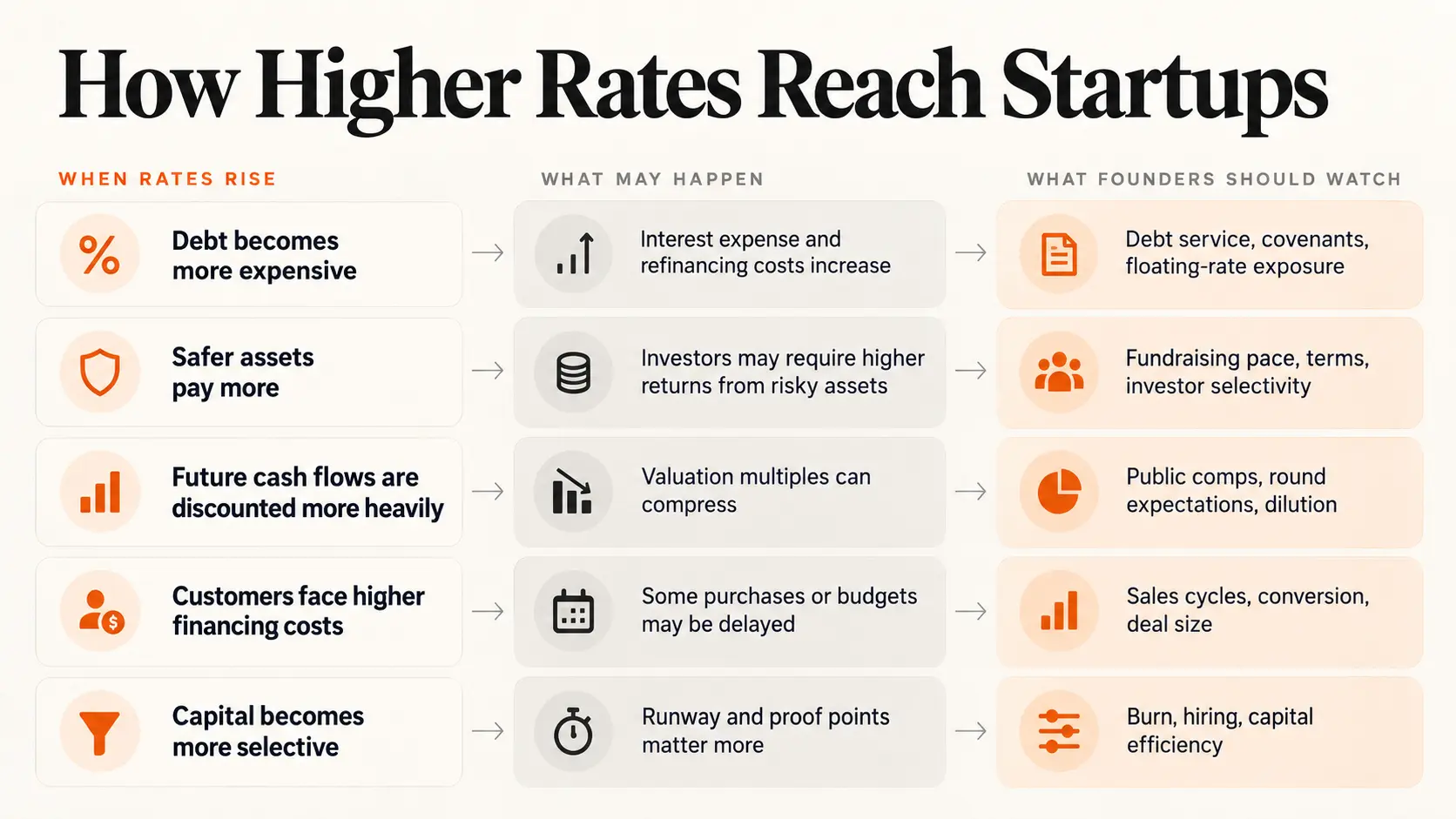
The direction can reverse when rates fall, but not always immediately. Funding markets, customer behavior, and private valuations often adjust with a lag.
Why Founders Without Debt Still Need to Care About Interest Rates
The most common misunderstanding is that interest rates matter only to companies that borrow money. That view misses how rates move through the broader capital system.
A bootstrapped SaaS company with no debt can still be affected if its customers tighten budgets. A venture backed company can feel higher rates through lower valuation benchmarks even if it never takes a loan. A marketplace can experience weaker transaction volume if buyers depend on credit. A hardware startup can face both higher financing costs and more cautious customers.
The useful exercise is to identify where your business is exposed. In many startups, the biggest interest rate risk sits outside the company with customers, investors, suppliers, or future acquirers.
The First Transmission Channel Is the Cost of Capital
Interest rates are often described as the price of money. For founders, that price appears most directly in debt.
Bank loans, revolving credit, venture debt, equipment financing, and other borrowing structures generally become more expensive when market rates rise. Variable rate debt can reprice quickly, while fixed rate debt may become a problem later when it needs to be refinanced.
The effect is not only the higher interest bill. More expensive debt changes the economics of projects that were previously attractive. A new warehouse, international expansion, acquisition, or aggressive inventory build may produce the same operating return but become less attractive once financing costs rise.
This is why founders should think about the cost of capital rather than only the quoted interest rate. The real question is whether the expected return from using capital still compensates for the cost and risk of obtaining it.
Why Startup Valuations Often Come Under Pressure When Rates Rise
Interest rates can affect startup valuations even when a company has no debt and is not currently fundraising.
The underlying logic is the value of future cash flows. A startup is often valued on earnings or cash flows that investors expect years into the future. When the required return on capital rises, those future outcomes are worth less in today's terms. The effect is especially important for high growth companies whose value depends heavily on results far into the future.
Public markets usually adjust faster because stocks trade every day. If public software, fintech, or marketplace companies begin trading at lower revenue or earnings multiples, those comparable valuations can eventually influence late stage private markets and then filter further down the funding stack.
This does not mean every 1 percentage point increase in rates produces a predictable drop in a startup's valuation. Company quality, growth, margins, retention, market position, and investor competition still matter. Rates change the valuation environment; they do not replace the fundamentals.
Higher Rates Can Make Venture Capital More Selective
Venture capital is risky by design. Investors accept a high probability of failure because successful outcomes can produce unusually large returns.
When safer assets offer very low yields, investors have a stronger incentive to search for return elsewhere. When government bonds and other lower risk assets offer more attractive returns, risky assets need to clear a higher bar.
Research summarized by the National Bureau of Economic Research found that interest rate increases are followed by persistent reductions in venture capital investment, along with lower R&D spending and patenting. The decline in VC activity was also present among early stage startups, suggesting that tighter monetary conditions can reduce investors' willingness to make risky bets.
For founders, the practical effect is usually not that venture capital disappears. It is that the market can become more discriminating. Fundraising can take longer, weak stories receive less benefit of the doubt, and investors may place more weight on revenue quality, margins, runway, capital efficiency, and a credible path to durable cash generation.
Customer Demand May Matter More Than Fundraising
Founders often focus on the investor side of interest rates, but customer exposure can be just as important.
Higher rates can reduce demand for products that depend on borrowing. Housing, automobiles, equipment, construction, and other financed purchases are obvious examples. But the effect can also reach software and services when customers become more cautious about discretionary budgets.
A startup selling to real estate developers may feel higher rates because projects are harder to finance. A fintech may see lower lending volume. A B2B tool sold to small businesses may face longer approval cycles if customers are preserving cash. A consumer company may see weaker demand for non essential purchases.
This is why founders should monitor internal customer behavior rather than assume the rate effect from headlines alone.
Sales cycle length
Win rate
Average contract value
Discount requests
Payment delays
Expansion revenue
Customer financing needs
Churn and downgrade reasons
Interest Rates Change the Value of Runway
When capital is abundant, founders can be rewarded for moving aggressively. When capital is expensive or selective, the value of optionality rises.
An extra six months of runway can mean more time to hit a revenue milestone before raising. A slower hiring plan can reduce the risk of entering the market at a weak moment. Preserving cash can give founders the ability to wait for better financing conditions rather than accepting a round from a position of urgency.
The correct response is not automatically to cut. Underinvesting can damage a startup just as easily as overspending. If a product has strong demand and attractive unit economics, pulling back simply because rates are high can sacrifice market share.
The operating question is whether the expected return from a hire, campaign, expansion, or product investment still justifies the cash committed and the reduction in runway.
The Impact Depends on Startup Stage and Business Model
Interest rate exposure is not uniform. A pre seed software company and a growth stage hardware company can live in the same economy and experience very different consequences.
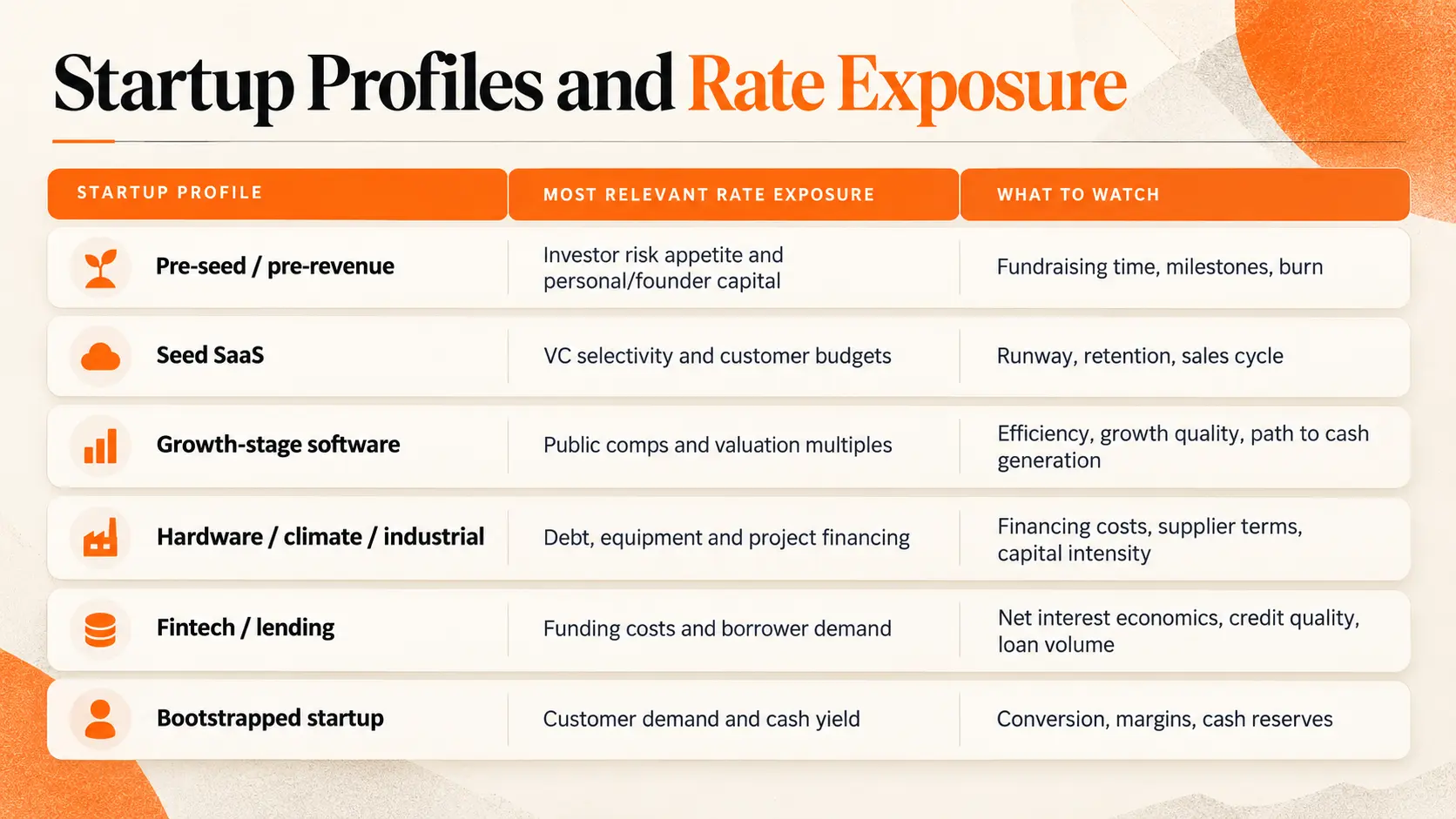
The same distinction applies across customer types. A startup serving highly leveraged customers may be more rate sensitive than one selling a mission critical product to cash rich enterprises.
What Changes When Interest Rates Fall?
Lower rates can improve the environment for startups, but founders should avoid treating a rate cut as an instant funding switch.
Cheaper borrowing can support investment and customer spending. Lower yields on safer assets can make riskier investments relatively more attractive. Public market valuation multiples may expand if investors become more willing to pay for future growth.
But the effects can arrive unevenly. A central bank may cut rates because the economy is weakening. Investors can remain cautious even after policy changes. Banks may tighten lending standards while headline rates fall. Venture firms can take time to deploy more aggressively.
The direction of rates matters, but so does the reason they are moving.
The 2026 Rate Environment Is a Reminder Not to Build Around One Forecast
As of September 2026, the Federal Reserve's target range for the federal funds rate is 3.75% to 4.00% after a 25 basis point increase. The Fed said economic activity was expanding at a solid pace while inflation remained elevated.
The current target range and policy history are available from the Federal Reserve.
For startups, the useful lesson is not to build a plan around a confident prediction that rates will soon move in one direction. Even professional forecasts change. A better operating plan should work across a reasonable range of financing conditions.
A Founder Framework for Managing Interest Rate Exposure
Founders do not need to forecast monetary policy. They need to know what would change if the financing environment moves against them.
1. Map direct debt exposure. List every loan, credit line, venture debt facility, equipment lease, and refinancing date. Separate fixed rate from floating rate obligations.
2. Map customer exposure. Identify whether customers rely on mortgages, business loans, working capital facilities, consumer credit, or other financing to buy from you.
3. Map fundraising exposure. Estimate how long a new round could take under a more selective market and what milestone would materially improve your position.
4. Stress test runway. Model what happens if fundraising takes three to six months longer, revenue growth slows, or debt costs rise.
5. Review investment thresholds. Require major hiring, expansion, and capital projects to show a credible return rather than assuming cheap capital will cover weak economics.
6. Define triggers. Decide in advance which changes in sales cycles, burn, cash balance, or financing terms would cause you to adjust the plan.
This converts interest rates from a market headline into an operating variable.
The Startup Interest Rate Exposure Test
A founder can usually identify the biggest risks with a short set of questions:
Do we have variable rate debt or a refinancing event in the next 18 months?
Do our customers depend on financing to purchase our product?
Would we need to raise capital before reaching the next meaningful proof point?
Are our valuation expectations based on public market multiples that could move materially?
Would a longer sales cycle meaningfully reduce runway?
Are we making large commitments based on the assumption that future capital will be easy to obtain?
Which spending decisions can be delayed without damaging the core business?
If several answers expose the company to the same rate scenario, the startup has a concentration risk worth addressing.
Common Mistakes Founders Make When Rates Change
Assuming high rates mean all startups should cut growth
Rate pressure is not a universal signal to stop investing. Companies with strong unit economics, clear demand, and sufficient runway may have opportunities precisely because competitors become more defensive.
Assuming rate cuts immediately reopen the funding market
Venture capital and private valuations can respond with a lag. Investors still care about company specific quality, portfolio constraints, exit markets, and fundraising conditions for their own funds.
Looking only at the startup's own debt
For many businesses, the customer's financing position is more important than the company's. A debt free startup can still be highly rate sensitive.
Using macro conditions to explain weak execution
A difficult rate environment can make growth harder, but it does not explain poor retention, weak positioning, bad sales execution, or a product customers do not value.
Optimizing for the interest rate forecast
Founders should not build a fragile operating plan that requires a specific sequence of central bank decisions. Resilience comes from being able to continue operating when the forecast is wrong.
Manage the Exposure, Not the Headline
Interest rates matter to startups because they change the environment in which capital, customers, and risk are priced.
Higher rates can raise borrowing costs, pressure valuation multiples, make venture investors more selective, and weaken demand in rate sensitive customer markets. Lower rates can ease some of those pressures, but they do not automatically create strong fundraising conditions or healthy customer demand.
The founder's job is not to predict the next rate decision. It is to understand how rate changes reach the company, know which assumptions are vulnerable, and build enough flexibility to keep making good decisions when the capital environment changes.
FAQ
How do higher interest rates affect startups?
Higher rates can increase borrowing costs, reduce investor appetite for risk, pressure valuations, slow customer demand in financed markets, and make runway and capital efficiency more important.
Why do startup valuations fall when interest rates rise?
Higher required returns reduce the present value of future cash flows and can lower public market valuation multiples that influence private company pricing. The effect varies by company quality, growth, and market demand.
Do interest rates affect startups that have no debt?
Yes. A startup without debt can still be affected through investor behavior, customer financing, public market valuations, fundraising conditions, and broader demand.
Do lower interest rates make startup fundraising easier?
They can make risk assets relatively more attractive and reduce financing costs, but fundraising conditions may improve slowly and still depend on traction, investor liquidity, exit markets, and company fundamentals.
Which startups are most sensitive to interest rates?
Capital intensive businesses, lending and fintech companies, startups serving customers that rely on financing, and companies that need frequent external funding are generally more exposed.
How should founders prepare for changing interest rates?
Map debt and customer exposure, stress test runway, allow more time for fundraising, evaluate major spending against expected returns, and define operating triggers before conditions deteriorate.

Masoumeh Jahangard
Markets & Economy Writer at PinerookMasoumeh Jahangard covers markets, economic trends, and business conditions for Pinerook, focusing on how they affect startups and growing companies.
 Seen first.