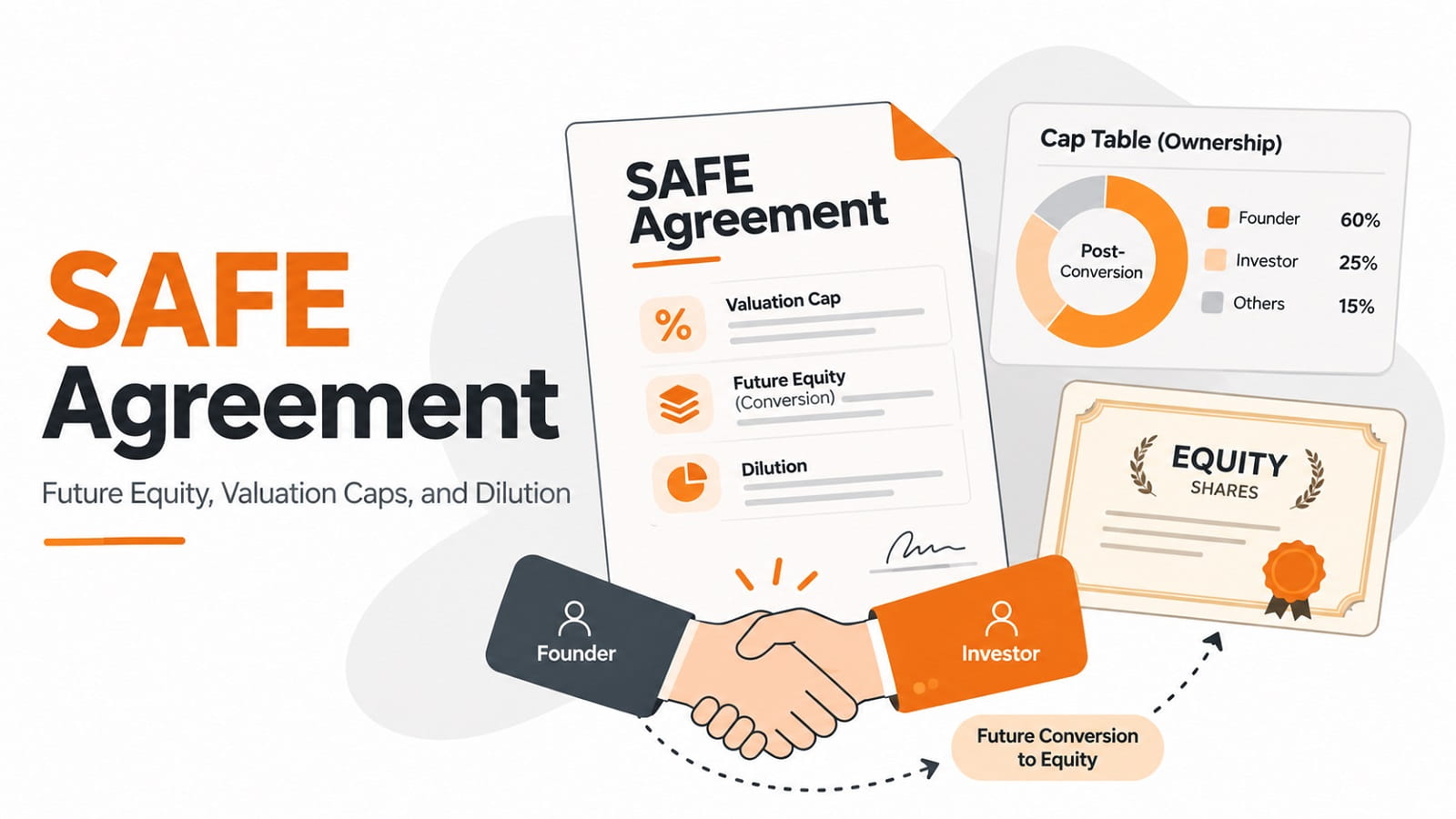
Raising capital can accelerate a startup's development, but securing investment is not the same as building a stronger business. Founders need to understand why financing is necessary, how much money the company requires, which investors are appropriate, and what the business must accomplish after receiving capital. Without a clear plan, fundraising can consume valuable time and create financial commitments that do not support the company's actual needs.
A fundraising strategy connects these decisions into a coordinated approach. It combines financial planning, business milestones, investor research, investment presentations, negotiations, and preparation for future financing. The objective is to secure appropriate capital while maintaining enough operational and financial flexibility to develop the company.
Successful fundraising begins before the first investor meeting. Founders need to identify the business opportunities that justify investment, understand the risks investors are likely to evaluate, and develop a realistic plan for turning additional capital into measurable progress. This guide explains how to approach fundraising as a strategic business decision rather than an isolated financing event.
What Is a Fundraising Strategy?
A fundraising strategy is a structured plan that defines how a business intends to secure capital for specific development objectives. It establishes the purpose of financing, the amount required, the appropriate timing, the investors to approach, and the conditions under which the company should accept investment.
A practical startup fundraising strategy should reflect the company's stage, financial position, market opportunity, and operating requirements. A business developing its first commercial product may need capital for engineering, customer validation, and initial sales. A company with established revenue may require financing to expand distribution, recruit experienced managers, or enter additional markets.
These businesses cannot rely on identical fundraising plans because their risks and milestones differ. The first company may need to demonstrate that customers want the product, while the second may need to prove that its existing business model can support expansion.
An effective strategy also considers the consequences of receiving investment. New shareholders may obtain ownership rights, reporting expectations, and a role in important company decisions. Founders should therefore evaluate financing as a long term business relationship, not simply an opportunity to increase their cash balance.
Why Fundraising Strategy Matters for Startups
Fundraising requires time, management attention, and access to reliable business information. Without clear objectives, founders may approach unsuitable investors, request an inappropriate amount of capital, or accept terms that complicate future financing.
A structured strategy helps management establish priorities before fundraising begins. It connects the company's next milestones with its expected operating expenses and provides a framework for assessing whether an investment offer is appropriate.
It also improves the quality of investor discussions. A founder who can explain what the company has achieved, which risks remain unresolved, and how the requested capital will support further progress presents a clearer opportunity than one seeking investment for broadly defined growth.
A fundraising strategy should also protect the company's ability to execute. During a financing campaign, founders still need to manage customers, employees, product development, and financial obligations. Investment activity should not become so demanding that operating performance begins to deteriorate.
The central objective is to make fundraising serve the business. The amount raised, investor reputation, and announced valuation are less meaningful than the commercial progress the financing ultimately makes possible.
Define the Business Milestones That Justify Funding
Before determining how much capital to raise, founders should identify what the company needs to accomplish next. These objectives should represent meaningful progress toward a stronger business model, improved market position, or reduced operating risk.
For an early stage software company, the next milestone might involve launching a product, attracting paying customers, or demonstrating consistent usage. A biotechnology business may need to complete research and technical validation before significant commercial activity becomes possible.
The appropriate milestones depend on the uncertainties facing the business. A startup with an unproven customer problem should prioritize validation before investing heavily in expansion. A company experiencing strong demand but limited delivery capacity may need resources to improve infrastructure and operations.
Milestones should be specific enough to support financial planning. A general objective such as increasing market share provides little guidance unless founders can explain which customers they intend to reach, what activities are required, and how results will be measured.
Investors also need to understand why reaching those milestones would improve the company's position. The strongest funding plans connect capital to achievements that create commercial value, reduce uncertainty, or make future financing more realistic.
Understand the Fundraising Process
The fundraising process describes the activities involved in moving from initial preparation to completed financing. These generally include defining funding requirements, identifying investors, initiating conversations, presenting the business, supporting detailed evaluation, negotiating investment terms, and closing the transaction.
Understanding the sequence helps founders manage expectations. An introductory meeting does not constitute an investment commitment, and an investor who requests financial information may still decide not to participate.
As discussions progress, investors often require greater detail about the company's customers, financial position, ownership structure, competitive environment, and management capabilities. Founders need to respond accurately while continuing to operate the business.
Some funding rounds involve a lead investor who negotiates principal terms, while others require commitments from several participants. The structure affects how negotiations are coordinated and which approvals are necessary before financing can close.
The process should be monitored carefully because different stages provide different levels of certainty. Verbal enthusiasm, preliminary interest, signed investment documents, and received funds should not be treated as equivalent outcomes.
A clear fundraising plan recognizes these distinctions and allows sufficient time for evaluation, documentation, and possible delays.
Choose the Right Fundraising Timeline
A realistic fundraising timeline begins with understanding the company's cash position and the time required to secure investment.
Financial runway provides an estimate of how long available cash can support operations under expected spending and cash receipt assumptions. Founders should review this estimate before deciding when to approach investors.
Starting too late can create substantial pressure. When the company urgently requires financing, management may have limited flexibility to negotiate, compare offers, or complete a detailed evaluation of potential financial partners.
However, beginning fundraising before the business has developed a credible investment case can also produce disappointing results. Certain milestones, including product launches, customer agreements, or improvements in retention, may strengthen the opportunity.
The appropriate decision balances investment readiness with financial security. A company should not postpone fundraising indefinitely in pursuit of an uncertain milestone, particularly when doing so creates a significant risk of exhausting available cash.
A practical timeline also includes room for investor meetings, due diligence, negotiations, legal work, and unforeseen delays. Founders should identify when the company would need to revise its spending or financing plan if investment discussions do not advance.
Calculate How Much Capital the Startup Should Raise
The amount of capital requested should reflect the resources needed to achieve important business milestones. Founders should begin with a financial forecast rather than selecting an investment amount based on what other startups have raised.
The forecast should account for expected revenue, operating expenses, planned hiring, product development, infrastructure, and other significant financial commitments. It should also reflect existing cash and the possibility that commercial progress may differ from expectations.
Consider a hypothetical startup with $150,000 in available cash and expected average monthly net cash consumption of $70,000. Financing 18 months of operations at that spending rate would require approximately $1.26 million. After considering the existing cash balance, the simplified additional requirement would be approximately $1.11 million.
That figure is only a starting point. The company may need additional resources for planned investments, financing expenses, or unexpected operating costs. Its actual requirements will also change if revenue, customer payments, or spending differ from the forecast.
Founders should examine alternative scenarios rather than assuming that the most optimistic business plan will occur. Slower customer acquisition or delayed product development can materially change the amount of money required.
Raising too little may force the startup to seek another round before demonstrating sufficient progress. Raising substantially more than necessary can increase dilution or encourage spending that the company cannot use productively.
The most appropriate funding target balances expected cash requirements, milestone achievement, financial uncertainty, and the long term interests of existing shareholders.
Finding Startup Investors Who Match the Business
Finding startup investors involves identifying financial partners whose investment preferences align with the company's development stage, industry, funding amount, and commercial opportunity.
A startup preparing its first product may attract interest from experienced angel investors or funds specializing in early stage businesses. A company with established revenue and significant expansion needs may require institutional investors capable of providing larger amounts of capital.
Investor research should examine recent investments, preferred company stages, typical financing amounts, geographic preferences, and relevant sector experience. Founders should also understand whether the investor usually leads funding rounds or participates alongside another financial partner.
Investment capacity is important, but the relationship should be evaluated more broadly. Investors with relevant operating experience may provide useful introductions, strategic advice, recruiting support, or assistance preparing for future financing.
However, founders should avoid assuming that every investor can deliver meaningful operational support. Experience, accessibility, reputation, and actual involvement with existing portfolio companies are more useful indicators than general promises.
A focused investor list allows founders to spend more time developing relationships with suitable financial partners instead of approaching every recognizable investment firm.
Fundraising Strategy: Key Planning Decisions
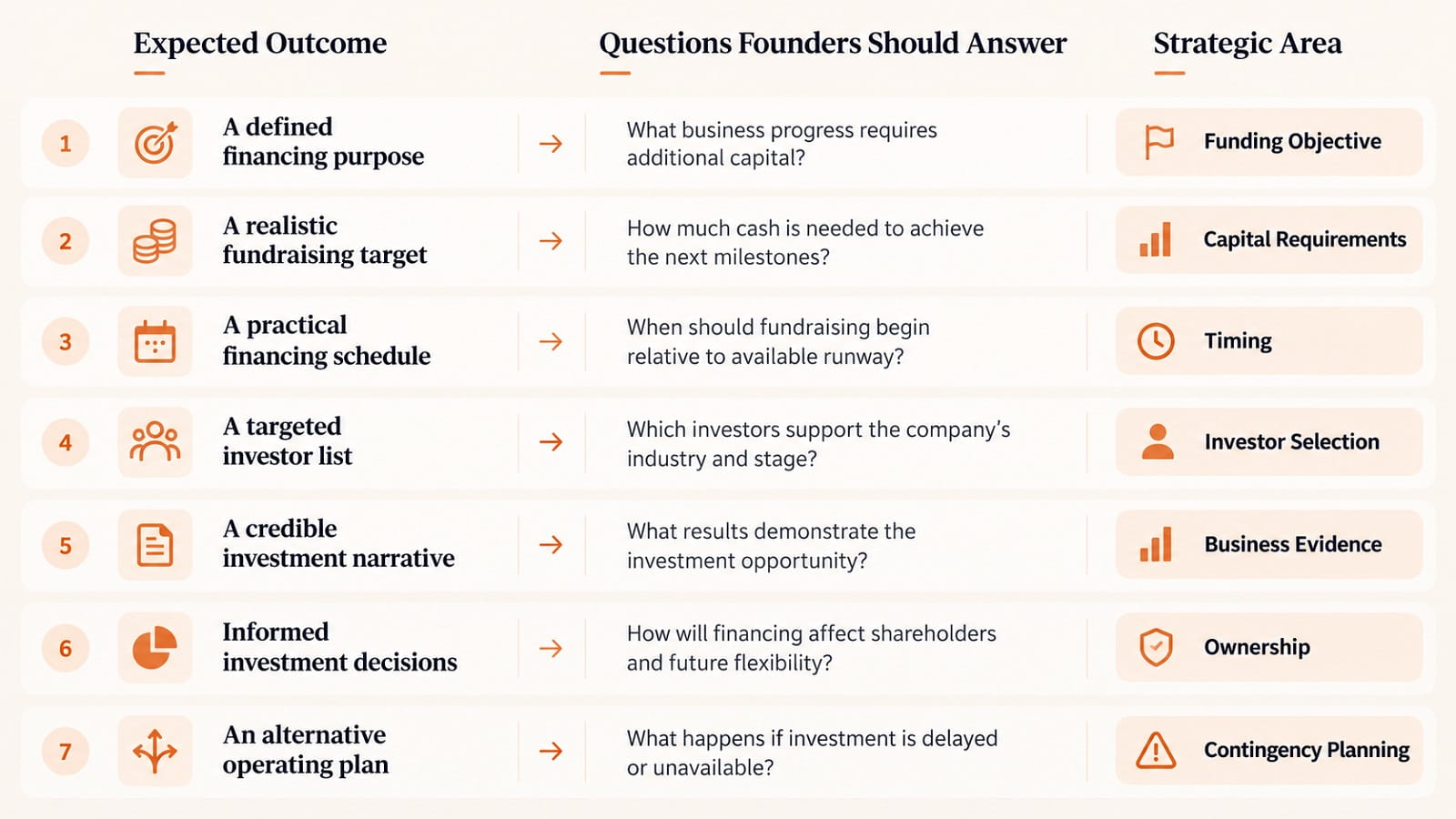
These decisions should reinforce one another. A funding target affects which investors are relevant, while the company's milestones influence the evidence needed to justify the requested amount.
Founders who establish this foundation before outreach are better positioned to communicate their financing requirements and evaluate offers consistently.
Build an Investor Pitch Deck That Communicates the Opportunity
An investor pitch deck presents the company's business and financing opportunity through a concise, organized presentation. It usually explains the customer problem, solution, market opportunity, business model, traction, competition, founding team, financial position, and proposed funding.
The strongest presentations connect these elements into a coherent investment argument. Investors should understand why the customer problem matters, how the company addresses it, and what evidence supports its potential.
A pitch deck should reflect the company's development stage. At an early stage, founders may rely on customer research, technical achievements, and initial validation. A company with established revenue should generally provide more developed information about growth, customer retention, and operating economics.
The presentation also needs to explain the purpose of the investment. A funding request becomes more credible when it is connected to specific business milestones rather than broad spending categories.
Financial figures, customer metrics, and projections should be consistent with the company's underlying records. Unsupported claims may create initial interest but can become problems during detailed investor evaluation.
Visual design should make the information easier to understand. Clear charts, readable typography, and focused slides are more valuable than decorative complexity that distracts from the business itself.
Prepare a Startup Pitch for Investor Conversations
A startup pitch is the spoken explanation of the investment opportunity. It should communicate the same underlying business case as the pitch deck while allowing founders to respond to questions and adjust the level of detail to the audience.
A compelling pitch begins with a meaningful customer problem and explains why the company is positioned to solve it. Founders can then describe the market opportunity, evidence of progress, competitive advantages, and the funding required to support the next stage.
Investor conversations vary in length and purpose. A short introduction may require a concise explanation of the business, while a formal meeting may involve detailed discussion of commercial performance, financial assumptions, market risks, and future development plans.
Preparation should include difficult questions. Investors may challenge assumptions about customer acquisition, pricing, competition, profitability, or the amount of capital requested.
Founders should distinguish between established facts and future expectations. A credible explanation of uncertainty is generally more useful than unsupported confidence about outcomes that remain unproven.
The purpose of the pitch is to create enough understanding and interest for productive evaluation, not to suggest that every business risk has already been eliminated.
Prepare the Company Before the Funding Round
The work often described as preparing for funding round activities involves making the startup ready for financial, operational, and legal evaluation.
Founders should maintain accurate financial records, understand the company's cash position, and prepare forecasts that explain expected revenue and expenses. Important customer metrics should use consistent definitions so investors can compare performance across reporting periods.
An accurate capitalization table is also essential because it records ownership and helps investors assess the potential consequences of new financing.
Depending on the company's stage and industry, preparation may include organizing corporate documents, important commercial contracts, intellectual property information, employment records, and other materials relevant to investment due diligence.
The objective is not to produce an excessive collection of documents. It is to ensure that important information is reliable, accessible to authorized recipients, and consistent with the investment narrative.
Founders should also establish internal responsibilities for managing the campaign. Someone must coordinate investor communication, maintain financial information, respond to requests, and ensure that fundraising does not prevent the company from serving customers and achieving operating milestones.
Understand Startup Valuation and Dilution
Startup valuation influences how much ownership the company gives investors in exchange for capital. It is therefore an important part of fundraising planning, even before formal negotiations begin.
In a straightforward priced equity round, the pre money valuation represents the agreed value of the company before the investment. Adding the new capital produces the post money valuation, assuming no additional capitalization adjustments.
For example, a company valued at $4 million before receiving a $1 million investment would have a $5 million post money valuation under a simple priced financing structure. The new investor would own 20% of the company, while existing shareholders would collectively retain 80%, before any other ownership changes.
Actual transactions can involve more complex arrangements. Convertible instruments, employee option pools, share preferences, and financing provisions may influence the final ownership structure and economic outcomes.
A high valuation is not automatically beneficial. If it creates expectations that the company cannot reasonably meet, future financing may become more difficult. Founders should consider valuation alongside business progress, dilution, investment terms, and future capital requirements.
The objective is to establish financing conditions that provide appropriate resources without creating unnecessary long term complications.
Negotiate Investment Terms With Long Term Interests in Mind
Negotiating with investors requires founders to evaluate the complete financing agreement rather than focusing exclusively on the amount invested or the company's valuation.
Investment terms may address governance, information rights, liquidation preferences, board representation, voting arrangements, and participation in future rounds. These provisions can influence the company's operations and the distribution of financial outcomes.
Founders should understand which rights are being granted and how those rights could affect important decisions. A financing proposal with an attractive valuation may still introduce restrictions that become difficult to manage later.
Investor alignment also matters. Financial partners may have different expectations about growth, profitability, spending, future financing, and possible exits. Discussing these issues before closing can help identify potential disagreements.
Negotiations should reflect the company's financial position. A startup with sufficient runway may have greater flexibility to compare options than one facing urgent cash requirements.
Qualified legal and financial advice can help founders understand the consequences of proposed agreements. The goal is to secure useful capital on workable terms while establishing a productive relationship with shareholders.
Avoid Fundraising Mistakes That Weaken the Business
Many fundraising mistakes result from weaknesses in planning rather than problems during formal negotiations.
One common mistake is raising capital without clearly defining what the company intends to accomplish. Investors may struggle to evaluate the request if management cannot connect financial requirements to meaningful milestones.
Another is approaching investors whose funding preferences do not match the company. Extensive outreach can create the appearance of progress without producing serious investment opportunities.
Unrealistic financial forecasts are another concern. Overestimating revenue, underestimating operating expenses, or assuming that funding will arrive quickly can leave a startup financially exposed.
Weak documentation and inconsistent business information can also undermine confidence. If customer figures, financial results, or ownership records differ across materials without explanation, investors may question the reliability of the company's reporting.
Founders should also avoid allowing fundraising to displace essential business activity. Neglecting customer relationships or product development during a long campaign may weaken the very investment opportunity they are trying to present.
The strongest prevention is a strategy built on realistic assumptions, reliable records, suitable investor targeting, and regular review of financial conditions.
Measure Progress During the Fundraising Campaign
A fundraising campaign should be monitored through meaningful developments rather than the number of messages sent or meetings held.
Founders need to understand whether outreach is producing relevant conversations and whether those discussions are advancing toward detailed investor evaluation.
If introductory messages generate few responses, the company may need to improve investor targeting or clarify its initial explanation. If many meetings take place without further engagement, investors may have concerns about market size, product differentiation, traction, or financial requirements.
Feedback should be interpreted carefully. A single rejection may reflect portfolio strategy or investment timing, while repeated concerns about the same issue may indicate that the company needs stronger evidence.
Fundraising Campaign: Progress and Decision Framework
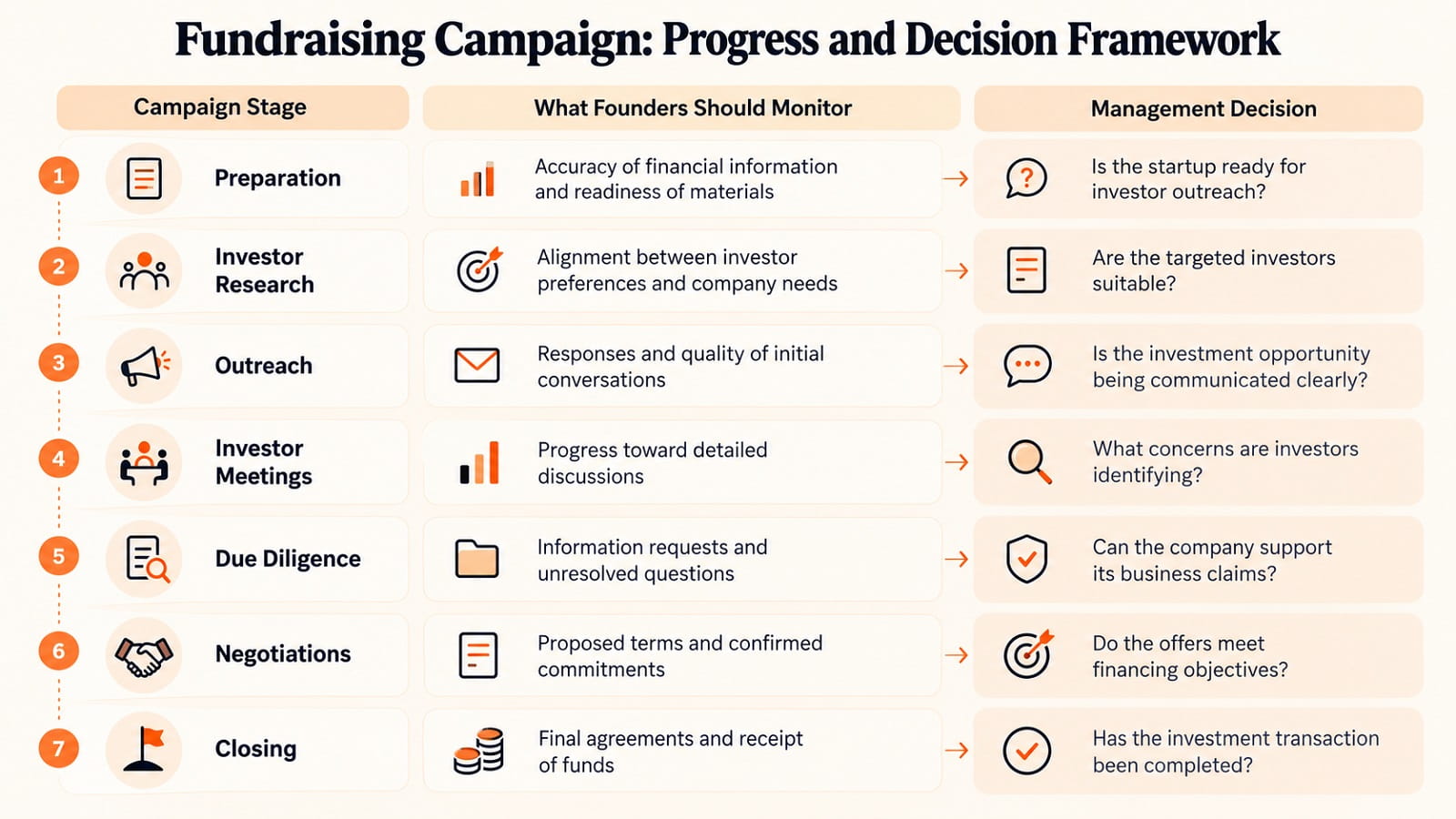
A structured review process helps founders identify problems while there is still time to respond. It also reduces the risk of treating preliminary interest as secured financing.
The campaign should be evaluated against its original objectives, including the funding amount, investor suitability, expected timeline, and financial resources available to complete the process.
Prepare a Contingency Plan for Fundraising Delays
Fundraising does not always proceed according to plan. Investor decisions may be delayed, financial conditions may change, or the company may receive less interest than expected.
A responsible strategy considers how these outcomes could affect the startup's operating position.
Founders should examine whether the company can continue funding essential activities if the process takes longer than anticipated. They should also understand which expenditures could be adjusted without seriously damaging product development or customer relationships.
Depending on the business, alternatives may include postponing discretionary spending, changing recruitment schedules, improving customer collections, or considering other suitable financing sources.
A smaller investment round may also require a revised operating plan. Founders should avoid continuing with expenditures based on a larger financing target when the actual capital available is significantly lower.
Contingency planning is not a prediction that fundraising will fail. It is a way to maintain decision making flexibility while financing remains uncertain.
The strategy should establish when management must reassess the campaign and what actions are available if expected commitments do not materialize.
Turn a Successful Funding Round Into Business Progress
Completing a financing round gives a startup additional resources, but the company's performance after closing determines whether those resources create value.
Founders should translate the investment plan into budgets, operating priorities, and measurable business objectives. Financial monitoring can then show whether spending is consistent with expectations and whether the company is progressing toward its intended milestones.
Investor communication also becomes important. Shareholders should receive appropriate information about business performance, material developments, financial position, and significant risks according to the company's agreements and governance requirements.
Management should continue evaluating the assumptions used during fundraising. If customer demand develops more slowly than expected or product delivery costs increase, the company may need to revise its plans rather than continue following an outdated forecast.
Future financing should also be considered before available cash becomes critically limited. Completing one funding round does not guarantee access to another, regardless of investor enthusiasm or previous valuation.
The most valuable outcome of a successful raise is a business that has developed stronger capabilities, reduced important risks, and created better options for its next stage of growth.
Creating a Fundraising Strategy That Supports Sustainable Growth
A strong fundraising strategy connects the company's financial needs with its commercial reality. It begins with clearly defined milestones, develops a funding target based on expected operating requirements, and identifies investors whose priorities match the business.
The strategy should remain consistent throughout preparation, investor outreach, presentations, negotiations, and post investment execution. Each stage should reinforce the same explanation of what the company is building and why the requested capital matters.
Founders should also recognize that investment conditions can change. Market uncertainty, investor priorities, and company performance may require adjustments to timing, financing targets, or operating plans.
A structured approach cannot eliminate these uncertainties, but it provides a framework for making decisions without depending on optimistic assumptions.
Ultimately, fundraising is most effective when capital serves a clearly defined business purpose. The strongest investment is not necessarily the largest round or highest valuation, but the financing that gives a startup the resources, relationships, and flexibility needed to create lasting value.
FAQ
What is a fundraising strategy for startups?
A fundraising strategy is a structured plan for determining why a startup needs capital, how much it should raise, when to approach investors, and how investment will support business milestones. It combines financial planning, investor selection, and preparation for financing.
How do startups develop an effective fundraising strategy?
Founders should begin with clear business objectives, calculate the resources needed to achieve them, evaluate available cash, identify suitable investors, and prepare reliable financial information. A coordinated outreach and negotiation process should support those objectives.
When should founders begin fundraising?
Founders should generally begin preparing before available cash becomes critically limited. The appropriate timing depends on financial runway, business readiness, investor expectations, and the estimated time required to complete the investment process.
How much capital should a startup raise?
The amount should reflect the financing required to reach meaningful milestones, expected operating expenses, existing cash resources, and reasonable allowances for uncertainty. Founders should also consider ownership dilution and future financing requirements.
What is the difference between fundraising strategy and fundraising process?
Fundraising strategy defines the objectives, financial requirements, timing, and investor priorities behind raising capital. The fundraising process covers the activities involved in executing that plan, from preparation and outreach through investor evaluation, negotiations, and closing.
What are the most common startup fundraising mistakes?
Common mistakes include raising without clear milestones, approaching unsuitable investors, relying on unrealistic forecasts, beginning too late, presenting inconsistent financial information, overlooking investment terms beyond valuation, and neglecting business operations during fundraising.

Mobina Khanki
Venture & Funding Writer at PinerookMobina Khanki covers venture capital, startup funding, fundraising, and startup finance for Pinerook, focusing on founders and investors.
 Seen first.