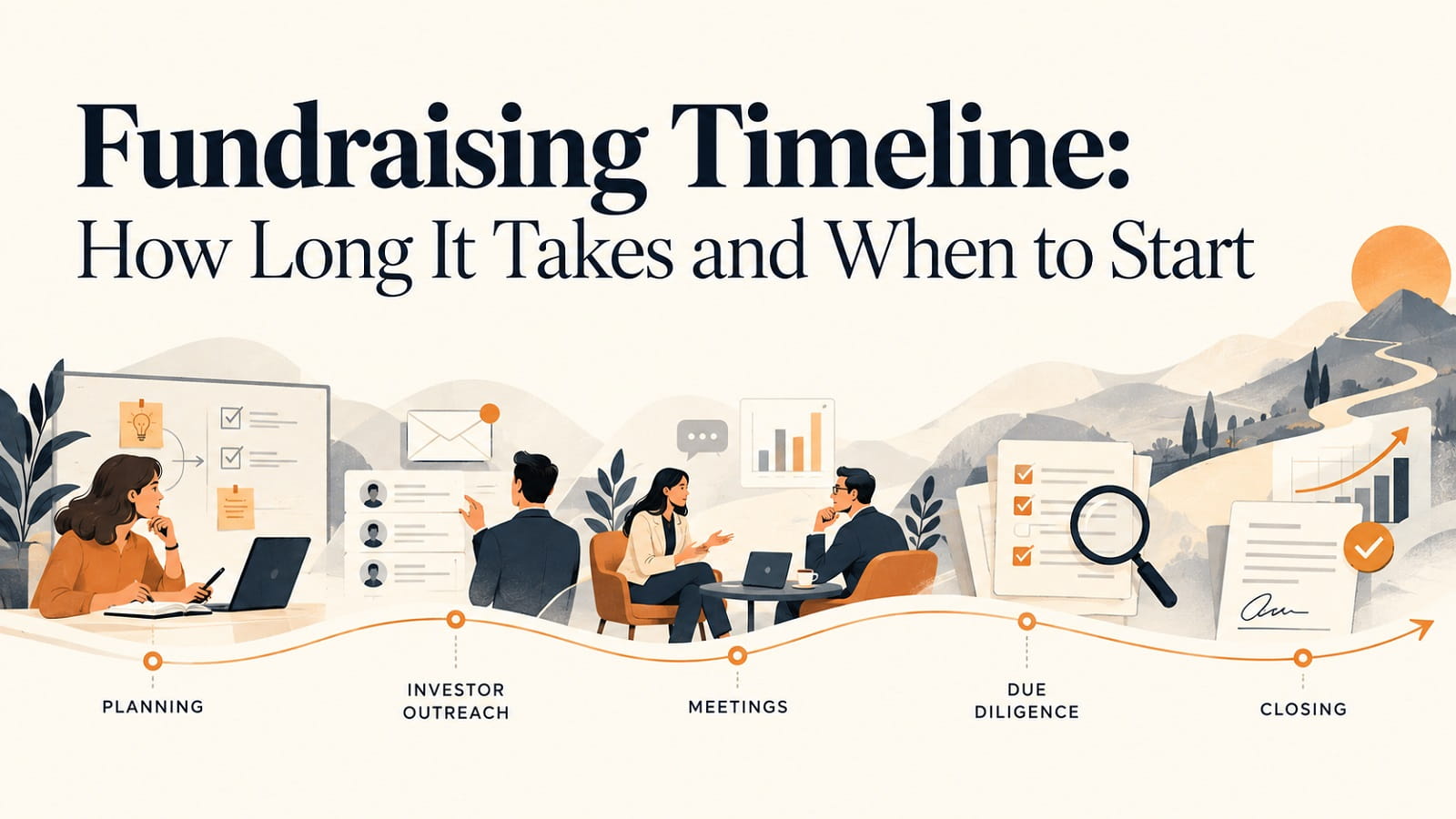
A startup fundraising timeline rarely follows an exact schedule. One investor may reach a decision after a few meetings, while another requires extensive financial reviews, internal approvals, and legal documentation. Even when conversations progress positively, the time between initial investor interest and receiving capital can be longer than founders expect.
This uncertainty creates a financial challenge. Startups continue paying employees, developing products, and serving customers while investment discussions take place. Starting too late can leave a company with limited options if financing is delayed. Beginning too early, however, may mean approaching investors before the business has enough evidence to support its valuation or financing objectives.
A realistic fundraising timeline connects cash runway, business milestones, investor decision periods, and closing requirements. It helps founders determine when to prepare, when to approach investors, and how to protect the business if the expected financing date changes.
A broader Fundraising Strategy establishes why the startup needs capital and what it intends to accomplish. The timeline focuses on when financing activities should occur and how management can coordinate them without placing unnecessary pressure on business operations.
What Is a Fundraising Timeline?
A fundraising timeline is a schedule that estimates when a startup should prepare for investment, contact potential investors, conduct discussions, complete evaluations, negotiate financing terms, and receive capital. Its purpose is to help founders coordinate these activities with the company's financial position and operating priorities.
Unlike a general explanation of the fundraising process, a timeline concentrates on duration and dependencies. Some activities can take place simultaneously. Investor research may begin while financial information is being prepared, and introductory meetings may continue while other investors review the company in greater detail.
Other activities depend on decisions outside the founder's control. A venture capital firm may require approval from several partners, while a proposed transaction may need additional documentation before funds can be transferred.
For these reasons, the timeline should be treated as a planning framework rather than a guaranteed closing date. It becomes useful when founders can identify upcoming decisions, recognize delays, and adjust their financial plans before problems become urgent.
How Long Does Startup Fundraising Usually Take?
Startup fundraising can take several weeks, several months, or longer. The actual duration depends on the company's maturity, investor relationships, financing requirements, market conditions, and transaction complexity.
A startup raising capital from individual angels who already know the founding team may face a relatively straightforward evaluation. A company seeking investment from an institutional venture capital firm may need several meetings, additional commercial evidence, partner approval, and detailed legal review.
The investment structure can also influence the schedule. Some early stage financing instruments involve simpler documentation than a priced equity round with multiple shareholders and negotiated governance arrangements.
However, founders should avoid assuming that every angel investment closes quickly or that every institutional round requires the same amount of time. An early startup without suitable investor relationships may spend months identifying potential investors, while a more developed company with existing investor interest could advance more efficiently.
A realistic forecast should include preparation before outreach and the time required after an investor expresses interest. Positive feedback does not mean financing is complete, and agreement on preliminary terms does not necessarily mean capital will become available immediately.
Instead of relying on a fixed industry average, founders should estimate a reasonable schedule for their own situation and examine what happens if the process takes longer.
When Should a Startup Start Fundraising?
The appropriate time to begin fundraising depends primarily on available cash and the business milestones that could strengthen the investment opportunity.
A company approaching an important commercial achievement may benefit from demonstrating that progress before seeking investment. For example, completing a paid customer pilot or showing improved retention could provide investors with stronger evidence of demand.
However, waiting for an uncertain milestone can become dangerous when financial runway is limited. Customer contracts may be delayed, technical development may take longer than expected, and investors may need additional time to make decisions.
Founders should therefore separate fundraising preparation from the official launch of investor outreach. Researching investors, organizing financial information, and developing a cash forecast can begin well before the company starts requesting investment meetings.
The timing should reflect how long a realistic financing process might take and how much additional flexibility the startup would need if the round were unsuccessful.
For some companies, preparation may need to begin while more than twelve months of runway remain. Others may have different circumstances because of predictable cash flow, established investor relationships, or access to alternative financing.
There is no universal rule that every startup should begin raising capital at the same runway threshold. The more useful approach is to estimate when financing would be required and work backward while allowing time for uncertainty.
Calculate Cash Runway Before Planning the Round
Cash runway estimates how long a startup can continue operating with its available cash under a specified rate of spending. It provides a starting point for determining how much time management has to complete a financing round.
For a company with relatively stable net cash consumption, the simplified calculation is:
Cash Runway = Available Cash ÷ Average Monthly Net Cash Burn
Suppose a startup has $900,000 in available cash and consumes an average of $75,000 more cash than it receives each month. Under those assumptions, its estimated runway is twelve months.
The calculation is useful, but actual cash consumption rarely remains perfectly constant. Hiring decisions, supplier payments, marketing expenses, customer receipts, and unexpected obligations can change the company's financial position.
Founders should therefore maintain a cash forecast that reflects when money is expected to enter and leave the business. A company may report growing revenue while still experiencing pressure on cash because customer payments arrive later than expenses.
Expected investment proceeds should not be included as available cash before financing has actually been completed.
It is also important to distinguish the point when cash would be exhausted from the latest date when management can make responsible operating decisions. Waiting until the final weeks of runway may leave insufficient time to reduce expenses, renegotiate commitments, or pursue suitable alternatives.
Build a Realistic Fundraising Calendar
A practical fundraising calendar should identify the main activities, their approximate timing, and the outcomes that indicate progress. It should also recognize that different investors may move through the process at different speeds.
The following example illustrates an eighteen week schedule for a hypothetical startup preparing a seed financing round. It is an educational planning scenario rather than an average duration or guaranteed closing timetable.
Example Startup Fundraising Timeline
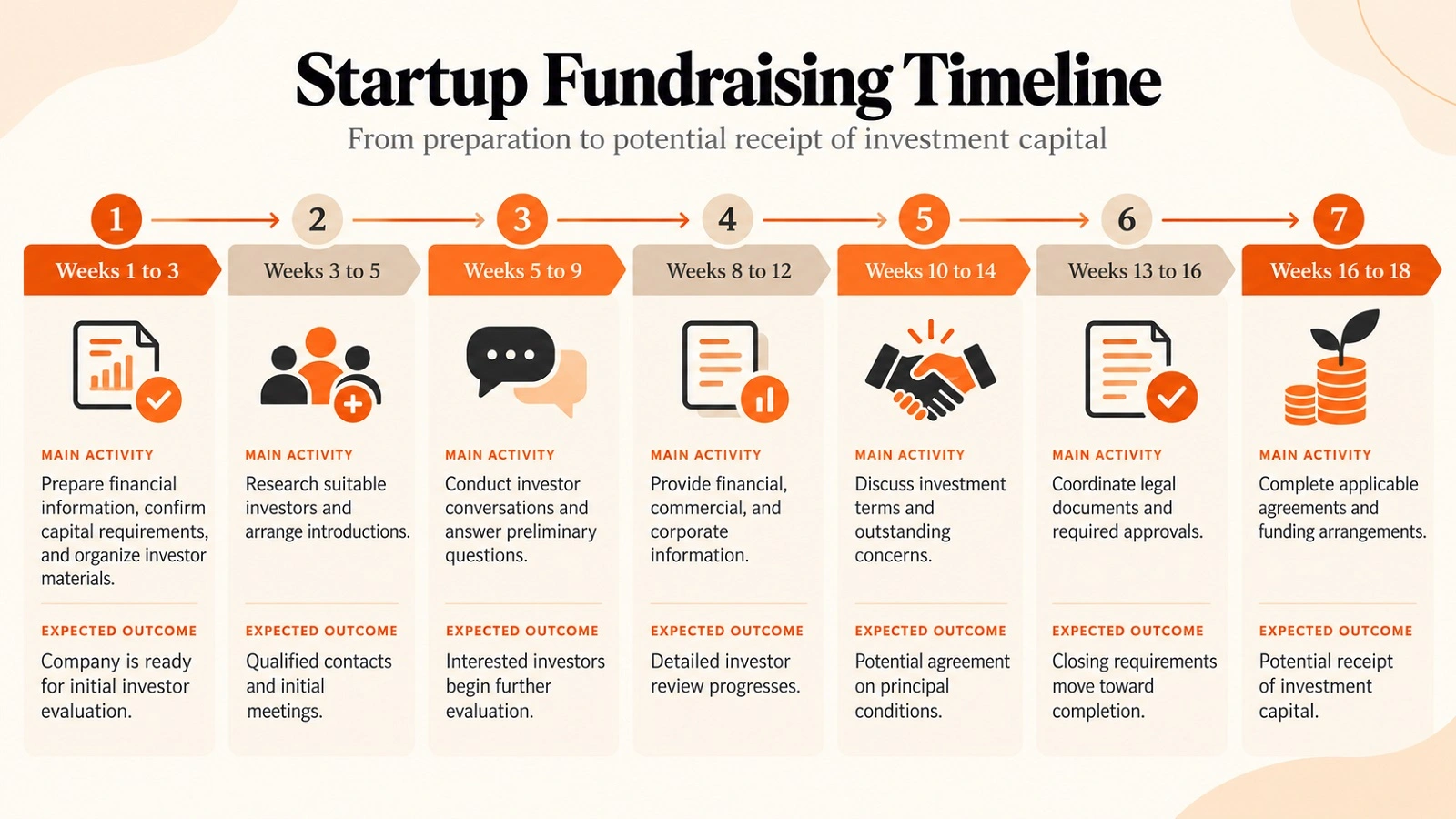
The overlapping periods reflect how fundraising commonly operates. One investor may still be evaluating the business while another has begun discussing financing conditions. Founders may also need to continue relevant investor conversations if other opportunities become uncertain.
This schedule should not be interpreted as evidence that a startup can reliably raise capital within eighteen weeks. The actual period may be shorter or substantially longer depending on investor availability and transaction requirements.
The calendar becomes valuable when management uses it to track unresolved activities and compare financing progress with the company's cash forecast.
Align Fundraising With Business Milestones
Business milestones influence when a startup may be ready to approach investors. A product launch, paying customer milestone, technical validation, or improvement in customer retention can strengthen the evidence behind the financing opportunity.
However, not every milestone is equally predictable. Completing an internal software feature may be easier to schedule than obtaining a large customer contract. A company waiting for a regulatory decision may face timing uncertainty that it cannot resolve through additional internal work.
Founders should identify which achievements would meaningfully improve the investment case and estimate when reliable evidence could become available. They should then compare those dates with expected cash requirements.
Suppose a software startup expects to complete a customer pilot in two months. If the company has sufficient runway, waiting for verified results may provide more useful information for investor discussions. If cash is already limited, delaying preparation until the pilot ends could create unnecessary financing risk.
The timeline should allow investors to evaluate actual business progress without making the company's financial survival depend on every expected milestone occurring precisely on schedule.
Schedule Investor Conversations Without Losing Momentum
Investor outreach requires coordination because multiple conversations may develop independently.
A concentrated period of relevant meetings can help founders compare investor feedback and identify recurring concerns. It may also reduce the time spent repeatedly preparing introductions or explaining the same basic information across an extended campaign.
However, a coordinated schedule does not mean sending identical messages to every investor. Founders should approach people and firms whose industry interests, development stage preferences, geographic requirements, and typical investment amounts match the company.
The investor's decision process should also be considered. Some contacts may provide an initial opinion but lack authority to approve financing. Others may need to introduce the company to partners or investment committees.
Founders should record meaningful next steps rather than assume that positive feedback represents progress toward closing. Additional meetings, specific information requests, and discussions with decision makers may indicate increasing interest, but none guarantees an investment.
The calendar should remain flexible enough to accommodate these differences while ensuring that investor communication does not overwhelm everyday business responsibilities.
Allow Time for Due Diligence and Closing
One of the most common fundraising planning mistakes is assuming that serious investor interest means money will arrive soon.
After initial conversations, investors may need to verify financial performance, customer information, corporate records, intellectual property arrangements, and other important business claims.
The scope of due diligence varies. Some transactions involve relatively limited reviews, while institutional financing can require extensive evaluation and multiple approvals.
Legal documentation introduces additional dependencies. Parties may need to resolve valuation, investor rights, ownership changes, or other financing provisions before the investment can close.
A signed term sheet may represent meaningful progress, but it does not necessarily complete the transaction. Certain provisions may be binding, while others remain subject to definitive agreements and outstanding conditions.
Founders should maintain accurate financial and ownership records before detailed investor review begins. Doing so can reduce avoidable delays without implying that the company controls the investor's final decision.
For operating purposes, capital should be treated as available only when it has actually been received under the applicable financing arrangements.
Test Your Fundraising Timeline Against Cash Burn Changes
A timeline based on one financial forecast may underestimate risk. Founders should examine what happens if spending increases, expected customer payments are delayed, or financing takes longer than planned.
Consider the earlier hypothetical startup with $900,000 in available cash. Its initial estimated runway depends on how much net cash the business consumes each month.
Fundraising Runway and Cash Burn Scenarios
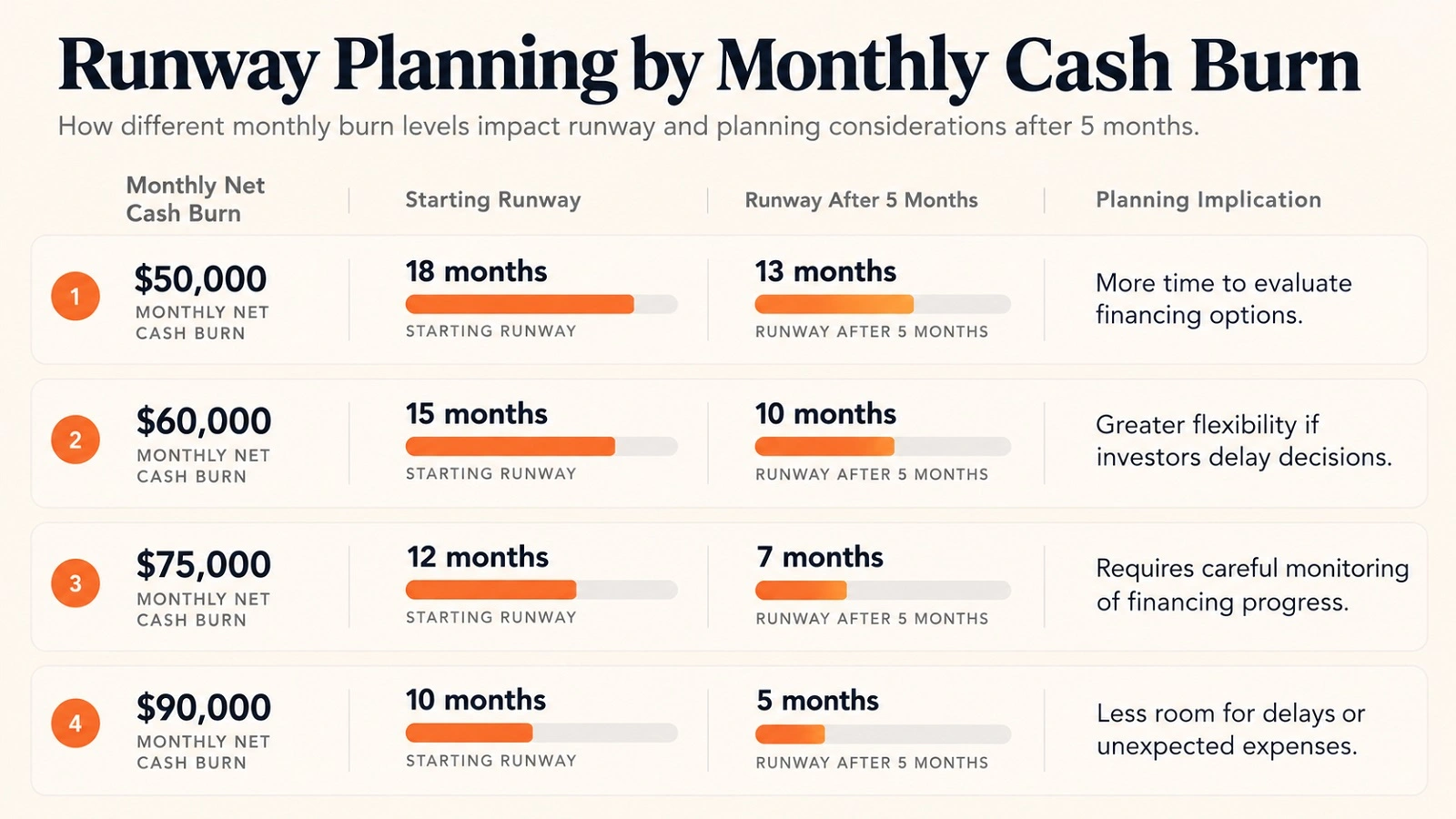
These calculations assume constant monthly net cash burn, no additional financing, and no other changes to cash balances.
At a monthly burn of $75,000, the startup would have approximately $525,000 remaining after five months, equivalent to seven months of runway. If burn increases to $90,000, the same five month fundraising period would leave approximately $450,000, equivalent to five months of runway.
The difference demonstrates why operating expenses and fundraising timing must be evaluated together.
Founders should use scenario calculations to identify possible pressure points, not to justify waiting until cash reaches a particular threshold. In practice, changes in revenue, hiring, payment schedules, and other financial obligations can make the position more complicated than these simplified examples suggest.
What Causes Fundraising Timelines to Slip?
Delays may originate from investor requirements, company readiness, or external market conditions.
An investor might need additional approval, request further information, or postpone a decision because of competing priorities. Market uncertainty can also influence how quickly investment firms make new commitments.
Company documentation is another potential source of delay. Inconsistent financial information, missing agreements, or unclear ownership records may require correction before a transaction can progress.
Investor selection can affect timing as well. Contacting firms that rarely invest in the startup's industry or development stage can generate meetings without creating realistic financing opportunities.
Founders should look for patterns rather than react to individual delays. A postponed meeting may be routine, while repeated requests for unresolved financial information may indicate a specific preparation problem.
When progress slows, management should identify what remains outstanding and whether the delay changes the likelihood or expected timing of financing.
A useful fundraising calendar reflects confirmed developments rather than maintaining an optimistic closing date after the underlying assumptions have changed.
Prepare for Delays Before Cash Becomes Critical
Contingency planning should begin before a fundraising campaign encounters serious difficulties.
Founders need to understand how the company would operate if financing arrived later than expected or did not materialize. Depending on its circumstances, the startup may need to adjust discretionary spending, reconsider hiring plans, delay expansion initiatives, or investigate appropriate alternative funding.
These decisions should reflect actual financial obligations and their consequences for the business. Reducing expenses may preserve runway, but cutting essential product development or customer support can also weaken the company's future prospects.
Regular management reviews can help determine when action is necessary. The team should compare available cash, projected obligations, active investor discussions, and the estimated time required to complete financing.
A company with several investors conducting substantive evaluation faces a different situation from one that has completed many introductory meetings without meaningful progress. The financial plan should recognize that distinction.
Founders should avoid making irreversible spending commitments based on informal assurances that an investment is likely to close.
The purpose of a contingency plan is to preserve the ability to make deliberate decisions while sufficient options remain available.
Keep the Business Operating During Fundraising
Fundraising can consume substantial founder attention. Investor research, meetings, financial questions, document preparation, and negotiations compete with product development and customer relationships.
This creates an operational risk because investors may continue evaluating the company's business performance throughout the financing campaign. If management becomes entirely focused on fundraising, commercial progress may weaken.
Founders should coordinate responsibilities so that investor communication and essential operations both receive appropriate attention. Smaller teams may need to reserve specific periods for financing activities, while larger teams can divide responsibilities among leadership members.
The timeline should account for important product deadlines, customer commitments, and other operational priorities. It should also allow founders to update investors when verified business milestones are achieved.
Maintaining business discipline throughout fundraising helps protect the company's position regardless of whether the financing closes on the original schedule.
Create a Fundraising Timeline That Protects Growth
An effective fundraising timeline is not a prediction of when investors will transfer money. It is a management framework that connects financing activities with the company's financial resources and business objectives.
Founders should begin with an accurate cash forecast, identify milestones that could strengthen the investment case, and allow realistic time for investor conversations, evaluation, negotiations, and closing.
They should also recognize the uncertainty surrounding investor decisions. Positive meetings and preliminary terms can indicate progress without guaranteeing that capital will arrive.
By updating the schedule regularly and preparing alternative operating decisions in advance, startups can reduce the financial pressure created by unexpected delays.
The ultimate goal is to pursue suitable financing while preserving the company's ability to operate, achieve meaningful milestones, and make sound decisions about its future.
FAQ
How long does startup fundraising usually take?
Startup fundraising may take several weeks, several months, or longer. The duration depends on investor requirements, the company's development stage, financing structure, and market conditions. Founders should plan for uncertainty rather than rely on a fixed completion date.
When should a startup start fundraising?
A startup should begin preparing while it has sufficient runway to complete a realistic financing process and respond to possible delays. The right time depends on available cash, business milestones, investor readiness, and alternative financing options.
How much runway should a startup have before fundraising?
There is no universal minimum runway. Founders should consider their expected financing duration, monthly cash requirements, operating commitments, and the time needed to respond if funding does not arrive. A detailed cash forecast is more useful than a fixed industry rule.
Does signing a term sheet mean fundraising is complete?
Not necessarily. A term sheet may establish preliminary investment conditions while due diligence, definitive documentation, approvals, and funding arrangements remain incomplete. Capital should not be treated as available until the applicable financing requirements have been satisfied and funds are received.
What should founders do if their fundraising timeline is delayed?
Founders should update their cash forecast, review the status of active investor discussions, identify unresolved issues, and reassess operating commitments. Depending on the company's circumstances, they may need to adjust spending, improve documentation, or investigate alternative financing before liquidity becomes critical.

Mobina Khanki
Venture & Funding Writer at PinerookMobina Khanki covers venture capital, startup funding, fundraising, and startup finance for Pinerook, focusing on founders and investors.
 Seen first.


