The fundraising process is one of the most demanding responsibilities a startup founder faces. Securing investment requires more than an attractive business idea or a convincing presentation. Founders must demonstrate business progress, identify suitable investors, manage multiple conversations, support their claims with reliable information, and negotiate financing terms before any capital becomes available.
For founders approaching their first investment round, the process can feel unpredictable. Some investors respond quickly, while others require several meetings and extensive documentation. A promising conversation may lead to further evaluation, but it does not necessarily result in funding. Understanding how each stage works helps founders manage these uncertainties without allowing fundraising to distract them from running the business.
A clear Fundraising Strategy defines why the company needs capital and what it intends to accomplish. The fundraising process focuses on execution: how founders prepare for investor engagement, advance conversations, complete investment reviews, and move a financing agreement toward closing.
This guide explains the fundraising process step by step, including the activities founders should prioritize, the documents investors may request, and the practical decisions that help a funding round progress.
What Is the Fundraising Process?
The fundraising process refers to the sequence of activities a startup completes to secure capital from external investors. It typically begins with internal preparation and continues through investor research, initial outreach, presentations, due diligence, negotiations, legal documentation, and the receipt of funds.
Although the general sequence is familiar across the startup industry, no two fundraising rounds operate in exactly the same way. An early stage company approaching angel investors may complete several activities through relatively informal conversations. A startup seeking institutional venture capital may encounter additional investment committees, technical evaluations, legal reviews, and approval requirements.
The investment instrument also influences the process. A priced equity round typically requires agreement on valuation and ownership, while certain early stage instruments may postpone the determination of the exact equity allocation until a later financing event. These differences affect the documents, negotiations, and closing procedures involved.
Founders should approach fundraising as a managed business project rather than a series of disconnected investor meetings. Each conversation should contribute to a clearer understanding of investor interest, unresolved concerns, or the next action required.
The process is complete only when the applicable financing conditions have been satisfied and the investment has closed. Verbal interest, favorable feedback, and preliminary agreements are important developments, but they should not be confused with capital already available to the company.
Why the Fundraising Process Matters for Startup Founders
An organized fundraising process improves more than administrative efficiency. It helps founders protect their time, maintain control over company information, and make decisions based on realistic financing progress.
Investor conversations can consume considerable management attention. Founders may need to prepare presentations, answer financial questions, schedule follow up meetings, and coordinate document requests while continuing to manage employees, customers, and product development.
Without a structured approach, the company risks spending too much time with unsuitable investors or repeatedly preparing information that could have been organized in advance.
A reliable process also helps founders distinguish between different levels of investor interest. An investor who agrees to an introductory meeting is not in the same position as one who has begun formal due diligence. Recognizing that difference prevents management from building financial plans around commitments that have not been secured.
Preparation can also improve credibility. When founders present consistent financial figures, explain business assumptions clearly, and respond to reasonable questions with appropriate evidence, investors can evaluate the opportunity with greater confidence.
This does not guarantee investment. Investors may reject strong businesses because of portfolio restrictions, investment mandates, or market conditions. Nevertheless, an organized process makes it easier to understand what is happening and respond appropriately.
The Main Stages of the Startup Fundraising Process
The fundraising process can be divided into eight principal stages. These stages provide a practical structure, although individual investors may combine activities or complete them in a different order.
Startup Fundraising Process Step by Step
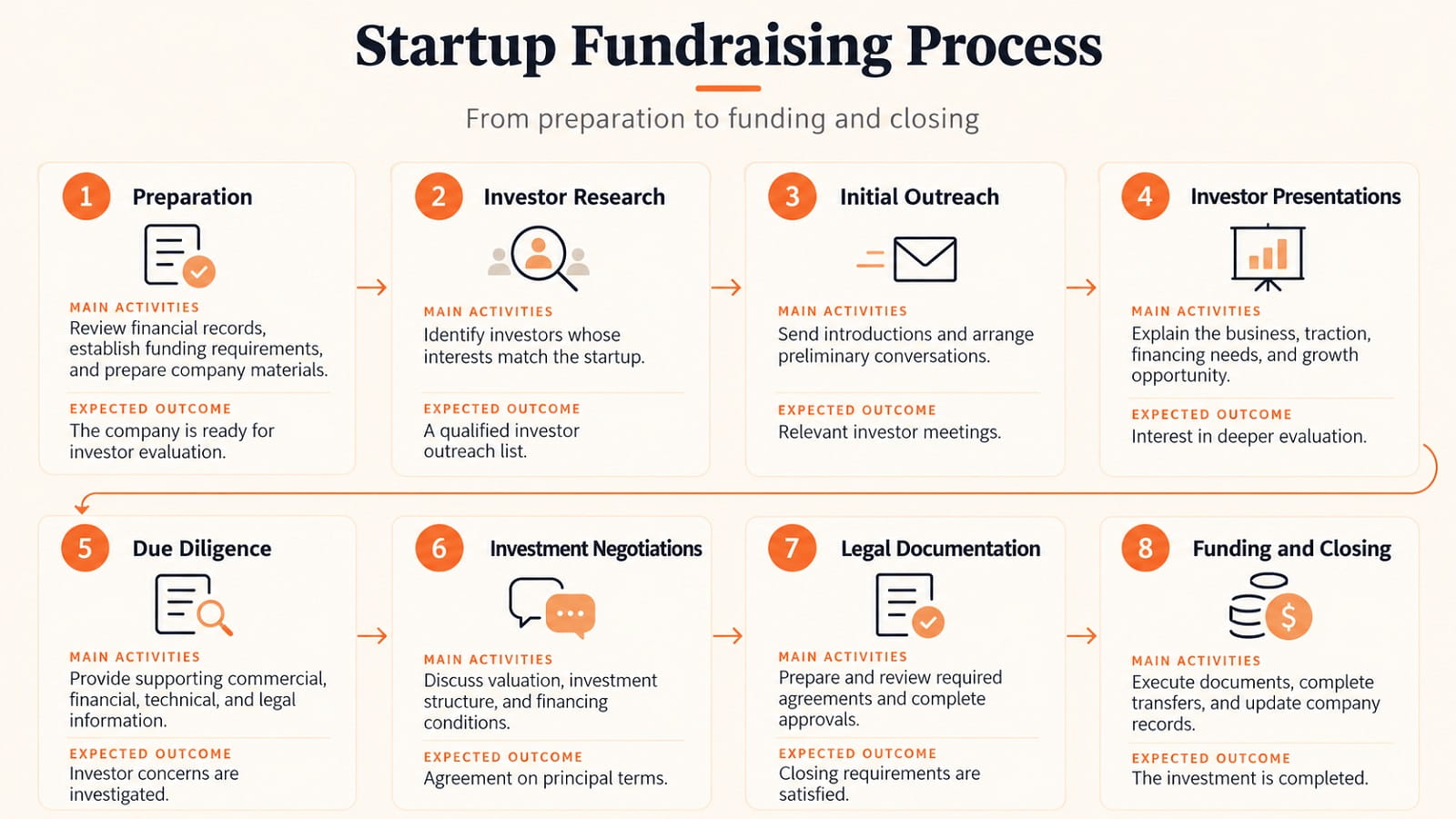
The table provides an overview, but founders should understand that moving between stages is not automatic. Some investors may decline after a first meeting. Others may request additional information before deciding whether to begin a formal investment review.
A funding round may also involve several investors progressing independently. The company therefore needs to manage the overall campaign while tracking each investor's individual status.
Prepare the Business Before Approaching Investors
Preparation is the foundation of an effective fundraising process. Before contacting prospective investors, founders should understand the company's current financial position, commercial progress, ownership structure, and principal business risks.
The first task is to establish reliable information about the business. Financial records should present a consistent picture of revenue, operating expenses, cash availability, and outstanding obligations. Where applicable, the startup should also be able to explain customer acquisition, retention, product usage, and the economics of its business model.
Founders must distinguish actual results from forecasts. Investors may accept uncertainty in early stage businesses, but they need to understand which claims are supported by evidence and which depend on management assumptions.
The company's capitalization table also deserves attention. It should accurately reflect existing share ownership and relevant equity instruments. Previous financing arrangements, employee equity plans, and other ownership commitments may affect the structure of a new investment.
Corporate records should be accessible and internally consistent. Missing agreements or uncertain intellectual property ownership can become important concerns during investment evaluation.
Preparation does not mean resolving every business weakness before fundraising. Rather, founders should know which issues exist, explain their implications, and avoid presenting an inaccurate picture of the company.
A well prepared startup can respond to investor requests more efficiently and spend less time correcting avoidable problems during negotiations.
Establish the Funding Requirements and Round Structure
Once the company has organized its information, founders should define what the financing round is expected to achieve.
The proposed funding amount should connect to the startup's operating needs and future business milestones. Investors generally want to understand why the company is raising capital now, how management intends to use it, and what progress the investment could support.
For example, a software startup may need funding to expand its engineering team, improve its product, and strengthen customer acquisition. The financing proposal should explain how these activities contribute to business development rather than presenting them as unrelated expenses.
Financial forecasts should reflect realistic assumptions about hiring, revenue, operating costs, and cash consumption. Founders should consider possible delays or differences between expected and actual business performance.
The proposed financing instrument is another important consideration. Depending on the circumstances, a startup might pursue a priced equity round, a SAFE, a convertible note, or another arrangement permitted under the relevant legal framework.
Each structure has different implications for future ownership, documentation, investor rights, and financing obligations. A convertible note, for instance, may introduce debt characteristics that do not apply in the same way to an equity investment.
Founders should seek appropriate legal and financial advice when selecting and documenting the transaction.
At this stage, the company does not need every negotiating term to be finalized. It does need a coherent financing proposal that allows prospective investors to evaluate whether the opportunity matches their investment criteria.
Research Investors and Build a Targeted List
Finding appropriate investors is a qualification process. The goal is not to approach the largest possible number of individuals or funds, but to identify investors whose experience and investment requirements align with the company.
Different investors support different stages of business development. Some specialize in companies that have not yet generated meaningful revenue. Others expect established customer demand, measurable growth, or a particular level of commercial maturity.
Sector focus also matters. An investor familiar with enterprise software may evaluate recurring revenue and customer retention differently from an investor concentrating on biotechnology or industrial technology.
Geography, investment amount, portfolio composition, and available capital can also influence investor suitability. Founders should understand these considerations before investing substantial time in outreach.
Existing professional relationships may provide relevant introductions. Advisors, previous investors, founders, and industry contacts sometimes help establish connections with investors who are familiar with similar businesses.
However, an introduction should not substitute for research. A well connected investor is not necessarily the right investor for the proposed round.
A useful investor tracking record should capture the investment focus, relevant contact information, introduction source, communication history, and current status of each opportunity.
This information becomes increasingly valuable when the company is managing several investor conversations at once.
Begin Investor Outreach and Secure Initial Meetings
Investor outreach is the first stage of active engagement. Founders introduce the company, communicate its investment opportunity, and determine whether a prospective investor wants to continue the discussion.
An effective introductory message should be specific and concise. It should explain the business, the problem it addresses, the customers it serves, and the most relevant evidence of progress.
The message should also provide enough context for the investor to understand why the opportunity is relevant to their interests.
Founders should avoid overwhelming an initial contact with lengthy company histories or unsupported market claims. The immediate objective is to establish whether a conversation is worthwhile.
Investors may request a pitch deck before agreeing to a meeting. Others may prefer a short introductory call before reviewing more detailed material.
When a meeting is scheduled, founders should research the investor's background and prepare for questions connected to the company's stage and industry.
An investor experienced in business software may focus on customer retention, sales efficiency, and the reliability of recurring revenue. An investor evaluating a research intensive startup may place greater emphasis on technical feasibility, intellectual property, and commercialization risks.
Founders should answer questions directly and avoid presenting uncertain forecasts as guaranteed outcomes.
The meeting should end with clarity about possible next steps. These may include providing supporting information, arranging discussions with additional decision makers, or confirming that the investor is not proceeding.
A positive conversation is useful, but its practical value depends on whether it advances the evaluation process.
Present the Business and Demonstrate Investment Readiness
Investor presentations provide an opportunity to explain the company's commercial proposition in greater detail.
A pitch deck usually covers the customer problem, product or service, target market, business model, competitive position, team, traction, and financing requirements.
The presentation should establish a logical relationship between the company's current progress and its future plans. Investors need to understand both the opportunity and the evidence supporting the founders' expectations.
For an early stage startup, relevant evidence may include customer interviews, initial product adoption, paid pilot projects, or early revenue. For a more established business, investors may examine financial performance, retention, acquisition efficiency, or expansion opportunities.
The appropriate evidence depends on the industry and development stage. Founders should avoid copying performance measures from unrelated business models merely because those figures frequently appear in investor presentations.
It is also important to communicate limitations. If the product remains in development or customer acquisition economics have not been established, the presentation should make that clear.
Credibility often depends on how founders handle difficult questions. Investors may challenge market assumptions, ask about competitors, or question the sustainability of the company's operating model.
A useful response explains the available evidence, identifies remaining uncertainty, and describes how management intends to investigate or address it.
The objective is not to remove every concern during a single meeting. It is to demonstrate that the founders understand their business and can discuss its opportunities and risks with discipline.
Manage Investor Discussions and Follow Up
Most investment decisions require more than one meeting. An investor may initially discuss the business with an associate or investment professional before introducing it to partners or other decision makers.
As discussions progress, founders may receive requests for additional financial reports, customer information, product demonstrations, or conversations with team members.
Each request should be recorded and assigned to someone responsible for providing an accurate response.
Follow up communication should relate to the investor's stated concerns and interests. Sending the same generic update to every investor is less effective than addressing the specific information needed to move an evaluation forward.
Founders should also monitor whether the investor is taking meaningful steps toward a decision. Additional meetings, detailed financial questions, and involvement from senior investment professionals may suggest deeper consideration.
Nevertheless, these signals are not commitments.
The company should continue engaging other suitable investors until financing arrangements are sufficiently advanced. Depending too heavily on a single prospective investor can create unnecessary risk if that opportunity is delayed or withdrawn.
Regular internal reviews can help the founding team identify which conversations deserve attention, where decisions are stalled, and whether the broader campaign needs adjustment.
An organized follow up process reduces the likelihood that potential opportunities are lost through missed communication or unclear responsibilities.
Complete Investor Due Diligence
Due diligence is the process through which an investor investigates the company before completing an investment.
The level of scrutiny varies considerably. An individual angel investing through a relatively simple instrument may conduct a focused review. An institutional investor participating in a larger round may require extensive financial, commercial, legal, and technical evaluation.
Financial due diligence often includes revenue records, operating expenses, cash balances, forecasts, and the assumptions underlying expected business performance.
Commercial due diligence may examine customer relationships, market demand, sales activity, competitive positioning, and the company's ability to maintain or expand its customer base.
Investors may also review contracts, shareholder records, employment arrangements, intellectual property ownership, regulatory obligations, and previous financing documents.
Technology companies can face additional questions about software ownership, information security, infrastructure, or the feasibility of their technical development plans.
Founders should organize documents in a controlled repository and provide access according to the investor's legitimate information requirements. Confidential information, customer records, and sensitive technology details should be protected through appropriate access restrictions.
The consistency of information is particularly important. If a presentation reports one revenue figure while supporting financial records suggest another, management should be able to explain the difference clearly.
Discovering a material issue during due diligence does not automatically end a financing opportunity. However, concealment, unsupported statements, or contradictory information may damage investor confidence.
Founders should treat due diligence as a serious verification process rather than a formality before receiving funds.
Negotiate the Investment Terms
When discussions advance, investors and founders may begin negotiating the terms of the proposed financing.
In a priced equity transaction, negotiations commonly address valuation, the amount invested, ownership allocation, and economic or governance rights. Depending on the deal, parties may also discuss board representation, information rights, liquidation preferences, and conditions affecting future financing.
For investments using convertible instruments, relevant terms may instead include conversion mechanisms, valuation caps, discounts, maturity provisions, or other features appropriate to the instrument.
The importance of individual terms depends on the transaction. Not every financing uses the same instruments or gives investors the same rights.
Founders should evaluate the overall agreement rather than concentrating exclusively on headline valuation.
For example, a proposed valuation may appear favorable while other contractual provisions create meaningful consequences for future shareholders or management decisions.
Negotiations should also distinguish between legally binding commitments and preliminary expressions of agreement.
A term sheet often summarizes principal transaction terms before definitive documents are prepared. However, its legal effect depends on the language used and applicable law. Some provisions may be binding even when other terms remain subject to further negotiation.
Receiving or signing a term sheet therefore does not necessarily mean that financing is complete.
Professional legal advice is particularly valuable at this stage because seemingly technical provisions can have consequences beyond the immediate funding round.
Finalize Documentation and Close the Funding Round
After principal terms have been agreed, the parties must complete the documents and conditions required for the investment.
The closing process varies according to the financing instrument, jurisdiction, company structure, and investor requirements.
A priced equity round may involve subscription documentation, revised shareholder arrangements, corporate approvals, and updates to ownership records. Other investment instruments may require different agreements and procedures.
Certain transactions involve conditions that must be satisfied before funds can be transferred. These may include completion of due diligence, approval by relevant parties, execution of final documents, or other contractually agreed requirements.
Founders should maintain a clear record of outstanding closing items and identify who is responsible for completing each one.
When several investors participate, the company may also need to coordinate different signing schedules and funding arrangements.
Not every financing round closes with all investors on a single date. Some early stage investment arrangements permit separate closings, subject to their terms.
Founders must distinguish between expected funds and capital actually received. An investor may communicate strong interest or sign preliminary documents without completing the transaction.
The company should confirm receipt of funds and completion of the applicable closing requirements before treating the financing as finalized.
After closing, management should update its capitalization records, financial forecasts, corporate documentation, and internal investment reporting as required.
How to Track Fundraising Progress
Managing the fundraising process becomes more difficult when a startup is speaking with several investors simultaneously.
Some investors may be reviewing the pitch deck while others are conducting detailed diligence or considering proposed terms. Without a consistent tracking system, founders may struggle to understand which opportunities remain active.
A fundraising pipeline helps organize this information. It records each investor's current position, outstanding questions, and next required action.
Fundraising Pipeline and Investor Decision Framework
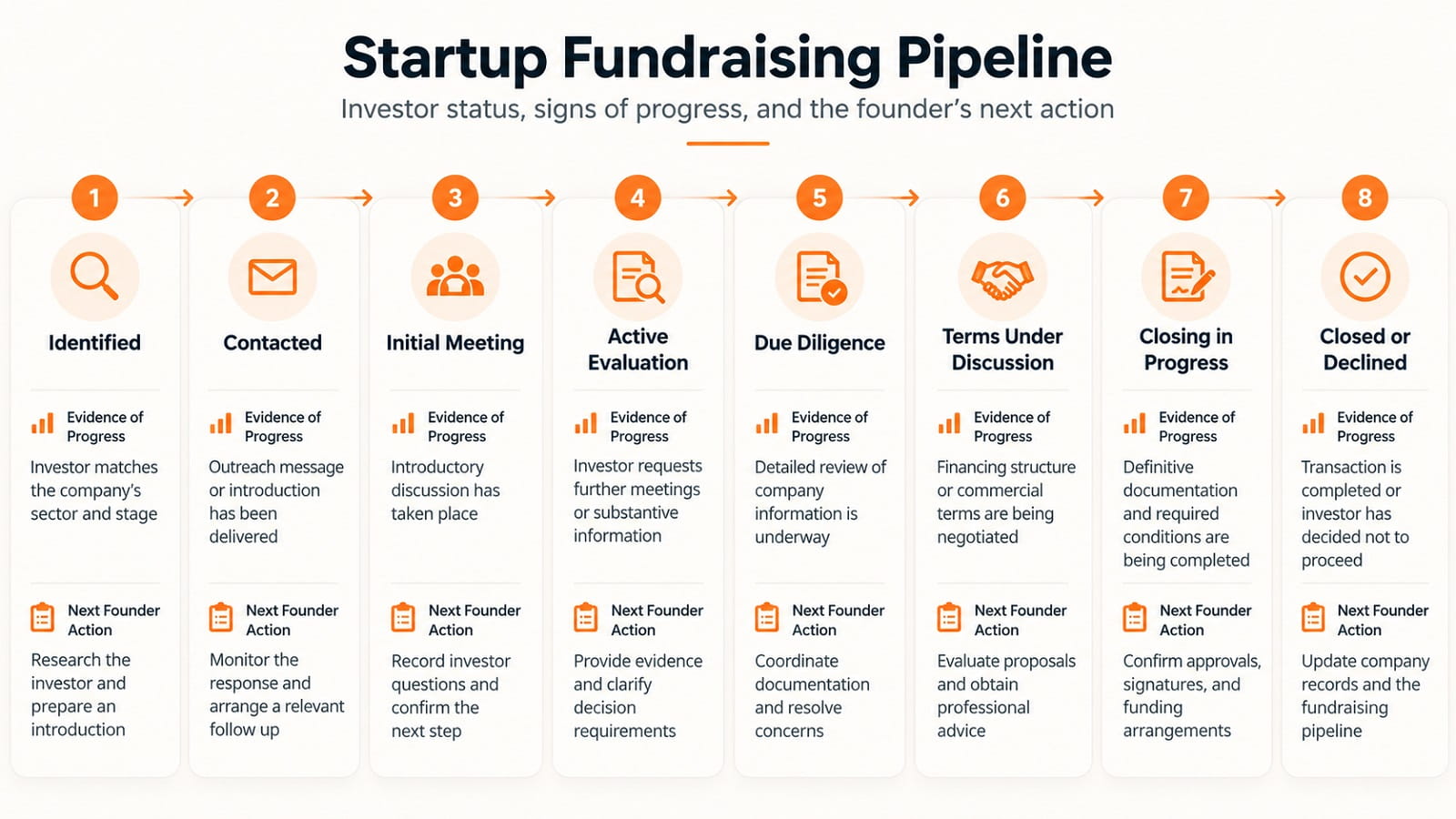
This framework provides a clearer picture than simply counting the number of investor meetings.
A company may have many introductory conversations but very few opportunities progressing to deeper evaluation. Another may have fewer conversations but several investors reviewing documentation or discussing specific investment terms.
The second situation may indicate stronger progress, although the outcome remains uncertain until financing closes.
Tracking can also reveal recurring problems. If investors frequently decline after reviewing the financial model, founders should examine whether the assumptions are sufficiently supported. If most opportunities stall after initial presentations, the company may need to reconsider how clearly it explains the business.
These patterns should be interpreted carefully. A small number of rejections does not establish that a particular aspect of the company is defective.
The purpose of the tracking system is to improve operational decisions, not to create an artificial impression of certainty.
How Long Does the Startup Fundraising Process Take?
There is no universal timetable for completing a startup financing round.
The duration depends on the company's readiness, the number and type of investors involved, the proposed transaction structure, prevailing market conditions, and the complexity of due diligence.
A relatively straightforward investment from an individual angel may require fewer approval stages than a financing round involving an institutional investment committee.
Larger transactions can also require more extensive financial review, legal documentation, and negotiation among participants.
Founders should avoid treating broad industry estimates as reliable deadlines. Even when investors express interest early, decisions can be delayed by internal approvals, additional information requests, or disagreements over financing terms.
An effective fundraising calendar should account for these uncertainties.
The company's financial runway is especially important. Management needs sufficient flexibility to continue operating if investment takes longer than anticipated.
Fundraising plans should also consider how the company will respond if an expected investor withdraws or the final investment amount differs from the original target.
The relevant question is not simply how quickly a round might close. It is whether the startup can maintain sound business operations while the financing process remains uncertain.
Common Problems That Delay the Fundraising Process
Fundraising delays arise for many reasons, and not all are within the company's control. However, several recurring issues can make the process unnecessarily difficult.
Incomplete Financial Information
Investors may request further explanations when revenue figures, expense records, or forecasts are inconsistent. Founders should maintain reliable financial information and understand the assumptions behind their projections.
Poor Investor Qualification
Contacting investors who do not participate in the company's industry, geography, or financing stage wastes time. Research should establish basic suitability before substantial engagement begins.
Unclear Communication
A complicated presentation or inconsistent explanation of the business can make the investment opportunity difficult to evaluate. Founders should communicate the company's commercial position clearly without oversimplifying important risks.
Disorganized Due Diligence
Missing agreements, uncertain ownership records, or delayed responses to document requests can slow investor evaluation. Organizing essential information before outreach helps reduce avoidable friction.
Unrealistic Expectations About Investor Interest
Positive feedback does not necessarily indicate that an investor intends to participate. Founders should look for substantive progress and avoid relying on informal assurances.
Negotiating Without Understanding the Terms
Concentrating only on the investment amount or stated valuation can lead founders to overlook important rights and obligations. A financing proposal should be assessed as a complete agreement.
Recognizing these problems early allows founders to correct their approach while the fundraising campaign is still active.
Managing the Business While Raising Capital
Fundraising can place substantial demands on the founding team. Investor meetings, document preparation, and negotiations compete with the daily responsibilities of building a company.
This creates an operational challenge: the startup must persuade investors that it can execute its business plan while fundraising activities consume management attention.
Founders should establish clear responsibilities for investor communication and internal operations. Where the team structure permits, one founder may coordinate much of the financing activity while others retain responsibility for product development, customer relationships, or commercial delivery.
Important business metrics should continue to be monitored throughout the campaign. Changes in revenue, customer activity, costs, or available cash can affect the investment opportunity and the company's financing requirements.
Investors may also expect updated performance information during a lengthy review.
Maintaining commercial progress matters because fundraising should support the company's development, not bring it to a halt.
If the financing process begins to interfere with essential operations, management may need to reassess meeting schedules, delegation, and how much time is allocated to investor engagement.
The ability to maintain business discipline under these conditions can itself provide useful evidence of the team's management capabilities.
What Should Founders Do If Fundraising Stalls?
A stalled fundraising campaign does not always mean that the company is unsuitable for investment. Investors may postpone decisions because of internal priorities, changing market conditions, portfolio restrictions, or uncertainty about the company's prospects.
Founders should first identify where progress has stopped.
If most investors do not respond to outreach, the problem may involve targeting, relevance, or the introductory message.
If investors attend meetings but do not request additional information, the business presentation may be failing to address an important concern.
If several opportunities stall during due diligence, founders should examine the specific financial, commercial, or legal issues being raised.
Repeated feedback can provide useful insight, but founders should avoid making significant decisions based on a single investor's opinion.
The company should also review its available cash and operating commitments. If financing is delayed, management may need to adjust spending, reconsider the scale of planned investments, or examine other appropriate funding alternatives.
Transparency remains important throughout this process. Unsupported claims about investor commitments or business performance can undermine credibility and create additional risks.
A disciplined response to delays combines investor feedback with realistic operating decisions.
What Happens After the Fundraising Process Is Complete?
Closing a financing round changes the company's financial position, but it does not remove the need for disciplined management.
Once funds have been received, founders should confirm that financial records and ownership information accurately reflect the completed transaction.
The operating plan may also require adjustment. If the company receives a different amount from its original target, hiring, product development, and commercial spending should be reviewed accordingly.
Management should understand any reporting, governance, or information obligations established through the investment documents.
Investor communication becomes an ongoing relationship rather than a temporary fundraising activity. Clear updates about business performance, important milestones, and material challenges can help maintain alignment between founders and shareholders.
The company should also evaluate the fundraising experience itself. Delays caused by incomplete records, unclear financial reporting, or organizational weaknesses may indicate areas that deserve improvement.
These lessons can support more effective internal operations and better preparation for future investment discussions.
Most importantly, the business must now demonstrate progress using the capital it has secured. The value of a completed funding round depends on how effectively management translates financial resources into meaningful business results.
Turning the Fundraising Process Into Business Growth
The fundraising process does not end with investor interest or promising discussions. It requires founders to move through preparation, investor evaluation, negotiations, and closing while maintaining control over the company's financial position and daily operations.
Reliable business information, suitable investor relationships, and clear communication help founders navigate each stage more effectively. Although no fundraising process guarantees investment, disciplined execution can reduce avoidable delays and support better financing decisions.
Ultimately, a successful funding round should do more than bring capital into the business. It should provide the resources and flexibility needed to achieve meaningful milestones, strengthen operations, and support the startup's next stage of growth.
FAQ
What is the fundraising process for a startup?
The fundraising process is the sequence of activities a startup follows to secure external capital. It generally includes preparing company information, researching investors, conducting outreach, presenting the business, completing due diligence, negotiating terms, and closing the financing transaction.
What is the first step in the fundraising process?
The first step is preparing the business for investor evaluation. Founders should understand their financial position, determine the purpose of the funding round, organize company records, and establish reliable evidence of commercial progress before contacting prospective investors.
How long does the startup fundraising process usually take?
The duration varies according to the company, investors, financing instrument, and complexity of the transaction. Some investments involve relatively limited evaluation, while larger institutional rounds may require extensive due diligence, multiple approvals, and legal negotiations. Founders should allow for uncertainty rather than depend on a fixed closing date.
What documents are needed during startup fundraising?
Investors may request financial statements, operating forecasts, a pitch deck, capitalization records, corporate documents, important customer agreements, intellectual property information, and previous financing documentation. The precise requirements depend on the investment stage, industry, and financing structure.
When is a startup fundraising round officially complete?
A financing round is complete when the relevant agreements have been executed, applicable closing conditions have been satisfied, and the investment has been funded according to the transaction terms. Preliminary investor interest or a signed term sheet does not necessarily mean the company has received the capital.

Mobina Khanki
Venture & Funding Writer at PinerookMobina Khanki covers venture capital, startup funding, fundraising, and startup finance for Pinerook, focusing on founders and investors.
 Seen first.


